Tag

dusu

Browsing

Rocky Tuseed, the President of the Delhi University Students’ Union (DUSU), appealed to the Vice Chancellor of the University of Delhi (DU) to suspend all classes till Sunday in the wake of alarming levels of pollution in Delhi.

In a letter to Mr. Yogesh Tyagi, Tuseed expressed concern over the effect of the pollution on the health of the students, especially as the semester examinations are about to begin. He also referred to the Lt. Governor’s order that demanded restricted entry of trucks, cessation of all construction activity, and the shutdown of schools in the city till Sunday, saying that a similar order needs to be in place for the DU students. A request for a joint meeting of the administration and the student body was also made in the letter.

Pollution has hit a record high of 478 on the Air Quality Index (AQI) in Delhi. The return of the odd-even scheme is also being contemplated by the state government, which was to be resumed only if the AQI exceeded 500 points. However, the severity of the current situation has prompted the Central Pollution Control Board (CPCB) to advice the government to re-start the scheme. So far, the call by the Indian Medical Association to declare a public health emergency has also been resisted, despite the problems caused by the smog in terms of vision and respiratory issues.

It is absolutely imperative that keeping these short-term fixes aside long-term policy actions are taken by the government to improve the state of the city’s air. The general public needs to give its full and unequivocal support towards making the city better for all of us to live in. It is truly infuriating that it has taken a crisis of such a scale for people to realise that the environment we live in needn’t be annihilated for satisfying human greed.


Image Caption: Record high levels of pollution have already led to the shutdown of schools.

Image Credits: India.com

Rishika Singh

[email protected]

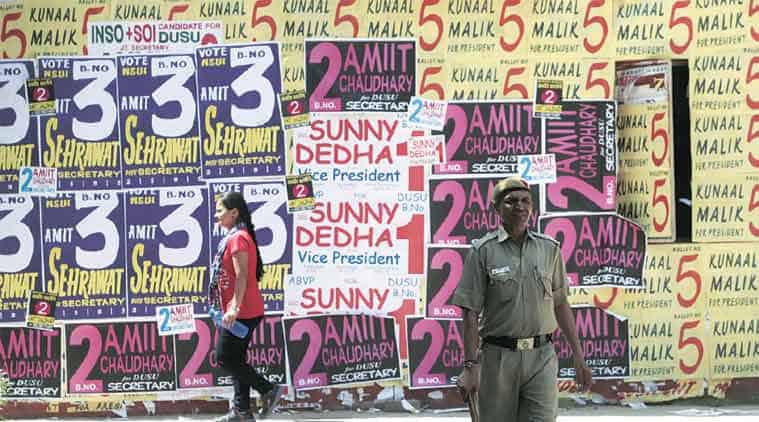
The Delhi High Court on Monday directed various authorities — including the Delhi Police, DMRC, MCDs, DU vice-chancellor, Union Home ministry, winning candidates of DUSU polls, the dean of students’ welfare, and the petitioner in the case of preventing defacement of public property during Delhi University Student Union election campaigning – to convene a meeting in order to devise a plan of action.

The court has also asked the winning candidates to place an action plan on how they proposed to clean the area and how future elections would be conducted. A bench of acting Chief Justice Gita Mittal and Justice C Hari Shankar issued the order while hearing the plea filed by advocate Prashant Manchanda, as reported by The Indian Express.

On Monday, the elected student representatives — including DUSU president Rocky Tuseed and vice-president Kunal Sehrawat — were in court. Stating that many of the defaced properties bore his name, the bench sought an explanation from Rocky. Counsel for Rocky told the court that they had carried out cleanliness drives in the North and South campuses — with the help of students and NGOs — to remove the graffiti and spray paint, irrespective of which candidate or political party had carried out the defacement.

The plea highlighted defacement of public property in Delhi University, properties within the jurisdiction of the MCDs and the Delhi Metro. It added that it was next to impossible to completely remove the defacement. The bench then directed the authorities to file a report of the meeting — to be held on 27th October at 3 pm at the dean’s office — on the next date of hearing on 28th November.

The bench has further said that defacement of public property was a cognizable offence, punishable with 10 years in jail. Rocky and the other candidates assured the bench that they would not do so in future.


Feature Image Credits: Hindustan Times

Ankita Dhar Karmakar
[email protected]

The elected president of DUSU has been barred for now from entering the office. On Thursday, he was told that the university will have to take legal opinion before he can take charge as DUSU president after a criminal case against him came to light. The case dates back to a complaint made on August 6, 2014, by a final-year student of Shivaji College, Bhagat Singh, who alleged that he was beaten with a “wooden stick” by Tuseed and his three associates. The varsity, however, asked the other three office-bearers to collect the keys for their respective offices.

Tuseed, along with his supporters protested at proctor’s office and attempted convincing that the court order does not mention that he should be withheld from taking over as the president.
The proctor’s office maintained they will not act till there are consultations with the university’s legal team. The arguments on framing of charges in the 2014 case against Tuseed will take place on October 16.
The 2014 complaint, filed at the Rajouri Garden police station, alleged that Singh had been “present in his college during the presidential election and some students were conducting a meeting”. According to the complaint, when Singh was leaving his college “he was stopped at the red light outside Shivaji College” by one of Tuseed’s associates.
It added that “minutes after stopping him”, three other men, including Tuseed, “reached the spot and hit him with a wooden stick”. Singh alleged that he had “received multiple injuries on his body and head”. “Police was informed and the man was taken to DDU hospital, where he was discharged after first-aid.
Police also arrived and recorded Singh’s statement. On the basis of Singh’s complaint, a case was registered under sections 308 (attempt to commit culpable homicide), 323 (causing hurt), 341 (wrongful restraint) and 34 of the IPC,” a senior police officer said. Tuseed was arrested and sent to a 14-day judicial custody in Tihar before he got out on a bail.
Speaking to Indian Express Delhi Police officials said after that day, the complainant has been absent and no further contact has been made with him.
Meanwhile, the Vice-president Kunal Sherawat had assumed the office while the secretary, Mahamedhaa Nagar, and joint secretary, Uma Shankar, were yet to collect office keys from the proctor’s office.


Image Credits: DU Beat Archives


Sandeep Samal

[email protected]

Be it hiccups like the election officials cancelling his nominations, or reliefs like the High Court allowing him to contest the elections, or moments of ecstasy at finally winning the elections, Rocky Tuseed of the National Students’ Union of India (NSUI), the newly elected President of the Delhi University Students’ Union (DUSU) who is currently pursuing a Master’s degree in Buddhist Studies, has seen it all in just a week’s time. In an exclusive interview with DU Beat, he discusses his ideas for the betterment of the University.


Q: You have been considerably active in politics this past year. From where did you start your venture into the field?

Ans: I joined Shivaji College in 2013; in my first year, I encountered several small problems like the non-functionality of the water-cooler, unavailability of Girls Common Room, etc. On being persuaded by my classmates, I contested and won the election for Executive Committee of DUSU, and that’s how it all started.


Q: Now that you are the DUSU President, what are the key areas you would like to personally focus on?

Ans: There are several areas that I am going to work on for the betterment of the students. Alongside working on every issue that has been mentioned in our manifesto, I will try to ensure that University students are entitled to metro passes because many students travel daily from far-off places.


Q: Providing affordable accommodation to students was one of the main agendas of NSUI this time. Given the fact that DUSU doesn’t have any power to construct hostels, how do you plan to see this promise fulfilled?

Ans: Although DUSU doesn’t have the authority and budget to construct hostels for students, we can certainly pressurise the University of Delhi (DU) administration to construct more hostels. The University returned nearly Rs 150 crore meant for infrastructure development to the Ministry of Human Resource Development (MHRD) despite the fact that it has more than 95 acres of vacant land where it could have constructed new hostels. We will also take up the issue of implementation of the Room Rent Control Act with the Delhi government.


Q: Your campaign focused on ensuring transparency in the DUSU budget. How do you plan to turn these words into action?

Ans: We are planning to ensure maximum transparency in our budget allocation. We will try to upload all our bills that are sanctioned by the Union on the DU website if allowed. Or else, every bill will be uploaded on the NSUI website.


Q: How do you plan to ensure a violence-free campus wherein our academic spaces remain free from intimidation and political interference?

Ans: We will try to restrict outsiders entry into the University. No type of violence in the shadow of fake nationalism will be allowed under our leadership of the Union.


Q: With several hiccups, your campaign must have been hectic. What is that one moment that you recall as being particularly unique in the course of your entire campaign?

Ans: There was this moment of disappointment after my nomination was cancelled by the University authorities. But, as the High Court reinstated my candidature and allowed me to contest the polls, the whole team just cheered and we all shouted in joy. I will cherish that moment of small victory forever.


Q: In one line, what would be your motto as the DUSU President for the year 2017-18?

Ans: Ho gayi peer parvat si bighalni chahiye, is baar DU se nayi dhara nikalni chahiye. Ye buniad ab parde ki tarah hilne lage, maksad hamari hai ki ye buniyaad badalni chahiye.

(The University has encouraged new voices and ideas. These very foundations are shaking now due to a new wave of change.)


Srivedant Kar

[email protected]

Newly elected Delhi University Students Union (DUSU) President, Rocky Tuseed now faces a setback to his victory run. On Wednesday, the Delhi High Court issued a notice to him after an intervening application held him guilty of concealing personal facts, including his arrest on criminal charges. The application was filed by Suman Chauhan and Jivesh Tiwari, counsel for Rajat Choudhary, the Presidental candidate of the Akhil Bharatiya Vidhya Parishad (ABVP). This September, Tuseed broke a five-year spell when he was elected as the first President of the DUSU from the National Students Union of India (NSUI) since 2012. The controversial candidate won the election with 16,299 votes, beating Choudhary who gained 14,709 votes.

The Allegation

The ABVP has played the Lyngdoh trump card; a recurring move in University elections across the country. The Lyngdoh committee guidelines which were implemented in May 2006 are to be followed in the Students’ Union elections in order to establish accountability, transparency, and discipline. The complainants have claimed that Tuseed hasn’t abided by these guidelines in his run for President.

Firstly, the application claims that Tuseed did not disclose that an FIR had been registered against him in Rajouri Garden on August 6, 2014, under Indian Penal Code (IPC) sections 308 (attempt to commit culpable homicide), 323 (punishment for voluntarily causing hurt) and 341 (punishment for wrongful restraint). It also mentions that he was sent to judicial custody on August 28, 2014, to September 15, 2014.In this respect, the Lyngdoh Committee guidelines state: The candidate shall not have a previous criminal record, that is to say, he should not have been tried and/or convicted of any criminal offence or misdemeanour. The candidate shall also not have been subject to any disciplinary action by the University authorities.

Secondly, the application alleges that Tuseed had been given ‘essential repeat’ in two semesters while pursuing a Masters in Buddhist Studies in the academic session 2016- 2017. The Lyngdoh committee states that “the candidate should in no event have any academic arrears in the year of contesting election”.

The NSUI stance

The NSUI has defended Tuseed by refuting charges in a press release earlier today. It accuses Choudhary of approaching the Delhi High Court on the basis of a false FIR which was registered by the Bharatiya Janta Party (BJP) government in August 2014 against a group of students, during the 2014 DUSU elections. According to the NSUI, the complainant had withdrawn the case against Tuseed within a month. They’ve also pointed out the fact that the newly elected ABVP DUSU Secretary, Mahameda Nagar is also being investigated in a criminal case filed by the Dean of Faculty of Law.

A bumpy presidential run

This is the third time that Tuseed has been accused of disciplinary charges. When the Delhi University’s Chief Election Officer’s (CEO) office released their list of candidates on 5 September, the NSUI candidate, Tuseed’s name had not been mentioned on “disciplinary grounds”. The NSUI had then sought to campaign for an independent candidate, Alka, until the High Court acquitted him of charges on 9 September, two days before the DUSU elections. This arbitrariness had also dogged his presidential run in the Department of Buddhist Studies last year. The election commission had cleared him to contest the election which he subsequently went on to win.

In the running for this year’s DUSU election, ABVP candidate, Choudhary had also been caught up in controversy. Independent candidate Raja Choudhary had been given police protection following his complaint to the police and the chief election commissioner, in which he alleged that he had been beaten up and threatened by the ABVP candidate. According to Raja, the ABVP candidate had feared that the students would get confused between the two names- Raja Choudhary and Rajat Choudhary, and would mistakenly vote for the other candidate rather than the candidate of their choice.

What now?

Justice Indermeet Kaur has sought a reply from Tuseed on November 15. The High Court has termed the alleged concealment on his part as “very serious”.

Keeping in mind the fact that the Lyngdoh Committee guidelines are more often flouted than not, students wonder whether any strong action will be taken against Tuseed. The same guidelines also mandate that candidates should not be affiliated with any national political party and that the campaigning expenditure per candidate should amount to ?5000. Yet, DUSU elections have been more about contesting parties than individual candidates. The expenditure requirement has also become a joke, so much so that when Tuseed cheekily announced in a discussion on national television that his total expenditure amounted to ?4800, every speaker laughed it off.

With inputs from The Indian Express

Image Credits: Financial Express

Swareena Gurung
[email protected]

What are the factors affecting college elections and how they put the average student with political aspirations at a disadvantage?

It is important to keep in mind that student life and the functioning of a college is largely influenced by the elected student representatives.  These members wield immense power over the day-to-day functioning of the college. They have an essential say in everything ranging from the cultural events to be organized, the fests, facilities offered to students and more. For a lot of students, this is an opportunity to actively participate in student governance, and have a say in how the administration runs. It is important to keep into account that in politics, the beam always tilts heavily towards the side that has money, muscle power and influence at its disposal.

And while it would have been naïve to assume that college elections in the University of Delhi (DU) are free from these influences, the extent of power these factors exert is shocking.

1) Hostellers vs Day scholars                                                                               

It seems that in the College union elections, the beam always tilts heavily towards hostellers. Student’s studying in DU College’s that have both a hostel and elected students union know that in most cases, as far as elections are concerned, hostellers are at an added advantage. They have the benefit of not just being physically present on the campus at all times which allows them to contribute effectively and easily for the college welfare but also gain traction over scholars over the same. The fact that they are present in college at all times allows them to participate more actively in college activities. Hosteller’s also had a closely knit network and support group which opens up more avenues for them. The relevance of being a hosteller is particularly more in college’s that are not affiliated to DUSU, since this reduces the influence of political groups. Sanchita from the Daulat Ram College Hostel says “ day scholars are at a disadvantage because they can’t be present on campus 24*7. Hostellers are more available during fest season and other events which puts them at an advantage”

2) Student political groups

Another major factor influencing college elections is the association with parent parties and organizations that help create background support. Recently Chattra Yuva Sangharsh Samiti, Aam Aadmi Party’s student wing won 25 seats out of the 28 seats it fielded its candidates on, across DU. ABVP and NSUI are key players in these elections. A lot of support from parent parties is covert and goes into the background. Building traction, getting contacts, organizational support during the campaigning period are all ways in which these parties contribute and influence college elections. While this kind of backing may not be very public and may seem irrelevant, it ends up influencing elections in a major way. It is especially relevant in Delhi University Student’s Union (DUSU) affiliated colleges, where student political groups help leaders in their campaign to win college elections and subsequently these students help them in DUSU elections. It is a symbiotic relationship that benefits both the parties into gaining supporters.

3) Regional sentiment

Regional sentiment plays a significant role in these elections. A student belonging to a particular region is more likely to support a candidate from the same place.  Not just that the idea of community and regional pride runs deep in the conscience of the majority. Recently a video was seen on social media which showed the celebrations post the victory of Shivam Bhadana as the President of Shaheed Bhagat Singh College Morning. The victory was seen as not just the candidate’s but also his community’s, it seemed. Statements like #GurjarPower and “Gurjar is king “could be seen in the comments section, which showed how relevant community lines are for a lot of voters. Student politics does not exist in isolation and the kind of regional sentiment that is central in all aspects of national politics, cannot miraculously be absent from universities. A source from KMC that chose to stay anonymous says “This regional idea is very internal, it’s not really broadcasted with people saying things like- we are from Haryana or we are from UP, but it’s there and it has a big role to play”.

4) Wealth 

A bevy of SUVs, music, crackers to celebrate victory and the occasional brightly coloured sports car is a frequent sight at off-campus colleges during election season. Candidates charm voters by their army of loyal supporters, their flashy automobiles and the slogans, drums, and claps that accompany them, each attesting to their popularity and influence. These shiny toys come with a shock value and they provide the student body all the more reasons to talk about the candidate. It is an effective way to generate interest and grab eyeballs. To add to that election costs include the cost of posters, hoardings, pamphlets and more. These banners and hoardings are ripped out and damaged by rival candidates and their supporters and need to be replaced regularly. These additional costs that come with contesting and winning elections acts as a barrier that filters out the majority of students. It is a primary reason why student unions’ are not as effective as they ideally should be. These candidates, with wealth and resources at their disposal, may not always be able to comprehend and relate to the struggles of the average student, which makes them ineffective as leaders. Students with an active interest in politics and a desire to contribute to change are dissuaded from pursuing it because more often than not, these factors passively work against them. A lot of debate has been going about around the idea that student politics has somehow lost its relevance. Student politics has not and will not lose its relevance but it has become ineffective and the marginal benefits gained from it are continuously decreasing. The first step to making it more effective would be realising how it has become an elite institution which heavily favours a small group of students, where everybody does not stand an equal chance. Once this insight is present in the student body at large, they will be less likely to fall prey to tried-and-tested election campaigning tricks and this would allow more dedicated students with political aspirations to pursue their goals.


Feature image credits: Facebook page of Shivam Bhadana

Kinjal Pandey

[email protected]


The entire University of Delhi is heaving a sigh of relief after the DUSU elections 2017. But now, what about the faulty voting machines?

Elections in colleges and universities are valued by every student.  The candidates for the various posts have to argue for the need of more advanced and automated voting systems. However, the design, construction, implementation, effectiveness, and security of electronic voting systems have proved to be problematic. The results of the DUSU polls were released last Wednesday. The outflow of freebies, goodies and movie tickets came to a fruitful end. But insiders have revealed that the voting machines were faulty in a few colleges. So, do we assume that the results were biased? First came the suspicions of vote flipping. And now, the stories and conspiracy theories have begun.

Sources have informed us that there have been reports of voters pressing one candidate’s name, only to have the opponent’s name light up instead. It is unnerving for the students. Have our votes got no value? After all the tohubohu in the university in the former half of the year, now we get to hear of alleged ‘rigging’ of machines. The colleges which got the faulty machines are demanding for another round of elections due to tampering of the ballot boxes. There is a popular demand to scrap the machines. The Chancellor has requested for a probe to look into this matter and the role of the officers involved in the entire process. It said that the machines were tested before the elections and recalibrated each day before voting began.

But the upheaval of students regarding justice in this issue has lead to a settlement: Now the winning party will be decided by a popular support rally, which is to be scheduled by the end of this month in DU’s North Campus. The working mechanism of this rally is described as follows: you have to register yourself under a party as their supporter, and then you must to join their rally walk from the prescribed time. The party with the highest number of supporters wins.

Statistics say more students came out to vote in DU this year as compared to last year.  In 32 of the 41-morning colleges, the voter turnout stood at 44% — a sizeable jump, when the overall voter turnout last year was 36.9%. But in a university like ours, we expect a higher number of voters. And if you could not vote this year, now you have another chance to have a say in the elections of your very own university. Also, increasing support implies another round of incentives to enjoy! Goodies are on their way, let’s join a rally.

**Disclaimer: Bazinga is our weekly column of almost believable fake news. It is a humorous, light hearted column that should only be appreciated and not accepted.

Feature Image Credits: Times of India 


Radhika Boruah

[email protected]

After weeks of campaigning, the Delhi University Students’ Union Elections 2017 were held on Tuesday, 12th September in colleges across the University of Delhi. At the end of the day, the voter turnout was said to be 42.8%, which was a huge improvement from last year’s turnout of 34.3%. The results for the same were announced on the afternoon of 13th September.

Rocky Tusheed and Kunal Sehrawat from the National Students’ Union of India (NSUI), affiliated to the Indian National Congress, won the posts of President and Vice President respectively. This was an enormous leap for NSUI, as they emerged victorious over Rajat Choudhary and Paarth Rana from Akhil Bharatiya Vidyarthi Parishad (ABVP), affiliated to the Rashtriya Sawayamsevak Sangh (RSS). ABVP has maintained monopoly over these 2 posts for the past 4 years in DUSU. The post of Secretary and Joint Secretary has been won by Mahamedha Nagar and Uma Shankar from ABVP.

However, in a recent turn of events, the counting of votes for the post of Joint Secretary is being taken to the Delhi High Court by NSUI. Neeraj Mishra, the National Communications In charge of NSUI, said, “The average NOTA vote count for the post of Joint Secretary had been declared as 5000, however ABVP claims the NOTA vote count to be 9000. Due to the discrepancies in these numbers, the matter of the final vote count will be moved to the High Court by NSUI”. The final tally of votes were, President: NSUI (16299), ABVP (14709). Vice-president: NSUI (16431), ABVP (16256). Secretary: ABVP (17156), NSUI (14532). The post of Joint Secretary has been won by Uma Shankar from ABVP as of now, however the final decision will be declared by the Delhi High Court.


Feature Image Credits: DNA India

Joyee Bhattacharya

([email protected])

The National Green Tribunal is strongly set against the blatant use of paper in the DUSU elections in violation of its order abstaining the students’ body from using pamphlets and splattering the walls of the varsity campus with posters. A bench headed by NGT Chairperson Justice Swatanter Kumar issued contempt notices to Delhi University Students’ Union, Delhi University and University Grants Commission on the issue of wastage of paper during students’ union polls and sought responses. They were asked to appear on Wednesday. The tribunal in 2016 had asked the university and the student’s groups that participate in the elections to go paperless during the canvassing.
The directions came on a plea by Delhi University law student Nithin Chandran, who had approached NGT against indiscriminate wastage of paper during the students’ body elections. “On every election, tonnes of paper are wasted for canvassing by the candidates and their supporters. Wherein, there is no accountability for usage of paper and neither there is any norm or procedure for recycling of this waste paper,” the plea had said.
It had has also cited the Supreme Courts 2006 order directing universities to implement the recommendations of the JM Lyngdoh committee in their students’ union elections.

The NGT Act 2010 has provisions for a penalty under section 26 of the act in case of failure to comply with orders of the tribunal. Maximum punishment of three years imprisonment and Rs 10 crore as fine.

DUSU elections are scheduled to be held on 12th of September.

Image credits: DU Beat archives

Sandeep Samal

[email protected]

Lyngdoh Committee Recommendations are perhaps the most cited phrases in DUSU politics today. To understand its importance and relevance, it’s necessary to know that they were approved by the Supreme Court in 2006, to curb the use of muscle power and money in student politics. The aim was to reform the election system to make it more inclusive for students and involve fewer malpractices. Unfortunately, the guidelines have received brickbats from students and politicians alike, as many clauses are unrealistic and utopian.

Lyngdoh had aimed to keep political interference out from student elections but unfortunately failed to realise that this endeavour doesn’t exist without acknowledging the ‘political’ aspect of student political parties. To escape these restrictive guidelines, parties have identified loopholes, a few such examples being:
Clause 6.6.1: The maximum permitted expenditure per candidate shall be INR 5000.
Probably the most flouted clause in the recommendations, parties spend as much as lakhs to print countless pamphlets and hoardings that can be seen across the campus. The loophole that every party takes advantage of is that the guidelines restrict the candidate’s expenditure to INR 5000, but nothing has been mentioned for the candidate’s respective party. All major parties reiterate this reasoning to escape legal action.
Clause 6.7.5: No candidate shall be permitted to make use of printed posters, printed pamphlets, or any other printed material for the purpose of canvassing. Candidates may only utilize hand-made posters for the purpose of canvassing, provided that such hand-made posters are procured within the expenditure limit set out herein above.
To cleverly counter this, parties have been releasing posters that misspell the name of its candidate but allow it to be distinguished back to the party as well. The use of an extra ‘A’ after the name would save it from any legal consequences.
Clause 6.7.9: During the election period the candidates may hold processions and/or public meetings, provided that they do not, in any manner, disturb classes and other academic and co curricular activities of the college/university. Further, such procession / public meeting may not be held without the prior written permission of the college/university authority.
It’s common knowledge that campaigners do disturb classes and disrupt routine workings in a college. It’s also never the candidate alone who partakes in this, more often the supporters do the loud sloganeering or get involved in brawls. Since the LCR specifies nothing for parties, political outfits do it as per their will, and candidates are absolved from all responsibility for its party’s action.
What could also be a major advantage for political parties is that the LCR are only applicable from the day the nominations are declared. Up until that day, parties can freely distribute pamphlets urging students to join their organisation.
Apart from one clause in the Lyngdoh Committee guidelines that calls for dissociation of student elections and political parties, there is no clause that directly links the entire party with the administration or puts it under the purview of the election officer’s power. This requires an urgent overview of the recommendations to make them more realistic to plug the loopholes and acknowledge the ‘politics’ in student elections.
Image Credits: Hindustan Times
Vijeata Balani
[email protected]