Tag

dusu

Browsing

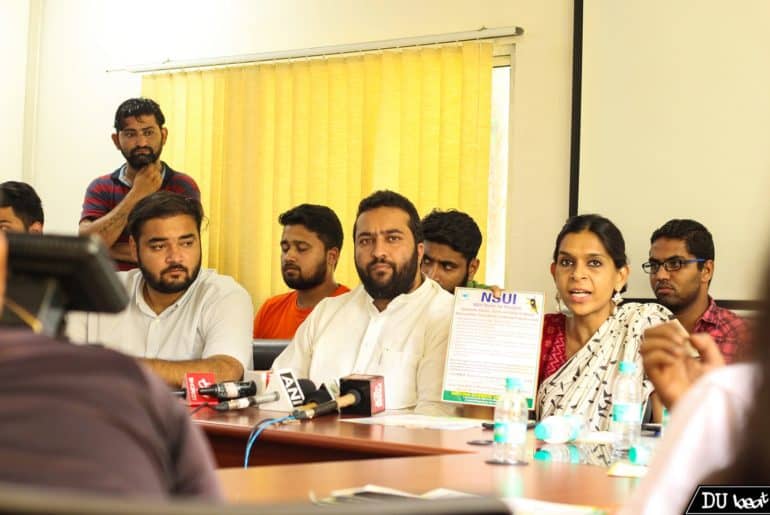
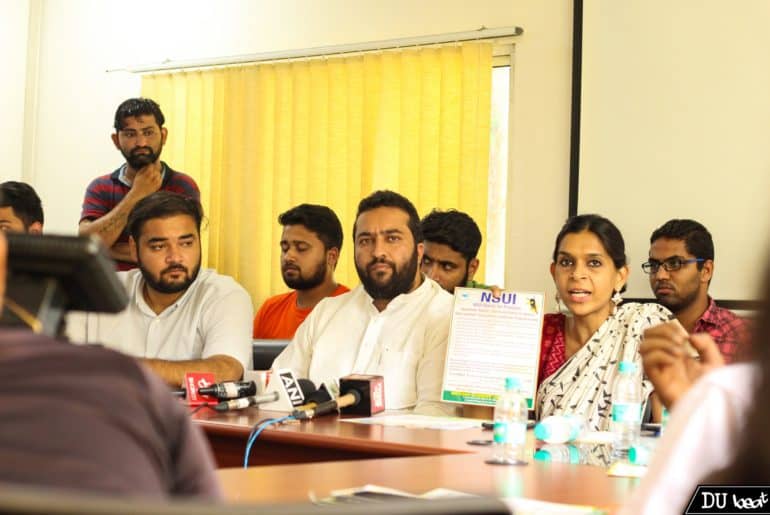
NSUI alleges that their magazine launch, which was slotted to be held earlier today, was cancelled due to ABVP involvement.

A magazine launch event organised by the NSUI-led DUSU which was to be held in the University Conference Center on 31st July, 2018 was abruptly cancelled and the organizing students were barred from entering the University Campus. The National Student’s Union of India (NSUI) alleged the involvement of the Akhil Bharatiya Vidyarthi Parishad (ABVP) in the cancellation and refused to budge, despite barricades being put in front of the Dean’s office by the police.

The event which was supposed to be attended by University of Delhi (DU) Professor of Hindi, Dr. Apoorvanand Jha, the founding Editor of The Wire, Siddharth Vardarajan and Member of Parliament (MP) Rajeev Gowda, was supposed to be on Freedom of Speech and Expression.

In a dramatic turn of events, the NSUI and the invited guests decided to launch the magazine in front of the police barricades under protest. The guests also delivered short speeches on the freedom of speech and expression while claiming that the spaces for creative freedom were increasingly lessening in the country.

Allegations of interference  

PicsArt_07-31-10.40.33
Rishabh Gogoi for DU Beat

The event was initially supposed to launch the first ever student magazine of DU named DYouth. The magazine which featured various articles by students of DU as well on-record interviews given by people like P. Chindambaram, Subramaniam Swamy, Yogendra Yadav, Sheila Dixit, Prashant Bhushan, Sunita Narain and Karan Thapar among others, was edited by a team of editors from the colleges of DU.

Ruchi Gupta, the NSUI’s National-in-charge, while speaking to DU Beat, claimed that the NSUI had obtained prior permission to launch the magazine in the Conference Center. “This permission has been cancelled at the last minute at the behest of a complaint by ABVP goons who are only able to understand the language of guns. They bring guns inside DUSU office and NSUI will not be allowed to launch a magazine.” she added. Ms. Gupta and several other members of the NSUI publicly condemned the cancellation after the magazine was launched under protest in front of the Dean’s office.

DU Beat spoke to several sources in the organising team of the event and they all alleged that the ABVP was putting pressure on the administration to cancel the event at the last moment. However, another source on the condition of anonymity, said that things were “too quiet for the ABVP to be involved.”  

AISA’s Kawalpreet Kaur, who was also present, extended support to the NSUI in a public speech claiming that she was upset as a student of the University because of the condition of politics in the campus. “We remember last year when there was a programme held by RSS here in the presence of Subramaniam Swamy and the ABVP waved saffron flags here inside the campus, indulging in hooliganism. We didn’t throw stones at them at that time.  Neither did we cancel that programme. We agreed that there should be dialogue within this University. We still remember the episode at Ramjas college where the teachers were brutally attacked by the ABVP. And today, at the eleventh hour, the launch of a magazine by NSUI, which should be a cause for celebration for every student, has been cancelled and bizarre arguments have been put forward in support,” Ms. Kaur added.

Perturbed dignitaries

NSUI led magazine launch
Rishabh Gogoi for DU Beat


The three dignitaries invited strongly criticised the sudden cancellation of the event. Mr. Vardarajan, speaking to DU Beat said, “I think it is very unfortunate that the DU administration did not allow this programme to happen. The irony is that we were going to discuss freedom of expression. And our own freedom of expression has been compromised in this way.”

When asked what he thought about the allegations of ABVP’s involvement in the same, he added, “I don’t know the facts because I am not from here. But the ABVP across the country has been well known to object to all acts of democratic expression that they don’t agree with. I was myself a victim of ABVP intolerance at Allahabad University when they wouldn’t let me speak. So if this has happened in Delhi University, it’s quite believable.”

DU Beat also asked Mr. Jha about the allegations of ABVP meddling in the cancellation of the event. While Mr. Jha denied knowing why the event was cancelled, he also added, “I can say from my experience that University spaces are being made inaccessible to people for open discussion and that is, in a way, dismantling this University. A simple release function is now being forced to be seen as protest, which is very telling.”

Rajeev Gowda, a professor of IIM-Banglore, claimed that the clamp down on NSUI’s launch was a symptom of events across the country. He attacked the National Democratic Alliance (NDA) government for all the instances under them where freedom of expression has been threatened claiming, “In a few miles away from where Prime Minister Modi rules the country, you are able to see that freedom of expression has no meaning but there are still people willing to stand up and fight for the fundamental right that we have enshrined in the Constitution.”

The other side of the story

PicsArt_07-31-10.41.34
Rishabh Gogoi for DU Beat

DU Beat spoke with several policemen on the scene who were all unwilling to answer our questions. They directed us towards the people in charge, including the Deputy Proctor, Dr. Anupam Jha. On speaking to DU Beat, Dr. Jha claimed that the NSUI was misleading the people and that proper permission for the event had not been taken. “We are just abiding by the High Court’s orders which have upheld the decision to disqualify Rocky Tuseed’s candidature as DUSU President,” he added. Mr. Tuseed’s candidature had been revoked by the Delhi High Court previously due to his inability to release the details of the disciplinary action taken against him during his undergraduate study.

In an attempt to know more, DU Beat also contacted Mahamedha Nagar, the secretary of DUSU, who denied allegations of ABVP’s interference. “Why should we allow a magazine which has been just spearheaded by a Vice-President or a Joint Secretary, under the banner of DUSU? Was the money that was used for the magazine, in the name of DUSU, only the right of a President, and that too, a President who is no more a President? There is nothing about DUSU in the magazine. No suggestions were taken. I don’t think it makes sense to launch such a magazine under any venue of DU.”

While both NSUI and AISA have issued several official statements condemning the ABVP for their alleged involvement, it remains to be seen where the discussion on freedom of speech and expression takes us.

Feature Image Credits: Rishabh Gogoi for DU Beat

Sara Sohail

[email protected]
Rocky Tuseed’s post as DUSU President has been held ineligible in a recent judgement by the Delhi High Court. His candidacy was being questioned for quite some time regarding criminal charges filed against him. Now finally, it seems some concrete rulings are going to be out.

Rocky Tuseed (or Rocky Tuseer according to campaign posters and graffiti) broke a dry spell of five decades by winning the President’s post with a margin of 1590 votes. However, since the very beginning, his records seemed to have grey areas which raised more than a few brows. Tuseed himself trumped several challenges to get elected and hold on to his post.

To begin with, the Delhi University’s Chief Election Officer initially rejected his presidential candidature, following the guidelines of the Lyngdoh committee, citing disciplinary action taken against him during his undergraduate days in Shivaji College.  This was challenged in the High Court where he was backed by political hotshots like P. Chidambaram and Vivek Tankha. As a result, he managed to turn the tables in his favour, and even generated a “sympathy wave” for himself.

An application by the Akhil Bharatiya Vidyarthi Parishad’s  (ABVP) Rajat Chaudhary, however, unleashed a new maelstrom, claiming that an FIR was lodged against Tuseed for an attempt to murder, which had caused him to remain in custody. The court took immediate action issuing notices to the DUSU President and Delhi University. Tuseed in his defence asserted that his name was unnecessarily dragged as he was politically active. Tuseed and the NSUI claim the matter has ended and it is unnecessarily being dragged now. Now finally when Tuseed has completed more than half of his first tenure as DUSU President, a 37-page final verdict by the Delhi High Court has become a barricade on the NSUI’s road to next DUSU election.

The ruling pointedly states, ““The issue raised in the petition goes to the root (of) whether the petitioner (Tuseed) could at all stand for election to the post of president. The answer to which is no.” As reported by the Indian Express, Tuseed’s counsel said they will appeal against the order before a larger bench.

ABVP members have seen this ruling as a major win as this judgement echoes their allegations against Rocky Tuseed aka “a leader who has hardly contributed to anything in the University”, as one of the ABVP media heads remarked.

With his nomination canceled, Rocky Tuseed would have to step down and resign, which might be a fatal blow NSUI’s reputation. The tarnished image of an NSUI leader so close to the 2018 elections might pave the way for ABVP’s victory

Feature Image Credits: DU Beat

Bhavika Behal

[email protected]

Shaurya Singh Thapa

[email protected]

The Delhi University Students’ Union (DUSU) will hold a meeting in June with all stakeholders and volunteers to decide ways to beautify the 11 Delhi metro stations that were defaced during the election campaign of 2017.

As a follow-up to a petition filed in the Delhi High Court, the court had instructed the students and candidates of different student political units to work with the Delhi Metro Rail Corporation (DMRC) to restore its defaced property across the city, last month.

 In a phone call conversation with the DU Beat correspondent, DUSU President Rocky Tusheed had said, “Responding to the petition filed in the Delhi High Court by Mr. Prashant Manchanda, the DMRC had called a meeting with us. As soon as exams are over, preferably in the first week of June, we will hold a meeting to decide on how to go about with the beautification process.”

 When asked how he planned to beautify the metro stations, he said “We won’t be able to restore it exactly to the original state. But we will beautify it through paintings and decorated tiles and the like. We have recognised 76 sites as of now.”

 When he was asked by this correspondent whether it will be a joint initiative by the ABVP (Akhil Bharatiya Vidyarthi Parishad) and NSUI (National Students’ Union of India) since members of both currently occupy DUSU, he commented, “We have invited volunteers and all respondents of the petition. Since the defacing was done by almost all student units, the responsibility falls upon us to beautify it as well.”

 The National Media Convener of the ABVP, Saket Bahuguna, told DU Beat, “Last year, many metro stations were defaced by different candidates and organisations. All 4 office bearers of DUSU have a responsibility to clean up the mess. So they were called by the court with this regard.”

 Responding to a question on the uneasy nexus between the ABVP and NSUI office bearers within DUSU, Mr. Bahuguna said, “This is not about politics. This is an initiative taken by DUSU. But we extend our complete support to them, because we have a collective responsibility to keep our University and city clean.”

Making a unique recommendation on how this ‘politics of pamphlets and posters’ can be controlled, he remarked, “What can be done to counter this menace is, the University should mandate every college to earmark one ‘wall of democracy’ dedicated to election campaigning. It is virtually impossible for one candidate to reach out to 1.43 lakh students without posters, since the entire process of election campaign for DUSU takes place within a span of 4-5 days.”

NSUI in-charge Ruchi Gupta said her organisation would do away with posters during this year’s election campaign. “We will put up flexes and run a vigorous online campaign. Our campaign will be progressive and issue-based and thus will not need to fall back on posters.”

 Notably, the DMRC has told the court that restoring the identified 76 sites would cost over INR 16 lakh and take six months’ time.
Some of the stations identified by the DMRC are R K Ashram, Kuhat Enclave, Vishwavidyalaya, Rajouri Garden, Vidhan Sabha, Shivaji Park, Civil Lines, and Pitampura.

Feature Image Credits: The Financial Express
Vaibhavi Sharma Pathak
[email protected]

Keshav Mahavidyalaya would be holding a referendum to determine the students’ verdict in the matter of the institution of the college students’ union as well as the college’s affiliation to the Delhi University Students’ Union (DUSU). The referendum is slated to be held on the 2nd of May 2018, and the entire process is deemed to be completed by 9 p.m. on the same day.

Keshav Mahavidyalaya does not partake in the elections held to the DUSU and neither does it have a students’ union. For years, certain sections of the students have demanded for both the aforementioned elements in their college.

Faculty members V.K. Verma and Surendra Singh have been appointed as the Election Officer and Returning Officer respectively. All the class representatives (CRs) of the college have been invited to meet the Students’ Union Formation Committee on the 26th of this month for a meeting to discuss the modalities of the referendum. All students enrolled in regular courses in the college, and having a valid identity card will be eligible to vote in the same. The students can cast their votes from the following options: ‘NOTA’ (None Of The Above), besides ‘Yes’ and ‘No’.

Priyavrat Joshi, former President of the Stage Play Society, who graduated from the college in 2017, told DU Beat, “When I was in college, there were many protests for the institution of a students’ union. Our society, along with a few others had tried talking to the Principal and the administration for the same, but to no avail.” He further explained, “Our college has always been like a school, more inclined towards academics. So the authorities never wanted elections to take place in our college, to retain the academic spirit. In fact, even our college societies don’t get adequate support from the administration.”

When asked about the probable trends of the referendum, he commented, “I think the trend would be towards a definite ‘yes’ to the formation of the students’ union.”

In stark contrast to the comments of Priyavrat, a student, on the condition of anonymity, told the DU Beat correspondent, “all the societies are really happy with the way the college is functioning. We don’t have much complaints or demands with regards to either a students’ union or our affiliation to the DUSU.”

Significantly, while demands for a Students’ Union have been prevalent for quite some time, the Principal’s sudden affirmation for a referendum to decide the fate of the college was considered as a “suspicious move” by some quarters of the college. Commenting on the same, the student told DU Beat, “The Principal didn’t take the decision under any political pressure. She wasn’t against the idea of a students’ union, in the first place. Her concern was, if referendum is what majority of the students demand, then it is fair to have it.”

While any form of campaigning has been officially banned in the pretext of the referendum, the sight of “politically active” students approaching other students to influence their decision either for or against the referendum has been a commonality in the college lately.

The compilation of results is expected to commence at 4 p.m. on the 2nd of May, following which the declaration of results will be undertaken by the Principal on the same day.


Feature Image Credits: Justdial

Vaibhavi Sharma Pathak

[email protected]

It is early July 2015 when Martha, a student from Nagaland studying in Hansraj College, got called “Chinese” by two men as they rushed past her in a bike through BD Estate,  a relatively posh area near North Campus. Three months later, during election campaigning for the Delhi University Students’ Association (DUSU) elections, Martha spotted one of those two men, garlanded and surrounded by a gang of loud sloganeers who were going from one college to another. He had his picture on hundreds of the same posters pasted on walls, behind e-rickshaws, and even on streetlight poles. In Vijaynagar, an area densely populated with North-Eastern students of DU, he was seen calling his Northeastern “brothers and sisters” to vote for him to see “progressive” policies implemented by DUSU. So much for duplicity and dissimulation.

During the campaigning for DUSU in August 2017, one candidate fielded by a particular student political unit went ahead to claim in his speech, “The North-East people are benefiting because of the quota which helps them get into DU.”

This perfidiously flawed statement made by a student political leader who believes in the existence of a “quota” for North-Eastern students is as vulnerable to laceration as is the laceration of a ripe tomato by a razor-sharp knife. Seeing this incredulous level of awareness of political leaders in DU, it is not startling that out of 20,000 North Eastern students, less than 5,000 cast their vote in the DUSU elections. These statistics were shared by the North East Students’ Society.

“During DUSU elections, tall promises are made for NE students. But nothing is ever done,” remarked Dr Kamei Aphun, Professor of Sociology at Delhi School of Economics. However, sometimes, student political leaders hesitate to even raise the issues of Northeastern students, let alone make tall promises. The issue of the murder of a 20 year-old student studying in Delhi, Nido Tania, provides evidence for the same. On 29th January 2014, Nido Tania died of severe lung and brain injuries from a racial attack inflicted upon him in a South Delhi market. It had led to a national debate on discrimination against ‘Northeasterners’ in Delhi’s educational institutions.

As activists and students expressed their outrage over Nido’s death with candle-light vigils all over Delhi, only a handful of the student political units took up this issue  in the DUSU elections of the subsequent year. “Were they afraid that they might lose their vote bank of “mainstream” Indian students if they pressed this issue too much?,” questions Tenzin, a DU graduate from Zakir Hussain Delhi College.

Alana Golmei, founding member of the Northeast Support Centre and helpline, says she gets half-a-dozen distress calls a week. The existence of such a helpline again makes us question the approachability of  student political units at DU and the DUSU, at large.

Samson Marak, a DU graduate, recounts a painful experience, “When I was a fresher in Ramjas College, I had faced racial abuse numerous times. This one time, mustering up all my courage, I remember marching into the DUSU office to complain about the abuse I was facing. I should have known better, for the first thing that the people did there was make fun of my dyed blonde hair.”

It is perhaps wishful thinking to expect much from student political units when even central authorities have been ineffective in assimilating this ethnically distinct population of students. In 2007, the Delhi police published a much-criticised booklet, advising migrants from the northeast to avoid wearing revealing clothes and to not cook their native foods, such as bamboo shoots and fermented soy beans, for fear of upsetting their Indian neighbors who were unfamiliar with those smells. “Campaigners at the DUSU elections, just after the publication of this booklet didn’t seem to have much of a problem with the same. They went  as far as espousing this booklet in their manifesto readings”, testifies Jordan Warbah, a Hindu College graduate who was  in his final year of college then.

When asked about this bone of contention between DU student politics and ‘Northeasterners’, Sanjay Hazarika, Director, Centre for North East Studies and Policy Research, Jamia Millia Islamia made an important observation. He said, “It takes great courage to do what North-Eastern students in Delhi are doing. Their ancestors might have opposed the idea of India by holding onto an impossible dream of freedom and separation, but many younger people these days are engaging with the idea of India and reshaping it.”

Highlighting the role that student political units of DU can play in creating a more inclusive student community, he added, “The wider arena of student politics needs to recognise this phenomenon. The process of building goodwill and understanding remains a work in progress.”


Feature Image Credits: Hindustan Times


Vaibhavi Sharma Pathak

[email protected]

An RTI has uncovered that the highest academic body of the University of Delhi, Academic Council, has not seen a single student as a member in the last 10 years.

Advocate Mohit Kumar Gupta’s RTI reply as received from the Delhi University read that “No student member has ever been elected/ nominated in the last ten years and even presently, there is no student representative in the Academic Council.” It further mentioned that no amendments have been made to the varsity’s Academic Council’s statute 7(I) (xiii), which would have introverted the membership of students in the Council.

The highest academic body of the varsity, Academic Council, is responsible for the preservation of standards of instruction, education, and examination within the University. In a statement made to the Sunday Guardian, Rocky Tusheed, President of the Delhi University Students’ Union (DUSU) said, “Ever since 2010, we have been trying to put this across to the administration, but nothing seems to have worked so far. Universities are for students and it is very unfortunate that there is a lack of representation of students in a body that decides their own future.” DUSU has been preparing a Students’ Charter in consultation with all the student bodies of the varsity that would include the demand for representation of students in the Academic Council.

The Vice-Chancellor, Principals of various colleges, Deans and Director of School of Open Learning and South Campus, and the Registrar are also intended to be members of the DU’s Academic Council apart from students.


Feature Image Credits: Sharda University

Oorja Tapan 
[email protected]


In an exceptional initiative, the NSUI-led Delhi University Students’ Union (DUSU), in consultation with the University of Delhi, has drafted a Students’ Charter that seeks to enable students to exercise their rights. The draft of the Charter was launched at a program held from 11 a.m. on 23rd January, 2018 at Ramjas College, in the presence of DUSU President Rocky Tusseed, Vice President Kunal Sehrawat, and AICC Secretary Ruchi Gupta besides others.

On being asked about the motive behind this momentous move, Ruchi Gupta, who is also the NSUI National In-Charge said, “The NSUI had fought the elections on the premise of two promises. One, restoring free speech, critical thinking and academic autonomy; the other, defining the democratic role of student unions in the governance of universities. Now, we want to take that forward by ensuring that there is free speech within the University.”
In the backdrop of the conflicting relationship between the students and university administrations across the country, this draft charter provides hope of reconciliation between the two, and provides a framework for the University to develop and improve its services.
The draft of the Charter is divided into 2 sections. One contains the Fundamental Rights of students that the University must recognise. The second contains the Directive Principles, which, although unenforceable by a court of law, are significant for the University administration. While the former notably includes the right to have an environment free from sexual and mental harassment, the noteworthy point in the latter is the guidelines for the University to provide accurate information to the students about its statutes, methods of assessment, and attendance requirements amongst other regulations.

On being asked about the future course of action, DUSU Vice-President Kunal Sehrawat assured, “We will be in consultation with DU colleges and will take feedback from the students. With their support, we will approach the VC for his endorsement. Once this charter is passed by the DUSU, we will take it to all the other universities to create a spirited learning atmosphere across the country.”


Feature Image credits: Anushesh Sharma

Vaibhavi Sharma Pathak [email protected]

In a press conference that took place on 17th January, Rocky Tuseed, President of Delhi University Students’ Union (DUSU), announced that DUSU is in the process of developing the Delhi University Students’ Charter.

The Students’ Charter, as conceived by NSUI-led Delhi University Students’ Union will be formed after rounds of consultation with the students, faculty, and administration of Delhi University. The consultation process is set to begin from 23rd of January, and the Charter is expected to be finalised by March.

The objective of the Charter is ‘to lay down the minimum expectations of students and administration vis-à-vis each other. It illustrates the entitlements and responsibilities of both, as well as provides a framework for the University to develop and improve its services.’

The proposed Charter is to be structured in two parts: Directive Principles for colleges and Fundamental rights of students.

There are a total of 30 Fundamental rights of students, which include the availability of transparent and online college budget, access to an active placement cell, and discrimination-free environment.

The Charter also has stated 18 Directive Principles for colleges. Some of these Directive Principles are: offer professional counseling services to students, provide mark sheet within a stipulated time period, hold orientation programmes to help students acquaint themselves with the University system, etc.

Rocky Tuseed said, ‘We hope to craft this Charter in such a way that it becomes an example for Universities across India to form similar legislation. We also hope that this initiative will form the basis of a state and national Students Rights Act and Students Rights Commission.’ When asked about the absence of the Secretary and Joint Secretary of DUSU, who belong to Akhil Bharatiya Vidyarthi Parishad (ABVP), from this initiative, he added, “We invited them, but they did not involve themselves.’


Feature Image Credits: UC Lan

Niharika Dabral
[email protected]


Yesterday, on 15th January, the Delhi University Students Union (DUSU) launched a Gender Sensitisation Cell (GSC). Rocky Tuseed, President of DUSU, is set to act as the Chairman, while Narayani Anand, a student of Campus Law Center, is announced as the Convener. The GSC will be operated from the DUSU office space at Chhatra Marg in the North Campus.

The aim of this initiative is to ‘represent and raise the voice of students who suffer any act of sexual harassment or gender discrimination’, ‘ hold interaction with students to create awareness about gender discrimination and remedies available to curb it’, ‘take preventive steps to curb eve-teasing’, and ‘create a healthy and safe atmosphere in the university for people of all genders, especially women and transgenders.’

The GSC, that is still in at the early stage of consolidation plans to work in sync with Women’s Development Cell (WDC), Delhi Commission for Women (DCW), National Commission for Women (NCW), and sexual harassment committees of various colleges. The GSC will also provide legal aid to the aggrieved students.

The recruitment of the members GSC has started. The selection process comprises of an online application that is to be filled through a Google form, and an interview. According to the application form, ‘the selected members will be expected to assist in planning, development, and execution of activities for the promotion of DU-GSC’s objectives.’

You can find the application here. 

Narayani Anand, the Convener of Gender Sensitisation Cell, informed DU Beat that the communication and grievance redressal channels will be open from the next month. She also said that co-conveners will be chosen from the students shortlisted after the interview, that is, from among the members itself.

Questions have been raise against Rocky Tuseed’s nomination as the Chainman of the cell. Accoding to the regulations the University Grants Commission, only women can head Gender Sensitisation Committee Against Sexual Harassment (GSCASH) and Internal Complaints Committee (ICC). When asked about this contradiction, Tuseed tol DU Beat, ‘My role would only entail the overseeing of the cell. The active role will be that of the convener. I will merely oversee the functioning of the cell as a DUSU representative. It will be a 50 member committee with mostly women and transgender members.’

Sexual harassment and discrimination against the members of the transgender community have prevailed in the University of Delhi for a long time. Despite the remarkable work of the feminist groups in the campus the incidents of pervasive sexism keep emerging. In this environment, DUSU’s this move is extremely important and commendable. However, owing to the history of DUSU-led initiatives, suspicion about the effectiveness and the sincerity of this Cell are bound to rise. Whether or not the GSC will be able to serve its purpose can only be established in a few months.


Image Credits: She The People

Niharika Dabral

[email protected]


Elections of the Executive Committee of the Delhi University Students’ Union (DUSU) saw major unrest after a voter, Gaurav Sharma, a central council member of Sri Guru Nanak Dev Khalsa College, alleged that somebody had forged his signature and voted on his behalf. When he complained to the authority then, instead of taking the matter seriously, his complaint was dismissed his claims and he was asked to leave the Conference Centre (voting venue).

Soon Akhil Bharatiya Vidyarthi Parishad (ABVP) and the National Students’ Union of India  (NSUI) got the whiff of the matter which led to a scuffle between police and students that resulted in minor property damage. DUSU President and NSUI member Rocky Tuseed and DUSU Secretary Mahamedhaa Nagar, who is from ABVP, asked authorities to allow the voter to cast his vote, but their request was refused.Election officer Rajeev Gupta forwarded the complaints of bogus voting to the DU Grievance Cell and further action will now depend on Grievance Cell’s decision.

A glass door was broken during the scuffle. Image Credits: The Indian Express
A glass door was broken during the scuffle.
Image Credits: The Indian Express

The results were announced on 27th November. ABVP asserted that they secured eight out of the 11 posts,   NSUI announced the win in five of 11 seats. Since there are only 11 candidates in total, which means that both ABVP and NSUI are staking claims on two winners. These two candidates are Naveen Yadav from Motilal Nehru College and Vaibhav Bansal from Rajdhani College. Naveen Yadav identifies as an independent candidate who personally supports NSUI and Vaibhav Bansal has had affiliations with ABVP.

The DUSU EC has 11 members who are chosen from presidents and central councillors of various college unions. Constitution of DUSU ensures that at least two out of 11 EC members should be girls. The Executive Committee is entrusted with an important task of proposing the DUSU annual budget which is then sent to the Central Council for approval.

A total of 146 people including all members of DUSU voted in the EC elections. Initially 18 candidates contested for 11 EC seats, but in the end only 14 contested owing to the withdrawal of nominations. In this sense, one can say that the selection process wasn’t very competitive in terms of numbers.


Feature Image Credits: The Indian Express

(With inputs from The Indian Express and Hindustan Times)

Niharika Dabral

[email protected]