Tag

dusu

Browsing

What was once termed as a force to reckon with, is now merely a shadow of its past. Chhatra Yuva Sangharsh Samiti (CYSS), the student wing of the Aam Aadmi Party (AAP) contested in the 2015 Delhi University Students’ Union (DUSU) elections but did not win. CYSS was the star debutante in the 2015 elections and was perceived at the time a strong opposition to the hegemony established by NSUI and ABVP in previous DUSU elections.
Students who were disappointed with the political climate then considered CYSS as a strong third alternative to clean up the murky politics. Despite huge hoardings of Arvind Kejriwal greeting students and asking for votes, CYSS did not win any seat and scored 16% of the total vote share. Barring a candle-light march to protest against ABVP’s hooliganism in the Ramjas row, it has been relatively absent from the DU political scene in 2017.

While it’s a speculative ‘fact’ that parent party’s win directly correlates to the chances of its student wing winning; why did CYSS lose in 2015, when AAP government raked a record 67 out of 70 seats in the Delhi legislative assembly elections? The agendas of CYSS are largely similar in ideology to AAP’s, which pertain to everyday issues of a student and plan to ensure a corruption-free university.

Anmol Panwar, the CYSS spokesperson and Vice-President, in conversation with DU Beat, said, “We boycotted elections last year because we don’t support the current muscle and money power politics in DUSU. Once DUSU candidates are declared, countless pamphlets are thrown in contravention to the Lyngdoh Committee recommendations (LCR). University authorities are aware, complaints are filed, but no action is taken against the perpetrators. Because of this, independent candidates with great ideas lose out to the bigger parties. If the situation changes, we could contest this year too.”
Leading up to the 2015 elections, CYSS was involved in multiple controversies. In 2015, CYSS faced backlash for putting up ‘fake’ posters of opinion polls that it would win 45% of the total votes; the veracity of which could not be verified. Similarly, opposition parties alleged that more than 50 hoardings had been put up across the capital, which was in violation to LCR which states that candidates cannot spend more than INR 5000 in campaigning. In September the same year, a concert, ‘DU Rocks’ was organised which had celebrities like Jasleen Royal, Vishal Dadlani(AAP supporter) and Arvind Kejriwal himself addressing the gathering.

The LCR clearly calls for disassociation of student elections and student representation from political parties. These allegations, amid dwindling support and lack of trust for AAP government in Delhi back then moulded into a sticky situation for CYSS. There’s always a chance the party may make a comeback, the same depending on their ability to garner support through the LCR guidelines it accuses others of not following.

Image Credits: pumirror.in


Vijeata Balani

[email protected]

Akhil Bharatiya Vidyarthi Parishad(ABVP), the student wing of RSS organised a press conference on 2nd September to discuss the work accomplished by ABVP-led DUSU last year. The panel consisted of Amit Tanwar, Priyanka Chhawri, and Ankit Singh Sangwan, the three outgoing DUSU office-bearers along with Monica Choudhary, ABVP’s National Secretary, Bharat Kumar, the State Secretary of ABVP and Saket Bahuguna, their National Media Convener.

During the conference, multiple achievements by ABVP in the past years were brought into notice and the rolling issue of discriminatory girls’ hostel rules was discussed. They further went on to talk about their role in a fight for printed mark sheets and hunger strikes held to promote students who had failed their last year of college. The outgoing Vice-President, Priyanka Chhawri spoke in length of the initiatives taken by DUSU in the past year, which included the DU paralympic sporting events and a university wide marathon being organised in North Campus along with cultural events and intellectual seminars under their hood.
Saket Bahuguna, ABVP’s National media convener touched upon subjects like DUSU’s controversial budget and the prevalence of violence across DU. Amid accusations, lies and slander, ABVP alleged opposition parties of putting forth “off-beat agendas to misdirect attention” and the university administration that had failed to competently handle the issue of permanent appointments in the staff. After a one-sided discourse on DUSU’s activities, questions were raised about ABVP’s involvement in the Ramjas issue and their stance on the thousands of posters defacing college walls throughout the campus. On this issue, Saket said, “It is practically impossible to cover all colleges that vote in DUSU in a span of 2 days. Even if we go by the cheapest means of transportation, we cannot cover all cost under 5000 rupees. Demands for a wall of democracy in every college has been placed in front of DU authorities, but no improvement has been observed.”
The conference concluded after the question-answer round and a hopeful parting note for DUSU elections 2017.
The party released its manifesto today.

Image credits: DU Beat archives

Vijeata Balani

[email protected]


On 1st September 2017, a referendum titled “Should Aryabhatta College be affiliated to Delhi University Student’s Union (DUSU)?” was held. The students of Aryabhatta College voted for the motion. Out of the 733 votes that were polled, 583 were for the motion, 140 against the motion, and 10 votes were regarded as invalid. The DUSU Constitution requires an absolute majority of the total number of students to support the motion for affiliation. As per clause 6(ii) of the DUSU Constitution, “Students of a College/Institution may become members of the Union by a resolution passed by absolute majority of the total number of students on rolls of the College/Institution concerned on the last working day of July of that year”. So even if most of the students voted in favour of being affiliated with DUSU, since a majority of the collective student body did not turn up for the polling, the resolution failed.

A strong reason for the less-than-ideal turnout could be because the 31st of August was a holiday in most colleges due to the Delhi University Teachers’ Association (DUTA) elections. The vote was scheduled on the 1st of September, with 2nd September being a Saturday and the 3rd being a Sunday. If students skipped college on 1st, they would end up having a four-day weekend. Some students believe that the college authorities had intentionally scheduled the voting on a date that would result in a low turnout. Yashank Bhutani, a third-year B.Com student from Aryabhatta College, said, “I think that this was a perfect plan made by our college authorities to get rid of DUSU from our college. As per the referendum schedule, 31st was the DUTA elections, 1st was the day of referendum, and the following days were Saturday and Sunday. College authorities knew well that students won’t turn up on this day due to which we got the following results. The main incentive behind not allowing DUSU in our college is that the authorities will form a dictatorship where teachers would rule like in a school.”

Being associated with DUSU for a lot of colleges means being involved with student politics and activism at a greater level. While DUSU does not come without its own baggage, it is undeniable that it plays a highly relevant role in shaping college life for a lot of institutions. DUSU affiliation means access to a platform to air one’s grievances, access to better fests and cultural events, and a the prospect of engaging on a wide platform of student politics.

In response to the failed referendum, the Akhil Bharatiya Vidyarthi Parishad (ABVP), which is currently in power in DUSU, alleged that the referendum was illegal on the grounds that voting in DUSU elections had been happening in the college when it was Ram Lal Anand Evening College until a few years ago.


Feature Image Credits: Edunuts

Kinjal Pandey
[email protected]

A constitution is ideally supposed to be a set of laws and principles laid down by those with authority, as the basis for governing a group of people. We know how important the Constitution is in a civilised society, especially with regards to the fact that previous week that saw the ruling on whether privacy is a fundamental right. Even though ground realities may take time to align with the lofty ideals written in a constitution, having high standards of ideals helps in aspiring for a more just world and providing legal recourse.

But what about an institution which is driven by ideas, like the University? Did you know that the Delhi University Students’ Union also has a constitution of its own? It’s a rhetorical question, because why would anybody know that? Unless, you’re writing an article about it – which is one of the more interesting ways of spending your weekend mass bunk due to the unthinking violent actions of the supporters of a certain amino acid-acronym Guru.

The Delhi University website has a link to the Constitution on it. Upon clicking on it, one is directed to a 16 page, 8 chapter PDF document. For those uninitiated in the ways of DUSU (which I’m sure is quite a lot of us given the recent years’ voter turnout), a lot of the clauses are new information. For instance, the source of DUSU funds is 20 rupees from each student who is a part of colleges affiliated to DUSU. It is apparently included in the college fees given by the students. Think of those sweet 20 rupees that you haggle over with rickshaw-wallahs for. The 20 rupees you can use for 2-3 cups of chai, depending on the generosity of your college canteen. A minute’s silence for those brave, invaluable (not literally) 20 rupees should be observed. So selfless, that they are someone else’s chai or someone else’s rickshaw fare to beat up the nearest leftist event’s organisers. It depends on you that which cause you’d rather have your money go to, if at all.

Under ‘Aims and Objects’ (not objectives, and I am not linguistically qualified enough to make a joke on that), there is the real substance – the meat of the Constitution. Among other things, “a democratic outlook”, “intellectual development” and “a sense of unity among students” is to be achieved, along with “harmonious relations” among the student community. That has definitely been achieved, no doubt. There is absolutely no irony in the Student Union demanding unity in a university where it doesn’t even serve a good number of colleges. Nope.

DUSU also has the power to organise events, debates, cultural and social service events under ‘Activities’. It can also publish magazines, journals and “wall newspapers”, whose existence had been unknown to me till now but as per Google Images it looks quite hipster, so I approve. There’s also some interesting organisational information: The Vice-Chancellor (currently Yogesh Tyagi, thank you Google) serves as the patron of DUSU, the hierarchy of the Council from top to bottom is President, Secretary, Vice President, and Joint Secretary; a student having been a part of the University for more than seven years cannot be an Executive Council member, and that a notice for an emergency meeting must be served by a telegram (Isn’t telegram dead yet?) Yes. “Why?” you ask? “Why not” is my response.

Regardless, it turns out that there are quite a few things to learn about DUSU and its functioning. We’re blessed enough to have an easily accessible Constitution that neatly mentions its aims, meetings’ procedures, structures and information on telegraph-usage. So go through it because it’s interesting, the 20 rupees trivia is definitely a great icebreaker for a date, and with the rains all around you have nowhere to go.

Feature Image Credits: DU Beat

Rishika Singh
[email protected]

With DUSU elections looming around the corner, students from various colleges of the University of Delhi have pledged to not vote for any party that partakes in the littering or vandalising of its college premises.
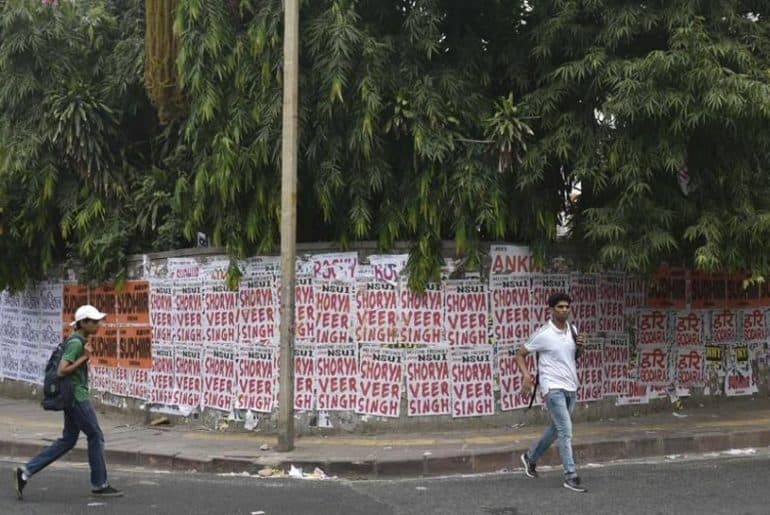
An unnamed notice at Ram Lal Anand College campus read, “We the voters of Ram Lal Anand College pledge to not vote for any candidate or a party whose supporters are found defacing or damaging the property of our college.” Similar notices from colleges like Kirori Mal College and Rajdhani College have begun doing the rounds in social media, and petitions which condemn wastage of paper are being signed. According to Vaibhav Bansal, a 3rd-year Political Science(H) student at Rajdhani College, “We are not planning on boycotting elections, we just demand a cleaner and violence-free campus. If a record of the campaigners could be maintained at the college gate and their number limited to 5, there won’t be as many problems. It’s our campus that is being defaced, not theirs.”
Akankshya Mohanty, a second-year Statistics(H) student at Ram Lal Anand College feels that the situation at her college is grim and severe. She said, “College just got renovated and many processes are underway as well. These campaigners are causing just too much destruction, with flyers and posters everywhere in and around the college.” She went on to describe her first-hand account of campaigners involved in a scuffle with the police at her college, and how quickly the fight turned violent.
A complete boycott is extremely far-fetched, but this new initiative to deter campaigners from defacing college property is gaining huge traction. Hopefully, more colleges will jump on the bandwagon and challenge authorities to take action against the wrongdoers.
Image Credits: RLA.in
Vijeata Balani
[email protected]

The Delhi University Student Union (DUSU) elections are one of the most important elections at the college level. Most of the DUSU presidents have gone ahead to make a significant mark in the field of national politics. Some examples of such leaders would be Arun Jaitley, Ajay Maken, Vijay Goel, Vijay Jolly, Alka Lamba etc. Thus being a DUSU president is one of the most lucrative posts that one can achieve at such an early stage of politics. Our country desperately needs the passion, vigour and zest of these young politicians.

With the approaching DUSU Elections, let’s have a look at what are the past DUSU presidents up to in their present lives.

  • Mohit Nagar

Mohit Nagar was the President of Delhi University Student Union (DUSU) in the year 2014-15. He belongs to Akhil Bhartiya Vidyarthi Parishad (ABVP).  He did his B.Com and M.com from Shyam Lal Anand College, University of Delhi. Currently, he is pursuing L.L.B from Law Faculty, University of Delhi and is in his first year and plans to practice law in future. He is also the Organising Secretary at Akhil Bhartiya Vidyarthi Parishad at present (ABVP).

  • Satendar Awana

Satender Awana was the president of Delhi University Student Union (DUSU) in the year 2015-16. He belongs to Akhil Bhartiya Vidyarthi Parishad (ABVP). He is currently the head of the Delhi University unit of ABVP and intends to pursue law as a career in future.

  • Ajay Chhikara 

He was the DUSU President for the year 2011-12. His tenure ended in September 2012 and by December 2012 he was appointed as the National Secretary, NSUI. He was also the made the Chandigarh Incharge, where NSUI won the Punjab University elections for the first time. He also worked in Amethi on Rahul Gandhi’s campaign during the Lok Sabha elections. He was later promoted to National General Secretary, NSUI. He was also made Punjab In charge during assembly elections where NSUI had a successful hold. He completed his law degree in 2012 and now actively pursues law along with politics. He also worked with the assistant Advocate General in the Supreme Court. His life is thriving both in personal and professional terms and he regards his one-year-old daughter Aavya as his lucky charm.

  • Arun Hooda 

He had an unconventional start as compared to most other DUSU Presidents. He pursued engineering and worked as an engineer for a while. Then he cleared SSC and worked for the Indian Air Force for a while. After withdrawing from the Air Force he joined the Faculty of Law, University of Delhi to pursue a Bachelor’s degree in Law.  He was the DUSU President from 2012-13.  He is the Observer Incharge of Delhi Pradesh Congress Committee. He has politically been active in Haryana and was one of the finalist’s for the post of NSUI National President. He practices in the Tees Hazari Court and Delhi High court as a lawyer. Along with an engineering degree, he has an LLB degree along with another in Forensics. He is also pursuing LLM from the faculty of law.

  • Nupur Sharma 

She was the DUSU President from 2008-09. She graduated with a Bachelor’s degree in Economics (Hons.) from Hindu College. When she won the DUSU election representing ABVP, many were shocked. Until her victory, DUSU was a NSUI stronghold. In fact, the remaining three posts in her union were won by NSUI. She went on to pursue a master’s in economics from the London School of Economics. She is an official spokesperson for the Bharatiya Janata Party and contested the 2015 Lok Sabha elections from the New Delhi constituency against Arvind Kejriwal.


Image Credits -The Indian Express

Anukriti Mishra

[email protected]

Kinjal Pandey

[email protected]

Following the Vice Chancellor’s historical decision, you can now expect student political parties to hand you out pens and notebooks in exchange of your vote.

In a press conference last week, the University of Delhi’s Vice Chancellor passed an order to student political parties that allows them distribute freebies legally on only one day, preceding the Delhi University Students’ Union (DUSU) elections. This decision comes right before the polls that are set to be conducted on the 12th of September this year. When the VC, Satish Saraf, was approached to reason this historical decision, he said, “The DUSU elections happen in an arbitrary manner, as no political party follows the Lyngdoh Committee guidelines anyway. Through this reform, we plan to introduce transparency in the system.” This report, however, is incomplete without the numerous terms and conditions it clearly states that need to be followed as protocol to distribute freebies legally. A few of these conditions are:

  1. Political parties can only distribute freebies on only one day, that day being at least one week prior to elections.
  2. Political parties can distribute only education related freebies like pens, registers, books and other similar items that add to the welfare of students.
  3. If the political party is found to be distributing alcohol or weed, its candidate would be prosecuted and disqualified to contest with immediate effect.
  4. No printed posters can be put up. This is in accordance with orders given by the National Green Tribunal (NGT) to conduct a poster-less and digital campaign.
  5. A maximum cap of 10 lakhs would be set so that parties with lesser funds have no complaints.
  6. To help students make an informed decision, all those parties that partake in distribution of freebies are expected to arrange for seminars and workshops, wherein they explain in detail the functioning of DUSU and delineate the actions they will take to achieve all points in their manifestos.

Two schools of thoughts have emerged from this landmark decision- one which strongly opposes this decision and one which stands in staunch support for it. A second year student of Shaheed Bhagat Singh College under condition of anonymity, said, “I think the DU VC has gone berserk. His decision places small, genuine parties to a major disadvantage and ensures that parties with large funding get abundant visibility.” However, not everybody harbours the same viewpoint. Avni Bansal, President of Sangharsh Yuva Parishad is of the view that this decision will transform elections for the better. In conversation with DU Beat, she said, “Everybody knows that use of muscle power cannot be removed from elections. But, this can definitely be put to good use for the welfare of students. Students belonging to lower economic backgrounds can benefit immensely from this opportunity”

While we already have protests from opposition parties against this decision, the executive council has been tabled to discuss reforms in DUSU budget as well. Most students consider this to be another spurious decision by the VC and have signed petitions that would be forwarded to the administration. Whether it will face a roll back like other significant reforms or undergo rigorous implementation, only time will tell.


Disclaimer: Bazinga is our weekly column of believable fake news. It is to be enjoyed, and not believed.


Image Credits: Days Of The Year

Vijeata Balani

[email protected]

Right before elections, a photo uploaded by the National Students’ Union of India (NSUI) had started making rounds on the internet. The picture alleged the Akhil Bharatiya Vidyarthi Parishad (ABVP) of spending Rs. 22 lakhs out of the assigned 26 lakhs for the Delhi University Students’ Union (DUSU) budget on tea.

Soon, there was an outrage in the student community regarding the blatant misappropriation of expenses. NSUI officials claimed that Mr. Mohit Garid, the Joint Secretary of DUSU, provided the information as he has got access to all DUSU official records.

20914196_110099089717513_600105314418395050_n

But when DU Beat reached out to ABVP, the other side of the story was unfolded. Mr. Amit Tanwar, president of DUSU, explained that the document making rounds is the budget of DUSU and not the expenditure. He further told DU Beat that many other events were conducted which didn’t fall in any of the other categories, hence, were included in miscellaneous sections.

Mr. Saket Bahugana, the national media convenor of ABVP, shared with us the original complete document, which clearly reflects the signature of Mr. Mohit Garid on the document.

img-20170822-wa0013
Image Credits: DUSU office


Mr. Bahugana adds, “Why didn’t the Joint Secretary object to the budget while it was being proposed?” He also alleged that Mr. Garid had taken more than Rs. 5 lakhs from the DUSU fund but failed to utilise the money towards an event with the money.


Feature Image Credits: NSUI Twitter Handle 


Sandeep Samal

[email protected]


The Delhi University Students’ Union elections are just around the corner and the election fever is in full swing. In this context, we analyse the finer nuances of what sways the DUSU election results.

  • The name game

While campaigning, candidates often change how their name is spelt. Posters and hoardings will often bear the names of candidates with one or more letters misspelt. This leads to the following benefit – if there are any pending cases or FIRs against them, it would be harder for the average Joe to look it up. The second benefit allows them to manipulate the ballot number they received by adding “A” at the beginning of their name as a prefix. For example, the 2015 DUSU President Mohit Nagar filed his nomination as “AAA Mohit Nagar” which resulted in him getting ballot number 1. The ballot list is made in alphabetical order which means that the candidates with the maximum number of As at the beginning of their name would get 1 as their ballot number. Since a lot of people in DUSU elections vote just for the sake of it, the probability of them voting for the first candidate on the list is considerably higher. To combat this, in 2015 the Delhi High Court described this practise as “flawed” and finally put an end to it.

  • Money matters

Freebies ranging from movie tickets, chocolates, t-shirts, pens, notebooks, water park tickets, and what not are distributed during the election season. But it does not stop there. Major student political parties also go to large PGs to promote and campaign for their candidates. An anonymous resident of Aparna Girls Hostel, a private PG that houses around 300 girls, says, “Last year both the ABVP and NSUI came to our PG to campaign. They spent around 20-30 minutes there and also sponsored special food for the day”. These freebies are aggressively thrown around as the election day comes closer in order to sway the maximum number of voters until the very end.

  • Graffiti

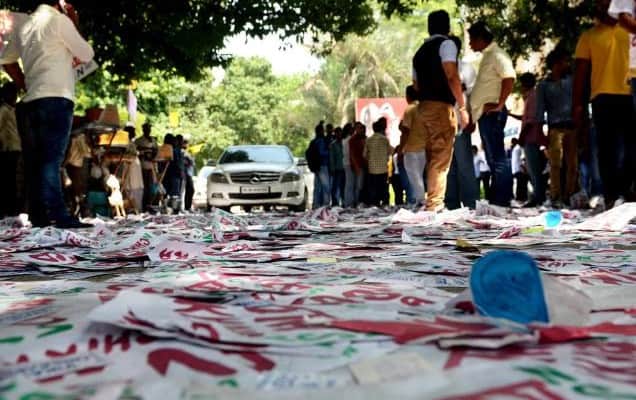
Without any regard to either public and private property or to aesthetics, candidates spray paint their names over walls, buildings, pavements, hoardings, and any flat surface which catches the eye. The idea is to familiarise the maximum number of people with a certain name before election day. If the rival party has already put up their logo on a particular wall, instances have shown that political candidates are not above throwing black paint all over it. Every year, in the name of elections, these walls are besmirched with black spray paint and posters.

  • Personal touch

Any politician worth the salt knows how important personal touch is. Vox populi vox dei is an ancient Latin phrase which means that the voice of people is the voice of God. Candidates in DUSU elections are more than aware of this philosophy.  Once people want a particular candidate to win because they think he/she deserves it, there is little that can stop them. As soon as the logistics are dealt with, door-to-door campaigning begins. Personally helping people, reaching out to them, acquiring  goodwill, and building up a network of loyal friends are keys to unlocking the puzzle that is DUSU elections. On the day of the elections it is this goodwill acquired across months of rigorous campaigning and a band of loyal supporters and friends that ensures victory.

  • Party lines

Contrary to what most of us would like to believe, student politics does sync with national politics. DUSU elections are a playground for major national political parties. Most DUSU presidents acquire a certain degree of political relevance and end up with successful careers working with their parent organisations or parties. Delhi University is also a recruitment pool for these parties. A considerable number of today’s political leaders started their careers in Delhi University itself.

As far as the DUSU election results are concerned, the stakes are extremely high. It is a matter of immense pride to win the student elections in one of the largest universities in the country. The pivotal driving force in these elections – perhaps the sole factor that makes it so very grand – is the involvement of national parties. When Delhi University becomes the battle ground for the biggest political parties in the country, one can expect a magnificent showdown.


Image Credits: Kinjal Pandey for DU Beat

Kinjal Pandey
[email protected]

Delhi University Students’ Union (DUSU) elections are just around the corner and the anticipation is palpable even from quite a distance. With just a fortnight before its commencement, All India Students’ Association (AISA) has urged Prime Minister, Narendra Modi’s intervention in subsuming the unwarranted and illegitimate practices of Rashtriya Swayamsevak Sangh (RSS) affiliated Right Wing students’ political body Akhil Bharatiya Vidyarthi Parishad (ABVP).

AISA has openly raised arguments about the alleged unethical behavior of ABVP goons and brought to light the ill temperament of right student wing delinquents in the university campus and particularly highlighted their near malevolent attitude towards Kawalpreet Kaur, AISA President, by calling her an “anti-national slut” and allegedly outraging her modesty.

“The ABVP has become the censor board in the campus and reserves the authority on what is allowed and what is not allowed…. The election cannot be free and fair as long as their violence continues,” Kawalpreet Kaur told the press of IANS live.

She has demanded the Delhi University’s administration to refrain from letting ABVP contest in the elections on account of their homicidal behavior during the incident in Ramjas College. She showed pictures of Ankit Basoya and Mahamedha Nagar, ABVP candidates, attacking protesters during the Ramjas incident. She also spoke about the fear that ABVP has entrenched in the campus with their blatant hooliganism.

They have drawn a very subtle parallel between Modi’s “Beti Bachao Beti Padhao” campaign and ABVP’s alleged reputation for shamelessly using force on women and their supposed misogynistic treatment of the ilk. They have also suggested failure of Modi’s “Swachh Bharat Abhiyan” under ABVP’s election campaigning which unabashedly involved soiling the varsity spaces with party pamphlets.

Sanjay Bohidar, a DU professor expressed his agitation towards ABVP in general and the government in particular for letting unscrupulous elements like that of ABVP to prosper. He was of the opinion that an atmosphere where even the police is under dire pressure and ceases to deliver justice, is anti-education, not because of one ideology domineering over the others but because of consensus of a common view under the ambit of that ideology.

He also recalled former DUSU President, Satender Awana’s outright tongue lashing at St. Stephen’s teacher, Nandita Narain and Law Faculty Dean Ved Kumari and how despite the severity of the event, the lack of prosecution by either the police or the university administration.

A video which went viral on social media platforms last year, witnessed Satender Awana verbally tormenting Ved Kumari in the presence of police and general public.

Another teacher from Shri Ram College of Commerce was of the view that the university premises lacked basic freedom and that there was no exhibition of cultural activities by any organisation other than ABVP.

In the light of the Ramjas incident which took place in February this year, AISA members accused ABVP, the alleged conspirers for physical assault and repeated threats. Similar cases have also undergone police intervention and legal trial. A very recent example of the same is Kawalpreet Kaur’s alleged harassment by ABVP activists in Satyawati College, immediately after which she approached the police to file an FIR.

The varsity is no doubt a sight of uneasy and murky politics as the election season unfolds and sets to witness the polls on September 12.

Feature Image Credits: Hindustan Times

Lakshita Arora

[email protected]