
This year’s law graduates and the current law students at the University of Delhi received a shock when the Bar Council of India decided to de-recognise DU’s law course, which is taught at three centres in DU, which are Campus Law Centre, Law Centre-1 and Law Centre-2. The BCI sent a letter to the Vice Chancellor of DU and to all state bar councils on Monday, announcing its decision.
In the letter, BCI states that “In absence of extension of approval of affiliation of these law centres, the students who were admitted in the sessions 2011-12 onward and passed out from the academic year 2013-14 are not eligible for enrollment as advocates. You are therefore advised to take appropriate action with regard to these law centres and inform BCI about steps taken in this regard immediately.”
Rules of the BCI state that a law college/law school/institution that has not been inspected for a continuous period of 5 years shall have to apply afresh to the BCI and seek approval of affiliation on or before July 31, 2010. Failure to do this deems the degree imparted by the college to be illegal.
Keeping these rules in mind, sources at BCI said that DU failed to respond to its repeated reminders on extension of affiliation beyond the academic year 2010-11. A communication was sent to the three centres in July 2010 for the first time that DU must seek approval and throw open its centres for BCI’s inspection.
The Dean of Faculty of Law, Professor Ashwani Kumar Bansal reassured the students that, “Today itself I have replied to BCI reminding them that they gave us time till December 31 this year to apply for approval. It is not a big issue. We came into existence in 1924 while BCI was born in 1960s. A few years ago they made certain rules and want us to abide by them. I would like to remind everyone that we lead legal education standards in the country. Around 80 of our alumni are judges in various high courts and four adorn the Supreme Court. Before declaring us invalid, look at our track record. We will resolve the issue amiably; students need not worry at all.”
Surya Raju, a student at the Campus Law Centre, said, “Of course there is a sense of confusion and fear, but as of now, we’re just waiting to see how it pans out.” She also said that the dean has put up a notice reassuring them and “We are, more or less optimistic that it’ll work out, but we are disappointed that the Faculty has put this off for so long.”






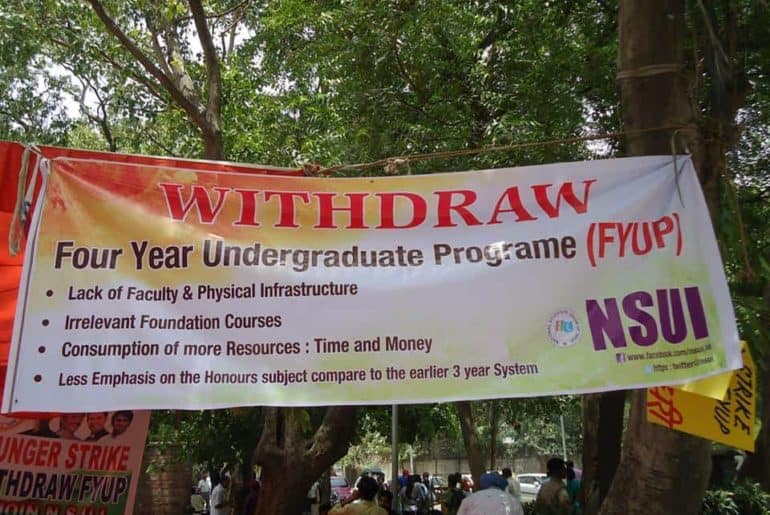
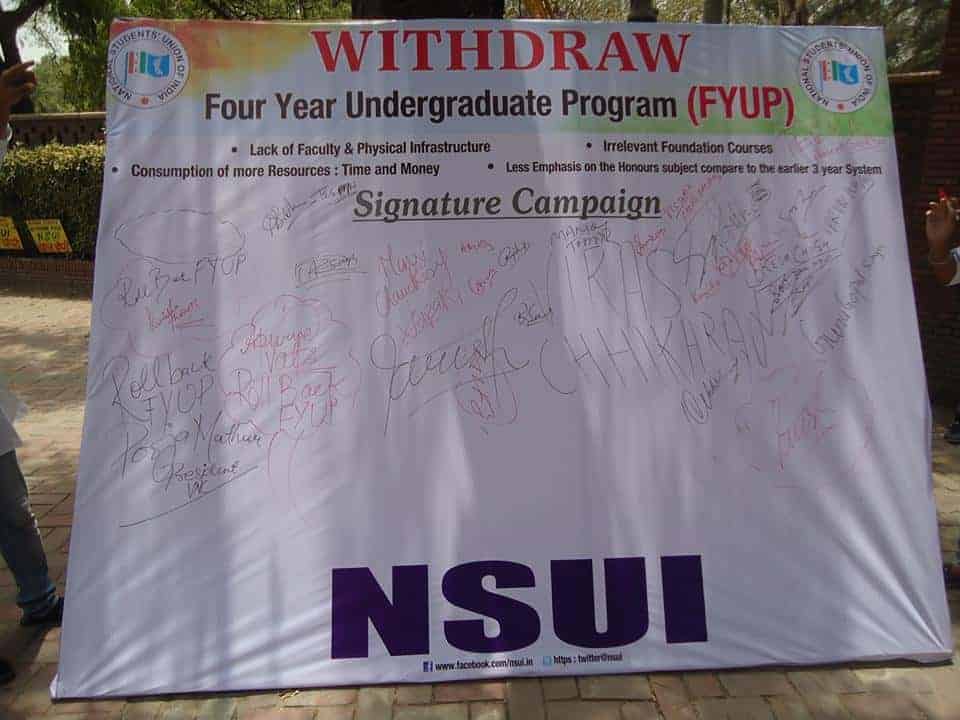 Congress’ student wing – N.S.U.I. musters support against F.Y.U.P. by means of signature campaign at North Campus, D.U.[/caption]
Sunny Kumar, State Secretary for Delhi, AISA in response to the same question, said that “It is high time the focus shifts to students’ issues from muscle-and-money politics. Therefore it’s not just the question of NSUI – every party has to raise students’ issues to survive. NSUI has now realized that the rage against F.Y.U.P. is not something they can tame and hence they oppose it now.” Calling ABVP, a passive opposition, Kumar said that any action against FYUP by the central government cannot imply that the party has done any ‘concrete work in the same direction’.
In their defense, Amrish Ranjan Pandey, NSUI national spokesperson, told IANS that, “It was something new last year, so we neither supported nor protested against the structure, but now after a year, we conducted a survey and have found that it is not good academically and students are not happy with it”.
Nonetheless, the coming together of all the parties is a clear sign that the students and teachers of DU unanimously agree that FYUP is not something they want and should indeed be rolled back.
]]>
Congress’ student wing – N.S.U.I. musters support against F.Y.U.P. by means of signature campaign at North Campus, D.U.[/caption]
Sunny Kumar, State Secretary for Delhi, AISA in response to the same question, said that “It is high time the focus shifts to students’ issues from muscle-and-money politics. Therefore it’s not just the question of NSUI – every party has to raise students’ issues to survive. NSUI has now realized that the rage against F.Y.U.P. is not something they can tame and hence they oppose it now.” Calling ABVP, a passive opposition, Kumar said that any action against FYUP by the central government cannot imply that the party has done any ‘concrete work in the same direction’.
In their defense, Amrish Ranjan Pandey, NSUI national spokesperson, told IANS that, “It was something new last year, so we neither supported nor protested against the structure, but now after a year, we conducted a survey and have found that it is not good academically and students are not happy with it”.
Nonetheless, the coming together of all the parties is a clear sign that the students and teachers of DU unanimously agree that FYUP is not something they want and should indeed be rolled back.
]]>