
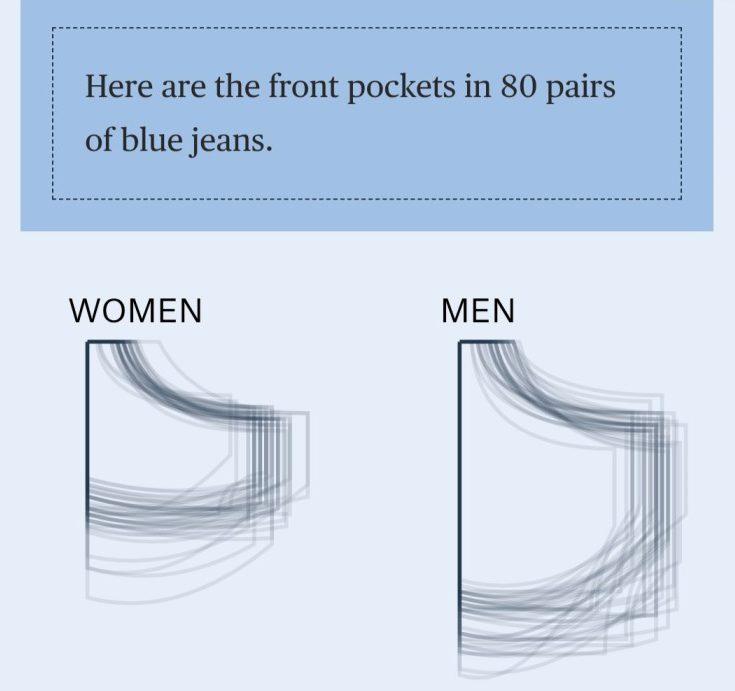
For “The Business Model Hiding in Your Jeans”: Women’s jeans pockets are 48% shorter than men’s, and it’s not a fashion afterthought. Here’s the economic logic that turned a design flaw into a billion-dollar industry.
A question to all the women reading this: Can most or even any of your pairs of jeans, trousers, or lowers fit a phone, keys, and your wallet in them?
Probably not…Because more often than not, men can fit a phone, wallet, keys, and probably even a small novel into their pockets, while women are stuck with pockets that feel less like pockets and more like decoration. And if you’ve ever wondered why, well, this is less of a coincidence and more of a deliberate design choice.
Back in 2018, data journalism outlet The Pudding measured the pockets of 80 pairs of 32-inch men’s and women’s blue jeans across 20 major brands. And here’s what they found: Women’s front pockets were, on average, 48% shorter and 6.5% narrower than men’s. Only 40% of women’s front pockets could fit a smartphone. And just 10% could fit a woman’s own hand.
But why is this so, and since when?
In medieval times, both men and women had “pockets” tied around the waist and hidden beneath their clothing. But in the 17th century, men’s jackets and pants were adorned with pockets sewn directly into the garment. Women, meanwhile, were still stuck with tie-on pouches strapped under their petticoats.
Toward the end of the 18th century, women’s fashion changed: waistlines crept up, silhouettes slimmed, and pockets shrunk, sometimes becoming nonexistent. Famed fashion designer Christian Dior further cemented the patriarchy of pockets in 1954, allegedly saying, “Men have pockets to keep things in; women, for decoration.”
As a consequence, the purse was born. Reticules, as they were called, were minuscule bags that women carried in their hands rather than on their hips. As the century ticked on, they became more elaborately decorated, and hence became a status symbol. And this was “the beginning of the end”
The beginning of the handbag industry, the end of choice….I mean pockets.
This consequence soon became a thriving cause, strong enough to keep the design as it is and the pockets well non-functional and petite. Just think about it. If our jeans can’t hold our phone, wallet, or keys, we need somewhere else to put them. And that creates space for an entirely different market to thrive… handbags.
Just to give you a sense of scale, the global handbag market was valued at roughly $86 billion in 2025. And this is not something that emerged in anonymity; a large chunk of it grew around the economics of manufactured need. There’s a well-known business strategy around this model called the razor-and-blades model: sell the base product cheap, then make your real money on a complementary product the customer has to keep buying. For example, Gillette sells cheap razors and expensive blades.
Pockets and handbags run on the same logic, with one twist. Nobody needs to lower the price of the jeans; they just need it to fail at a basic job. Which doesn’t lower the demand for jeans; people still need the jeans, right? What it does do, though, is generate demand for something else entirely, a bag to carry what the pocket won’t.
The more useful economic explanation is that once a design constraint creates a dependent market, there is no market incentive for the original manufacturer to fix it. A denim brand has no financial reason to give you a pocket that fits your phone; doing so doesn’t sell more jeans. The cost of the small pocket is anyway externalised; it’s paid by you, in the form of a bag you now have to carry.
So in an illogically-logical manner, this creates a pink tax of sorts. The well-known pattern where women pay more than men for near identical products. A US government study of 800 gender-specific products found personal care items priced 13% higher for women, accessories 7% higher, and clothing 8% higher, according to the World Economic Forum.
Economists have a formal name for this: third-degree price discrimination, where a seller charges different prices to different groups for essentially the same good, sorted by an attribute like gender rather than by production cost.
In this case, though, it is a little different; nobody per se is charging more for a woman’s pair of jeans; they’re just subtly removing a utility that should come with it, forcing women to spend twice, just to solve a problem that fabric simply solves for men. Towards the end, leading to men paying less than women for the same utility.
Now, you could argue that women simply “prefer” handbags. And sure, maybe we do now. But it’s funny how preference and necessity have a way of blending into each other when necessity is manufactured first.
Arshia Sharma
[email protected]
Read also: Beyond the Binary of Pink and Blue
Image credits: The Pudding




Comments are closed.