
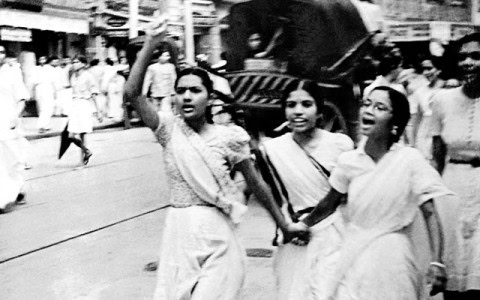
As we celebrate the 80th Independence Day of India’s gaining freedom from The Raj, it becomes important to remember those youth, too, whose names we seem to forget when counting the innumerable heroes who laid down their lives for the nation that now is—India.
It is time to celebrate the 80th anniversary of a moment that comes but rarely in history—the day India freed herself from decades of British rule. But it is worth noting that the names we hear every day associated with this historic day were certainly not the only ones behind it. Long before Delhi University or Jawaharlal Nehru University became spaces synonymous with protests, Indian students were already doing so. They were walking out of classrooms and going to jail before most could vote. Universities were not the inventors of the culture of student protests, but rather its inheritors. That culture was built decades earlier by students whose names rarely make it past a footnote in history books.
University of Delhi itself was born inside this tradition. When the University of Delhi was formally established in 1922, its founding colleges—Hindu College, St. Stephen’s, and Ramjas—were already deeply entangled in nationalist politics. Hindu College had been a hub for Swadeshi and Quit India activity, with figures such as Lala Har Dayal among those associated with its early history. A group of Ramjas students were jailed during Quit India, their names reportedly inscribed on a plaque near the college auditorium. St. Stephen’s counted freedom fighters like Asaf Ali among its alumni, and its principal corresponded directly with Gandhi.
When Bengal was partitioned in 1905, the British responded with the Carlyle Circular, which threatened to cut off government grants to institutions whose students joined the agitation against Partition of Bengal. But the students walked out anyway—students walked out and built new institutions themselves: the Bengal National College, with Aurobindo Ghosh as principal, and the National Council of Education, established in 1906 to run schools free of British control. This was arguably the first time Indian students demonstrated that they could build alternative institutions rather than simply protest within existing ones.
Non-Cooperation Movement (1920)
Mahatma Gandhi launched the Non-Cooperation Movement in 1920, appealing specifically to students over sixteen to leave government-aided schools and colleges. An estimated 90,000 students across India responded, enrolling instead in roughly 800 newly formed national institutions. This is also how several Delhi institutions came into being: Jamia Millia Islamia was founded in October 1920 after a group of nationalist teachers and 300 students walked out of Aligarh Muslim University’s MAO College, rejecting its pro-British character. Dr Zakir Hussain, later President of India, was among them. In Bengal, Subhas Chandra Bose gave up a secured position in the Indian Civil Service to become principal of Calcutta National College.
Civil Disobedience Movement (1930)
By the time of the Salt Satyagraha, colonial administrators had learned to see students as a genuine threat. In Assam, the British issued the Cunningham Circular, forcing students to sign loyalty pledges to the Raj. This order, however, backfired almost immediately for them, triggering mass protests and picketing inside schools across the province. Students also took part directly in salt-law defiance, picketing, and the boycott of foreign cloth alongside peasants and women who, for the first time on a mass scale, joined the movement in large numbers.
Quit India Movement (1942)
It was in 1942 that the role of students became particularly prominent via the Quit India Movement. With most senior Congress leaders arrested within twenty-four hours of Gandhi’s “Do or Die” call, students took charge. In Ballia, Uttar Pradesh, college students shut down their institutions and organised a complete market shutdown by mid-August, briefly losing the British administration’s control of the district. In Cuttack, 200 students stormed their college on 14 August, burning government records and setting up an underground bulletin network called the Secret New Service. At Banaras Hindu University, students raised slogans calling for police stations to be burnt and railway stations to be torched, spreading the movement’s message to surrounding villages.
Among these students, perhaps the most striking example is Usha Mehta; not a leader in any formal sense, but a 22-year-old master’s student at Bombay’s Wilson College. Days after Gandhi’s arrest, she set up a clandestine radio transmitter, Azad Radio, also known as Congress Radio, broadcasting nationalist messages across India and, briefly, into Japanese-occupied Burma. She ran it not as a trained revolutionary but as a student who refused to let the British monopolise the airwaves.
The most frequently remembered names from the freedom struggle are those of men and adults. But some of its youngest, least-resourced participants were teenage girls with no institutional backing at all. Kanaklata Barua, a 17-year-old in Assam, was shot dead by police in 1942 while leading a procession to hoist the national flag at a police station. In Chittagong, Pritilata Waddedar and Kalpana Dutt, both students, trained in combat and helped plan an armed raid on a British-only club in 1932. Waddedar died by suicide rather than be captured; Dutt was arrested the following year and sentenced to life imprisonment while still in her twenties.
By 1936, the scattered energy had coalesced into a formal organisation. The All India Students’ Federation, founded in Lucknow, became India’s first nationwide student organisation, a sign that students were building their own political infrastructure.
Then came the eve of 15 August 1947, when students who had spent their college years in and out of jail cells inherited a country whose borders were being redrawn in blood through Partition. But it is important to note, lest we forget—India’s student movements didn’t end in 1947; student protest culture descends directly from this lineage of asking questions, debating, dissenting, and demanding what’s theirs.
Image Source: Enroute Indian History
Also Read: The Game Theory of Dirty Dishes and Nuclear War
Sheetal Mishra

Comments are closed.