Prof. Rama Sharma takes charge as DSJ Director as students continue their indefinite protest demanding transparency and accountability
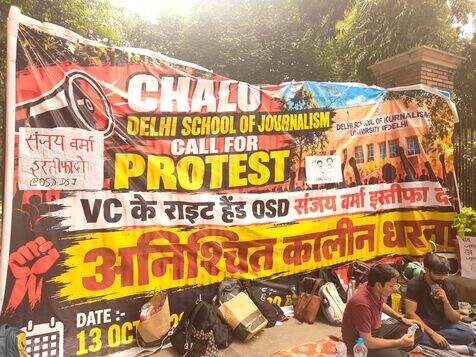
On 15 October, the University of Delhi appointed Professor Rama Sharma, Principal of Hansraj College, as the Director of the Delhi School of Journalism (DSJ) with immediate effect until further orders, in addition to her existing duties. The appointment comes amid an indefinite protest by DSJ students demanding the resignation of the now-former director of DSJ, OSD Sanjay Verma, and greater transparency in the enquiry process initiated by the DU administration.
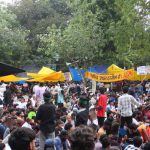
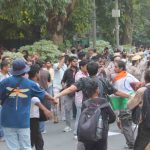
Following the protest held at the Delhi School of Journalism (DSJ) on 8 October, students claim that they had been assured of a concrete decision and corrective intervention by 12 October. However, amid the administration’s failure to deliver on this assurance by the stipulated date, students began an indefinite protest outside Gate No. 4 of the Arts Faculty at Delhi University’s North Campus.
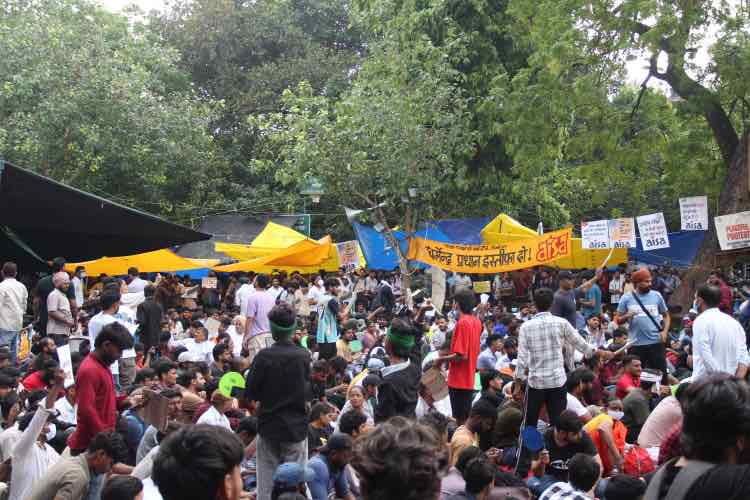
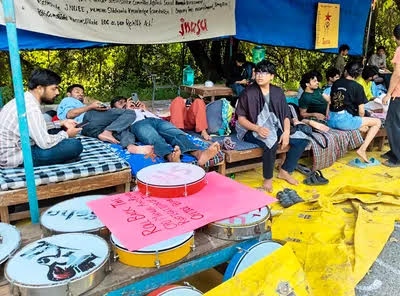
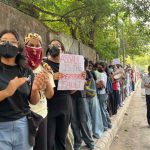
The protest began with spirited echoes of songs and slogans, and culminated in a peaceful demonstration outside the Arts Faculty by the end of the day. Students set up mattresses and other essentials at the site.
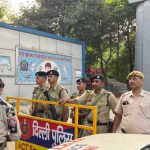
Twenty-four hours into the protest, police barricaded the area as students continued to express dissent.
When asked about their plan of action beyond the ongoing protest, a student representative said that they remained resolute in their demands and would continue to dissent until their concerns were heard and discussions initiated with the administration. While expressing disappointment with the DU administration, the representative maintained that the students would continue to place their faith in the institution, while expecting greater transparency and accountability in the process.
Delhi’s autumn protests, from DU women’s safety marches to the ‘Cockroach’ movement, were called scattered, unserious and futile. But the actual question is whether an ‘ideal protest’ really exists, or if the question itself is flawed.
Protest is one of the biggest elements of the Spirit of Democracy, and this concept is not alien to our land, be it the British era or the Indira era. And naturally, protests follow every government. But in the end, every protest in India eventually meets the same three questions. Why was it so scattered? What did it actually stand for? And what exactly has changed?
In September and then early October this year, protests in Delhi got all three: They were called unserious, disjointed, ideologically vague and, because no minister resigned the next morning, pointless. It is a tidy verdict.
But at the same time, it is also built on quite an assumption: there is an “Ideal Protest” somewhere out there, organised, focused and victorious, against which the real ones fall short. Almost utopian. But before looking at what happened, it is worth asking whether that benchmark exists at all.
Outcomes are harder to pin down. Three days after the march, the Supreme Court took suo motu cognisance of a series of rape and sexual assault cases across Delhi-NCR, saying they underlined a systematic failure by authorities. Nothing in the coverage links the two events, and it would be dishonest to claim one caused the other. But the timing shows the issue had reached the highest court within a week. The charter’s final text and any official response were not reported in the coverage I reviewed, so that part of the story is still open.
Here the “disjointed” charge has more bite, because the coalition is wide. Starting October 2, AISA led protests on the streets of Delhi. On 4 October, AISA’s national president Neha Bora was detained near Ashoka Road as marchers tried to reach Jantar Mantar without police permission. Days later, the INDIA bloc held its own protest at Rajghat. Student groups, party workers and a national opposition do not share a single script. Whether that is incoherence or simply what a coalition looks like is the question.
Scenes from the 4th October Protest (Credits: Mananya for DU Beat)
The state’s response is itself evidence. Ahead of the 10 October protests, Amnesty International India criticised the “lockdown-like” restrictions, including planned Metro closures, sealed borders, and thousands of additional armed personnel. Nobody deploys that much machinery against a protest they consider irrelevant.
CJP Protests at Jantar Mantar Over NEET Cancellation (Credits: Mananya for DU Beat)
But the jokes were a delivery system, not the demand. Foreign Policy reports that the movement mobilised through memes, Reels and humour, and one Delhi participant said social media made the protest feel like a conversation, not a lecture. The test of seriousness is the result, and reports that a movement that began as a call for education reform and grew into a broader protest over unemployment and accountability won its first major concession in July.
“Gen Z” is not one register, either. The DU marches ran on a different grammar: the Hum Auratein Azaad Hain banner, a rhyming chant about breaking apart the society that keeps women bound, open consultations and a charter. Students of the same age used satire in one protest and earnest verse in another, so tarring both as “unserious” lumps together two different strategies.
The 10 October protest at Jantar Mantar was blunted before it began, and the way it was blunted is the story. The CJP’s founder had called it “Season 2”. Delhi Police refused permission, saying the application arrived on 7 October against a 10-day notice requirement and pointing to alleged violations at an earlier protest. The city was then locked down with about 25,000 police and paramilitary personnel, a notice of closure of 57 metro stations, which, after the Apex Court’s intervention, was later reduced to 45 Metro stations, and several trains were cancelled.
Protesting crowd at Jantar Mantar on 4th October (Credits: Aaratrika for DU Beat)
On Sunday, a court released Dipke and the two others on condition of no breach of peace for a year, and with central Delhi sealed, turnout stayed small and people who started slogans were detained. By crowd size, the BJP has a point. By every other measure it doesn’t: a party that began as a joke took a 25,000-strong deployment to contain and put four former chief ministers behind the same barricades. It also exposed the weak point of an online-first, leader-centred movement. Detain the leaders, seal the venue, and the street goes quiet. The CJP itself called the arrests an attempt to cripple its leadership.
A Domino Reaction
Read as separate events, these protests might look scattered. Read in order, they look like a chain reaction. An important point to note is that after the first CJP protests, multiple small protests also took place at the Jantar Mantar, with each one lowering the cost of the next. That is an interpretation, not a documented fact, and the sequence below is where it has to hold up.
Jantar Mantar is sealed; opposition and CJP leaders are detained
Now, an important question—What links?
First, precedent. Noted that the government has rarely yielded to sustained public pressure, with the 2021 farm-law withdrawal the notable exception. The July resignation showed young protesters that a street campaign can extract a concession, and every later protest inherits that proof.
Second, the shared grievance: exam leaks, public space, and the electoral rolls are different issues carrying the same message: that institutions are not answering this generation.
Third, the state’s response. Heavy-handed policing, which Amnesty called lockdown-like, turns each crackdown into a reason for the next protest, and it draws in the opposition parties that now stand beside the students.
The limits matter. Nothing in the coverage reviewed for this piece shows the women’s-safety marches feeding into the CEC protests, and the Supreme Court’s notice doesn’t appear to respond to the marchers. The honest picture is closer to neighbouring fires fed by the same dry grass than to one line of dominoes. That still makes spillover a useful way to measure a protest, as the next section argues.
Ways to count scores of Protests
If “did it win?” is the only question, nearly every protest fails on the day. A fairer scorecard has more columns:
Concrete outcomes: were demands met, whether a policy change or a resignation?
Agenda-setting: did the issue enter public debate and the courts, and stay there?
Infrastructure: did it leave behind charters, coalitions or networks that can act again?
Participant formation: did it politicise the people who showed up? A first-year at her first march is an outcome too.
State response: what do bans, barricades and detentions reveal about how the protest was perceived?
Time horizon: judged after a week, a year, or a decade?
Spillover: did it make the next protest easier to start, for the same people or for others?
By these measures, the DU marches score well on agenda-setting, infrastructure, and formation, and are unproven on outcomes. The CJP protests score high on state response and agenda-setting, and it is too early to say on the rest. Neither is a failure. Both are mid-sentence.
Can there be ideal protests?
Short answer: NO! Because the virtues contradict each other. A tightly led protest is easy to message but at the same time easy to decapitate. A leaderless one is resilient enough but might be hard to negotiate with. A narrow demand might be achieved or fulfilled with easier efforts, while a broad one has the potential to change a country. Disruption gets attention but can lose public sympathy, and politeness does the reverse. Humour travels furthest and is the easiest to dismiss, while solemnity is taken seriously and reaches fewer people. In order for a protest to maximize one of these, the only way is by sacrificing another.
That is why “ideal” is the wrong word. A better question is whether a protest fits its purpose. A march meant to put an issue on the agenda and start a charter did its job if the issue got on the agenda and the charter got started. A campaign meant to force a resignation has to be judged on whether the resignation happens, and sometimes it does, after two long months.
The perfect protest is a retrospective fiction, tidied up by history in writing once the mess has been long gone to be witnessed by the readers. The real ones are loud, plural and unfinished. The honest critique is not that they failed to be perfect, but a more specific question: what were they trying to do, and can we see it working?
The Students’ Union of JNU has sat on an indefinite strike as it demands immediate reforms in infrastructure and hostel facilities, restoration of the JNUEE exam, alongside raising allegations of admission irregularities and unjust rustication of office-bearers.
Jawaharlal Nehru University Students’ Union (JNUSU) office-bearers and 14 other students have been sitting on an indefinite hunger strike since 3 October 2026, demanding that rustication orders against office-bearers be addressed, along with deteriorating university and hostel infrastructure, students’ rights and social justice.
JNUSU President Aditi, Vice-President Gopika and General Secretary Sunil are among the students currently observing the hunger strike.
The office-bearers have been rusticated for several months following protests earlier this month, and the union has opposed this disciplinary action, arguing for reinstatement. They have also called for a review of the Chief Proctor Office (CPO) Manual, as it has been alleged that its provisions negatively affect students’ rights and their participation in campus affairs.
For their infrastructure demands, JNUSU has demanded a fundamental overhaul of basic facilities, including renovation and upgradation of hostels, expansion of library seating, and lifts, especially in Kaveri, Periyar, and Godavari hostels. The students have also raised a demand for the repair of campus roads and gender-neutral washrooms in the Health Centre, accompanied by functional mess and Wi-Fi facilities in Barak Hostel.
The students have also raised a demand for the reinstatement of the Gender Sensitization Committee Against Sexual Harassment (GCASH), restoration of the JNU Entrance Exam (JNUEE), and reform of the Equal Opportunity Cell (EOC) in accordance with the principles of the Rohith Act. Alongside this, the union is also demanding an independent inquiry into a recruitment scam through the Internal Quality Assurance Cell (IQAC), an increase in MCM scholarships, provision of hostel accommodation for PhD students until the submission of their thesis, reservation norms in hostel allotment and their enforcement, along with student representation in university councils and committees.
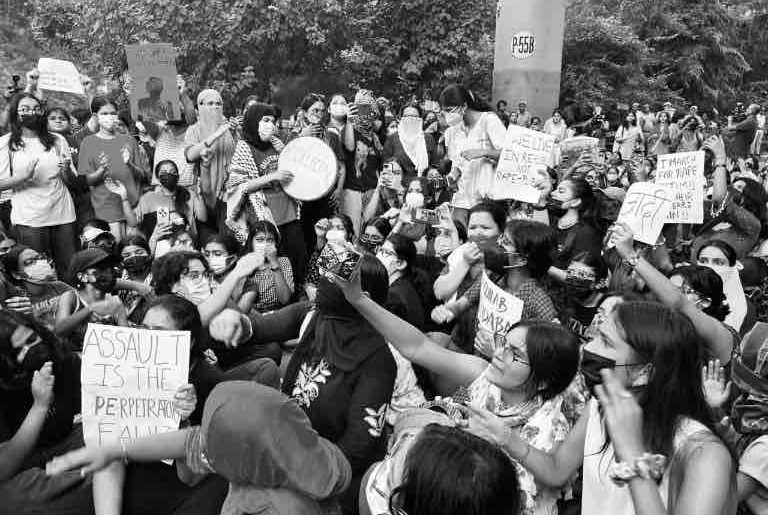
The back gate area of Lady Shri Ram College For Women, DU, bustled with slogans of “Azaadi” on the evening of 23rd September, with hundreds of women joining the solidarity march that was organised to raise concerns about women’s safety following the alleged gang rape of a 17-year-old minor near Aastha Kunj earlier this week.
Around 4PM, on the evening of 23rd September, hundreds of women students from various DU colleges like LSR and Gargi gathered at National Park, near the back gate of Lady Shri Ram College For Women, DU, to lead a solidarity march, raising their voices about concerns of women’s safety in the national capital of the country, especially in and around Delhi University colleges.
Despite several media channels portraying this as a solidarity march organised and participated in only by LSR students, several students present at the march have denied such claims.
“To clarify, this is not an LSR issue; this is an all-women, all-DU issue,” says a student present at the march. “When a curfew is established, it only stops women from going out; it doesn’t hinder the men from committing heinous crimes, like rape,” she further states.
Female students and faculty members from across DU Colleges join the solidarity march
The march was joined in by hundreds of women from multiple DU colleges, making it successful in raising collective concerns about inadequate CCTV surveillance and patrolling in the area, as students state that security concerns had persisted long before the recent incident. Demanding the same, chants of “Azaadi” and “Inquilab Zindabaad” filled the premises of National Park and Moolchand.
Police cars, along with abundant police forces, covered the entire area, ensuring the march remained peaceful and didn’t turn into a public disruption. However, these same police forces were also seen to stop for deliberations and negotiations with the student body regarding which path the march should take or till where they should be allowed to move forward. Despite this, the march did not come to a halt for once.
Police manned with guns observed patrolling the solidarity march
This all-women’s march saw students raising slogans and carrying posters highlighting the need for better security infrastructure around the college and its adjoining areas, as yet another rape incident brought the longstanding demand for women’s safety into focus. The posters that were carried by the students highlighted slogans like, “Moral policing women will not stop rape” and “A woman’s body isn’t a battleground for your power.”
This march is an attempt to reclaim the spaces that are overpowered by men and patriarchal people who have normalised violence against women,”
says a faculty member from LSR who also actively took part in the march.
The march, upon reaching the Pink Booth, which was inaugurated earlier this year in hopes of securing safety for women travelling by the roads nearby leading to Moolchand Metro Station, was met with a long-lasting discussion going back and forth between a few people from the march and the police forces. The spirit of the march was intact, however, as most of the students were seen to sit down, continuing with their loud, energetic chants.
The Pink Booth, though established to make women feel safer, has received heavy scrutiny from students of nearby colleges, especially LSR, ever since its establishment. The concern of the booth being mostly empty has remained a recurring complaint.
The solidarity march however, wasn’t limited just to the students of the nearby colleges. Student organisations like SFI and AISA also joined the march, while parties like ABVP were spotted at the Amar Colony Police Station spreading pamphlets to the police in an attempt to spread awareness.
Line of students spotted demanding basic security and raising concern for women’s safety
This inciting incident comes within days of sexual violence in Bihar’s Jamui district, where two juveniles were hounded by a group of masked men who tried to abduct and molest the girl on camera. NCRB data shows increasing incidents of violence against women, with a crime reported every 71 seconds.
Less than a third of cases reported result in convictions. Despite claims of “Encounter Justice” by many Chief Ministers from the BJP, including Adityanath (UP), Hemanta (Assam), Samrat Chaudhary (Bihar) and Suvendhu Adhikari (WB)—the police being ordered to shoot perpetrators before proving their guilt in courts—the rising numbers show that this has not stopped crimes against women. In fact, the majority of reported crimes are by people known to the survivor. The current regime has also famously celebrated powerful men involved in sexual violence, from Brijbhushan Singh to rapists at Kathua – Unnao – Hathras and IIT BHU, even garlanding Bilkis Bano’s rapists.
The institutional shortcomings are starkly evident in the recurring campus violence and administrative failures in DU. The reinstatement of a professor found guilty of sexual harassment at Ramjas College in 2025, the routine normalization of sexual harassment during college fests at women’s colleges, systemic harassment allegations at Bharati College in 2018, and the aggressive hooliganism and harassment targeting women during DUSU elections reiterate how unsafe university spaces remain for women and gender minorities.
As one of the posters said, “It’s not my fault I crave the night air; it’s your fault you crave taking it away from me.”
This march is not new, nor are the crimes against women. Today, the students of a central university do not feel safe around their own campus; tomorrow, we will hear headlines talking about another case where women do not feel safe inside the four walls of their own house. The perpetual oppression and violence against women have been continuing for centuries, yet the system fails them time and again, compelling them to take to the streets and reclaim spaces that were never supposed to be bound by any ownership.
As we celebrate the 80th Independence Day of India’s gaining freedom from The Raj, it becomes important to remember those youth, too, whose names we seem to forget when counting the innumerable heroes who laid down their lives for the nation that now is—India.
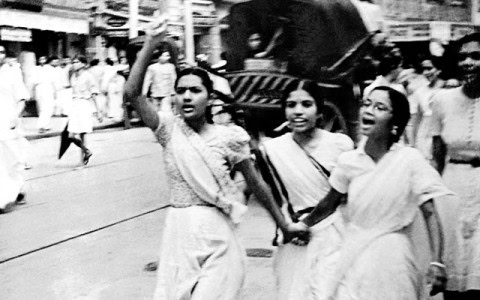
It is time to celebrate the 80th anniversary of a moment that comes but rarely in history—the day India freed herself from decades of British rule. But it is worth noting that the names we hear every day associated with this historic day were certainly not the only ones behind it. Long before Delhi University or Jawaharlal Nehru University became spaces synonymous with protests, Indian students were already doing so. They were walking out of classrooms and going to jail before most could vote. Universities were not the inventors of the culture of student protests, but rather its inheritors. That culture was built decades earlier by students whose names rarely make it past a footnote in history books.
University of Delhi itself was born inside this tradition. When the University of Delhi was formally established in 1922, its founding colleges—Hindu College, St. Stephen’s, and Ramjas—were already deeply entangled in nationalist politics. Hindu College had been a hub for Swadeshi and Quit India activity, with figures such as Lala Har Dayal among those associated with its early history. A group of Ramjas students were jailed during Quit India, their names reportedly inscribed on a plaque near the college auditorium. St. Stephen’s counted freedom fighters like Asaf Ali among its alumni, and its principal corresponded directly with Gandhi.
When Bengal was partitioned in 1905, the British responded with the Carlyle Circular, which threatened to cut off government grants to institutions whose students joined the agitation against Partition of Bengal. But the students walked out anyway—students walked out and built new institutions themselves: the Bengal National College, with Aurobindo Ghosh as principal, and the National Council of Education, established in 1906 to run schools free of British control. This was arguably the first time Indian students demonstrated that they could build alternative institutions rather than simply protest within existing ones.
Non-Cooperation Movement (1920)
Mahatma Gandhi launched the Non-Cooperation Movement in 1920, appealing specifically to students over sixteen to leave government-aided schools and colleges. An estimated 90,000 students across India responded, enrolling instead in roughly 800 newly formed national institutions. This is also how several Delhi institutions came into being: Jamia Millia Islamia was founded in October 1920 after a group of nationalist teachers and 300 students walked out of Aligarh Muslim University’s MAO College, rejecting its pro-British character. Dr Zakir Hussain, later President of India, was among them. In Bengal, Subhas Chandra Bose gave up a secured position in the Indian Civil Service to become principal of Calcutta National College.
Civil Disobedience Movement (1930)
By the time of the Salt Satyagraha, colonial administrators had learned to see students as a genuine threat. In Assam, the British issued the Cunningham Circular, forcing students to sign loyalty pledges to the Raj. This order, however, backfired almost immediately for them, triggering mass protests and picketing inside schools across the province. Students also took part directly in salt-law defiance, picketing, and the boycott of foreign cloth alongside peasants and women who, for the first time on a mass scale, joined the movement in large numbers.
Quit India Movement (1942)
It was in 1942 that the role of students became particularly prominent via the Quit India Movement. With most senior Congress leaders arrested within twenty-four hours of Gandhi’s “Do or Die” call, students took charge. In Ballia, Uttar Pradesh, college students shut down their institutions and organised a complete market shutdown by mid-August, briefly losing the British administration’s control of the district. In Cuttack, 200 students stormed their college on 14 August, burning government records and setting up an underground bulletin network called the Secret New Service. At Banaras Hindu University, students raised slogans calling for police stations to be burnt and railway stations to be torched, spreading the movement’s message to surrounding villages.
Among these students, perhaps the most striking example is Usha Mehta; not a leader in any formal sense, but a 22-year-old master’s student at Bombay’s Wilson College. Days after Gandhi’s arrest, she set up a clandestine radio transmitter, Azad Radio, also known as Congress Radio, broadcasting nationalist messages across India and, briefly, into Japanese-occupied Burma. She ran it not as a trained revolutionary but as a student who refused to let the British monopolise the airwaves.
The most frequently remembered names from the freedom struggle are those of men and adults. But some of its youngest, least-resourced participants were teenage girls with no institutional backing at all. Kanaklata Barua, a 17-year-old in Assam, was shot dead by police in 1942 while leading a procession to hoist the national flag at a police station. In Chittagong, Pritilata Waddedar and Kalpana Dutt, both students, trained in combat and helped plan an armed raid on a British-only club in 1932. Waddedar died by suicide rather than be captured; Dutt was arrested the following year and sentenced to life imprisonment while still in her twenties.
By 1936, the scattered energy had coalesced into a formal organisation. The All India Students’ Federation, founded in Lucknow, became India’s first nationwide student organisation, a sign that students were building their own political infrastructure.
Then came the eve of 15 August 1947, when students who had spent their college years in and out of jail cells inherited a country whose borders were being redrawn in blood through Partition. But it is important to note, lest we forget—India’s student movements didn’t end in 1947; student protest culture descends directly from this lineage of asking questions, debating, dissenting, and demanding what’s theirs. Image Source: Enroute Indian History
Two Delhi University students remain hospitalised after the July 20 Jantar Mantar protest, as eyewitness accounts and medical findings draw attention to the injuries sustained.
Days after Delhi Police baton-charged thousands of demonstrators marching towards Parliament as part of the Cockroach Janta Party’s “Chalo Sansad” march, at least two Delhi University students remain hospitalised with serious injuries, raising questions about the extent of force used to disperse the July 20 protest. While Delhi Police have consistently denied using pellet guns, multiple eyewitnesses and medical reports have disputed that claim.
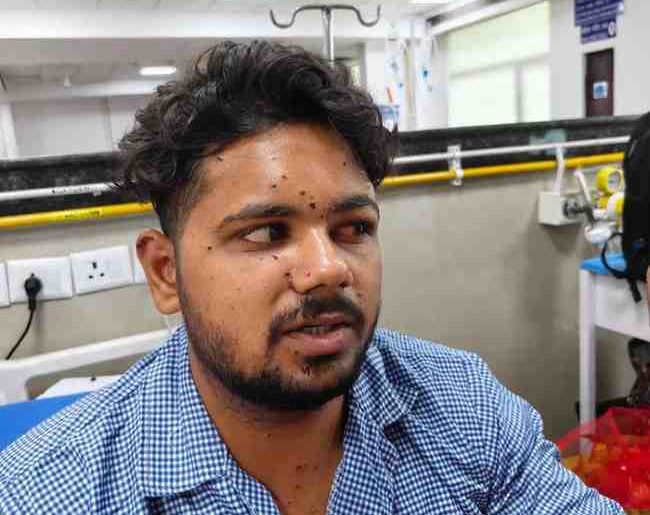
Sahil Lochab, a Delhi University School of Open Learning student preparing for the SSC Combined Graduate Level examination, may lose vision in his right eye after what his family alleges was a pellet gun injury sustained during the march. Lochab underwent surgeries at Lady Hardinge Medical College and Safdarjung Hospital before being shifted to the AIIMS Trauma Centre, where doctors reportedly removed a pellet lodged in his eye that had caused a corneal perforation, along with others from his lung and the tissue surrounding his heart. His family was initially told there was only a one per cent chance of his sight returning. Doctors have since said his prognosis remains “guarded”, meaning the likelihood of vision recovery remains uncertain.
Twenty-one-year-old Sakshi, also a Delhi University student, was caught in a crowd crush near Jantar Mantar after police allegedly pushed demonstrators into an already congested area following the use of tear gas, according to protesters. She was carried unconscious to a police vehicle after demonstrators alleged officers at the scene were reluctant to transport her to hospital. Admitted to the intensive care unit (ICU) at Ram Manohar Lohia (RML) Hospital and placed on ventilator support, she was extubated on July 23 after hospital authorities said her condition had shown “steady improvement”. They added that she was conscious, breathing independently, and that MRI scans of her brain and spine were normal.
Protesters on July 20 have described police charging at people who were simply filling water from a cooler, triggering a stampede. One eyewitness who was present when Sakshi was found unconscious, said her face had turned blue and that she was bleeding near one ear. Bystanders, guided by others in the crowd, attempted cardiopulmonary resuscitation (CPR) and, when that appeared unsuccessful, administered mouth-to-mouth resuscitation. The witness also alleged that protesters restrained a police officer whom they believed was responsible for her injuries, and described difficulties in locating an ambulance before she was eventually taken to hospital in a police vehicle.
Delhi Police have said around 60 protesters and 118 police personnel were injured in the clashes. They also reported that more than 20 police vehicles were damaged and that 70 protesters were detained. Officers, including Head Constable Balram, Inspector Nand Kishore Singh, ACP Vivek Bhagat, and Head Constable Babu Lal, alleged they were separated from their units and assaulted by crowds.
Delhi Police have repeatedly and categorically denied using pellet guns during the protest, stating the force neither possesses nor uses them and warning against circulating “false and misleading” information. However, medico-legal case (MLC) reports for at least three injured protesters, including Lochab, 25-year-old Sheikh Irshad Mansoori, and a 28-year-old Outlook journalist, reportedly describe “suspected gunshot injury” or “pellet injury marks”, and hospital sources have said the pellets recovered were metallic rather than plastic or rubber. Pellet guns and shock batons form part of the Rapid Action Force’s (RAF) riot-control equipment. However, no official evidence has conclusively established whether pellet guns were fired during the protest.
Leader of the Opposition Rahul Gandhi, speaking to reporters in Parliament, accused the government of suppressing students’ voices and said the police action against them was “completely wrong,” renewing the Opposition’s demand for Prime Minister Narendra Modi to apologise and for Education Minister Dharmendra Pradhan to resign.
Delhi University’s FYUP fourth year may not continue across all colleges after low student participation prompted principals to propose alternative implementation models for the research-based programme.
Delhi University’s optional fourth year under the Four-Year Undergraduate Programme (FYUP) may no longer be offered across all affiliated colleges after low student participation raised concerns over the programme’s practical implementation.
According to reports, the Delhi University Principals’ Association (DUPA) has proposed that the fourth year be conducted only at designated colleges instead of every institution. The recommendation comes after only around 30% of eligible undergraduate students opted to continue into the fourth year during the previous academic session, leaving several colleges with very small batches that are difficult to accommodate academically and administratively.
In conversation with Times Of India, Delhi University Registrar Vikas Gupta commented that the University is positively considering the recommendation, adding that resources must be deployed judiciously where student strength is low. According to him, the final decision will be taken after the University receives complete enrolment data from colleges.
Introduced under the National Education Policy (NEP) 2020, the fourth year forms part of Delhi University’s Undergraduate Curriculum Framework (UGCF) 2022. Students who complete the additional year with a research dissertation are awarded an Honours with Research degree, intended to strengthen research opportunities and provide a pathway to doctoral studies. More information on the UGCF can be accessed on Delhi University’s official website.
College administrations have cited multiple challenges in implementing the programme with limited enrolment. Running specialised research courses for small groups requires adequate infrastructure, faculty members qualified to supervise dissertations, and sufficient academic resources. In many cases, these requirements become difficult to meet when only a handful of students remain in a department.
Gupta also clarified that if the proposal is implemented, students whose colleges are not designated to offer the fourth year would not have to formally migrate. Instead, they would attend classes at the identified cluster college offering the programme.
Student preferences have also contributed to the low participation. Many choose to graduate after three years to prepare for competitive examinations or pursue postgraduate studies elsewhere.
To address these concerns, principals have suggested a cluster-based model in which selected colleges would host fourth-year classes for students from multiple institutions. They have also proposed introducing minimum eligibility criteria to ensure that the research component remains academically rigorous. The proposal is yet to receive formal approval from the University. If implemented, it could significantly change how the fourth year of FYUP is offered across Delhi University’s affiliated colleges.
While protests at LSR continue for the removal of the Principal’s video featured on BJP’s official Instagram page, debates spark on institutional identity, political freedom, and the student’s right to dissent.
After the protests staged at LSR on the 15th of April over the Principal’s video on Nari Shakti Vandan Adhiniyam being featured on the official Instagram page of the Bharatiya Janata Party came to an inconclusive end, the Principal, Dr. Kanika K. Ahuja issued an official statement to The Indian Express. She stated,
The views were shared in the video in an individual capacity. While I hold the office of the Principal, it is important to distinguish between personal intellectual engagement with a social subject and a formal institutional communique.”
Addressing the college’s reiterated commitment to maintaining the ‘apolitical’ stance, she said, “The college’s commitment to an apolitical environment refers to an absence of partisan affiliation not a detachment from critical social discourse.” She further addressed the alleged “saffronisation” on campus through selectively inviting speakers by adding,
The selection of speakers and the organisation of events are decentralised processes at LSR. These decisions are primarily driven by the respective student societies in consultation with their faculty advisors.”
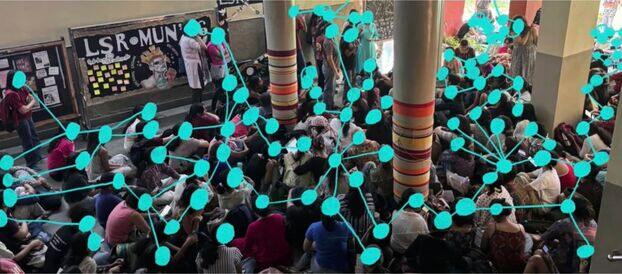
These clarifications come in the wake of the student-led protest held on campus where students across departments and years organised sit-ins at the lower foyer—the immediate area outside the auditorium, adjacent to the Principal’s Office—along with the adjoining corridors, staircases, and outdoor spaces to raise concerns regarding the circulation of this video, which they believed to be in direct opposition to the college’s stated ‘apolitical’ stance that has been reiterated to close down exhibitions, refuse approval of speakers, and hinder free political expression on campus.
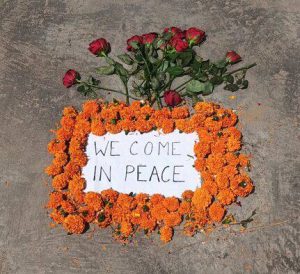
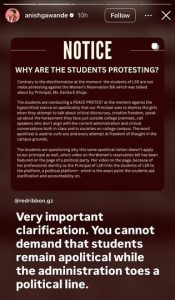
In a clarification issued by the students through a statement they refute accusations of being against the Women’s Reservation Bill. The statement published through an anonymous Instagram account reads, “Contrary to the disinformation at the moment—the students of LSR are not mobs protesting against the Women’s Reservation Bill which was talked about by Principal, Ms. Kanika K. Ahuja. The students are conducting a PEACE PROTEST at the moment against the hypocritical stance on apoliticality that our Principal uses to dismiss the girls when they attempt to talk about critical discourses, creative freedom…”. To the students of LSR who stress on their protest as peaceful—one that they reasserted with a floral arrangement reading “We Come in Peace” against the accusations of being a “mob” as asserted by a faculty member—their primary cause of dissent is the featuring of the Principal’s video where she is identified not in an individual capacity but as the Principal of Lady Shri Ram College on the official Instagram Page of BJP.
Image of the floral arranged shared by anonymous source.
While Ahuja reported to the Indian Express that, “I, staff advisors, faculty and others in the administration have remained in active dialogue with students to address campus concerns”, students report otherwise. During a brief interaction with students on the day of the protest, which multiple attendees reported as lasting less than fifteen minutes, Ahuja reportedly presented documents of communication and stated that the video was originally recorded for the Ministry of Women and Child Development but was uploaded by the BJP without her permission.
When asked if any actions had been taken to get the video removed, the students reported that no such action had been initiated, and that the Principal informed that gathering that she would “consider” sending an email for removal of the video. Similarly, on the second day of the sit-in, that is 16th April, she allegedly did not show up to the auditorium after her presence was requested by the protesting students, who complied with her initial request of an audience at the Auditorium instead of the Lower Foyer.
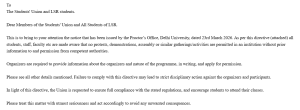
Following the protest on 15th April, which ended in the Principal walking-off in lieu of what she termed as “disrespect”, the administration of the college sent an email quoting a directive issued by the University of Delhi’s Proctor’s Office on March 23, 2026. The notice emphasised the need for prior approval from the concerned authorities for organising protests and demonstrations on the institution’s grounds. It further said that failing to comply with these requirements could result in disciplinary action, and asked students to follow the directive and continue attending classes.
Screenshot of Notification from LSR Administration.
Multiple students reported that the administration had been calling their guardians and parents to report their involvement in the protest, which they viewed as a clear violation of their rights. Additionally, the Students’ Union of Lady Shri Ram College of 2025-26 and 2026-27 issued a joint statement across liaison groups: they wrote,
We the Student Union of Lady Shri Ram College, wish to state unequivocally that we are not the organisers, convenors, or leaders of the protest currently taking place within the college premises…As elected representatives, our role is limited to facilitating communication and ensuring that the concerns of the students are conveyed appropriately to the relevant authorities.”
As news channels and social media pages continue a widespread reporting on the protest, the students of LSR involved in the sit-ins released a statement through the anonymous Instagram Page to “please represent the truth of our protest to the public so it doesn’t have the false narratives attached to it.” This request comes in light of multiple accounts on X accusing the protestors to be “Left-wing students (backed by terrorist org SFI) [who] not only made the Principal captive but also almost tried to lynch her and her daughter, just because she made a video supporting the women’s bill.”
Multiple such statements trying to relegate the protests to a political party have been actively refuted as the students’ demand remains the same—removal of the video, issuing a public clarification, avoiding external speakers on campus without proper background checks, ensuring all political engagements remain strictly non-partisan on campus, and ultimately reaffirming the institution’s commitment to secular and democratic values.
Multiple students have reported that during the first day of the protest, that is 15th March, a certain faculty member had been recording videos of the protesting students, many of whom were minors, without their consent. On informing the Principal regarding the same, including a case of alleged manhandling by the aforementioned Professor, the Principal reportedly stated that she would believe her colleague over the students in light of an adjacent incident which was brought up without the involved student’s consent. A deletion of such videos and photographs have been immediately demanded by the students, which the Principal reportedly agreed to.
Prominent public figures like Anish Gawande and Akhilesh Yadav have stepped up in support of the protesting students of Lady Shri Ram College; the former wrote on his Instagram story, “Very important clarification. You cannot demand that the students remain apolitical while the administration toes a political line.”
Screenshot of Anish Gawande’s Instagram Story
A student in conversation with DU Beat said,
We’re fighting to protect the ethos of our institution. What we’re seeing right now is a spread of convenient misinformation led by the principal, which is shaping a narrative against her own community, against her own students. That is unacceptable.”
This protest against the actions of Dr. Ahuja is however not the first incident of outrage by the student body of Lady Shri Ram College, but follows the sexist and Islamophobic comments passed by ex-diplomat Deepak Vohra in the presence of the Principal during an event organised within the college.
However, while the outrage continues, it is to be noted that while the online community of students supporting the protest remains at large numbers of 1000+ across multiple channels, on-campus limited students have actively engaged in the sit-ins. At the same time, student responses have been mixed; while a section of the students are concerned about institutional consistency and the larger implications of the Principal’s involvement on a particular party’s platform, others wholeheartedly welcome her stance. They emphasise an individual’s right to participate in public affairs, especially those involving women’s representation; a LinkedIn user from LSR writes,
“At the end of the day, she is not only our Principal but also an individual entitled to her own thoughts and opinions, just as each of us.”
On this, Principal Ahuja reported to Times Now, “Roughly 175 students participated in the protest out of around 4000 enrolled on campus. They do not represent the majority.” The separation of the personal from the political has at large remained the cause of support towards the Principal’s video, which claims to remain stationed only upon the Bill, and not upon the political party.
These recent developments across Delhi University and in particular within LSR, with respect to the conversations between the students and the administration during times of dissent, which remain inconclusive, point to a larger question of autonomy, authority, and hierarchy within college spaces, particularly on colleges that allege to be ‘apolitical’ but in practice remain otherwise. If to be or not to be [political] is the question, then the shaping of this incident, especially for a campus like LSR which has a long-standing history of intellectual inquiry, student engagement, and expression of free speech, shall determine the long-term implications of how college spaces are reconstructed, for both the students and the administrators.
After protesting and ultimately being granted permission for an artist at their college fest, Confluence 2026, Hansraj College witnessed a fight breaking out, creating chaos right before the artist’s performance began.
On 9th April, 2026, Hansraj College stepped into the final day of their fest, Confluence 2026, with an artist performance by singer Vilen marking the end of their 2-day celebration. However, right before the curtains drew to a close, a fight ensued, causing chaos, commotion, and the inevitable rumours of a larger catastrophe.
Spectators reported a brutal knife stabbing incident right before the artist’s performance began, with students of Hansraj College, and even outsiders, engaging in a fight with tables and chairs being thrown around. An unofficial students’ page of Delhi University alleged that the bricks used for construction in the renovation of the Gau Shalla were thrown around by the students, and one student’s head was injured as a result. However, the alleged stabbing incident has not been confirmed yet by any official reports.
Videos shared with the Editorial Team of DU Beat showcased individuals engaging in physical fights with one another, involving punching, kicking, and stomping on an unidentified individual near what has been identified as the C Block. Reportedly, the Art Society of Hansraj, Kalakriti, had to close down its stall as it was in the direct vicinity of the incident.
Similar fights were recorded where individuals were seen running out of the college hostel gates with one unidentified individual’s shirt being torn apart, tables being thrown at him, and ultimately, him being dragged out by a group of individuals.
A student from Jesus and Mary College attending the fest stated,
There was a fight but it was before Vilen came on stage. But the concert duration was only till 5 or 5:30 and they wrapped it up pretty quickly.”
Similarly, another student from Hansraj College added,
There was an unexpectedly large crowd at the event, which became difficult to manage, especially once the artist arrived. There were instances of people climbing barricades and a lot of pushing, making it hard to even stand, particularly in the front rows. The situation was also made worse due to the hot weather. Some of the disturbance had actually started even before the artist arrived, as we noticed groups of people rushing towards the hostel gate.”
The understaffing of security and poor management due to an unprecedented crowd have been highlighted across testimonies received by the Editorial Team.
Reports, including Instagram stories shared by members of the Hansraj Students’ Union and Students’ Council, hinted at a similar chaos unfolding on Day 1—the Secretary of Hansraj College shared an Instagram story with regard to the incidents of 8th April, captioned, “Guys kal please thoda civilised behave krlo” [Guys please behave civilised tomorrow].
In one video circulated on Instagram, police officers were also seen intervening amongst the fighting students. A first-year student from Hansraj College added,
The incident at the hostel gate was the most severe one. From the information that’s being circulated, the fight involved a group of students allegedly fighting over a girl, which required police being called to handle the situation.” The same student observed that most of the rights and acts of violence were initiated by non-Hansraj students who were thereafter escorted out of the campus.
Despite the chaos that ensued, videos have been widely circulated of the singer Vilen performing with a large audience cheering, dancing, and singing along. Many students added that the fest was successful, given the protests undertaken by the Hansraj Students’ Union and the college at large, with respect to obtaining artist permission from the administration.
In an exclusive conversation with the President of the Students’ Union of Hansraj College, Abhijit Singh, he added that the majority of chaos and fights were ensued by outsiders with the intent of lobbying. He stated,
“Throughout the whole night, me and the Union were awake securing barricades for safety arrangements, however, on the day of the fest the crowd exceeded expected capacity. We tried our best to help the students and the artist performance was thereafter conducted smoothly.”
Singh additionally criticised the failure in security management from the police and noted that budget allocations were abruptly changed and payments were held by the college administration. He further stated that the stabbing incident has not been officially reported to the Union and is likely a rumour, along with issuing a clarification regarding the fight at the hostel gate; he said,
The video showcasing the fight located at the Hostel Gate is in fact Gate No 5, which is also the entry gate to the college. No fight happened within the hostel and most of the violence and chaos was orchestrated by non-Hansraj students.”
Delhi University has announced a month-long ban on protests and public gatherings across campus, citing concerns over safety and public order.
The University of Delhi has imposed a temporary prohibition on protests, demonstrations, and public gatherings across its campuses for a period of one month, according to an official order issued by the Office of the Proctor on February 17, 2026.
The circular, addressed to students, faculty members, and staff, states that all forms of public meetings, processions, rallies, dharnas, and demonstrations are “strictly prohibited” within university premises with immediate effect. The restriction will remain in force until March 17, 2026, unless withdrawn earlier.
According to the order, the decision was taken following inputs suggesting that unrestricted gatherings on campus could lead to traffic obstruction, threats to human life, and disturbances to public peace. The Proctor’s Office noted that in previous instances, protest organizers had allegedly failed to manage crowds effectively, leading to escalation and deterioration of law and order within university spaces.
The directive also references an order issued by the Assistant Commissioner of Police (ACP), Civil Lines subdivision, under provisions linked to notifications by the Ministry of Home Affairs. These regulations extend the scope of restrictions to several specific activities.
Under the order, the assembly of five or more persons for protest-related purposes has been prohibited. The use or carrying of potentially hazardous materials, including mashals, beacons, or torches, has also been banned. Additionally, slogan shouting, public speeches, rallies, and any activity that could disrupt public tranquillity or impede the smooth flow of traffic are not permitted during the enforcement period.
University authorities justified the move as a preventive measure aimed at maintaining safety and ensuring normal academic functioning across campuses. The order emphasizes concerns over crowd management and the potential spread of unrest during large gatherings.
The circular has come into immediate effect from February 17, 2026, following approval from the competent authority, marking a significant temporary restriction on collective demonstrations within Delhi University campuses.