Tag

Protests

Browsing

The year 2016-17 has been a year of constant campus activity and mobility. Many protest, dharnas, drives and other such events have taken place rampantly across the campus with the students and teachers unifying to protect their cause. From student politics to intra college protests against unfair means, DU has seen yet another year of mobility and expression on campus. Here we take a look at some of the protests, dharnas and drives which shook campus:

  • May 2016- Hindu College cancels girls’ hostel admission: After heavy protest and strikes by students and teachers of the college and later by DUSU led to the intervention of Delhi Commission of Women (DSW) in the issue of exorbitant fees of Hindu College girls’ hostel, the college cancelled the girls’ hostel admissions for this year.

Read the whole story here.

  • May 2016- SFI protests against the callousness in investigating Jisha’s rape and murder case in Kerala: A huge gathering of people along with the Students’ Federation of India (SFI) participated in a protest at Kerala House against the inefficiency of the authorities and the carelessness and insensitivity with which the case has been handled. They raised their voice against the increasing brutality and offences not only against women but also against the underprivileged sectors of the society. The protest focused on how such crimes are nothing but an “exercise of naked power” on women in the patriarchal society of today.

Read the whole story here.


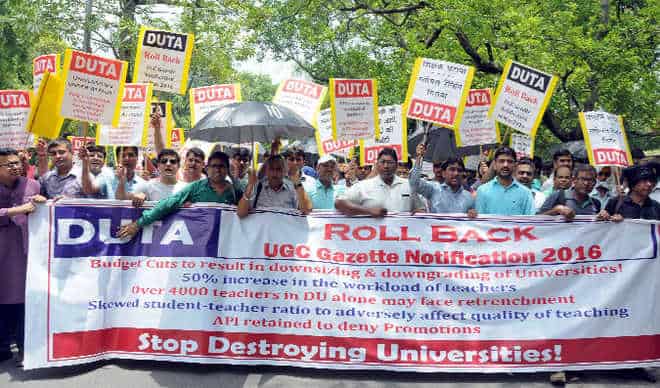
  • July 2016- DUTA protest delays results of students: Teachers of Delhi University protested against an UGC notification that increased the working hours of teachers and this led to Delhi University Teachers Association (DUTA) boycotting the admission and evaluation process of University. Only after the notification was withdrawn, teachers joined the evaluation process.

Read the whole story here.


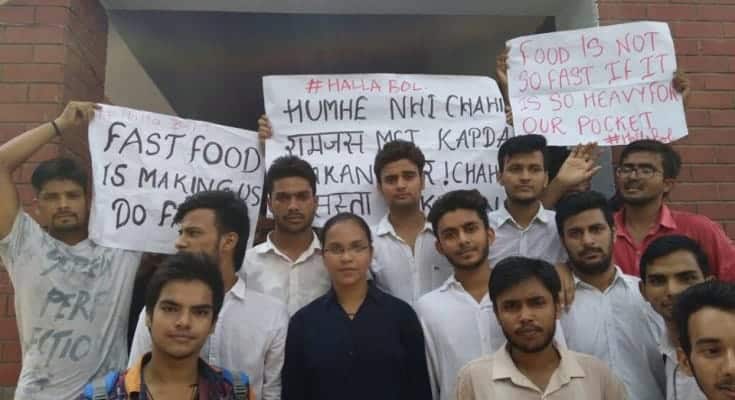
  • August 2016- Protests at Ramjas College regarding canteen prices: Ramjas College saw organised protests held by its students on 11th August, 2016. The protest primarily targeted the exorbitant increase in prices in the canteen since the start of this academic year. The canteen staff apparently charged higher prices than those mandated by the college. In what a student called an act of “corruption,” the canteen staff would charge a first-year student INR 50 for an item that actually cost INR 30. Speaking out against this practice, a group of students spread word through social media and organised a protest by inviting the Ramjas community to gather at the college gate and march towards the canteen.

Read the whole story here.


  • August 2016- Protests at Daulat Ram College questioning the governing style of the chairperson: Protests regarding the governing body took place in Daulat Ram College on 6 and 8 August 2016. Both students and teachers came together to question the governing style of the chairperson, Ms Suneeta Sudarshan. The protest revolved around key infrastructure problems that the college faces, as well as the chairperson’s reluctance to handle these issues. The protest concentrated primarily on the issues of infrastructure such as unhygienic washrooms, inadequate space in classrooms, and the unstable condition of the college building itself.

Read the whole story here.


  • September 2016- Mass failure in Law Faculty, students protest in agitation: The students of the Law Faculty, Delhi University sat on a hunger strike from 2 pm, 14th of September. The strike was against the mass failures of students that had occurred for the second year in a row. Alleging some problems with the results, they went on an indefinite hunger strike, urging the authorities to look into their grievances.

Read the whole story here.


  • October 2016- Law faculty students go on hunger strike: The students of law faculty went on a hunger strike demanding supplementary exams and rechecking of their papers. The strike also found the dean of the faculty going on a parallel hunger strike. The strike was called off after discussions and assurance of the Vice Chancellor.

Read the whole story here.


  • October 2016- AISA’s meeting disrupted by ABVP: AISA’s seminar on ‘Idea of University’ was disrupted by ABVP members who latter even roughed up several members of AISA including its president. Both sides got into a scuffle, after which the event was cancelled. The surprising fact was, all of this happened even after heavy police presence.

Read the whole story here.
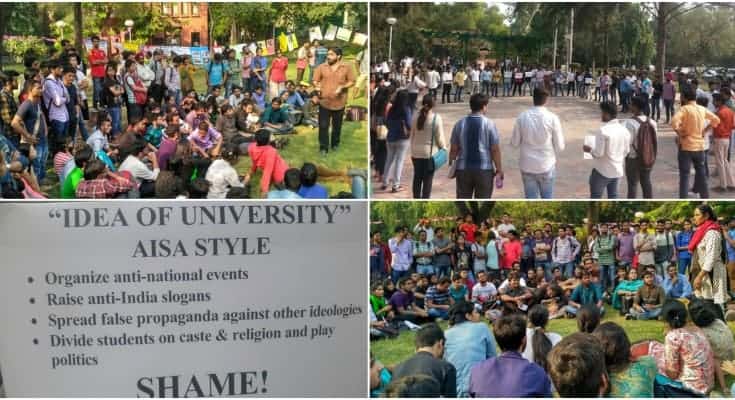
aisa-vs-abvp-the-never-ending-battle

Battle of ideologies: ABVP vs. AISA

  • December 2016- The Pinjra Tod Movement: What began as a Facebook page turned into a great call for revolution within academic institutions to relook on its hostel policies which cage students with curfew times. The movement not just grew largely in Delhi University but also spread to other parts of the country.

Read the whole story here.


  • February 2017- ABVP protests against Umar Khalid and disrupts two day conference: A two day seminar on Cultures of Protest, organised by Wordcraft, the Ramjas literary society and the English department of Ramjas college, was disrupted when members of the ABVP protested against Umar Khalid speaking at the conference. Khalid is a PhD scholar from Jawaharlal Nehru University and a student activist who was slapped with sedition charges last year. ABVP’s reason for obstructing the conference was the presence of Umar Khalid and Shehla Rashid, JNU students, who were amongst the speakers at the conference.

Read the whole story here.


  • March 2017- Students, teachers AND politicians join in thousands to protest against ABVP’S hooliganism: A historic march consisting of over a thousand students, teachers and politicians started from SGTB Khalsa College and culminated at Arts Faculty. Students and teachers from colleges across University of Delhi, Jamia Millia and JNU joined in huge numbers to protest against the hooliganism that was allegedly perpetrated by ABVP karyakartas on 22nd February at Ramjas College. The march, which was called ‘Save DU’, garnered many students who were first-time protesters.

Read the whole story here.
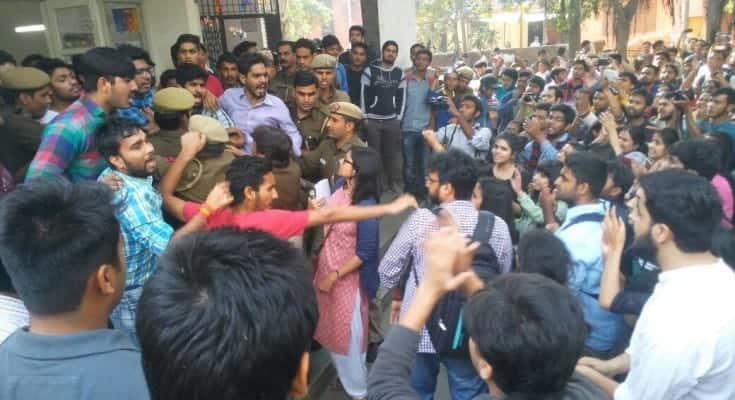
abvp-hooliganism-at-its-best

Scuffle between ABVP and Ramjas college students

  • April 2017- Students and Karamcharis join DUTA in its MARCH AGAINST ‘AUTONOMY): With growing demands against the grant of ‘autonomous’ status for colleges, Delhi University Teacher’s Association (DUTA) called had called for a joint protest of students, teachers and karamcharis on 29th March.

Read the whole story here.
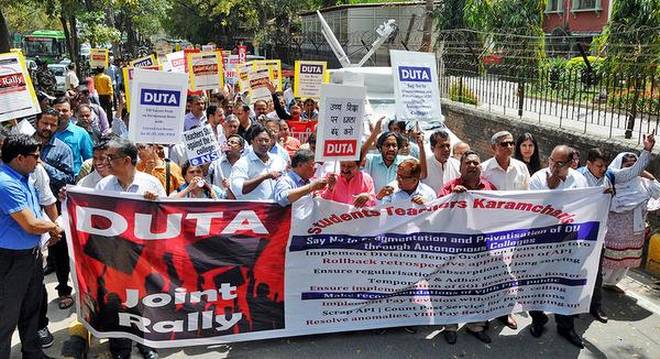
 the-dangers-of-autonomy

Protest over the ‘dangers of autonomy’


Picture Credits: DU Beat Archives

Anahita Sahu

([email protected])

Ankur, the theatre society of Shri Guru Tegh Bahadur Khalsa College, have postponed their street play competition, Pratyaksh, which was being organised in the Nukkad on the second day of the college’s annual cultural festival, Lashkara.

Day 1 of Lashkara on February 22 saw myriad competitive events by a plethora of societies, metres away the violence and chaos that erupted in the north campus mid-day onwards. Disrupting a peaceful march by students and teachers to protest against the intervention by the ABVP of an academic conference at Ramjas College, the student political party blocked the entrance of Ramjas College. Violence erupted in front of the college campus with students also stuck inside the college premises for hours.

Following reports and warnings advising students against entering the college campus after the events of February 22, the cultural festival observed a low turnout on February 23. The theatre society’s street play event, organised for the second day, was set to witness participation from majority of colleges around the campus. The street play events during Delhi University festivals are known for raising pertinent issues about the prevailing social and cultural issues, often on taboo and lesser-discussed themes.

“The DUSU president asked us to call off the competition as elements from different plays might be construed negatively in the current political environment. The police also appealed to us to call off the event in the interest of restoring peace and normalcy in the campus. The administration had to take the call of cancelling the event to ensure safety of students,” said Saikat Ghosh, staff advisor of the theatre society. He also pointed out that theatre in Delhi University has always been a tool of speaking up against what was felt unfair, and the medium of raising voices and taking a stand whenever words have been discouraged.

After deliberations between the society, the students’ union, and the college principal, with recommendations from the police authorities to ensure the safety of the students, the event was postponed to a later date to prevent escalation of chaos on campus. Members of the society were unavailable for comments.

Feature image: Kartik Kher for DU Beat

Saumya Kalia ([email protected]) and Akshara Srivastava ([email protected])


500 students who demanded the right to hostel facilities for everyone on campus. The major demands laid by AISA include the demand for a rent regulation act to monitor exorbitant rent rates at various paying guest accommodation facilities, House Rent Allowance (HRA) for the students and more hostels across the campus. The march formed a symbolic part of the movement that the organisation started to address the issue through multiple means. A post card campaign was also started in the later part of July. The campaign allowed students to convey their grievances regarding inadequate or no accommodation facilities on campus to the Vice Chancellor. AISA succeeded in getting over 10,000 post cards from students across 25 colleges of the varsity but failed to meet the Vice Chancellor who was reluctant to meet the students at the end of the march. Apart from students, professors from various colleges formed a major chunk of the march. Individual experiences in relation to the unregulated brokerage system were also narrated by some students at the event. AISA, in the previous week organised marches of similar nature in Vijay Nagar and Satya Niketan to address the issue. One such protest was where students were seen carrying their luggage as a mark of protest to demand hostel facilities. Image credits: Sidharth Yadav for DU Beat Sidharth Yadav [email protected]  ]]>

Protests regarding the governing body took place in Daulat Ram College on 6 and 8 August 2016. Both students and teachers came together to question the governing style of the chairperson, Ms Suneeta Sudarshan. The protest revolved around key infrastructure problems that the college faces, as well as the chairperson’s reluctance to handle these issues.

[caption id="attachment_43751" align="alignleft" width="375"]Protests at DRC 1 Image credits: Sukanya[/caption]

The protest concentrated primarily on the issues of infrastructure such as unhygienic washrooms, inadequate space in classrooms, and the unstable condition of the college building itself. A teacher from the political science department also highlighted the fact that ID cards are yet to be issued to first-years due to the lack of administration and section officers. Furthermore, no permanent appointments – of either the teaching or non-teaching staff – have taken place in several years. Posters of ‘We Want Dignity’ and ‘Save Daulat Ram College’ were spotted. Students also exclaimed slogans such as, “Chairperson hosh mein aayo” and, “ek do teen char, band karo yeh atyachaar.” Priyanka, a student of Philosophy Honours, claimed that “we have contracts and funds,” but that the chairperson was hindering access to them and thereby the renovation process of the college. The administration staff refused to comment.

[caption id="attachment_43750" align="alignright" width="413"]Protests at DRC 2 Image credits: Vineeta Rana for DU Beat[/caption]

After hours of protesting in the front lawn directly opposite the admin block, the gathering was addressed by the Principal, Ms. Savita Roy, who explained the conflict with the governing body. She claimed that the condition of the college was “pathetic” and that despite carrying out proper procedure and taking permission for its renovation, the process was taking much longer than necessary due to lack of cooperation of the chairperson. She claimed that the governing body had frozen the hostel accounts and had filed an FIR against the Principal for breaking a lock that was put up by the matron in the hostel. With regard to the students’ demands for lowering of the tuition fee (the fee has more than doubled in a span of two years), the Principal said that she invites a delegation to formally present the issue so that it can be resolved. The chairperson has denied the allegations against her.

After the demonstrations in college, several students and teachers marched to the Vice Chancellor’s office in an effort to make their demands heard. It was reported that the Teachers’ Union of the college had an altercation with Satender Awana, the DU Students’ Union (DUSU) President, who verbally and physically assaulted staff members from the college. The DU Teachers’ Association (DUTA) issued a press release which detailed the events of the day and declared its solidarity with the staff of the college. Students of the college have also been posting messages on social media which detail the shortcomings in the college’s infrastructure and management, particularly with regard to the hostel, where the warden is seen as being autocratic and unreasonable. The outcome of these protests is yet to be seen.

Featured image credits: Asmita 

Vineeta Rana

[email protected]

]]>

In a recent press release, the Delhi University Teachers’ Association (DUTA) has decided to continue its boycott of the recent semester exams evaluation till 16th June 2016, when the General Body (GB) will convene again to review the situation. The protest is in response to a notification by the UGC giving nod to the implementation of the  Academic Performance Indicators (API) system and other amendments that DUTA calls ‘retrogressive’ and an ‘attack’ on the higher education system of the country. This is a setback for the graduating students of the varsity as this has put on hold the post-graduate admissions to the varsity and might even stall the declaration of the semester exam results. Calling the gazette notification ‘draconian’, the DUTA has gone far to claim that if the government fails to roll back the notification, it might consider boycotting the admission process as well. The API system allows for teachers to be evaluated on the basis of students’ performance, a manoeuvre DUTA has called ‘unreasonable’.  Given the increase in the working hours of assistant professors from 16 hours to 24 cumulative hours and of associate professors from 14 to 22 cumulative hours, the DUTA claims that such a move will result in the loss of over 4,000 jobs and will work against the interests of both teachers and students. The Akhil Bhartiya Vidyarthi Parishad (ABVP), in contrast to its previous position has demanded an immediate rollback of the notification and urged the teaching community to ‘resume evaluation work immediately’ to avoid compromise of the students. Agreeing to one of the demands of the protesting teachers, the UGC, on 10th June 2016, decided to set up a 5 member pay revision committee for academic staff. The committee will be chaired by UGC member Prof. V S Chauhan and will submit its report in six months. With no end in sight, the UGC has claimed that the system will bring ‘more flexibility’ to the academic environment and ruled out any claims of loss of jobs due to it. Image Credits: www.tribuneindia.com   Sidharth Yadav [email protected]]]>

On the evening of 23rd April’16, the women residents of Undergraduate Hostel for Girls (UGHG) in Delhi University took to the streets in protest against the severe water crisis that they had been facing in the hostel for almost two months leading to unbearable living conditions and water-borne illnesses. The hostel administration led by the Provost Rita Kakkar had refused to respond or meet the protesting students. Thus, the women broke their hostel curfew and marched to the provost’s residence demanding action. The Provost finally met the students around midnight, after Kapil Mishra, Delhi Government Water Minister, arrived at the protest venue and termed the negligence on part of the hostel authorities as ‘inhuman’. In the negotiations that followed in writing by the DU Administration, clauses that no individual student would be targeted for participating in the protest and, no resident would be denied a hostel seat the next year for the same were added. However, in contrary to this, the hostel administration started witch-hunting of women students identified as ‘ring-leaders’ of the protest.

Parents of several UGHG residents received letters stating “your daughter left the hostel on 23rd April, 2016 at around 5pm and returned around 2.30am on 24th April, 2016 without obtaining prior permission from the hostel authorities”. The letter further alleged that their daughter’s behaviour “has a bad impact on other residents and brings a bad reputation to the hostel”.

Further, exorbitant fines have been levied against financially weak students for late payment of fees. The hostel authorities also sent these notices to the college administrations asking them to confiscate the students’ admit cards.

“I’m furious at the college hostel administration. They had sent the notice without duly informing me. I felt mentally harassed at that time. I had to run between offices to get my admit card as they made wait for hours to give me the fee receipt. It was trying time for me and family, my parents understood the situation but I can’t say the same for the parents of other students,” said a UGHG resident on anonymity.

Pinjra Tod condemning this act of witch-hunting held a protest outside the DU VC office on 23rd May, Monday, at 1:00 PM to submit their demands – to revoke the issued letters, no further vindictive targeting of students involved in 23rd April protest and removal of Rita Kakkar, Provost from her post.

Moreover, Pinjra Tod will be writing to the Vice Chancellor and Proctor of Delhi University, Kapil Mishra, Delhi Government Water Minister and Swati Maliwal, Delhi Commission for Women Chairperson to lodge a complaint about this issue.

Image Credits: www.indiaresists.com 

Nidhi Panchal

[email protected]

Ram Lal Anand Professor G.N. Saibaba, who was suspended from the university, following his arrest by Maharashtra Police in 2014 for alleged maoist links, recently became a centre of attack after his visit to the college. The English professor, who is out on bail, went to the college to submit a letter where he allegedly became a target of anger and protest by members of ABVP (Akhil Bharatiya Vidyarthi Parishad).

While Professor Saibaba might be hopeful of a fresh start, his request for reinstatement has invited mixed reactions. A group of students, led by the members of the ABVP, strongly oppose the professor’s rejoining unless he is cleared of all the charges by the court. Talking to us, ABVP’s Delhi State Secretary, Bharat Khatana, said, “Saibaba has been suspended by DU and despite that he is coming to the college and addressing students. We believe that unless he gets a clean chit from the court and the Governing Body (GB) of the college, he must not be allowed to enter the college premises.”

Despite the relentless protests and public bashing, DUTA strongly condemned the attack on Dr. Saibaba. DUTA President Nandita Narain, while emphasising on the lack of security for the professor, told us, “Had it not been for the protection given by some faculty members and hundreds of college students, Dr. Saibaba could have suffered grievous injury. The DUTA expresses grave concern that the college administration as well as the local police did not prevent this violent intrusion, even though similar incidents had taken place over the last few days. The DUTA appeals to the VC for his immediate intervention to prevent this breakdown of governance in this university maintained college.”

Sharing the same sentiment, Narendra Pande, Associate Professor from the Department of History and a colleague of Saibaba told us, ” There are two important things which we must keep in mind. One is that, rule of law must prevail and second that,any suspended employ has a right to approach his workplace. We met the chairman of the Governing Body of the college, Mr. R.M. Kohli today and he will soon foresee the situation himself. The Staff Association, which is the teacher’s collective body of the college, passed a resolution with consensus to expedite the functioning of the one—member committee which has been formed by the college to look into the issue.”

The Staff Association plan to impress upon the Chairman of the Governing Body as well as the Principal of the college to take steps in order to stop the breakdown of normal functioning of the college and the creation of a conducive and safe environment for teaching. The Supreme Court had earlier this month granted the professor bail on the pretext that Maharashtra government had been “extremely unfair” to him.

To recall the important twists and turns of the case, read our timeline of Saibaba’s case here. 

Image credits: www.thehindu.com 

Riya Chhibber

[email protected] 


th semester, in which 57 students failed sociology out of a total of 60 in Shivaji College. Not just in Shivaji, many off campus colleges such as Keshav Mahavidyala, Rajdhani College and Lakshmi Bai College have reported a similar result. 102 students out of 120 in Lakshmi Bai College and 20 out of 25 students in Keshav Mahavidlaya failed Sociology, all of whom had opted for it as their interdisciplinary course or CDC. This result from the University is being claimed to be erroneous, which will affect the aggregate of the final year students, who want to pursue higher studies after graduation, adversely. But as much as a shock it was for the students, they have decided to call for action and not helplessly accept a glitch in their results. As a result, there was a mass protest outside the office of the Dean,  Students’ Welfare, Professor J.M. Khurana on Monday, the 29th of June. It started at 9 in the morning and went on till at noon, when a few student delegates were called inside. A student delegate from Shivaji College, Bismee, said, “This result is a reckless mistake from the University and we only want the marks that we truly deserve in the subject. We have filed a written petition with the Dean’s office to revise our results and give us an answer at the earliest.” When asked about the behaviour of the authorities towards the issue, another student, Mitali told us that they were “indifferent” towards their plight. So far there has only been a bleak response, though it has not dampened the spirits of the protesters and there will be protests everyday till a clear decision has been reached. Bismee, one of the organisers of the protest, told DU Beat that he met the Dean of Students’ Welfare, who assured appropriate action over the issue. The students representatives are expected to meet the Dean again tomorrow. A major cause of such protest and unrest among students is that many of the affected students plan on getting a higher education, and such low marks are harmful for their aggregate score of all semesters. Ironically, students who have Sociology as their major have been marked well, and so it appears that a careless approach has been adopted for the students who opted for Sociology as their interdisciplinary course. Further, all the affected students have so far scored well in other subjects and have had 60% and above aggregate in all the preceding semesters. This fact has also fueled the rage around the University’s result and shocked many.   Image credits: Bismee Taskin Islam]]>

Delhi University Teachers’ Association (DUTA) conducted their cultural protest, Jashn-e-Azadi, on 27th March in front of the Kirori Mal College hostel gate against the rising instances of ‘totalitarian misgovernance’ by the University authorities. The stage was opened by a speech by DUTA president, Nandita Narain, who called out the authorities on the recent passage of the code of conduct which, she said, is meant to crush any dissenting voice in the university. She also pointed out the one-year MA course will only lead to further degradation of the academic standards of the university, which is already reeling under the affects of Four Year Undergraduate Programme (FYUP). Other points of concerns were FYUP itself, the second term of office of the VC and immediate filling of vacant posts in the faculty.

Artists followed her speech with their own forms of protests on stage. While former Indian Ocean member Sushmit Sen performed with his band, Sushmit Sen Chronicles, belling out one fusion number after another, folk artist Ratan Gambhir talked about the increasing commercialisation of education. Narain brought the evening to an end by again calling out for the urgent need to group and protest against the increasingly draconian nature of the university governance. She said that culture is one of the sharpest ways of protest and Jashn-e-Azadi was only one in a line of similar events, pointing to the cricket match which was played after the protest march on 14th February. She ended by saying, “Jab jab andhakar ka samay ayega, tab tab hum andhakar key bare mein bolengein, gaayengein”.

Featured Image Credit: Iresh Gupta for DU Beat

The Delhi University Teachers’ Association (DUTA) in association with various students’  groups conducted a Protest March to the Parliament demanding a roll-back of the FYUP on the 18th of February. The DUTA had organized this March along with various students’ organisations including All India Students’ Association (AISA), All India Democratic Students’ Organization (AIDSO), Democratic Students’ Union (DSU), Students’ Federation of India (SFI), All India Students’ Federation (AISF), and the students’ wing of Aam Aadmi Party – CYSS.

fyupprotest

In what was labelled as a March towards Parliament, students and teachers marched from outside Zakir Husain College to the Parliament Street where they were joined by MPs, leaders of political parties, trade unions, women’s organizations and civil society bodies. Political leaders including Manish Sisodia and Ashutosh (AAP), Sitaram Yechury (CPI-M), OP Kohli (BJP), Tarun Kumar Mandal (SUCI-Communist), Udit Raj (SC/ST Federation), DP Tripathi (NCP), Kavita Krishnan (CPI-ML and AIPWA), Jagmati Sangwan (AIDWA) and Iqbal Singh Sindhu (AIFUCTO), All India Forum for Right to Education (AIFRTE) joined the procession at Parliament Street. The March culminated in a massive Public Meeting next to the Parliament Street police Barricades.

The marchers not only demanded a roll-back of the FYUP but also a reversal of the education policies’ thrust towards commercialization and PPP model. Removal of VC Dinesh Singh and condemnation of the Government’s decision to award him with a Padma Shri after allowing him to destroy Delhi University were also put forward in the form of slogans and handbills distributed to the public.

Manish Sisodia addressed the issue of commercialization of education and large-scale contractualization in teaching jobs. He also criticized the DU VC’s disregard of all democratic norms and processes, as was recently evident in the controversy over the formation of Governing Bodies in the Delhi Government colleges. He underlined the need to build popular resistance against the Government’s commercialization agenda in Education and expressed the AAP’s commitment to fighting against FYUP.

dutakav

Women’s organization leaders Kavita Krishnan, Jagmati Sangwan and Ritu Kaushik (AIMSS) expressed their opposition to the FYUP by stating that it would keep the large majority of girls and young women from poorer families out of good jobs and higher studies that are the only guarantee against the conservative pressure of Khap Panchayats and the patriarchal family structures.

DUTA President Nandita Narain expressed the DUTA’s resolve to continue the struggle with greater intensity till the principal demands of the teachers and students are met. She warned the Government that its indifference to the plight of the Delhi University community would cost it heavily in the General Elections as the destruction of a Central university like DU is going to alienate the masses and turn them against any party in power that imposes anti-people measures under the garb of reforms. She attributed this indifference as a factor in the Congress Party’s heavy defeat in the last Assembly elections. She appealed to all sections of the public to join the struggle against FYUP and the policies which undermine the future of students and teachers in higher education.

In a similar protest, on 15th February, AISA led a march to UPA chairperson, Sonia Gandhi’s house to protest against the new format of UPSC exams and Delhi University’s four year undergraduate programme.

AISA has been condemning FYUP for a long time now and is demanding a full rollback. The student’s party had already made its stand clear on the same during the Delhi University union polls, adhering to which they have been carrying protest marches along with ABVP and DUTA in the recent past.

According to sources, due to the unavailability of UPA chairperson Mrs. Sonia Gandhi, the party led its march to All India Congress Committee’s Office where they met Mr. Janardan Dwivedi, senior leader of Indian National Congress who further deputed the case to Mr. Shakeel Ahmed, senior spokesperson of INC. Mr. Dwivedi, though ensured the protesters that their demands would be looked into and action would be taken.

DUTA and students organisations also conducted protests against Antardhvani the previous week, condemning the nature of FYUP promotion embedded in all activities of the cultural fest.