Tag

DUTA

Browsing

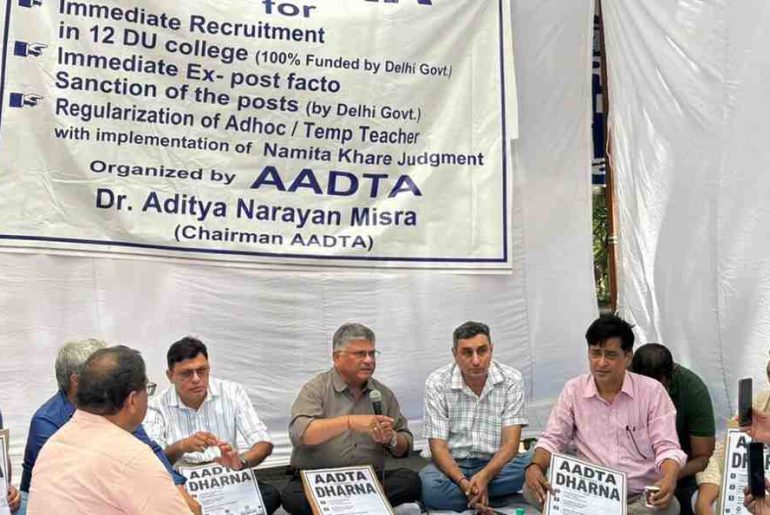
AADTA-led teachers protested at Delhi University against delays in regularisation and promotions of ad hoc faculty in 12 colleges, demanding recruitment approvals and implementation of the High Court’s 2025 judgement.

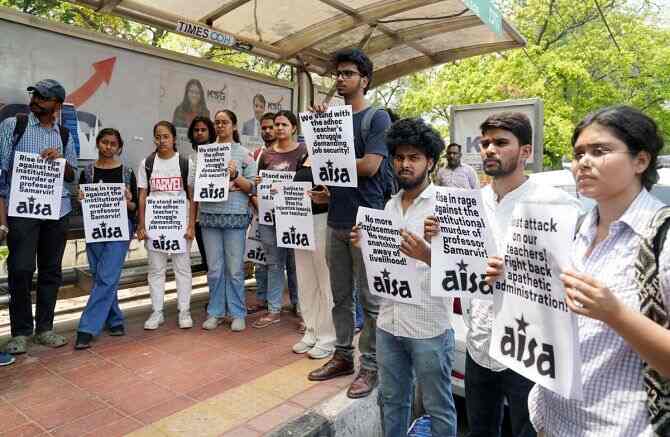
On Friday May 15, members associated with the Academic for Action and Development Delhi Teachers’ Association (AADTA) staged a protest calling out the lack of regularisation and promotion to permanent positions of the ad hoc teachers working in 12 colleges across Delhi University. The association called for immediate action and for the immediate approval of ex post facto sanctions for posts, enabling colleges to commence recruitment processes without delay.

The protest saw wide support from the teaching staff across the university. Academic Council members, Delhi University Teachers’ Association (DUTA) executive members and office-bearers of several college staff associations participated in the protest, the organisation shared in a statement. Additionally, presidents of staff associations from Bhagini Nivedita College, College of Vocational Studies, and Atma Ram Sanatan Dharma College also expressed solidarity with the demands during the protest.

Former Executive Council member and AADTA member Rajesh Jha said,

 “DU has done away with the ad hoc system in other colleges, which naturally leads to a feeling of insecurity among these teachers as they have no idea where they stand.” Mr Jha said the issue emerged due to the limited number of sanctioned posts created in 2010-2011.

 “A total of 301 posts were sanctioned in these 12 colleges, but those were not enough. Currently, there are around 1,000 teachers, including permanent and ad hoc faculty, working in these colleges,” he said.

The association’s demand is with relation to the Delhi High Court’s judgement of the Namita Khare case in which a teacher from the Department of Germanic and Romance Studies demanded regularisation after her prolonged ad hoc status. She had been an ad hoc teacher for 8 years, yet her pay grade and teaching position remained unchanged. The court ruled that long-serving ad-hoc teachers should be made permanent and regularised, underlining that the ruling should be enforced “in letter and spirit”.

In conversation with DU Beat, Bimlendu Tirthunker, the secretary of DUTA and a member of AADTA, said,

 “The teachers that we are raising this issue for have been teaching for more than 18-20 years; the lack of regularisation really affects their lives in terms of low pay scale and other benefits. They are not in a position to switch jobs. It is a duty on a human level to give them a permanent position.”

He further added,

‘The DUTA delegation had previously met Rekha Gupta with this grievance, and she gave us reassurance, but it still isn’t getting implemented.’ Our simple demand is for the administration to follow directions given by the Delhi High Court in the Namita Khare case with immediate effect.’

Read Also: The Age of Automated Academia
Image Credits-Facebook Page of AADTA

Divyanshi Dusad
[email protected]


Bihar Governor’s directive mandating “five hours of daily teaching” for university faculty has triggered sharp backlash, with FUTAB and DUTA contesting the interpretation of UGC norms.


The Bihar Governor’s recent directive mandating ‘five hours of daily teaching” for all University faculty in the state has sparked protests. The Federation of University Teachers’ Associations of Bihar (FUTAB) has launched a formal protest against the directive, claiming it to be in violation of the University Grants Commission (UGC) 2018 norms. The 2018 regulations set forth a national standard for appointment and workload of teachers. 

The Delhi University Teachers’ Association (DUTA) has also joined the pushback, penning a letter to the Governor-cum-Chancellor Syed Ata Hasnain to withdraw the controversial order. 

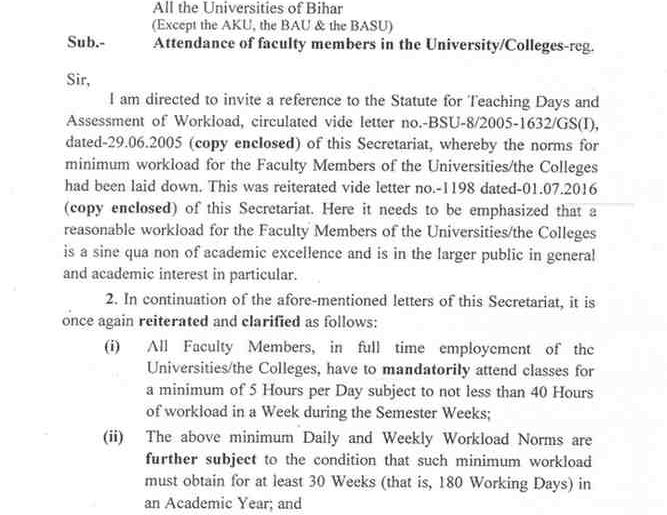
The directive was sent to all vice chancellors of universities/colleges in the state on 7th April 2026, via Kalpana Srivastava, the Officer on Special Duty (OSD-Judicial). The notice mandates all faculty members in employment of the universities to “attend classes for a minimum of 5 hours per day….not less than 40 hours of workload in a week.” The notice further states the UGC Workload norms to be the basis of the directive. 

Document excerpt showing UGC workload norms for teachers, including the clause on five-hour daily availability and weekly teaching hours for assistant professors and professors.
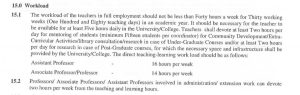
Excerpt from UGC workload guidelines stating that teachers should be available in colleges or universities for at least five hours daily during the academic year.


The main point of contention was the interpretation of the ‘five hour rule’. The teachers’ body contested that the norms define the five-hour rule as “stay-in hours” and not “direct teaching hours”. FUTAB president Kanhaiya Bahadur and general secretary Sanjay Kumar contested the directive in a letter to the Governor’s Secretariat, dated 13th April. They argued that the norms merely require the physical presence of faculty in college for five hours per day, and not direct teaching. 

The UGC regulations set down a workload of 40 hours per week across a minimum of 30 working weeks per year. Teachers must be available for at least five hours daily at the university/college. Teachers are also asked to dedicate two hours a day to mentoring students. The guidelines also describe explicitly the limit for the number of direct teaching and learning hours allowed for faculty. No more than 14 hours a week is allowed for Professors and Associate Professors, and 16 hours for Assistant Professors.

The letter from FUTAB noted that this distinction between “stay hours” and “teaching hours” was previously clarified by the Ministry in the Rajya Sabha and through official press releases in 2016, as reported by The Indian Express. “A teacher stays for five hours, but teaches for the specific hours allotted by rank,” the letter stated.

The teachers’ body has threatened intensified protests if the order is not withdrawn soon. In a statement with The Indian Express, president Kanhaiya Bahadur shared “We have written to the UGC to provide a fresh clarification. If Raj Bhavan does not withdraw the letter within a month, we will escalate our agitation.”

A spokesperson for the Bihar Governor’s Secretariat announced that the matter is under review. “The Governor is looking into the issue. We will examine the legal and practical aspects of the letter issued by the OSD (Judicial),” the official said.


Image Source: Governor of Bihar (Official Website)

Read Also:   Delhi University Revises UG Exam Timetable, Sunday Papers Added for NEP Students


Anjali Paruvu

[email protected] 

DUSU Joint Secretary Deepika Jha allegedly slapped Professor Sujit Kumar at Dr. B.R.Ambedkar College, prompting outrage from teachers’ associations, police investigation, and a DU-appointed six-member committee to probe the assault.

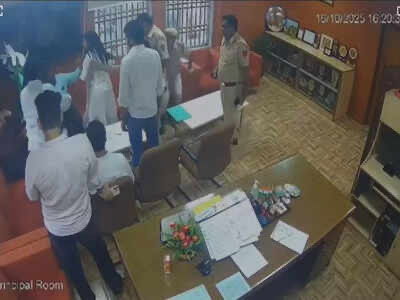
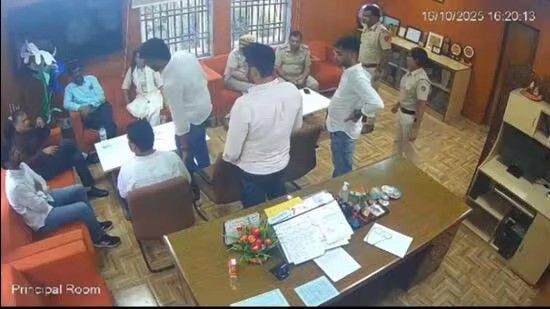
On 16th October, Deepika Jha, the Joint Secretary of DUSU (Delhi University Students’ Union) of the current term, was seen slapping Professor Sujit Kumar, a senior teacher of Bhim Rao Ambedkar College of Delhi University. The incident occurred at the principal’s office in the presence of the police.

Professor V.S. Negi, the President of DUTA, in his letter requesting a General Body Meeting after the autumn vacation, stated that,

This incident has rattled the entire university and is an assault on the dignity of teachers and other stakeholders of the teaching-learning process in Delhi University. Teachers from across the country too have expressed their shock and indignation.

The letter further stated that DUTA’s effort to call for a flash protest on the 17th is simply not enough, in addition to the lack of a public addressing system.

Several organisations, including the Common Teachers’ Front, Democratic Teachers’ Front, Democratic Teachers’ Initiative, INTEC (I), Rashtriya Shiksha Morcha, and Samajwadi Shikshak Manch, have come together to demand a DUTA GBM on the 16th October physical assault on teachers.

The letter further stated,

It is shocking that the perpetrators of this act of violence are acting with total impunity. Encouraged by the fact that no action has been taken against them, they are making public statements maligning the teachers and creating a false narrative of the incident. Meanwhile, the affected teachers wait for justice.

The letter saw signatories from various organisations, including the Common Teachers’ Forum (CTF), Democratic Teachers’ Front (DTF), Delhi Teachers’ Initiative (DTI), Rashtriya Shiksha Morcha (RSM), and Samajwadi Shikshak Manch (SSM).

A senior police officer confirmed that a complaint has been received and the matter is under investigation.

We received the complaint late in the evening. The video has been seen by investigators. They are obtaining CCTV footage now. The matter is being enquired into.

The University of Delhi has formed a six-member inquiry committee to investigate the alleged assault. The committee will be chaired by Professor Neeta Sehgal of the Department of Zoology. Vice-Chancellor Yogesh Singh said the panel has been directed to submit its report within two weeks. Other members of the committee include Professor Jyoti Trehan Sharma, Joint Proctor (Member Secretary); Professor Rama, Principal of Hansraj College; Professor Swati Diwakar from Environmental Studies; Professor Darvinder Kumar, Principal of PGDAV College; and Awadhesh Kumar, Joint Proctor

Image Credits- The Indian Express

Also Read – Crisis Erupts at SAU: Students Protest After Alleged Gang Rape

Divyanshi Dusad
[email protected]

Delhi University witnessed an assault on one of their Commerce Professors, after he was allegedly slapped by DUSU’s Joint Secretary while being on duty.

A professor of Dr. Bhim Rao Ambedkar College, Mr. Sujit Kumar was allegedly slapped and assaulted by Delhi University Students’ Union (DUSU) Joint Secretary Deepika Jha and other members of Akhil Bharatiya Vidyarthi Parishad (ABVP), in the presence of police personnel on Thursday, 16th October. Sujit Kumar serves as the convener of the college’s disciplinary committee and is a senior teacher at Delhi University’s B.R. Ambedkar University.


The incident sparked immediate outrage in The Democratic Teachers’ Front (DTF), who claimed that around 50 students entered the college, alongside Aryan Maan, the DUSU President and Deepika Jha, the Joint Secretary, and ‘mistreated teachers, demanding the resignation of the disciplinary committee convener.’ 


The Democratic Teachers’ Front (DTF) issued a statement asserting that the committee was investigating recent incidents of campus violence involving students from different groups when the assault took place. The Delhi University Teacher’s Association in turn has written to the Vice- Chancellor demanding swift action and has urged the university administration to conduct thorough research and to take further measures. 

The incident has drawn widespread condemnation from the university’s teaching community.


Even though Deepika Jha alleged that Prof. Kumar misbehaved with her, she apologised to the entire teaching community. The professor, however, rejected the allegations. Deepika Jha asserted that she was called to the college to address complaints of `misbehaviour and physical assault’ raised by the students against Prof. Kumar. She further accused the professor of being in an inebriated state and of making indecent remarks, constantly threatening her and of making her feel unsafe. 


Aryan Maan, on his Instagram, implicated that the party showed up after a student was seen to be dragged by the collar by the professor in addition to him smoking within the college premises. 


The Joint Secretary admitted to slapping the teacher but asserted it to be an impulsive reaction to his alleged `staring’, `verbal abuse’ and `provocation’. She expressed regrets over her actions but claimed them to be a concern for female safety on campus. 


A DU professor, on the condition of anonymity, had given a statement: “A student from the National Students’ Union of India (NSUI) had won the president post in the college student council, and two other posts had been won by the ABVP. The NSUI student had allegedly been assaulted by ABVP members, and he had lodged a complaint against them.”

Prof. Kumar stated that he was forced to resign from his position, and the event took place after. 

In an a statement, the incident was labelled as `ABVP-led DUSU hooliganism’ by the NSUI, who condemned the lack of action by the authorities despite CCTV evidence. 

Anonymous

Featured Image source: Screengrab from CCTV footage

Delhi University’s PG syllabus cuts on religion, caste, LGBTQ+ issues, and Pakistan spark faculty backlash, raising concerns over academic freedom and ideological interference.

On 25 June 2025, the Standing Committee of the University of Delhi (DU) proposed several contentious changes to the postgraduate syllabi of Geography, Sociology, and Political Science. The revisions include the removal or significant reworking of content related to religion, caste, LGBTQ+ issues, and the study of Pakistan. The changes have triggered widespread criticism from faculty members, with further discussion scheduled in the upcoming meeting on 1 July.

In the Department of Geography, three major papers were affected. In the elective paper Territorial Bases of Politics in India, the committee objected to Unit 3, titled “Internal Conflicts and Problems of Nation Building,” which addressed religious conflicts. A key reading, The Production of Hindu Muslim Violence in Contemporary India, was removed. In Social Geography, Unit 4 on “Distribution of SC Population” was eliminated. According to committee members, this decision was made to de-emphasise caste-related material. Additionally, Vulnerability and Disaster, another elective, was completely removed from the syllabus.

The Sociology syllabus also saw significant intervention. In Introduction to Sociological Theory, the committee questioned the absence of Indian thinkers and suggested their inclusion. Objections were raised regarding the inclusion of the reading Weston, K. (1997). Families We Choose: Lesbians, Gays, Kinship, as same-sex marriage is not legally recognised in India. In Sociology of Religion, Unit IV on Religious Authority and Organizations was flagged for using academic terms such as “church,” “sect,” and “cult.” Members questioned why terms like “rishi-muni” were excluded. Despite faculty clarification that these were standard sociological terms, the committee still recommended revision.

Urban Sociology also faced changes. The committee argued that Unit 2 focused excessively on violence. Key readings addressing religion and caste were removed, including The Muharram Procession of Mumbai, Animating Caste: Visceral Geographies of Pigs, Caste and Violent Nationalisms in Chennai City, and Deceptive Majority: Dalits, Hinduism, and Underground Religion.

Some faculty members have raised concerns about the committee’s role in mandating syllabus revisions.

The Standing Committee’s direction to the Departments of Geography and Sociology to change their syllabi defies academic rationale and is an act of overreach. While the Standing Committee can share inputs and feedback with the departments, it cannot direct the departments to remove papers and readings without giving academic justification.”

said Rudrashish Chakraborty, Associate Professor at Kirori Mal College and elected member of the DUTA Executive (2023–25).

The Political Science syllabus came under the most scrutiny. Faculty members were directed to ensure the content remained “India-centric” and avoided material that “glorifies Pakistan.” This instruction aligns with Vice Chancellor Yogesh Singh’s earlier stance amid recent geopolitical tensions.

Dr. Monami Sinha opposed the changes, stating,

“It is imperative to study Pakistan in detail because, pedagogically, we need to train our students and foster scholarship on Pakistan, as it remains one of India’s constant foreign policy challenges.”

Four electives relating to China, Pakistan, and Islam in international relations were removed. These included Pakistan and the World, China’s Role in the Contemporary World, Islam and International Relations, and Pakistan: State and Society. In Religious Nationalism and Political Violence, the topic “Sangha politics, civil warfare and the peace process” was removed, along with the reading by Blom Hansen on Hindu nationalism and violence.

Read Also: DU Student Murdered by her Classmate; Body Burnt at Delhi’s Sanjay Van.

Image Credit: Times of India

Yashika Jain 

[email protected]

In a clarion call of distress and solidarity, DUTA on Friday gathered professors against the governmental lapses that they allege have been affecting the livelihood of many.

On the 16th of February, professors from all over Delhi University gathered at the Delhi Vidhan Sabha to protest against the administrative inconsistencies plaguing various colleges. Alongside a call to suspend classes, the Dharna was organised by the Delhi University Teachers’ Association. Their official demands include the release of salaries and other dues as well as the withdrawal of Delhi Higher Education Minister Atishi’s letters to the central government. 

Atishi had earlier in December written to the Union Education Minister, pointing out the discrepancies in 12 colleges that are funded by the Delhi Government. The aforementioned colleges have been operating since the 1990s; reportedly, however, the issues at play today started emerging as a result of the advent of two different governments at the central and state levels around 5 years ago. 

In a conversation with DuBeat, Dr. Abha Dev Habib underlines the structural origin and nature of the problem of the withholding of grants in a centre-state conflict. She alleges that this has been leading to interference in the traditional procedural approach of the governing bodies of these colleges, which was earlier adopted to reduce bureaucratic red-tapism. 

“To punish salaried individuals for institutional lapses and to starve close to 2000 people is criminal,” she says. Of note, in addition, is the Vice-Chancellor’s response to the Minister’s letters, which makes no mention of addressing the state of the employees.

Earlier in 2022, DUTA President Professor Bhagi reported to ANI that the problem had persisted for quite some time and pointed to the existence of a deficit of 85 to 90 crores in the 12 colleges funded by the Delhi government. While ANI had already identified the potential of this snowballing into a confrontation between the AAP in the state and the BJP at the centre, Dr. Habib maintains that the brunt of such conflict cannot be taken out on employees. 

The solution endorsed involves the University Grants Commission (UGC) completely taking over the 12 colleges. 

Read Also : Inquiry to be Launched Against 12 DU Colleges Funded by the Delhi Government

Featured Image Credits : PTI

Deevya Deo

[email protected]

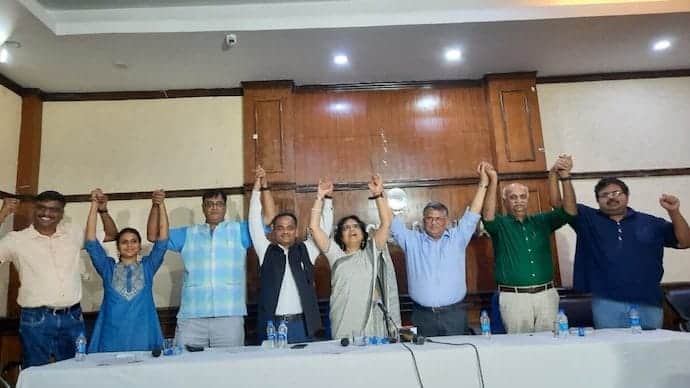
The alliance formed by the teachers’ associations aims at “reclaiming the DUTA from the cronies of the ruling dispensation and defend public higher education.”

10 Delhi University teachers’ organisations and 4 independent teachers have come together to form the Democratic United Teachers’ Alliance (D.U.T.A) to contest the Delhi University Teachers’ Association (DUTA) 2023 polls. Ahead of the elections, which will witness over 10,000 academics of the University casting their votes to elect the leadership, the alliance has announced Dr. Aditya Narayan Misra as the joint candidate for the post of DUTA president. The teachers’ organisations have joined forces to challenge the BJP-RSS affiliated National Democratic Teachers Front (NDTF) in the upcoming DUTA elections scheduled for September 27. The DUTA elections are expected to witness a tough contest between the D.U.T.A and the NDTF, which emerged victorious in 2021 after a 24-year hiatus. AK Bhagi was elected as the DUTA President, defeating his nearest contender, Abha Dev Habib by a margin of 1382 votes.

The Democratic United Teachers Alliance, formed with the aim of “defending public education by reclaiming DUTA”,  is a coalition of multiple groups including Congress’s Indian National Teachers’ Congress (INTEC), AAP’s Academic for Action and Development Teachers Association (AADTA), the Left-leaning Democratic Teachers’ Front (DTF), and various independent teachers’ associations such as the Common Teachers’ Front (CTF), Delhi Teachers’ Initiative (DTI), Independent Teachers’ Front for Social Justice (ITF-SJ), and Samajwadi Shikshank Manch (SSM) and the Voice of DU Adhocs.

There is an immediate and serious need to reclaim the DUTA as a teachers’ collective that works in defence of public-funded education and rights of teachers and students in the forthcoming DUTA elections,” – the joint statement by D.U.T.A read.

At a press conference on August 25, held at the Press Club of India, Prof. Nandita Narain, former DUTA President said that the current NDTF leadership had turned the union office into a “department of the administration which slaughtered thousands of good teachers in the ongoing recruitment drive.” While the teachers’ movement in the country looked for guidance and inspiration from DUTA to reclaim the rights of the teachers, the alliance alleged that the DUTA leadership failed thousands of ad-hoc teachers in their quest for permanent jobs after decades of service.

We are here together to safeguard the dignity and security of all teachers. We are here to defend full public funding and build public opinion against the privatisation and other sinister designs of NEP, 2020. We are committed to absorption of all existing ad hoc and temporary teachers and reinstatement of those who have been displaced during the last two years, while protecting the services of those who have already secured permanent appointment.” – read a statement by the teachers’ alliance.

 The Academic Council of Delhi University, in its meeting held on 11.8.2023, reported a letter from the UGC granting approval to DU as a Category 1 – University under the Graded Autonomy Regulation. By permitting the University to function on a self-financing basis, the D.U.T.A alleges that the regulation would pave the way for commercialisation and deprive the University of necessary Government grants for teaching-learning and infrastructure.

Salaries, promotion, and pension will all have to be taken care of through self-financing. No expectations of funds can be kept from either the University Grants Commission or the Government. Will teachers be displaced? Are we handing over the entire University in private hands? Will the character of the University remain what it is?”- commented Prof Narain in the press conference on Friday.

 Prof. Narain, Convener of the Democratic United Teachers’ Alliance, stated that the policy-driven decline in the academic quality of public universities is best demonstrated by the new version of the four-year undergraduate programme (FYUP), which carries a plethora of anti-academic moves to undermine the integrity of various disciplines.

 The DUTA leadership has refrained from raising their voices about the degradation of academic quality due to the National Education Policy (NEP), 2020. A number of academically vacuous courses have been introduced in the name of most Value Added Courses and Skill Enhancement Courses, which add neither to values nor skills, and leave students too exhausted to focus on the core academic disciplines. On the other hand, internal assessment has been increased from 25 to 45%, with a new component of continuous assessment. This, given the massive reduction in teaching-tutorial-practical time, is an academic fraud. None of these changes were brought after consultation with teachers.” – mentioned the statement released on August 25.

 The statement by D.U.T.A highlights the concern that self-financing by institutions will be undertaken by loans, which will be repaid through increasing student fees for “commercially viable courses” and discarding “uneconomic” ones.

Massive fee hikes will follow, exacerbating the exclusionary tendencies that have been already initiated by the CUET process. Even if the constitutionally mandated provision of reservation is retained (though it finds no mention in the NEP document), students belonging to deprived sections will be excluded through the back door of high fees.” – added the statement.

 Claiming this as “the death of higher education, DUTA joint candidate Dr. Aditya Narayan Misra, of the AAP-affiliated Academic for Action and Development Delhi Teachers’ Association (AADTA), urged teachers to join hands and fight for the withdrawal of the National Education Policy,2020.

Despite our dissent, the fees for certain courses under the Law Faculty were approved at nearly Rs.12.5 lakhs, the same courses which were being taught at a fee of Rs 5000-7000. How is this “greater autonomy?”. This should not simply be a reporting item that is brought and told to us. The students’ future depends on it, and the teachers’ future depends on it- why are such decisions being imposed without due discussion? The DUTA has failed us. It is being used as an extension to privatise and commercialise higher education.” – remarked Misra, a three-time president of DUTA.

 Clause 19.2 on Graded Autonomy in the NEP 2020, which envisages that all public colleges and universities will become “independent, self-governing institutions” for the governance of which “a Board of Governors (BoG) shall be established consisting of a group of highly qualified, competent and dedicated individuals”, has also been opposed by the alliance. They fear that the BoGs will govern institutions without external interference and make decisions concerning the “incentive structure” unilaterally without reference to UGC regulations.

The Board of Governors will have the complete autonomy to establish new courses and curriculum and hire and fire as per will, with recruitment of contractual teachers and foreign faculty being given more importance. Post independence, we established institutions like the D-School, the IITs, the IIMs, and the English, Commerce and Sociology Departments – but we were always self-sufficient in devisiong and teaching our own curriculum. Why do we need foreign faculty now? They will display the foreign teachers for 4 months and use it as a tactic to raise fees. We are witnessing the biggest privatisation deal of India.” – said Misra, who has been teaching Political Science at DU since 1986.

Democratic Teachers’ Front (DTF) Secretary, Abha Dev Habib, remarked that the reluctance of the DU administration to form the governing bodies of colleges administered by the Delhi Government will formalise the dependence of public higher educational institutions on private corporates.

 DU authorities have packed the Academic Council (AC) subcommittee for academic affairs with NDTF members whose only role is to subvert statutory powers of Committees of Courses (CoCs), Departments and Faculties, and impose unacademic changes in syllabi in keeping with their agenda of saffronisation. The DTF teachers of DU have decided that public higher education cannot be redeemed if the current leadership is successful in its aim of converting the teachers’ collective into a patronage dispensing tool to further NEP through undemocratic demobilisation.” – remarked Habib.

Alleging that NDTF-led DUTA remained silent during the mass displacement of ad hoc teachers in the University, the alliance asserted that the teachers’ union’s claims that displaced teachers are being absorbed elsewhere are not supported by transparent data.

What is most reprehensible is that instead of taking up the cause of all teachers, the leadership has been selective and discriminate. It is the first time in the history of DUTA that a large number of teachers are afraid of displeasing their own elected representatives,” the statement added.

 The alliance claimed that the outgoing (present) DUTA committee has been hand-in- glove in furthering anti-academic and anti-teacher moves. It has also undermined the functioning of wider trade unions of teachers such as FEDCUTA that are fighting against privatisation and for the restoration of the old pension scheme.

 The D.U.T.A. is committed to ensuring absorption of all existing ad hoc and temporary teachers, reinstatement of those displaced in open positions, and protection of services of all permanent teachers, with counting of past services at all levels of promotion and restoration of the Old Pension Scheme, and also for the protection of service conditions of Librarians and teachers of Physical Education. It will launch an effective struggle to strengthen public-funded education by demanding a rollback of NEP2020, Graded Autonomy and all such attempts to privatise our public universities.” – the statement by D.U.T.A concluded.

Prof. Abha Dev Habib said that this unprecedented unity of different groups comes in the light of the “gravest challenges confronting the teachers, students and non-teaching employees of DU”.

There has been mass displacement of serving temporary and ad hoc teachers with the active connivance of the NDTF leadership and especially in institutions helmed by those who are part of the ruling dispensation. The institutional murder of Samarveer was possibly the abysmal low to which the state of affairs in DU have descended.”, Habib, a Professor of Physics at Miranda House, commented.

 The statement by the alliance claimed that 80% of serving ad hoc teachers have been displaced in the interviews held recently, most of them in colleges headed by the Principals close to the ruling dispensation.

 I have been part of Delhi University all my life. I have been an ad-hoc teacher and was thrown out so I understand how it feels. I can connect to the pain of the people who have been ousted. Regularisation of ad-hoc teachers would be one of our main agendas.” – mentioned Misra, a professor at Dyal Singh College.

 On Friday, Delhi Finance Minister Atishi expressed displeasure over the non-release of Rs.100 crore to Delhi Government’s 12 fully-funded DU colleges after a representation was submitted by Dr.Aditya Narain Misra and DU Executive Council (EC) members Seema Das and Rajpal Singh appraising her of the delay.

 On 28th June 2023, I approved the release of Rs 100 crore as the second quarterly grant was announced. But this fund has not reached colleges yet despite one and a half months having lapsed. The faculty and the ministerial staff of these colleges cannot suffer due to administrative technicalities and the finance department should have a facilitatory approach over these financial issues. Hence, the funds should be released without any further delay.”- Atishi said in an official statement.


 D.U.T.A Press Conference held on August 25 – D.U.T.A. Press Conference, Save Public Funded Education

 Featured Image Credits: India Today

 Read also: After a Three-Year Hiatus, Delhi University Students’ Union Elections Are Back – DU Beat – Delhi University’s Independent Student Newspaper


Manvi Goel

[email protected]

While the University Officials work on finalizing the dates, student leaders have started preparing for their election campaigns.

The student elections at Delhi University are scheduled to take place in September. The Delhi University Students Union is the representative body that stands for the majority of colleges and faculties’  students. Aside from this, elections are also  held each year for the students union at every college. The Delhi University Students Union is elected directly by the university’s and its member colleges’  students. Every year, the elections are typically held in August or September. Occurring every four years, it was last held in 2019, and was halted as a result of the Corona virus pandemic and its effects on the academic calendar.

Officials from the university stated earlier in July that election preparations will begin as soon as the university finished the admissions process for the upcoming session. Although the date has not yet been confirmed, DU registrar Vikas Gupta stated that it would be announced shortly and that one may anticipate it to happen in the final week of September.

Vice-chancellor Yogesh Singh, who will oversee the election process, named office bearers and members for the central council of the Delhi University Students’ Union (DUSU) for the academic year 2023–2024, according to a University announcement dated August 1. The VC also appointed college principals and heads of institutions to serve as office holders and council members in their respective colleges. The chief election officer, Professor Chandra Shekhar, has stated that the employing of Electronic Voting Machines (EVMs) will be done during the entire election process, which is expected to last between 10 and 12 days. In 2019, the Akhil Bhartiya Vidyarthi Parishad (ABVP) gained three seats, while the National Students’ Union of India (NSUI) gained one. Akshat Dahiya of the ABVP served as President, Pradeep Tanwar as Vice President, Ashish Lamba as Secretary, and Shivangi Karwal as Joint Secretary for the 2019–20 term.

Elections will be held for all four of these positions once again this year. All around the University, especially in the North Campus, preparations are being made for the same. While student leaders are planning, students are actively responding. The current president of the ABVP, Akshat Dahiya, states that they are getting ready to nominate their student leaders and will also begin disseminating information about the election procedure for students. Additionally, other organisations like the All India Students’ Association (AISA) and the Students’ Federation of India (SFI) are prepared to start their election campaigns. The previous president of SFI says that they will focus on issues that are specific to students, such as accommodation and other problems that students have on a daily basis, whereas ABVP will centre their election campaign on the four-year undergraduate programme, FYUP. In the meantime, the elections for the Delhi University Teachers’ Association (DUTA) have been set for September 27. The election calendar states that teacher nominations must be submitted by September 1. At the north campus of DU, the Arts Building complex and Satyakam Bhawan will serve as the locations for the voting.

On August 12, a number of teachers’ organizations, including the Democratic Teachers’ Front, merged to form the Democratic United Teachers’ Alliance. Among them were the Democratic Teachers’ Front, the Academic for Action and Development Teachers Association, and the Indian National Teachers’ Congress, which is a branch of the Congress. They declared Aditya Narayan Misra as a potential candidate for the position of DUTA president.

The University of Delhi student elections are unique and prominent, adding to the capital’s already politically charged climate. These elections hold value for the future of the University and also reflect student sentiments.

Read Also : https://dubeat.com/2023/07/12/dusu-launches-one-day-dusu-presidents-scheme/
Image Credits : Telegraph India

Priya Agrawal

The absorption of temporary teachers initiated last year has been heavily scrutinised for being unjust and highly opaque, post the death of a DU professor who, after years of service at Hindu College, was told to vacate his position. This has sparked several protests and questioned the credibility of the recruitment process.

The suicide of a 33-year-old former Delhi University ad-hoc professor, Dr. Samarveer Singh, has sparked student and teacher-led protests throughout campuses. The deemed “institutional murder” of the professor hailing from Barna, a small district in Rajasthan, has led many to question the level of transparency and fairness in the system of inducting permanent faculty into central universities. Professors view this as an assault on their right to employment and dignity, while students have expressed great concerns and discontentment at the loss of a talented pedagogue and the unjust removal of plenty of other immensely competent academicians.

Professor Singh died on April 26, allegedly by suicide. His body was found hanging in his room in a rented apartment in outer Delhi’s Rani Bagh. As per police reports, empty liquor bottles and cigarette packets were found in the room. No suicide note was found. He was staying put in the accommodation with two of his cousins.

“The top floor of his house has two rooms. One of the rooms was locked. First, the mesh of the iron door was cut, and then the wooden door was broken. We took him to MV Hospital, where he was declared dead on arrival.” – Harendra Singh, Deputy Comissioner of Police (DCP)

Dr Samarveer, who had been working as an ad-hoc faculty member in the philosophy department for the past six years at Hindu College, was one of the many professors who were being displaced after the interview rounds for the recruitment of permanent faculty at Delhi University that started in September 2022. Despite having done his master’s from Hindu College itself, completing an M.Phil. degree, being enrolled in DU for a PhD, and having had the experience of teaching at Hindu College for the last few years, Professor Samarveer was mercilessly, in an utterly unjust manner, told to vacate his office merely on the basis of a highly opaque, unfair interview.

“It is very unfortunate and upsetting, and we are all shocked. Across colleges, the recruitment process is currently underway, and selection committees are holding interviews. Even though he had been associated for quite some time, he could not be regularised. The displacement happened in the first week of February, and he was asked to look for other opportunities. However, we had adjusted him for some time, but after that, it was not possible”.- Prof. Anju Srivastava, Principal Hindu College

The professor’s family and colleagues have spoken about his helplessness and distress. After being displaced in February, he was called back to Hindu College. Owing to his love for his college, Dr Samarveer decided to give up the position of a guest lecturer at another college, but no more than twenty days after resuming work, he was told to leave once again. Creating an insecurity this intense, constantly keeping professors in the dark, and treating the pedagogues of our nation this mercilessly exhibits the diminishing respect of academicians in the education sector. Such circumstances are grave enough to create an environment conducive to the development of feelings of constant self-doubt and helplessness, which is probably what led to the unfortunate loss of Dr Samarveer. Losing out on employment in an institution to which one has devoted so many years can be disarming for anyone.

“Sir was let go in February. It came as a huge shock for all of us, considering he wasn’t even a guest lecturer and had been teaching at the college for years. Then, after being called back, he was told to leave again. April 11th was his last working day, and April 17th was the last day I saw him. He was replaced by teachers far less competent, teachers who don’t even come from a philosophy background. All thanks to the highly problematic recruitment system. I regret not being able to spend as much time with him; I wish I would have.”- Keshavi Sethi, a student from Hindu College in conversation with DU Beat

Recent events have shown how there is a greater normalisation of recruiting mass ad-hoc teachers, paying them meagre salaries, conveniently displacing them, and brazenly prioritising those with political affiliations. Under such circumstances, where does a teacher hailing from humble grounds without “appropriate” connections stand? This is a slap in the face to the legacy of exemplary pedagogy that Delhi University has long been known for. Be it the attempts to revise the syllabus, politicise the learning spaces, rob students of valuable pedagogues, or displace them with political puppets, the University’s increasingly corrupt systems are failing everyone. Several professors from various organisations like Delhi University Teachers’ Association (DUTA), Democratic Teachers’ Front (DTF), All India Students’ Association (AISA) have expressed their concerns on these perils.

“It is a fact that a sizable number of long-serving ad-hoc teachers, who otherwise fill all the criteria and have worked very hard for their institutions, have been displaced in the recent interviews. With permanent appointments being made through a so-called “open” recruitment process which has seen massive displacement, there expectedly looms in many ad-hoc teachers a sense of betrayal as they have been rendered without a livelihood after having taught in colleges/departments and contributing to the University for years. They have been falsely promised that they will be retained and regularized in open interviews, which of course has remained a hoax. In majority of these interviews, it has been felt that merit and past experience do not count, and that it is rather non-merit factors like nepotism, cronyism, favoritism, adherence, liaising, influencing and obeisance that are at play.” – Prof. Maya John, faculty at Jesus and Mary College and member of DU’s Academic Council, in a Facebook post

A deplorable state of affairs can be witnessed in the statistics presented in the Parliament by the Union Education Ministry. Of the total number of teachers employed in central universities, 3904 were in temporary positions; of these, 1820 were on a contractual basis and 1931 were guest faculty, with over 6500 permanent positions yet to be filled. 2,252 seats of these were for unreserved categories, while the rest were for OBCs, STs, and SCs. Dr Samarveer himself was eligible for application to a permanent job through the reserved category but was still denied a job.

“Academia is not as attractive a profession as it was earlier. It takes years to gain expertise, the necessary qualifications in one domain to be able to get a decent-paying job in the teaching sector. It is disheartening to see how the maltreatment of teachers is leading to a degradation in the quality of pedagogues owing to a lesser number of people opting into the profession. The career of all teachers is in a perpetual crisis. Under such conditions why would one want to become a teacher?” Dr Abha Dev Habib, a professor in Miranda Hourse, in conversation with DU Beat.

She continues,

“For as long as 10 years there were no appointments to permanent positions, with a greater number of ad-hoc and guest lecturers being appointed. 2017 was the year DUTA raised demands for absorption of temporary teachers. The deterrence to appoint permanent teachers stemmed from the larger conspiracy to weaken teachers unions which speak up against injustice. 2022 onwards, after great pressure the government finally opened up to the prospect of appointing permanent teachers. A huge number of teachers were awaiting their due. Injustice has been done to so many who have served their institutions for years. Services were taken from people, and were dishonored. There is a systematic rigging in the system which prioritises spouses, friends of office bearers over merit. Loss of a breed of exemplary teachers can cause an irreversible damage to the education system of our nation.”

Following the unfortunate demise of Dr Samarveer, several student and teacher unions have taken to the streets and college campuses to protest against the unjust system. The DUTA (Delhi University Teachers’ Association) held a protest on Thursday, followed by a condolence meeting. AISA (All India Student’s Association) has held protests against “brutal injustice to teachers.” Student groups like SFI (Students Federation of India) at Hindu College organised a condolence meet on April 27, the same day the college was celebrating its annual fest, Mecca, in full swing. Many students have also expressed their concern and frustration over the lack of acknowledgement and action on behalf of the college administration, the University, and even the student body.

“From diligently taking his classes to giving us an off whenever it got too hectic for us, Sir was a gem of a person. It’s sad to see that the college administration didn’t even bother to acknowledge the loss of such a brilliant mind while celebrating it’s annual fest. The ad-hoc issue is no longer costing professors their jobs, it’s costing them their lives, their dreams and their souls.”- Himasweeta, final-year student at Hindu College

Among the ongoing protests was the Joint Press Conference dated May 2, held at the Press Club of India. Students and teachers of DU met the press regarding the ‘orchestrated conspiracies’ of favouritism in recruitments against the backdrop of Dr Samarveer’s suicide. Teachers from CTF (Common Teachers Forum), Democratic Teachers Front, Delhi Teachers Initiative, and Samajwadi Shikshak Manchak participated in the conference. Representatives from DU’s academic council and DUTA were also present. The institutionalisation of NEP was severely scrutinised, with increasing privatisation, commercialization of education, contractual hiring, and an orchestrated attempt to weaken and demobilise the teachers union forming the core of the conversations. The speakers included Nandita Narain (President of DTF, former member of DUTA), Ratan Lal (senior activist from Hindu College), Udaibir Singh (member of the academic council), Aftab Alam (Zakir Hussain College), Maya John (academic council member and JMC professor), and Uma Raag (from IP College).

During the conference, Rusham and Keshavi, former students of Dr Samarveer Singh, expressed their frustration with the current apathy of the university community. Puneet and Sama, Hansraj College students, spoke about how the best of the faculty was being replaced methodologically, with 50–60 teachers having lost their jobs in their college. The speakers also highlighted the silence of the DUTA leadership and its inability to stand against political cronyism. Discussions on the selection committee’s selective work on furthering the interests of the ruling majority were held. It was reported that some interviews did not last longer than 2 minutes and seldom included actual meaningful questions. There are instances of candidates being humiliated by the board. All speakers finally agreed upon the solution that all teachers be absorbed, keeping the reservation roster in mind. All the teachers who attended the press conference have sent a letter to the Vice Chancellor underlining these issues and demanding justice for Dr. Samarveer and all other ad hoc and guest faculty of the University.

Read also: DU Teachers Stage Protest for Absorption of Ad-Hoc Teachers

Featured Image Credits: Rediff.com

Rubani Sandhu
[email protected]

Abha Dev Habib (treasurer of DUTA), in conversation with DU Beat, sheds light on the impasse between the Delhi government, and the DU administration and teachers, requesting the students to stand in solidarity with the teachers of Delhi University and gauge what has been happening on this front.

On 9th March, DUTA called for a complete DU shutdown, requesting teachers across its 70+ colleges to go on strike. Ms Abha, in this interview, goes on to elaborate on the .. of the issue.

Can you brief us about all the major developments, action steps and a timeline of all the events until now?

The whole standoff between the Delhi government and the University of Delhi started in 2019. And there was a very ugly tussle between the University of Delhi and Delhi Government over Governing Body formation: the formation of Governing Bodies was delayed, and also, who will become the chairperson kind of situation. And this standoff resulted in the stopping of grants-in-aid by the Delhi government to these colleges. 

There are 28 colleges out of which 12 are hundred per cent funded by the Delhi government. The centre gives money to the Delhi government so that the government can forward it to these colleges. So a hundred per cent in that sense, the money comes from the Delhi government. Now, they stopped the salaries of the employees and ever since then, the tussle began. DUTA would intervene and would hold protests, and only then there was a release of salary.

It is extremely unfortunate that through the pandemic, the Delhi government maintained this style of functioning where they would withhold the grants-in-aid. Employees today include a large number of non-teaching staff working on a contract basis, and ad-hoc teachers, thus making it impossible for them to sustain themselves in an expensive city like Delhi. A lot of state universities have already been destroyed by this kind of attitude of the government that salaries are not released on time, and therefore, nobody wants to work in such units.

DUTA wrote to the government, enlisting all these concerns, and even held physical protests during the pandemic, but the government did not melt. Grants should be released so that salaries come on time which then, in turn, helps the teachers and employees to perform to the best of their abilities. Now, I mean, with a lot of restraint due time, these teachers function because we did not call for a strike through the pandemic: teachers were involved in admissions, and OBE examinations; teachers continued to teach despite the fact that they had not got salaries, and they also had to go to court for release of salaries. It was only in November that the salaries were finally released Saturdays and in November, that is released only because the court instructed the ligament to do so, or, uh, November Quebec, uh, uh, there was a, such a short one is, or the inordinate delays in grant.