Tag

Delhi University

Browsing

Dyal Singh College faces a big administrative crisis as the Principal’s office gets sealed over ongoing probe on financial and administrative irregularities.


Dyal Singh College, faces a big crisis as a part of the ongoing tussle between the Principal and the Chairman. It all started when, on September 24, 2018, Governing Body [GB] chairman Mr. Amitabh Sinha issued an order, sending the Principal on a ‘long leave’. The reason stated was alleged him of being guilty for the financial and administrative irregularities. The Principal, I.S. Bakshi was charged with serious allegations regarding the state of financial and administrative irregularities and was asked to avoid visiting campus during the inquiry against him. Despite the notice, Bakshi has been continued coming to college, chiding the allegations as “illegal” with mala fide intentions.

The tussle grew stronger when the Chairman overturned the decision of the college’s Election Committee to cancel the election of Rohan Awana, an ABVP member, as president.

Things escalated as Mr. Sinha sealed his office on Friday, claiming it had been occupied ‘without authority’. The Principal also received a letter from the college’s bank stating that no transactions will be processed with his signature, as they have been mandated by the GB to conduct all official transactions through the officiating or the acting principal.

In a letter addressed to the chairman dated October 10th 2018, the branch manager of State Bank of India, Lodhi Road stated that the appointment of the acting principal should be done in accordance with the prescribed guidelines of the Ordinance XVIII which states that in absence of the Principal, the vice-principal will act as the principal, and in the vice-principal’s absence, the most-senior teacher will take over the administration and financial duties. This stands for colleges other than those that are maintained by the Government Of India.

According to a report in Jagran Josh, the tussle between the Principal and Chairman is reportedly causing financial losses to employees. DSC teachers’ Association’s president PK Parihar stated that the money is not being transferred into their PF account because of which they are losing interest and the medical reimbursement of all, especially the pensioners, is under threat.

Following the sealing of the office, Bakshi will be allowed inside the college campus only after the convener of the inquiry committee, Mr. OP Malik, retired IPS officer and DGP, provides written information, according to recent sources on the issue.

Sources: The Indian Express, Jagran Josh

Feature Image Credits:  The Hindu, image of the notice from the college’s official website


Avnika Chhikara

[email protected]


Yogi Sadhguru paid a visit to SRCC recently, as a part of his campaign titles ‘Youth and Truth’. An analysis of the advice given by innumerable motivational speakers in The University of Delhi reaped interesting outcomes.

Sadhguru, a renowned yogi, mystic, and founder of the NGO Isha Foundation, was at Shri Ram College of Commerce on 4th September 2018. The biker and English-speaking guru was accompanied by his entourage, following a suspension of lectures and extensive police barricading, extending from SRCC till Patel Chest Institute (bit much for a yogi, perhaps?). Contrary to popular belief, he wasn’t there to preach, and true to the essence of his campaign, ‘Youth and Truth’, his session included but wasn’t limited to, genuine advice about goal setting, relationships, confidence building and parenting. Once the initial aura of celebrity had subdued, and snapchat stories had been uploaded, people started to really listen. This was probably succeeded by the realization that the speaker hardly partook in original preachings, instead, like most motivational speakers, he simply validated already existing feelings and knowledge. This is a common occurrence, and it is this validation and connection that students seek from motivational talks/speakers, in the University of Delhi.

Celebrities, leaders, motivational speakers, members of the elite academia, and those who made it big by pure chance; the students of Delhi University have stood firsthand witness to it all, via panels, seminars, conferences, conclaves and other events similar in nature.

Students flock to these events in large numbers, seeking motivation, inspiration, enlightenment, or to simply catch a glimpse of a famous entity. However, when reconsidered, it seems as if all of these speakers, regardless of their field of expertise, are making the same point. You seldom come across anything radically enlightening, rather receive recycled gyaan.  If you’ve heard the terms ‘hardwork’, ‘leadership’, ‘innovative thinking’, ‘bringing something new to the table’ and ‘being humble’ one too many times; congratulations! you have unwittingly become a victim of nebulous direction.

Everything makes sense and nothing makes sense. Vague and nebular advice is the new preaching. Nothing anybody says adds any intrinsic value to the lives of students, their leaders themselves often presenting recycled ideas while simultaneously urging students to be ‘innovative’. One reason for the same is that there is no set path to success, and students are often too delusional to realize that. Students are burdened with the desire and/or pressure to overachieve, and often this desire arises not from within, but as a result of environmentally generated competition.

Leaders and speakers are an important part of college culture, but often, making examples of the small fraction of people who ‘made it’ advertises a lifestyle that is probably already out of stock. There is no market equilibrium; the demand and supply are poles apart, and in the end, students are suffering.

Nikita Bhatia

[email protected]

The board is set, the pieces are now moving. The battle is won, but the cause is lost. Do you sense the same?

The roads are all strange these days, without the smattering of a thousand flyers and pamphlets. It is almost disappointing to not see the flyers fall around the campus. Almost consoling are the misspelt names on the Wall(s) of Democracy. As the campus finally breathes in all its silence, the screaming political sobriety is in question. So, what follows now? Is it too early to recede to our apprehensions? Some might agree, but then there was never much space for agendas in those swanky BMWs on roads so choked with flyers. Beards and gold rings drove these SUVs and sedans, and beards and gold rings drive politics now.
Politics is a progression in the sense that it has always followed patterns. There are changes, but not necessarily as we would like to have them. After a raging contest of power in the past fortnight, the election results were in favour of some, while many others were left baffled. In an endless volley of blames and shaming, we saw some candidates rise to power recently. You hope to make sense out of it, but it all reduces to a clout of pointless manifesto promises. How long before these promises are fulfilled? Will the year be enough? Anyone who is even remotely familiar with the idea of politics will know what it means in practice. Agendas are good, but for a change, we would like to see some action too. Ironically, the only action we see is the action of the fist. In multiple brawls and the loss of public property, what is damaged most is the very idea of politics. Most of our representatives think that all politics has to offer is power, and power in India is scarce anyway. Responsibility is fantastical, so we cannot use this word for our politics. Politics is always about differentiated representation because two opinions can never be alike. This is what democracy implies, after all, it is the freedom to choose a representative. However, politics has become more divisive than ever before – it is driven by everything but democratic ethics. In DUSU, caste politics prevails, for instance, and in the national perspective, the division extends to manifold realms.
This year, like most years, political outfits claimed their primary objective to be that of women safety and claimed to improve their representation, the opportunities available to them, and provide a better environment to them in general. Introduction of U-special buses has been on the card since long, and new ideas like under INR 10 thali have been introduced this year. What we fail to observe amongst these tall promises is the question of what could possibly be their plan of action here? Being apolitical is a choice, but indifference can only mean ignorance that refuses to see the truth, and ignorance seems to sit at the core of all our problems. It is only right then, to be informed, aware, active, and to fight back with our form of dissent laced with logical arguments. The agendas might find fulfilment or hope to do so still, but only with an initiative from our side and that of the elected leaders.
Power gives you the strength to change, to reinvent, and to exercise an idea for the betterment of a cause. No one is wrong to expect this from those who stand for the upholding of power, but we all know who has the last laugh.
Kartik Chauhan


The University of Delhi is planning to start a new course on entrepreneurship from the next academic session i.e. 2018-19. The course will be a three-year degree program and will be called BBA Entrepreneurship.

The standing committee on academic matters met on Monday, 20th August 2018 and welcomed the proposal to introduce a course on Entrepreneurship. The course is yet to be approved by the academic council. It will be established under the Faculty of Applied Social Sciences and Humanities.

For admission into the course, there will be a three-stage procedure. The first round will be a national level entrance test, followed by a group discussion round as the second stage, while the last stage will include personal interviews. The entrance test will be designed to check the logical and quantitative reasoning of the students. During the course of study, the students will be expected to complete two internships and submit a dissertation by the end of the third year. The course will follow the Choice Based Credit System (CBCS) and a total of 158 credits will be awarded to students completing the course.

DU Beat contacted Ms. Poonam Verma, Principal of Shaheed Sukhdev College of Business Studies (SSCBS) who made this proposal. She remarked, “The course will start from next year. The academic council and executive council of the University will pass the proposal in  reasonable time so that the admission process can get started for the next academic session. Once we get the approval, we are going to get started with it.” She informed that the course will be first of its kind in the University. Ms. Verma also spoke about the two most sought-after courses in University of Delhi- Bachelors of Management Studies (BMS) and Bachelor of Business Administration in Financial and Investment Analysis (BBA-FIA)which are available in her college. The course, BBA Entrepreneurship, will start from her college if approved. She hopes that other DU colleges also welcome the course so that maximum students get the benefit. Ms. Verma also mentioned the incubation centre in SSCBS,  which could provide a progressive and comprehensive platform to the budding entrepreneurs.

The course aligns with the Delhi government and Central government’s initiative for skill development and entrepreneurship at academic and undergraduate levels. Currently, very few universities in India offer BBA Entrepreneurship and most of them are private institutions.


(With Inputs from TOI)

Feature Image Credits: DU Beat Archives

Anoushka Sharma
[email protected]


From sheltering Chandra Shekhar Azad to jumping over the walls of confined campuses for leading a protest, DU students have a story of their own to tell about their contribution to the Indian freedom struggle.

The University of Delhi (DU), established in 1922, was supposed to be the centre of educational and cultural control for the Britishers. The University received funds amounting to INR 1 lakh per year. Since the British had the monetary power over the DU colleges, they threatened to withhold government grants and forced the college principals to take strict action against any politically active student and staff. In fact, in September 1942, the government cancelled the wheat permits of hostels of three colleges of Delhi University – Indraprastha College, Hindu College, and Shri Ram College of Commerce. Although the British didn’t give any reason for this action, it was seen as an act of vengeance against the colleges for participating in the freedom struggle.

Despite that, DU contributed actively in the form of cadre and infrastructure in the Indian freedom struggle. During the Civil Disobedience Movement, they put up the national flag on the flagstaff in campuses. Even the college buildings served as hiding places for revolutionaries and hosted crucial conferences.
Vice Chancellor’s office The building which now houses the Vice Chancellor’s office was earlier called the Viceregal Lodge. It served as the residence for five Viceroys and hosted several crucial conferences. Bhagat Singh was confined here and his trials were held in this very building too. It is also said that the Gandhi-Irwin pact came into existence in this Lodge.
Ramjas College This beautiful campus was surrendered during World War II for the use of Allied forces. Around the same time, India was taking the opportunity to revolt against the Great Britain, which had weakened due to the war. A group of Ramjas students was arrested and jailed for its involvement in the freedom struggle. Their names have been inscribed on a plaque, near the college auditorium.
The hostel students also sheltered Chandra Shekhar Azad, while he was evading the British government. They kept him in hiding, and for months disguised him as a Sikh student from Pakistan.
St. Stephen’s College Several significant leaders including Lala Hardayal, the first revolutionary, and Sir Chhotu Ram, the leader of Unionist Party of Punjab, were from the St. Stephen’s College.
Students and staff of this college protested in several ways, for example, C. B. Young, an English professor wrote a column condemning the Jallianwala Bagh massacre. In 1946, Sameeruddin Khan, a Stephanian, disrupted the morning assembly and with 50 to 100 boys, they boycotted classes, organised a protest march, and pulled down the Union Jack from the flagstaff. Charles Freer Andrews, an English teacher in the college, was close friends with Mahatma Gandhi and Rabindranath Tagore and even went to South Africa in 1914 to persuade Gandhi to come to India and lead the freedom movement.

Hindu College This college was the centre for political debate and action particularly during the Quit India Movement. Several students and teachers of the college went to prison following the movement.
Since Hindu College had a Students’ Parliament back then, it became an easier platform for many national leaders including Mahatma Gandhi, Pt. Jawahar Lal Nehru, Sarojini Naidu, and Subhash Chandra Bose to motivate and guide the youth of the nation.
Indraprastha College for Women Writing about the bravery of students of Indraprastha College for Women (also known as IP College), Dr. Aparna Basu, a professor of history at DU and author of the book University of Delhi (1922-1997), writes, “During the Quit India Movement on 10th August 1942, a vociferous gathering of Hindu College students and ladies from Indraprastha College collected outside Stephens’ and urged Stephanians to join them in a procession to support the Congress leaders who had been jailed the previous day. The crowd marched down Alipur Road, passing enroute IP College, whose authorities had shut the gates to prevent the girls from joining in. They resourcefully jumped down the walls assisted by willing Stephanian hands and the procession continued down Chandini Chowk, shouting slogans.”

Dr. Meena Bhargava and Dr. Kalyani Dutta, in their book, Women, Education, and Politics: The Women’s Movement and Delhi’s Indraprastha College, mention that the students of IP College also started a charkha association in college against the principal’s order.
Zakir Husain Delhi College Situated in central Delhi, the 326-yearold Zakir Husain Delhi College predates Delhi University by over 200 years. At the time when the British would demean our literary heritage by saying, “A single shelf of a good European library was worth the whole native literature of India and Arabia,” this college established international standards of education in the medium of Hindustani or Urdu. Its old walls have braved the Revolt of 1857. During the partition of India, the college was set on fire by the mobs but somehow the staff members managed to protect the library.
The Foundations of Delhi University Delhi University was established 96 years ago with only two faculties. Since then it has flourished to be one of India’s largest universities with 90 colleges, 87 departments, and more than a dozen centres. But what was the beginning of this enormous educational institution and what is its inspiration?
The University of Delhi came in existence in 1922 and saw the affiliation of St. Stephen’s College, Ramjas College, and Hindu College, which was closely followed by Zakir Husain Delhi College and Indraprastha College for Women. The importance of instituting DU came to the British as an exercise to mitigate the attempts by nationalists to set up their own institutions. A bill to reorganise Indian universities was passed and came into effect on 1st May 1922. We celebrate this date as the Foundation Day.
Mr. Hari Singh Gour, a distinguished jurist and social reformer, served as the University’s first Vice-Chancellor and pioneers like Mr. Daulat Singh Kothari and Mr. Panchanan Maheshwari were part of the faculty. With its motto, ‘Nishtha Dhriti Satyam’ (Dedication, Steadfastness, and Truth), the University has time and again shown its contribution and commitment to nation building. DU has produced an illustrious array of alumni across the fields who went on to become presidents, scientists, and artists.
Be it the Indian independence movement or the democratic struggles of the present times, Delhi University has been on the forefront of all important events. The University that once operated out of Ritz Cinema, Kashmiri Gate, has today expanded its web in all directions of the National Capital Region.

On a lonely day if you press your ear against the college walls, you will hear the whispers of those who came before us. They will tell you their stories of struggle against the British. It will speak of the foundation that has been made and its legacy which is in the making.


Feature Image Credits: Delhi University

Khyati Sanger

[email protected]

Niharika Dabral

[email protected]

As your initial classes begin, so does your fear and anxiety regarding your course. While having second thoughts about the chosen course is a common phenomenon amongst students, knowing how to maneuver through these doubts and uncertainties is important in order to extract the most out of the three years’ undergraduate programme in the University of Delhi (DU).

As the alarm clock resounds and a new morning invites you, your drowsy self gets up and gazes into the mirror. While you attend to your routine morning activities, your mind is shrouded by a cloud of perplexing thoughts.  College is the arena which beholds the foundations of your career. Hence, it is natural to feel minor pangs of anxiety about your chosen course and worry about your compatibility with the same.  However, you must not stress about these apprehensions,  since these are mere insecurities which will fade away very soon.

Every course offered by DU has significance, so don’t get jittery or plunge into a confused state of mind based on assumptions that your chosen course is not adequate or not good enough. Exhibit some gratification. Queuing up for admission in the sweltering and oppressive weather of Delhi to secure your seat in DU is an achievement in itself! Then why do these unwholesome thoughts come into your mind and engulf you in a bout of uneasiness? It is because you haven’t received clarity of your course yet.

The best way to acquire greater clarity would be to undertake some research and understand what exactly your subject of choice entails and what it has to offer.  You may also look for opportunities like internships associated with your field of study to get better insight into the same.

Here are a few points to bust the insecurities:

Research Extensively on Your Course

Thanks to the age of the internet, you will be able to gain access to many websites providing you the information required to conduct an extensive research on your course and the career prospects emanating from it.

Coordinate Your Future Plans With Your Course

Since it is your first year in college, don’t be too hard on yourself. While you don’t need to be ascertained about what you want to pursue in life,  you must start structuring basal ideas about how you can connect the offerings of your course to your areas of interest.

Experienced Faculty Across All Courses

If there’s one thing which makes Delhi University so great, it is the amazing and supremely qualified faculty brimful with years of experience and unparalleled expertise. Your teachers will be able to do away with your qualms once the classes begin and you delve into your syllabi.

Time Heals Everything

Last, but surely not the least, give some time to your course and to the other changes that you have encountered. As Leo Tolstoy would say, “The two most powerful warriors are patience and time.” Give it time as it is an inherent aspect of human nature to invariably take time before  adapting to something unfamiliar. So don’t be under the impression that you’re the only one skeptical about your course.  Once you take a few deep breaths, you will soon be able to comprehend what a privilege it is to get to spend three years in one of India’s most prestigious universities.


Feature Image Credits: Eflux Conversions

Avnika Chhikara

[email protected]

For me, the idea of Delhi from a nondescript town in Assam had been small. It was bounded by red brick buildings of a campus, in the souls of what I considered the crème de la crème of India’s student life. But after a year in this glorious city, after countless kebabs in paranthe wali gali, I realize that there is so much more to it.

I moved to Delhi during August of the year 2017, very pleased with my admission in Miranda House, a college I had hoped would cater to my feminist wings. I encountered a bunch of people there, who amazingly tackled subtle forms of misogyny and sexism with grace and patience. I was proud to be a part of such an institution.

Come winter, me and my roommate went on the quintessential Delhi darshan: meandering through the crumbling lanes of Chandi Chowk, the jaded monuments of Majnu ka Tila, and the looming monuments of South Delhi. All were relics of the history of the city, all enshrined in glorious magnificence. Having a best friend as a roommate means that you get a partner to be insane with and to hang onto that insanity through the nitty-gritties of college life. It is a blessing to have someone so close to you, that you literally sleep on top of each other during winters (because we cannot afford a heater so we proudly rely on body heat). I saw dervishes in Nizamuddin’s famed dargah, cried in its sweltering heat, and let my teeth chatter during winters. I saw the ghosts of the past and the present.

Ghalib once wrote, “I asked my soul: What is Delhi? She replied: The world is the body and Delhi its life.” His words ring true in every cobblestone path, every blade of grass of the city. The world’s life beats in the streets and the blades of grass of Delhi. But it is the University campus that is where I come to roost— Hudson Lane, McDonald’s, Tom Uncle’s Maggi point, Kamla Nagar, Arts Fac, and Vishwavidyalya Metro Station became my daily vocabulary.

There are still great desires to be fulfilled with Delhi. My tryst with its ghosts and its denizens will continue. But I have come to realize that like Ghalib, my soul lies not just with the city but with its people. It lies with my roommate, my friends at the University, with DU Beat, the guards at my college, the rickshaw pullers from Vijay Nagar who know me well enough to know I won’t ride their rickshaws, the professors who seem to grow in stature, and in the fire that burns in every individual of the city. It lies with the ghosts of Edwin Lutyens, Nehru, and Ghalib. For the freshers stepping into the city, I only hope your experience is just as subliminal and yet sublime. That you realize that it is the people of the city who breathe life into what would have otherwise been a lifeless, insipid necropolis.


Feature Image Credits: NDTV

Sara Sohail
[email protected]

When the month of May is taken over by the vigour of fresh University of Delhi (DU) admissions, it is time to recall and pay respect to the culture which these newbies will blend into soon. One of the intrinsic elements of the Delhi culture is the language passed down to us by our fore bearers! To familiarize you with the same, here are 10 words from that language, which will get added to your vocabulary when you spend too much time in Delhi University.


  1. K Nags – Kamla Nagar, a cool hangout spot

Now, if you are part of North Campus, chances are you’d want to chill with your friends after going through hours of torturous classes. One of the cool hangout spots, 5 minutes away from the North Campus is Kamla Nagar. But, are you going to call it Kamla Nagar? Nope, you’re too cool for that. You, thus, call it K Nags!


“Hey, let’s go somewhere nice!”

“Yeah, man. Let’s hit K Nags and take advantage of our Stanza Living ID cards to get student discounts at some happening place.”


  1. Mecca – ‘The’ Fest of Hindu College

When you enter Delhi University, Mecca changes from a peaceful place of pilgrimage to a place with colourful confetti and loud musical concerts! Mecca is the name of one of the most awaited fests throughout the year, in Delhi University. It is the annual cultural fest of Hindu College that takes place every year in March. “I was at Mecca” can never mean you were praying, after you’ve entered Delhi University!


“We’re all heading to Mecca. We’ll be back by 11.”

“Does your PG allow such late nights?”

“Bro, we are Stanzens!”


  1. Soc (pronounced as sock) – Society

You are now a part of Delhi University, so welcome to the real world! We introduce to you a soc your mom can’t help you find. Every society in DU is called a soc because these societies are too active to have the time to say ‘Society’! (Not even being sarcastic!) Deb Soc refers to the debating society; Lit soc is the Literary Society etc. These societies are a great way to take your talent up a notch and be a part of a network of like-minded people.


“Guess who just became the President of Debsoc?”

“How would you even find time to manage academics, Debsoc work, and taking care of things like cooking, cleaning, washing your laundry, etc?”

“Dude, great minds don’t worry about trivial things – Also, Stanza Living takes care of everything for me.”


  1. Fuchcha – A fresher

The word fuchcha traces its roots from the words fresher and bachcha. You are bestowed with this title when you enter college as a first year student. This is the time when your seniors will give you immense attention and build tight friendships with you. All of them will call you a fuchcha, until you suddenly enter the second year and have to do the same for the new set of fuchchas.


“Stanza Living seems to be the preferred choice of accommodation with the fuchchas this year.”


  1. Satya – Satya Niketan

Satya may mean truth to you but you can’t be all truthful about the delayed assignments, missed tests, and low attendance. So, if a DU student is walking on ‘satya ki raha’, they are probably going to Satya Niketan, a cool hangout spot near South Campus.


“Now that we got our proxies, let’s go chill at Satya!”


  1. Companion – A guide book for DU students

It is said that you create lifelong friendships during your college years. However some friendships last only a semester. They remain your ‘companions’ till the final exams and once you clear that, you get new ‘companions’. However, such ‘companions’ must not be underestimated. They are meaningful and useful friendships you can’t do without. English Honours students can probably relate the best.


“My friends and I haven’t studied anything but we’ve got a ‘companion’ which will help us during the exams!”


  1. Superseniors – Seniors to your immediate seniors

If your course is a 3 year one, you will have just one set of superseniors. If you’re in first year, your only superseniors are the third year students. They never come back and you never get another set. They are guides you’ll look up to and learn the most from, even if you spend the least time with them.


“My superseniors were very sweet to us so we’re trying to make their farewell special.”


  1. Tutes – Tutorials

Since each batch has a lot of students, it can sometimes be difficult for teachers to connect with each student. Therefore, the teachers like to divide the batch up into smaller groups that can meet the teacher every week at an allotted time. These classes with smaller groups are called tutorials. They are used for discussions, doubts, extra topics etc. They are almost like ‘extra’ classes. And while it may not be very cool to attend them, we thought we might as well give it a cool name to hide our pains!


“Bro, I can’t come right now, I have a tute!”


  1. Ricks – Rickshaw

When you drop off at Vishwavidyalaya or the South Campus, the Electric Rickshaw drivers or bhaaiyas give you more attention than you’ll ever receive from your boyfriend, parents, or best friend. They will make you feel like a celebrity as they crowd around you and somehow judge which college you’re from based on how you look and what you wear. If they ask you ‘Miranda?’, they mean you look amazing! To suit all the attention you get, it is important to use a cool substitute like ‘ricks’ for calling the rickshaw, it lets you maintain your character. Only, the bhaaiyas might not understand you.


“Bro, stop the rick. Let’s go back and attend the movie night at Stanza!”


  1. Jugaad – Making ANYTHING Happen

The University works on jugaad. Want fest passes? Want to complete an assignment in 2 hours? Want the Gods to come bow down to you? “Tera bhai jugaad karwa dega!” Delhi University has a lot to offer to its students. However, sometimes it becomes difficult to juggle all that you can do, simultaneously. Sometimes it’s the time constraints, other times it’s lack of contacts. But, remember there will always be that one person who can get the work done through jugaad! Keep them close!


“I don’t have the Crossroads passes. Koi Jugaad karwao, yaar!”

“Ask a Stanzen, they usually have jugaadu networks across the University.”
Feature Image Credits: Stanza Living
Khyati Sanger

[email protected]

Delhi University is not just a place of learning but it also provides a variety of opportunities for all-round development of students. This article shows just some reasons why this remains an ideal choice for students.

Delhi University is a vibrant place to study and probably one of the foremost universities in the country. There are various reasons why this is the ideal place for a diverse group of people to come and rack their brains together. At the risk of sounding like propaganda, here are our top reasons why you should opt for DU over other universities:

1. Holistic learning: Delhi University hosts numerous undergraduate programmes through its affiliated colleges in various streams of studies under different faculties namely Arts, Social Sciences, Applied Social Sciences & Humanities, Commerce & Business Studies, Mathematical Sciences, Sciences and Inter-Disciplinary and Applied Sciences, around 70 postgraduate courses in addition to diploma and advanced diploma courses, certificate courses, Ph.D and M.Phil programmes. Sports and ECA category students are also given freedom to develop their extra-curricular activities. Such a plethora of courses means that students get to experiment and explore various disciplines. Combined with a distinguished faculty and research opportunities, this provides for a holistic learning experience. Academic excellence: In the year 2018, The National Institutional Ranking Framework (NIRF) under the Ministry of Human Development saw 5 DU colleges make it to the top 10 colleges in the country. The University overall bagged the 7th rank. In the National Assessment and Accreditation Council’s yearly assessment, most DU colleges end up in the top ten slot. Regardless of the ranking parameters, there are other aspects like teacher-student relations, opportunities for research, and presence of well-stocked libraries that make this place a haven for students around the country. As one of the foremost undergraduate centres of learning, it also attracts the best of the brightest students in the country.

2. Diversity: In terms of cultural diversity too, Delhi University attracts students from all across the country as well as other nations. You will get an opportunity to interact, live, and dance with the best of the minds of the country.

3. Campus life: The campus life in Delhi University goes beyond the red-brick canteens. It is always bustling with research seminars, talks, film screenings, society fests, and not to mention the college fests that happen in every winter semester. The central location of the university means that students are in constant touch with not just students from other colleges but also from other heavyweight Institutions such as the Jawaharlal Nehru University (JNU).

4. Teaching faculty: Delhi University’s myriad teaching faculty adopts a student-friendly approach to learning. Their diverse research interests and numerous publications mean that they are also experts at their fields of interest. An exposure to them certainly helps the students here.

5. Fest season: Come winter, you will wait excitedly for the fests, which will mean that all the colleges in the University will open their doors to other students. You will meet new people, eat amazing food and dance to the beats of the likes of KK, Benny Dayal, and Nucleya, amongst the many artists that visit DU. It is the perfect time to meet new people, places and that occasional crush you will persistently stalk for the next two months on Facebook.

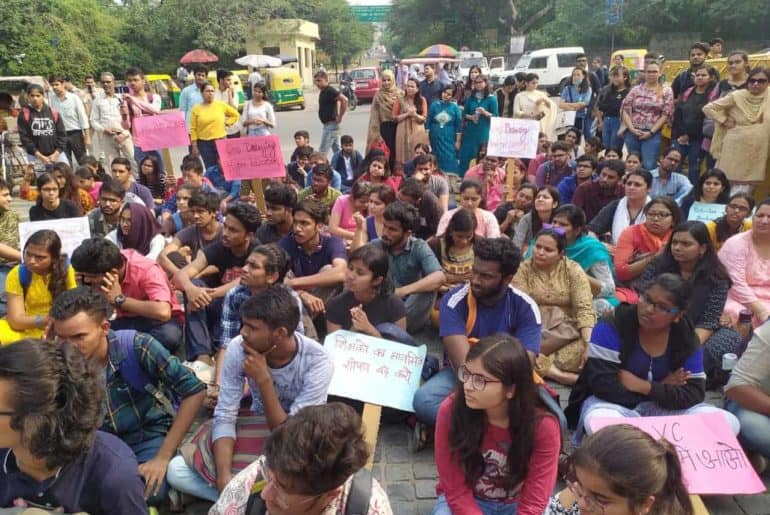
6. Protests Season: There are three seasons in DU: test, fest, and protest season. Whether or not you are politically inclined, it is the best place to see different kinds of student movements develop from scratch. From the anti-autonomy strikes to the protests held by Pinjra Tod, students here are politically very active, and they often organise creative ways to assert themselves. Students are not just restricted to the classrooms but they also have an acute sense of the happenings of the world around them.

7. Placements: Although the rate of placements varies from college to college, it is one of the most successful universities to get placements in the country. Students also branch out to different streams of higher learning once they graduate from the university.

7. Food: If you are like every other student at a university, you are most likely to be a foodie too. For foodies, DU is among the best possible food havens. Whether you fancy a plate of savoury momos (Dolma Aunty’s) or just that perfect cuppa, (Sudama’s Chai) the university and its food joints will cater to your taste buds. Explore areas like Majnu ka Tila, Old Delhi and Hauz Khas to get other kinds of food experiences. Moreover the canteens of the different colleges also present low-cost, hygienic food that will leave you wanting more. The city: History, myth, language, and centuries of culture merge together in Delhi and lend a unique touch to the University. With an active nightlife, markets, food joints and places to hang out with your friends, the city provides immense opportunities for a new cultural experience. For both the avid traveller and the casual wanderer, Delhi is a treasure trove of monuments, forts, rivers and ancient nooks and crannies. The short distance between the city and hill stations like Dharamshala, Shimla, Manali means that those road trips might just manifest during your college years.

Feature Image Credits – India Today

Sara Sohail 

[email protected] 

The 2018 Annual Best Colleges of India Survey by India Today and Outlook saw multiple colleges of Delhi University and Jamia Milia Islamia included in the top ten.

The annual survey of best colleges done by India Today and Outlook was done through extensive survey methods that included detailed questionnaires and field visits and revealed the rising academic excellence of Delhi University and Jamia Milia Islamia.

The India Today annual survey was conducted in collaboration with Marketing and Development Research Associates (MDRA), a Delhi-based marketing research and consulting organisation. It surveyed around 1000 colleges in various streams across the country on the basis of a revised tightly-structured methodology. Field visits to over 100 colleges helped to survey them objectively through five broad parameters:  ‘Intake Quality & Governance’, ‘Academic Excellence’, ‘Infrastructure & Living Experience’, ‘Personality & Leadership Development’ and ‘Career Progression & Placement’.

Among the Best Arts Colleges of the country, St. Stephen’s College attained the 1st rank, while Lady Shri Ram College (LSR) was deemed to be in 2nd rank. Hindu College (3rd rank), Miranda House (4th rank) and Kirori Mal College (5th rank) were also among the top ten.

Among the Best Science Colleges of the country, Miranda House bagged the 1st Rank while Hindu College came second. St. Stephen’s (3rd rank), Kirori Mal college (4th rank) and Loyola College, Chennai (5th rank) were among the top ten as well.

In the list of the Best Commerce Colleges of the country, Sri Ram College of Commerce bagged the first rank.  Hindu College came second followed by LSR, Hansraj College and Department of Commerce, Christ College (Bengaluru), in that order.

Among the best colleges for Mass Communication, Indian Institute of Mass Communication, Delhi bagged the first rank followed by AJ Kidwai Mass Communication Research Centre, Jamia Milia Islamia (JMI). In a press release, JMI’s Vice-Chancellor, Prof Talat Ahmad congratulated the centres and departments of the university and also said that the findings complemented JMI’s 12th rank in the ‘universities’ category in MHRD’s NIRF (National Institutional Ranking Framework) for two consecutive years, 2017 and 2018.

In terms of other parameters as well, the colleges of Delhi University were again at the top position. A few categories where they shone were  Career Progression and Placement (Kirori Mal), Personality and Leadership Development (St. Stephen’s), Academic Excellence (LSR), Intake Quality and Governance (St. Stephen’s) and Cost of the Best (St. Stephen’s).

The survey done by Outlook in collaboration with the Mumbai-based research agency Drshti Strategic Research Services included detailed objective questionnaires that were sent to more than 2700 colleges in the country across 12 streams including Engineering, Medicine, Social Work and Mass Communication. Five key parameters of selection process & institute profile, academics, personality and development, placements, employment & graduating outcome, and infrastructure were used to judge the colleges while separate perceptual surveys were conducted among students, faculty members and other professionals.  

In the ranking of top Social Work Colleges in India, Delhi University’s Department of Social Work was granted the 2nd rank with an overall score of 929 with TISS, Mumbai bagging the 1st Rank and an overall score of 947. Among the Best Law colleges of the country Faculty of Law, JMI bagged the 5th position as did the Faculty of Architecture & Ekistics of JMI, in the Best Architecture Colleges category. In Mass Communication, AJK MCRC, Jamia Milia Islamia, was judged to be the best college.

DU Beat wishes the heartiest congratulations to the colleges for their achievements.

Feature Image Credits: India Today

Sara Sohail

[email protected]