Tag

Delhi University

Browsing

A ‘what if’ scenario imagining politicians as DU students. 

The great leaders of tomorrow are made in the great educational institutions of today. So, for satire’s sake, we tried thinking how it would be to place some eminent politicians of our nation as students in some eminent colleges of the University of Delhi. The results have been weirdly amusing, to say the least.

Manmohan Singh: He is the studious student who has it all sorted out. You can find him on the front seat with thick lenses focused on the words in his books, and the words on the blackboard. He arrives in class, studies diligently, and goes back home without anyone detecting a trace of his existence, as he hardly utters a word. He belongs to the species of nerds but finds it tacky to show off his knowledge.

Preferred course- Economics, Political Science, and Philosophy. 

Preferred college- SRCC, Hindu, Hansraj

Assaudin Owaisi: He is the one kid in college who can’t live without using his vocal cords to the maximum of their capability. The troublemaker student, he will always find himself in some sort of pickle, be it with the fellow students or the administration. Despite this rebellious attitude, you cannot expect him to align himself with one particular faction or group. Therefore, he also falls in the category of those students whose friend circle keeps changing every college year, not implying that he is a snake (saap in classic DU terms). 

Preferred course- Political Science, Law

Preferred college- Ramjas, Law Faculty

Maneka Gandhi: She is the classic feminist University of Delhi girl. You can find her tactfully expressing her opinions against misogyny and patriarchy through her carefully chosen words. Apart from issues related to women, she is be expected to show up at any/all protests surrounding threats made to the members of the DU fraternity face, with the venue, mostly being the classic Faculty of Arts. Mess with this student and you might end up paying a hefty price.

Preferred course- Sociology

Preferred college- LSR, Miranda House

Shashi Tharoor: He is known for his good grades, good looks, self-confidence, and charm, used to impress all the girls in the college; Shashi Tharoor easily falls within the bracket of students who have it all. He is usually self-obsessed and narcissistic in order to maintain his image, especially in the way he arranges his hair or the bourgeoisie language he uses. As mentioned previously, he is the Casanova of the college and is likely to have a girlfriend who meets his intellectual capabilities. However, when two intellectuals are together, a clash of opinions is inevitable. 

Preferred course- English, Philosophy

Preferred college- St. Stephen’s (isn’t that obvious?)

Lalu Prasad Yadav:  Our classic Bihari babu is an expert at everything pertaining to cattle and fodder, but, don’t underestimate him “inki girlfriend Rabri Vidhayak hain”. He is the kid that questions the teacher and mimics him behind his back for the sake of entertaining the whole class. He helped us understand the value of friendships in college; he says ‘I thought Nitish babu was my friend in the first year, but by the third year I realised he is a snake in lieu with that CR Modi’. No one ever trusts him with money as he always says it’s for his cows back home, but never returns it.

Preferred course and college – “arrey bhaiya kuch bhi dedo bas DU main le lo”

Yogi Adityanath: Hailing straight from Uttar Pradesh, this bhakt of Ram is the most religious kid on campus, with a passion for ‘renaming things’.  As a result of this, Jackson from class became Jai kishan! He’s always dressed in orange, a unique dress code that seems to be the fashion of the days. Don’t underestimate him by his size because he beats (quite literally) everyone in his love for the cow. He is a fresher to the college but has already made his presence felt everywhere.

Preferred course – B.Sc. mathematics

Preferred college – Hindu college   

Rahul Gandhi:  The baba himself, though it is too early for him to go to college, his mother still comes to drop him off. You can never spot him in class as he is most likely to be sitting somewhere doodling, or staring into space. No one takes him seriously even after he became the CR. People from the other class joke about him on their class Whatsapp groups. He is following family suit in standing for college elections, but honestly, he just wants to sit at home and watch Shinchan. However, he is surrounded by a lot of seniors who are saving him from trouble, but until when?

Preferred Course – whatever Mom says

Preferred college – St. Stephens (is home tuition still an option in college?)


Feature Image Credits: India.com

Shaurya Singh Thapa

[email protected] 

Haris Khan


Here is a recap of Day 1 at Tempest 2019, the annual cultural festival of Miranda House.

Tempest 2019- the Annual Cultural Fest of Miranda House- University of Delhi kick-started on 14th February 2019. There were a plethora of events scheduled by the college but most of them got delayed due to unfavourable weather conditions. Nevertheless, the events ran smoothly and the first day of Tempest turned out to be a fulfilling and vibrant experience for the attendees.

The Annual Rachita Das Gupta Quiz was organized by the Quiz Society of Miranda House. They conducted three quizzes on Day 1. The Open General Quiz saw participation of 30 teams with 2 members in each team. Mukund and Dhruv bagged the first position, while Rorik and Rohan came second, and Basab and Amlan stood third. Eco Biz Filler witnessed Kirti and Pragati win the competition. In the Open India Quiz, Ashish and Abhishek Paliwal came first while the duos of Jayant and Amlan, and Ankur and Kartik Puri stood second and third, respectively.

Vaatavaran, the Eco Club of Miranda House organised Enviro Quiz, a short-film-based quiz. It saw participation from 20 teams from across different colleges. The first prize was awarded to Poornima and Yash, while Karishma and Garima, and Pragati and Niharika bagged the second and third prizes, respectively.

E-Cell, Miranda House, organised three Inter-College events at Tempest 2019. Combination- an event related to geographical locations of companies, saw participation of 20 teams with two students in each team. Addictive- a marketing competition of pitching products in the style of Bollywood, was won by Ashok, while Pinku came second. Boss Hunt- a Treasure Hunt had 35 teams compete, where Aditya Sah came first, while Neeruganti Purnima came second.

11 Dance Societies from across different colleges, which qualified the online preliminaries, performed at Burlesque, the Western Dance Competition, organised by Tanz, the Western Dance Society of Miranda House. The event was judged by Mrs. Sameeksha and Mr. Nitin Theo Kerketta. Enliven (Western dance society of Gargi) won the competition, while Crunk (Western dance society of Sri Aurobindo) came second.

The next event was the Hindi Debating Competition where the students battled their wits on the topic- “Sadan ke math mein loktantra maatr ek saashan pranali nahi, jeevan mulyo ka srot hai (In the opinion of the House, democracy is not only a regime conduct, but it is the source of life values).” It was judged internally by teachers- Mrs. Kusuma Krishna Subha and Mrs. Meeta Kumari. Smriti from Lady Shri Ram College was awarded the title of Best Speaker in favour of the motion while Happy from Ramjas College was awarded as Best Speaker in opposition.

Amid the melody of raag Darbari and Yaman, Sangam- the Indian Classical Music Competition- organised by Geetanjali, the Indian Music Society of Miranda House saw various performances that had the audiences captivated. With 14 participants in the Duet Singing Competition and 13 teams representing their colleges in the Choir Singing Competition, the event was a huge success. The Duet Singing Competition concluded with SGTB Khalsa College’s Sukriti and Saksham bagging the second prize, with the winner’s title being claimed by Hansraj College’s Pranava and Ram.

Adwitiya, the Fine Arts’ Society, in a stunning display of powerful art, transformed SAC to an exquisite art gallery. From portraits to abstract brushstrokes, all the artwork presented had a story to tell. An art-piece labeled ‘Nirvana’ captured the modern world in a representative manner. A symbolic display promised and delivered aesthetic pleasure.

The day concluded with the performance by PARASHARA- a popular Delhi-based progressive band, with an idea conceived and brought to action in the mountains. The audiences swiveled to the beats as they played their melodies, revolving around the realities of life, with an interesting modern touch to it. This wraps up the Day 1 of the fest and all the festivities stuck true to the theme of the fest: “Future of Fun”.

Image credits: Mahi Panchal for DU Beat


Sakshi Arora

[email protected]


Shaurya Thapa

[email protected]


Kartik Chauhan

[email protected]


Shivani Dadhwal

[email protected]


The tradition of the ‘Virgin Tree pooja’ at Hindu College, wherein students pray in front of a tree on Valentine’s Day with the hope of losing their virginity, is viewed with diverse and opposing perspectives.

“I’m just young, rich, and tasteless,” says rapper Pusha T in the song ‘Runaway’. It might be an apt slogan for the tradition of the Virgin Tree (V-Tree) pooja at Hindu College. “Young” because maybe we’re the youth desperate to get laid; but also “tasteless” because maybe we recognise the problems with the tradition and go on regardless. “Rich” is slightly irrelevant here.

The tradition, which takes place at Valentine’s every year sees students worshipping the V-Tree. A female celebrity is chosen as the ‘Damdami Mai’ and the Mr. Fresher of the boys’ hostel, dressed as the pandit, does the pooja. Recently, the same has begun for the girls’ hostel also, wherein a ‘Love Guru’ is worshipped by the Ms. Fresher. Water filled condoms are hung on the tree, an aarti is sung, the water is showered on the crowd and a Holi-like celebration follows. Apparently, thou shall loseth thy V-card should thou showereth in the condometh watereth. Hindu 6:9, perhaps? Students view the pooja in a variety of ways. Defenders say that the motive is spreading awareness about safe sex. Others say that it’s patriarchal, misogynist, and excludes many. Yet others fall somewhere in between. “(The pooja) serves the purpose of spreading sexual awareness. It tries to do away with the taboo associated with sex,” says a second-year History Honours student. This was reiterated by Shubham Yadav, the Girls Students’ Welfare Minister. She said that while posters about AIDS awareness are also put up, the aarti is very demeaning.

This reasoning isn’t convincing to many.
Kareema Barry, a second-year English Honours student says that the inclusion of the male celebrity was only “tokenistic.” “What about transgenders? Aren’t we neglecting them? The solution is not to put their picture but to remove all of them,” says Sakshi Priya, Vice President of the college’s Women’s Development Cell while proposing a discussion on safe sex instead. Parakram Chauhan, a Philosophy Honours fresher comments on the “toxicity” behind the the pooja in terms of “seeing getting laid as some sort of prize or blessing.”

What are the freshers expecting?
One such expectation is to see a proper way of disposing of condoms, according to Mrinalinee Sharma of the History department. Khushi Gupta of the same department says “I want to see how they hang condoms after filling them with water, I’m very excited.” Parakram says he’s expecting “nothing at all.” However, a large chunk of them seems to be unaware of what the pooja is. Various students have protested against the tradition and some tell us that the crowds had declined last year. While Pinjra Tod’s article on the subject, which condemns the pooja as a contributor to “rape culture — which slut shames women who assert their sexuality,” is a bit overblown, not even the defenders deny that it could be made more inclusive and less demeaning.

Whether it’s a silly tradition or a serious issue, and whether it needs amendment or abolition, is for us to decide. We must ask if we’re just being tasteless, or something much more serious than that.

Image Credits: DU Beat

Prateek Pankaj
[email protected]

Here is a re-cap of Day 1 at Reverie 2019, the annual cultural festival of Gargi College. 

The opening day of Reverie 2019 commenced with the lighting of the lamp by the chief guest and actor, Sushma Seth, followed by her speech. Performances by Professor Ruchika Sharma, Euphony – Western Music Society, and Enliven – Western Group Dance Society ensured of the fun that is to follow at Gargi College’s Annual Cultural Fest, Reverie.

Events and competitions began soon after the inauguration. Students participated in the Talent Recognition competition and showcased their prowess in the form of dance, singing, slam poetry, and more. A number of students also participated in the English creative writing competition organised by Quilluminati, the English Creative Writing Society.
The first event in the seminar hall, Khayal, the classical solo singing competition, was supposed to begin at 11 a.m., got delayed due to the late arrival the two judges; Sriparna Nandi and Arundhati Bhatacharji, the total number of contestants that took part in the event was 11 from across University of Delhi (DU) colleges. The contestants had to perform one classical piece each and the participants were allowed to bring one instrumental player to accompany them. The minimum time limit was 4 minutes per performance. The winner of the event was Chinmay from Kirori Mal College, Abdul from Shaheed Bhagat Singh College bagged the 2nd place, and Daksh from Zakir Husain College came third.
The second event if the day in the seminar hall, featuring The same jugdes as before, Jugalbandi the semi classical duet competition saw, a total of 6 teams with two participants in each team performing a piece with one additional instrument player. The winners of the event were Minatullah and Rupanshi from Kirori Mal College, Sukriti and Sukprit tied from SGTB Khalsa College tied with Yugandha and Sakshi from Lady Shri Ram College for Women for the second position and Abdul and Hardik bagged the third prize.
The final competition of the day in the seminar hall also had the same judges with an additional judge, Mr. Debu Bhatacharya. Vadaan, the instrumental solo competition saw only 4 participants playing various different classical instruments like the tabla, harmonium, dhol etc. They had to present an instrumental piece within a maximum time of 5 minutes. The results for the same were: Anant Raman from Dyal Singh College in first place, Nabeel Khan from Zakir Husain College in second and Sarveshwar from PGDAV (morning) College in third place.

The Western Acapella competition was conducted by Euphony in Gargi’s annual cultural fest Reverie. A total of 16 teams from across different colleges had passed the online prelims competed to win the cash prizes. The event saw delay and the management had to shift their venues from the Auditorium to the seminar hall after the 11th performance owing to the demands from Sparx, the choreography society, for them to begin their own competition. The competition was judged by Mr. Joshua Peters and Mr. Maker Kashung. The acapella society from Sri Venkateshwara College came first, there was tie for the second place between societies of Jesus and Mary College and Lady Shri Ram College for Women, St Stephen’s College came in third.

Dhanak, India Group Folk dance competition organized by Nazakat saw a participation by 11 teams who had cleared their online prelims. The event was judged by Mrs. Swagata Sen Pillai, who gave the third position to Delhi Technical University, 2nd position to the Bhangra Society Sri Guru Gobind Singh College of Commerce, and Annhad, Daulat Ram College came 1st . In her speech, she said that Bhangra Society of SGND Khalsa could not win because they exceeded the time limit, whereas according to the members of the society they had not exceeded the time limit at all. While talking to DU Beat, Jaskaran Singh, President of the Bhangra society of SGND Khalsa College said that it was cleared with the organisers beforehand that their time would be counted once the dhol beats begin after the sher but somehow the judges had counted their time just after the sher began. It is to be noted that the teams from SNDT, SSG and DTU almost backed out from the competition when an allegedly intoxicated guard misbehaved with them at the entry early in the morning.

9 teams across different colleges participated in the Choreography competition organised by Sparx, called the Creative-iti. The event began after a 3-hour delay because of a domino effect of all the previous events being delayed. Capella, NSUT won the competition while the second and third place was awarded to LSR and Sparx, of Gargi College respectively. The event was judged by Ms. Surya Sharma and Deva Smita.

Day 1 of Reverie witnessed power packed performances by the participants in the Talent Show event, organised by the Students Union of Gargi College. Both solo and group performances were allowed. Students performed on latest Bollywood hits. The show also witnessed solo and duet singing. The theme of the fest: “A brave new world; an ode to Diversity” works on the basis of 3 C’s- Choice, Consent, and Conservation. These cover broad topics like LGBTQ empowerment, sexual harassment, female empowerment, equality, wildlife preservation, and protection. Individually these are significant and necessary issues of today’s world but interlacing all of them together as a theme for one of the largest annual cultural fest of Delhi University brings down its gusto.

The day came to a magnificent close with The Local Train’s performance, which swept the crowd off its feet. With songs like Choo Lo, Dil Mere, Aaoge Tum Kabhi the band ensured that the crowd didn’t lose their energy.


Feature Image Credits: Surabhi Khare for DU Beat

Prachi Mehra

[email protected]

Anoushka Sharma

[email protected]

Haris Khan

[email protected]

Sakshi Arora

[email protected]

The Delhi University Teachers’ Association (DUTA) held an Executive Meeting on Saturday, 12th January 2019.

The resolution for the same is a comprehensive account of the crisis being confronted by the teachers of the University in lieu of the Central Government’s withdrawal of government funding from public-funded universities. This was termed as a “highly misguided policy” and “commercialisation of higher education”. This has led to a delay in the announcement of revised allowances and pensions of teachers. The exploitative conditions in terms of long working hours and lack of job security and employment benefits for ad hoc teachers have also contributed to the rage and unrest among teachers.

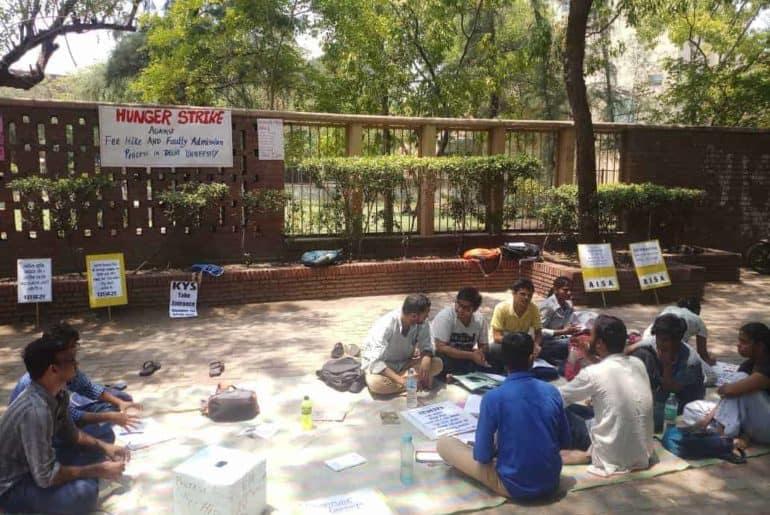
In addition, DUTA has also directed rage and disappointment against the Vice Chancellor (VC) of the University of Delhi, and condemned him for his inaction and lethargy in carrying out timely appointment procedures for teachers. They expressed strong criticism towards the VC for capitulating to the Government’s agenda by not even allowing the tabling of the report of the sub-committee set up to facilitate the adoption of the UGC Regulations 2018. Owing to the same, several young ad hoc teachers had declared a hunger strike in effect from 4th January 2019, which has now continued for nine days in the blistering cold.

In the resolution dated 12th January 2018, the DUTA has declared solidarity with the teachers on hunger strike, and has demanded that the Government bring in a one-time Regulation for the absorption of temporary and ad hoc teachers. They have proposed a one day strike and dharna at Gate No.1, DU to highlight their demands for the re-convening of the adjourned meeting of the Academic Council. They have also announced an immediate action programme of One Day Strike along with a Long March to MHRD on 17th January 2019.

Emphasising that these consequences emanating from a reduction in Government funding will soon affect the students as well, and has called for support by all sections of the university community, including and especially students.

Feature Image Credits: The Indian Express

Nikita Bhatia

[email protected]


Delhi University to ensure centrally air conditioned campuses, due to the growing climate concerns.

Delhi University issued a statement on the 7th of January, 2019 that it will instal central air conditioners in all the college campuses. The proposal is set to be in motion from the new academic year (July onwards). On a trial basis, a few select colleges will have these installed. Depending on the affect or reaction of the college community, this measure will be taken on a full-fledged mode.

The reason, issued earlier, is the shifting climatic conditions. With the northern India witnessing a cold wave, it is expected that the summers will be as scorching as ever. Heena Garg, a student of Maitreyi College says, “The college infrastructure, especially the ventilation is a big problem in classrooms. The rooms are very stuffy and it creates a lot of problems in the hot summer months. The fans do not work properly. It results in a lot of discomfort among students.” A lot of private universities have already adopted the centrally conditioned system in their campuses. Infrastructure is still a major issue faced by a lot of Government or state based colleges.

Professor Yogesh Tyagi, the 22nd Vice Chancellor of Delhi University, expresses his views on this decision, “It is about time the Delhi University improves its infrastructural facilities. Addition of the centrally conditioned campus will be a major boost for the University and will benefit the students and staff.”

With the rising levels of pollution and lack of pure air in the Capital’s air index, a lot of households are also shifting to centrally treated air conditioning. Their growth in the Indian markets has been very restricted as compared to that of their western counterparts, where every house is already centrally conditioned. India is lagging behind in this lifestyle concern as its affordability is restricted only to the rich.

Apeksha Jain, a second year B.Com. student of Shaheed Bhagat Singh College comments, “In a city which has such extreme climates, DU’s decision for central air conditioning is a really good one. it will improve campus engagement and attraction, and improve the existing infrastructural conditions of the university.” While some of the colleges in DU provide air conditioned classes to its students, the call is for a campus wide change for the better.


Feature Image credits: Interact Classroom

Avnika Chhikara

[email protected]

The beginning of a new year is  followed by a whole new semester to look forward to. New semesters can be a lot of fun, but extremely demanding and confusing at the same time.

Right after the New Year has been welcomed, and the party shoes have been carefully taken off and kept back in the cupboard for another year, the new semester begins without much of a wait. The semester break granted seems too short, and the idea of getting back into the grind is almost painful. Sleeping seems like the best option, the cold only aggravating the situation. The freshers are now well-acquainted with college life, and do not seem to harbour the same kind of curiosity, the sparkle almost completely lost from their eyes now.

New semesters also mean the arrival of the much-awaited fest season. The usual college hopping to check out the happenings, pestering your friends from SRCC or LSR to get you passes to their fests, skipping classes to go to North Campus from South Campus.  Students who are a part of a society might find their hands full, as this is the busiest time of the year for extra-curricular activities. The various cuisines, exciting games, attractive people, and engaging performances, create an enchanting atmosphere. People from all over the country come to attend the brilliant shows put on by Delhi University colleges. No expense is spared to make fests the brilliant affairs that they are. 

However, competitions of various kinds, fests, after-parties, and the unnecessary bunking of classes eventually comes to an end. What follows is a feeling of emptiness, and a general glooms overcomes the same people, and buildings, which were once covered in gold streamers. Once individuals and institutions are striped of their decorations and party-faces, getting back to a routine becomes a task. The good old blues, associated with mundanity, kick in, and the anxiety of existence slowly creeps back in.

One finds themselves short of attendance at the end of it all, be it society or a non-society member. Academics take a backseat, and one may find themselves cursing their decisions during end semester exams, for not being more vigilant. Moreover, it doesn’t help that the semester is shorter. The duration might not seem like a huge problem at the beginning, but towards the end, when the end-semester pangs set in, you would be wishing for more time.

The only piece of solid advice here would be to relish this time as much as you can, since you are only young once. Managing your time efficiently during this period, is also imperative, along with the ‘fun’ part. After all, attending lectures, and learning new things, can also be as much fun as dancing till dawn to EDM. The goal lies in defeating the ever-present semester blues, and facing each day with as much zeal as possible.

Too many things packed into five months would just fly by in a wink and one does not really want to be seen wishing for lost time back.


Feature Image Credits: The Indian Express

Anoushka Singh

[email protected]


Dyal Singh College faces a big administrative crisis as the Principal’s office gets sealed over ongoing probe on financial and administrative irregularities.


Dyal Singh College, faces a big crisis as a part of the ongoing tussle between the Principal and the Chairman. It all started when, on September 24, 2018, Governing Body [GB] chairman Mr. Amitabh Sinha issued an order, sending the Principal on a ‘long leave’. The reason stated was alleged him of being guilty for the financial and administrative irregularities. The Principal, I.S. Bakshi was charged with serious allegations regarding the state of financial and administrative irregularities and was asked to avoid visiting campus during the inquiry against him. Despite the notice, Bakshi has been continued coming to college, chiding the allegations as “illegal” with mala fide intentions.

The tussle grew stronger when the Chairman overturned the decision of the college’s Election Committee to cancel the election of Rohan Awana, an ABVP member, as president.

Things escalated as Mr. Sinha sealed his office on Friday, claiming it had been occupied ‘without authority’. The Principal also received a letter from the college’s bank stating that no transactions will be processed with his signature, as they have been mandated by the GB to conduct all official transactions through the officiating or the acting principal.

In a letter addressed to the chairman dated October 10th 2018, the branch manager of State Bank of India, Lodhi Road stated that the appointment of the acting principal should be done in accordance with the prescribed guidelines of the Ordinance XVIII which states that in absence of the Principal, the vice-principal will act as the principal, and in the vice-principal’s absence, the most-senior teacher will take over the administration and financial duties. This stands for colleges other than those that are maintained by the Government Of India.

According to a report in Jagran Josh, the tussle between the Principal and Chairman is reportedly causing financial losses to employees. DSC teachers’ Association’s president PK Parihar stated that the money is not being transferred into their PF account because of which they are losing interest and the medical reimbursement of all, especially the pensioners, is under threat.

Following the sealing of the office, Bakshi will be allowed inside the college campus only after the convener of the inquiry committee, Mr. OP Malik, retired IPS officer and DGP, provides written information, according to recent sources on the issue.

Sources: The Indian Express, Jagran Josh

Feature Image Credits:  The Hindu, image of the notice from the college’s official website


Avnika Chhikara

[email protected]


Yogi Sadhguru paid a visit to SRCC recently, as a part of his campaign titles ‘Youth and Truth’. An analysis of the advice given by innumerable motivational speakers in The University of Delhi reaped interesting outcomes.

Sadhguru, a renowned yogi, mystic, and founder of the NGO Isha Foundation, was at Shri Ram College of Commerce on 4th September 2018. The biker and English-speaking guru was accompanied by his entourage, following a suspension of lectures and extensive police barricading, extending from SRCC till Patel Chest Institute (bit much for a yogi, perhaps?). Contrary to popular belief, he wasn’t there to preach, and true to the essence of his campaign, ‘Youth and Truth’, his session included but wasn’t limited to, genuine advice about goal setting, relationships, confidence building and parenting. Once the initial aura of celebrity had subdued, and snapchat stories had been uploaded, people started to really listen. This was probably succeeded by the realization that the speaker hardly partook in original preachings, instead, like most motivational speakers, he simply validated already existing feelings and knowledge. This is a common occurrence, and it is this validation and connection that students seek from motivational talks/speakers, in the University of Delhi.

Celebrities, leaders, motivational speakers, members of the elite academia, and those who made it big by pure chance; the students of Delhi University have stood firsthand witness to it all, via panels, seminars, conferences, conclaves and other events similar in nature.

Students flock to these events in large numbers, seeking motivation, inspiration, enlightenment, or to simply catch a glimpse of a famous entity. However, when reconsidered, it seems as if all of these speakers, regardless of their field of expertise, are making the same point. You seldom come across anything radically enlightening, rather receive recycled gyaan.  If you’ve heard the terms ‘hardwork’, ‘leadership’, ‘innovative thinking’, ‘bringing something new to the table’ and ‘being humble’ one too many times; congratulations! you have unwittingly become a victim of nebulous direction.

Everything makes sense and nothing makes sense. Vague and nebular advice is the new preaching. Nothing anybody says adds any intrinsic value to the lives of students, their leaders themselves often presenting recycled ideas while simultaneously urging students to be ‘innovative’. One reason for the same is that there is no set path to success, and students are often too delusional to realize that. Students are burdened with the desire and/or pressure to overachieve, and often this desire arises not from within, but as a result of environmentally generated competition.

Leaders and speakers are an important part of college culture, but often, making examples of the small fraction of people who ‘made it’ advertises a lifestyle that is probably already out of stock. There is no market equilibrium; the demand and supply are poles apart, and in the end, students are suffering.

Nikita Bhatia

[email protected]

The board is set, the pieces are now moving. The battle is won, but the cause is lost. Do you sense the same?

The roads are all strange these days, without the smattering of a thousand flyers and pamphlets. It is almost disappointing to not see the flyers fall around the campus. Almost consoling are the misspelt names on the Wall(s) of Democracy. As the campus finally breathes in all its silence, the screaming political sobriety is in question. So, what follows now? Is it too early to recede to our apprehensions? Some might agree, but then there was never much space for agendas in those swanky BMWs on roads so choked with flyers. Beards and gold rings drove these SUVs and sedans, and beards and gold rings drive politics now.
Politics is a progression in the sense that it has always followed patterns. There are changes, but not necessarily as we would like to have them. After a raging contest of power in the past fortnight, the election results were in favour of some, while many others were left baffled. In an endless volley of blames and shaming, we saw some candidates rise to power recently. You hope to make sense out of it, but it all reduces to a clout of pointless manifesto promises. How long before these promises are fulfilled? Will the year be enough? Anyone who is even remotely familiar with the idea of politics will know what it means in practice. Agendas are good, but for a change, we would like to see some action too. Ironically, the only action we see is the action of the fist. In multiple brawls and the loss of public property, what is damaged most is the very idea of politics. Most of our representatives think that all politics has to offer is power, and power in India is scarce anyway. Responsibility is fantastical, so we cannot use this word for our politics. Politics is always about differentiated representation because two opinions can never be alike. This is what democracy implies, after all, it is the freedom to choose a representative. However, politics has become more divisive than ever before – it is driven by everything but democratic ethics. In DUSU, caste politics prevails, for instance, and in the national perspective, the division extends to manifold realms.
This year, like most years, political outfits claimed their primary objective to be that of women safety and claimed to improve their representation, the opportunities available to them, and provide a better environment to them in general. Introduction of U-special buses has been on the card since long, and new ideas like under INR 10 thali have been introduced this year. What we fail to observe amongst these tall promises is the question of what could possibly be their plan of action here? Being apolitical is a choice, but indifference can only mean ignorance that refuses to see the truth, and ignorance seems to sit at the core of all our problems. It is only right then, to be informed, aware, active, and to fight back with our form of dissent laced with logical arguments. The agendas might find fulfilment or hope to do so still, but only with an initiative from our side and that of the elected leaders.
Power gives you the strength to change, to reinvent, and to exercise an idea for the betterment of a cause. No one is wrong to expect this from those who stand for the upholding of power, but we all know who has the last laugh.
Kartik Chauhan