
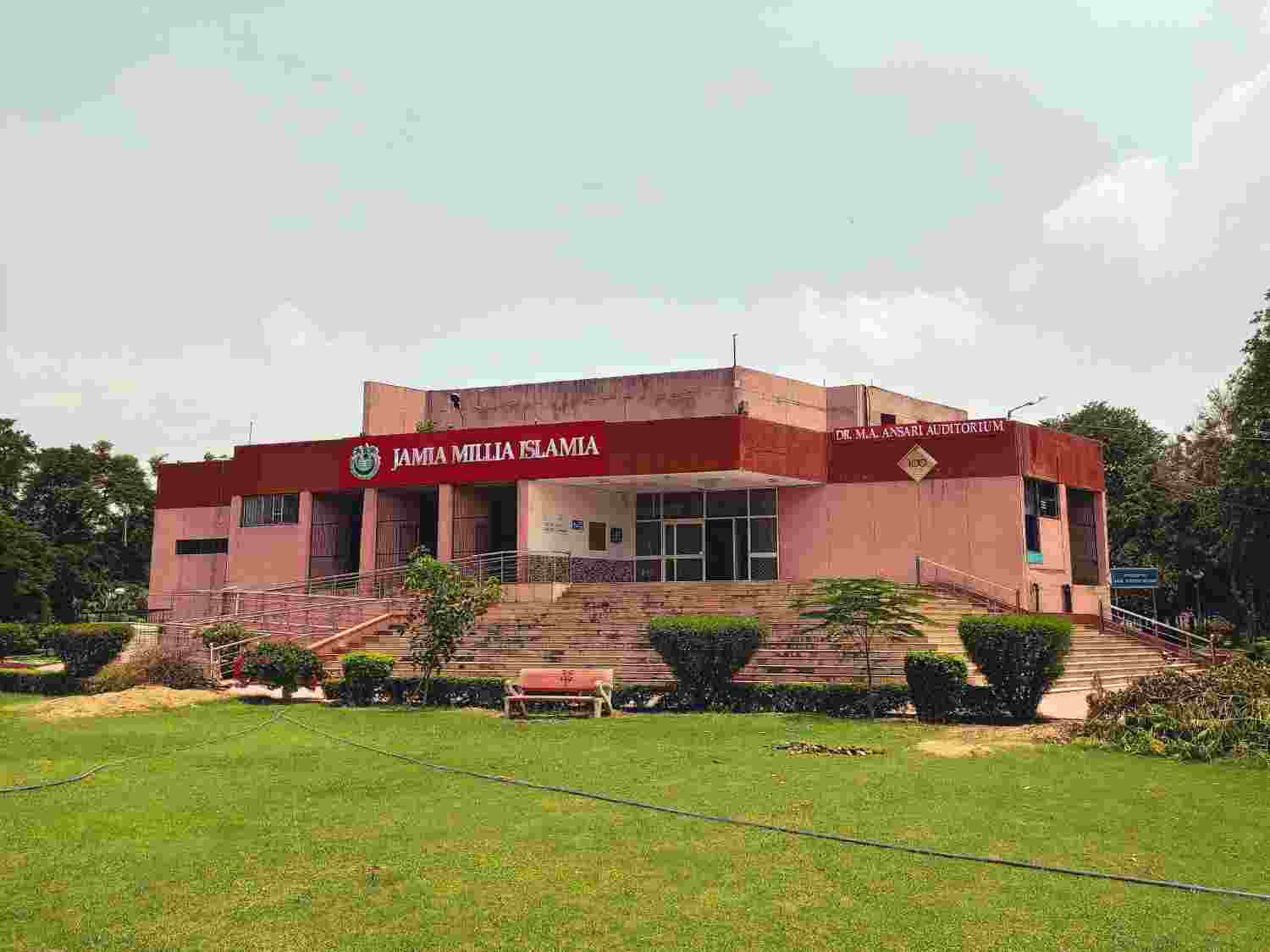
At Jamia Millia Islamia, what began as a hunger strike demanding the restoration of student union elections has escalated into a confrontation between students and the administration, with disciplinary action and campus restrictions intensifying the unrest.
The hunger strike to restore student union elections at Jamia Millia Islamia (JMI), which began on 12 October, took a contentious turn on Saturday, 17 October, when university security personnel forcibly removed protesting students from the campus. The incident sparked further demonstrations, with students alleging that they were assaulted during the eviction and subsequently detained by the Delhi Police.
According to The Times of India, the incident occurred at around 5.30 am, when three protesting students were removed from Ghalib Lawn, where the hunger strike was held. Around 60 security personnel, accompanied by the chief proctor and security adviser, allegedly dismantled the temporary structures erected at the site and removed the protesters.
Kamil, a Jamia student, alleged that 20–25 security personnel arrived at around 4 am and began pushing and dragging students away from the protest site. He added that the administration subsequently announced a complete campus closure, citing mosquito control as the reason. Another student, Akhil, alleged that security personnel intervened in the hunger strike even before the protest site was dismantled. He accused them of kicking students and pulling protesters by their hair, adding that while some managed to escape, others were arrested.
Disciplinary action against protesters
The eviction was followed by disciplinary action against students participating in the hunger strike. According to The Times of India, Ebin Basil was rusticated for one year, while postgraduate student Jasim Khan received a six-month rustication order. A third student, Rehaan Haider, was also rusticated. The students were barred from entering the campus. In its disciplinary notices, the university accused the protesters of holding an unauthorised demonstration and obstructing university personnel. The administration also alleged that the protesters had tampered with the wiring of a CCTV camera.
The students and their supporters have challenged the disciplinary measures, demanding their withdrawal alongside an inquiry into the alleged assault.
Sana, a Jamia student, said the confrontation reflected a broader breakdown in communication between students and the administration. She pointed to unresolved concerns over hostel food, the admission process and other campus-related issues, alleging that assurances given by the authorities had not been fulfilled.
“Students are not a threat to the university; they are part of it,” she said, arguing that the situation could be resolved only if the administration addressed students’ grievances through due process and meaningful engagement, rather than force or the formation of another committee.
The university, meanwhile, maintained that its security personnel had acted in self-defence, according to The Times of India. On 18 October, the Vice-Chancellor announced the formation of a high-powered committee to address students’ grievances. The committee comprises five deans, with the Dean of Students’ Welfare serving as its convener.
Protests continue beyond the campus
The confrontation triggered further demonstrations on Saturday, with students gathering outside the university to protest the alleged assault and the disciplinary action against their peers. According to a PTI report published by ThePrint, several students were detained after a demonstration entered the campus through Gate No. 7. They were released after approximately an hour.
Student organisations, including the All India Students’ Association (AISA), the National Students’ Union of India (NSUI) and the Jawaharlal Nehru University Students’ Union (JNUSU), extended their support to the protesters. AISA demanded the chief proctor’s resignation, an independent inquiry into the alleged assault and the withdrawal of all disciplinary action against the students.
The demand for an elected student union
At the heart of the unrest is a long-standing demand: the restoration of an elected student union at Jamia Millia Islamia, where university-wide union elections have not been held since 2006.
The hunger strike began on 12 October, with students arguing that the absence of an elected representative body has left them without a formal platform to raise academic and administrative grievances. For the protesters, the demand extends beyond the restoration of elections to the question of student representation in university decision-making.
The union was dissolved in 2006, during the tenure of former Vice-Chancellor Mushirul Hasan. According to the university administration, concerns about alleged incidents of violence and clashes between students and teachers have informed its decision to restore a university-wide student union.
An official also referred to proceedings before the Delhi High Court in 2022, stating that they had not resulted in a direction requiring the university to restore the union.
Aeera Aroush Khan
Image Credits: jmi.ac.in


Comments are closed.