
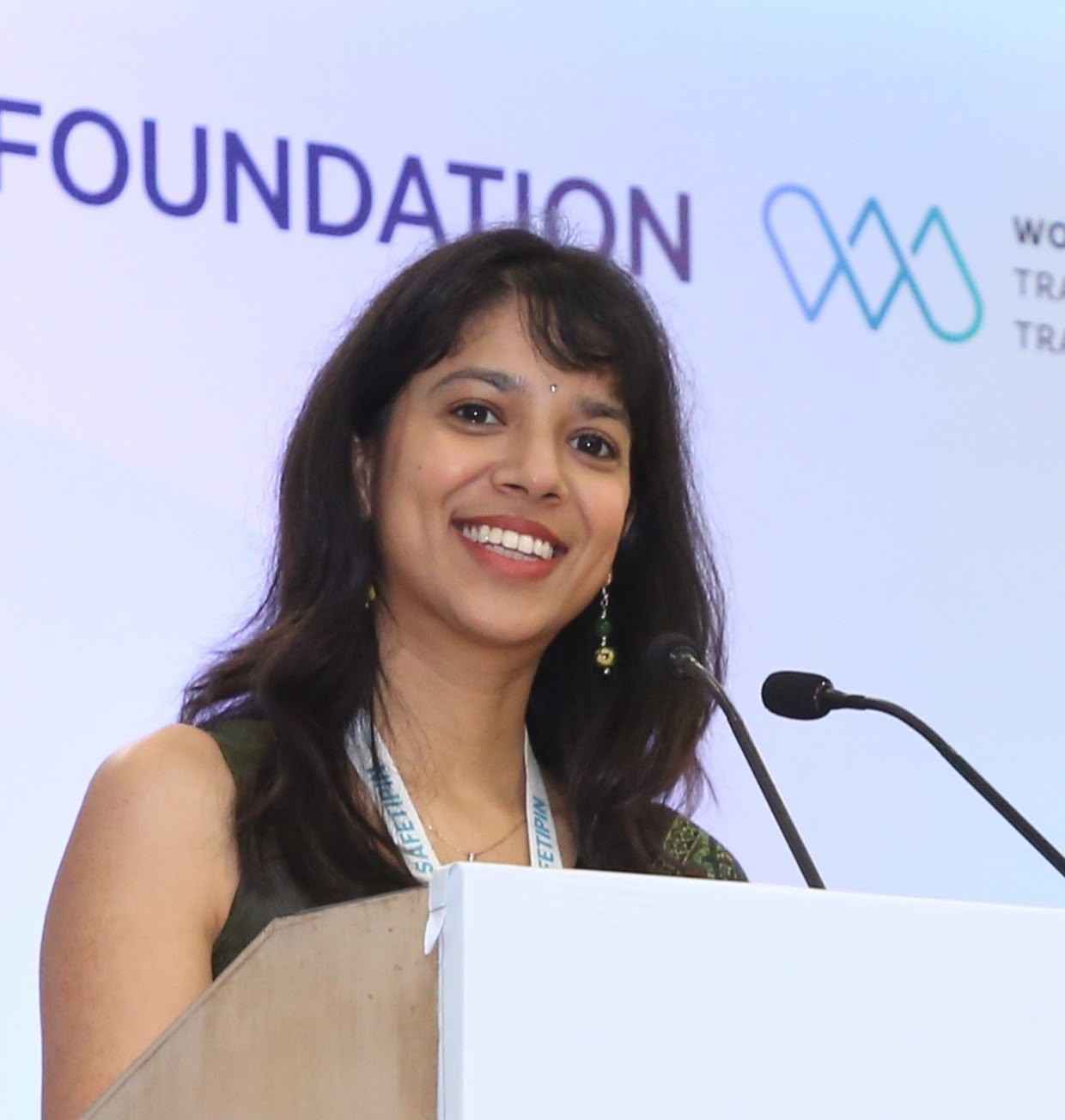
DU Beat sits in conversation with Ms. Shreya Basu, Head of Partnerships and Growth at Safetipin, to discuss how the narrative around women’s safety has changed and the gaps that we are yet to overcome.
Rishika: When we talk about making spaces safer for women, there’s often a move towards more CCTVs and more police. How do we make sure that women’s safety doesn’t become synonymous with surveillance and restricting women’s behaviour?
Shreya: I think the first thing to understand is that safety and security are not the same thing. Safety is about feeling free from fear. Surveillance is a part of safety, so it doesn’t need to be completely taken away, but it has to be backed by trust and accountability. If you’re going to put up CCTV cameras, I have to feel safe, and I have to feel confident that there is someone who will help me out. The same goes for police personnel. It’s not just about putting up the infrastructure, but it also has to do with how you maintain it. It is crucial to ask who’s managing the space and how it impacts your day-to-day activity and movement in that space. It’s really important to find that balance. So, security is not bad, but security is not everything, and security without trust and accountability is only a curative measure if they care about it. We should look at safety as prevention because it’s a feeling of fear that we’re trying to eliminate.
Rishika: You spoke about the need to strike a balance between security and trust. In an ideal world, how do you think this balance should be achieved? While safety requires structural changes in how spaces are designed and managed, it also involves addressing societal attitudes and the patriarchal mindsets that shape how we perceive and approach women’s safety. What are your thoughts on this?
Shreya: First, there are two kinds of surveillance: actual surveillance and natural surveillance. In actual surveillance, in theory and in an ideal world, all the systems and institutions in a government work for the citizen. They’re supposed to be working for our welfare, but who is the citizen they’re realistically working for is the question. Because men are able to walk around. Women are not. So it’s also: who are you designing the system for? Who are you including at the table? Who are you actually asking these questions to? Because if a bunch of men sit around and discuss and design a public space, they’ll design it in a way that they understand. And that’s not their fault; that’s their reality. So, for it to be inclusive and responsive to the needs of other genders and other ages, you have to include those people in the conversation when designing. And I think the point of maintenance is very important. You can’t just do one thing and say, now it will be done. You have to continue it. It has to keep building.
Then there’s the concept of natural surveillance—activity on the streets, eyes on the streets—which changes the game. If you have space with vendors that women are actively using, as well as female vendors, you will feel more comfortable being out there. If you see more of you outside, you will feel comfortable being outside. I looked at the Safetipin data from 2023 to 2025, and what we found was that when there are no people around, both men and women feel unsafe. But as the number of people increases, the feeling of safety for men and women both increases. However, for men, the gender composition doesn’t matter. For women, the gender composition does matter. That’s why we have a gender parameter in our audit. And the feeling of safety differs for men and women when those are different, and that’s what matters.
So, activity on the street first: if you have a vendor, if you have shopkeepers, they add life to the street, and they take ownership of the street. Then you don’t feel alone. But what it also does is invite more women to use it.
What type of vendors do you have? What type of things are you selling? What type of seating is around it? Are you creating a public space where women feel comfortable to actually be? Because there’s very little room for women to be in public spaces just for leisure, for pleasure, for loitering. And it’s very important that we question why that is for all women, so that’s the conversation we need to change. Something like when Safetipin puts up their tea stall, wherein we tell women to come sit and have chai. You don’t need to be on the move all the time. Social norms won’t change quickly. They will not change in our lifetime, 100%. But infrastructure informs social change. So we can start there.
If you look at just the difference between what happened in the Nirbhaya case and the Aastha Kunj case, at the time of Nirbhaya, the instant reaction was, “Let’s install panic buttons, let’s put out a Nirbhaya fund, and let’s kill the people who did this.” In the Aastha Kunj case, it’s “Let’s do audits of public parks. Let’s look at public infrastructure. Let’s look at street lighting.” So in the last 15 years, the conversation has changed. Safety in public spaces has become mainstream, largely due to the work of feminist organisations in Delhi and in India. We have to acknowledge that it is changing very slowly, but it is. So we have to keep pushing that forward. We can’t just say it’s okay that this happened. No. But at least we’re addressing the real problem. I don’t know if they’re doing it fully correctly, but at least the wording is right. It’s not just “Kill the rapists”. I think they should be convicted, and a lot more should happen. But we’re also looking at the streets and the parks, and public toilets. If you don’t put public toilets in places, there is no reason women can come and hang out.
Rishika: Safetipin measures gender diversity in a space. But women may not be present because a space feels unsafe, and then their absence can itself become part of what makes the space feel unsafe. How can we break this vicious loop?
Shreya: That’s true. I think we also don’t feel comfortable going out alone, and I understand that. Because even if the street is completely safe, you may still not use it, because other streets are not safe. We’ve accustomed ourselves to change internally before we even question what’s happening outside.
I think that community-mobilisation activities like Jagori’s ‘Sleep in the Park’, Why Loiter’s walks around places, and Safetipin’s night safety walks are very important. Going around with a group of women, including men, also, that’s not a problem; it builds your confidence. Of course, your security and safety are very important. The reason you’re not moving around the city is that you don’t feel safe, because you’ve never done it.
It’s also okay if you don’t want to; I think that’s also fair. Maybe somebody doesn’t want to go out in the evening; sometimes they’re just lazy. We can’t say that every woman has to be an activist in everything she does. I think it’s fair to say we need a break also. But when you want to go out, you should. You want to reclaim a park, go reclaim a park; go hang out there.
How you use a space is shaped by social norms, and social norms do get created based on how you also act in those social public spaces. So I would say that’s a very community-driven feeling. It’ll increase the gender diversity; of course, don’t get me wrong, infrastructure does have to change, and other people also have to change. But this part we can do.
I don’t think the onus of my safety should be on me. Never. If something happens to me ever, it won’t be my fault. I can wear what I want, I can do what I want, say what I want, be whoever. But the onus of my enjoyment can be on me. If I try to figure out how I can look for my joy, if my joy is about being out, I should be able to access that. The negative cannot be on me; that’s on the perpetrator. But my happiness and what I can enjoy, I can do with my friends, my community, and I can choose to do that.
Rishika: Back in March of 2015, LSR and Jagori conducted a Safetipin audit of the areas around LSR, and 11 years later, Safetipin and Jagori have returned to almost the same stretch and found many of the same concerns. Students reported feeling uncomfortable in the space in 2015, and students still feel uncomfortable there in 2026. What does that tell us about the limits of producing evidence?
Shreya: I think the gap is what you do with that data, and how you make it actionable. Getting a woman’s feelings about a space is not enough, so the 8 other parameters I’m collecting—that’s what the action items are. Let’s say Safetipin does the audit with a bunch of students; we have found that you feel uncomfortable here; we have figured out what the reasons are for the parameters; we can give actionable recommendations on what needs to be done. Who will do it now is a little bit of an issue. And I’m not saying that’s an excuse. I’m saying it’s a very, very poor reality of the world we live in that we can’t get that done. But if you fight enough, if you push enough, you may even get the streetlights installed, but will they work? You may get a vendor for one day, but will they stay? So, what is the longer-term vision? And I think that’s why some of these things are slower, because the point is, it shouldn’t be a one-time thing. Implementation is not just doing it once. And I think that’s also what we have to understand: implementation is a longer process. Projects can’t just end.
Shreya V. Basu, Head of Partnerships and Growth at Safetipin
Interview Conducted by
Rishika Jain
Image Credit: Shreya V. Basu
Read Also: Dilli-Dallying After Dark




Comments are closed.