
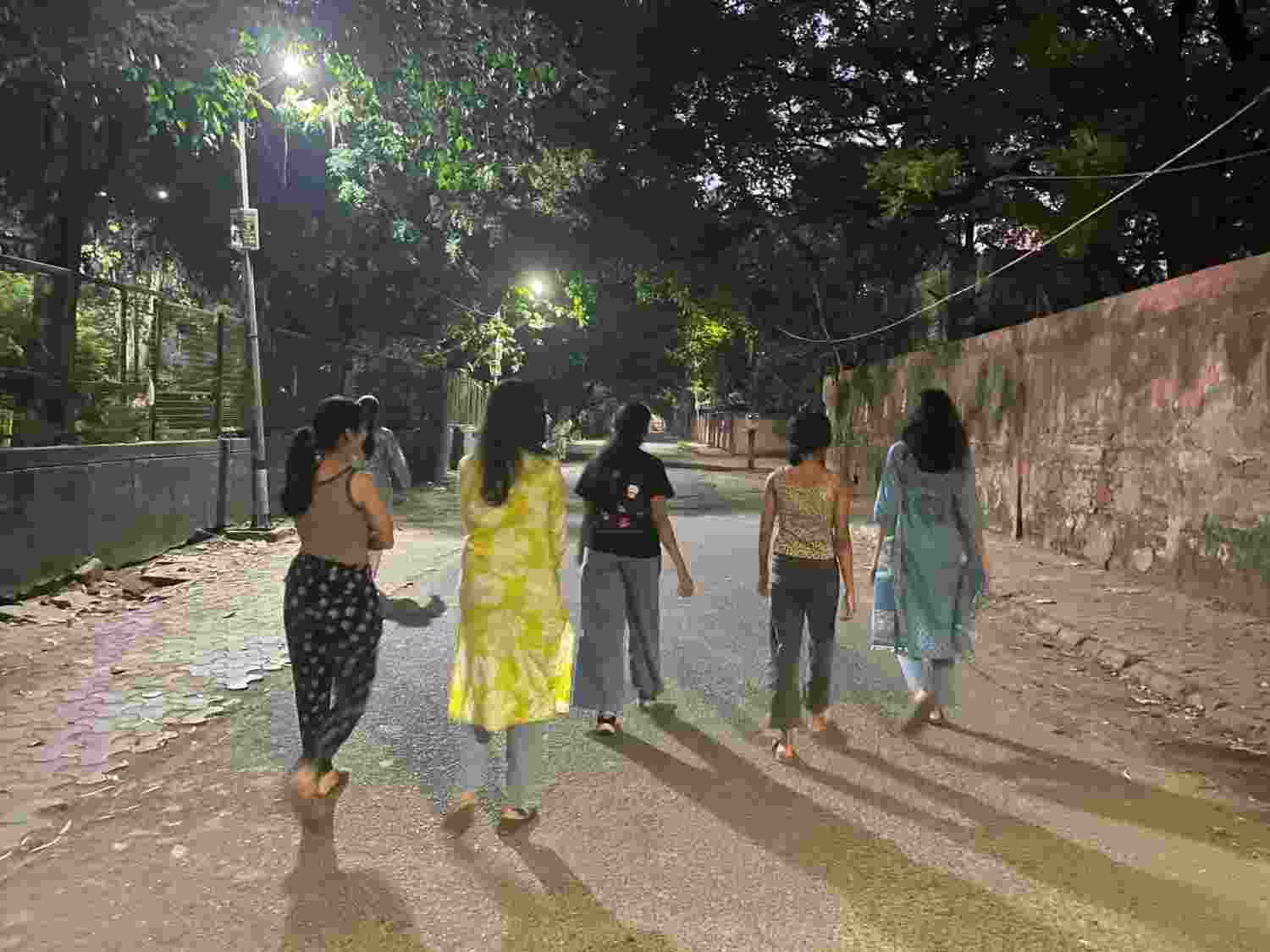
Students of colleges across Delhi University assess safety outside their colleges across nine parameters using the My Safetipin app, revealing the terms and conditions of mobility around campus.
11 years of safety around LSR
In March 2015, Lady Shri Ram College’s Committee Against Sexual Harassment, the Aung San Suu Kyi Centre for Peace and the Department of Political Science conducted a safety audit from LSR to Moolchand. It rated the space as ‘uncomfortable’. The audit was meant to give students agency and local ownership: a safety map based on factors such as lighting, openness and visibility, to help outstation students choose PG accommodation. According to professors back then, the initiative focused on taking immediate action rather than waiting on institutional intervention. The extent of subsequent progress remains uncertain.
Eleven years later, on 24 September 2026, another audit was conducted in the lane adjacent to the college’s back gate, following the alleged rape of a 17-year-old girl nearby. Hosted by Safetipin and Jagori, the audit saw 8–10 LSR students use the My Safetipin app to rate the lane across nine parameters: lighting, openness, visibility, people, security, walking path, public transport, gender diversity, and feeling.
The lane scored low across all nine parameters, with the average rating for feeling indicating that the space was frightening and uncomfortable. It is only in a group that one would feel safe travelling here.
When night falls in North Campus
The five audits conducted around North Campus colleges: Hindu College, Hansraj College, Miranda House, Shri Ram College of Commerce and Kirori Mal College, reveal a mixed picture of safety around campuses. While several locations scored relatively well on openness, concerns surrounding lighting, security, and gender usage raise questions about safety in these areas.
An audit outside Hindu College, conducted at 4:08 pm, recorded no street lighting. As the auditor noted, ‘From 6 pm, there will be no light as there is no street lamp,’ warning that the area becomes ‘highly unsafe for women unless they are travelling in groups’. Similarly, Hansraj College recorded low scores for lighting and security, alongside moderate ratings for openness, visibility and gender usage.
At Miranda House, the audit recorded moderate lighting and visibility but low security and gender usage. Although public transport accessibility received a high score, the limited presence of women raises questions about whether connectivity alone ensures safety. SRCC presented a comparatively ‘safer’ picture, scoring highly on security and walk paths, with the auditor reporting feeling ‘comfortable’ in the space. The audit conducted near Kirori Mal College at 8:22 pm offers the most relevant evidence for examining safety after dark. Despite high scores for openness, visibility, the presence of people, and public transport, the location received low ratings for lighting, security, walking paths, and gender usage.
These findings suggest that favourable physical infrastructure does not automatically ensure women’s safety in public spaces, although it may contribute to a sense of security. However, only one of the five audits was conducted after 8 pm, and gender diversity was rated low rather than absent. Therefore, it is difficult to determine whether the presence of women in North Campus declines significantly after dark.
Safety and sundown in South and Off Campus
Students from seven colleges across South Campus and off-campus areas identified gaps in mobility outside their campuses. While these spaces scored highly on openness and walkability, perceptions of safety were shaped by gendered usage and temporal conditions.
Audits around Gargi College and Kamala Nehru College, conducted near the gates between 5:32 pm and 6:46 pm, revealed a stark decline in women’s presence after sunset. While the streets consistently scored highly on openness and walkability, students reported poor lighting, with illumination coming primarily from secondary sources, such as the colleges themselves. The audits also revealed limited public transport accessibility and a sharp decline in gender diversity as evening fell.
In an audit conducted outside Gate 2 of Gargi College, the user, a second-year student who uses the space daily, wrote, ‘Streetlights are not functional’. Locals commented that the police leave after sunset. All women PCR vans are nowhere near. The area is fairly deserted except for the traffic. A similar picture emerged outside Gate 2 of Gargi College, where the auditor reported ‘natural light blocked by trees’ and described the stretch as deserted. These factors, compounded by relatively few or no eyes on the street, the absence of security personnel, and extremely low gender diversity, contributed to students reporting a feeling of being ‘alarmed’. They said they would avoid the space if they could.
Comparatively, Gate 1 of Gargi College was reported to have better lighting and a larger crowd in the surrounding area, contributing to a feeling of being ‘secure’, although the location still scored low on security and gender diversity.
Outside Gates 1 and 2 of Kamala Nehru College, situated close to Gargi College, the reported feeling returned to ‘frightening’ and ‘uncomfortable’, with scarce lighting around 6:30 pm, distant public transport, and gender diversity reported as ‘no one in sight’. In contrast, the area scored highly on openness, and the walking paths were good enough to run on. The auditor also added, ‘There are no working street lamps on the entire Siri Fort road.’ An audit conducted at 5:32 pm, before sunset, recorded adequately lit surroundings and a higher, though still low, female presence. By 6:39 pm, gender usage had dropped to zero.
The perception of low safety persists even in broad daylight. Outside Delhi College of Arts and Commerce, an audit was conducted at 1:11 pm, and almost every parameter was rated poorly. With virtually no street lighting, no eyes on the street, undiversified gender usage, unavailable public transport, and no security, the student reported feeling ‘frightened’ in the space surrounding the college. ‘It is a construction site, and everywhere there are construction workers even during the daytime. The way to the nearest residential area is all but worse,’ the auditor wrote.
Outside Jesus and Mary College, audits were conducted at 10:03 am and 5:17 pm. While the ratings for the different parameters fluctuated between the two times, students reported the feeling in the space as ‘acceptable’. Outside Venkateswara College, an audit conducted at 12:41 pm reported fairly diverse gender usage and an overall feeling of ‘acceptable’.
Outside Deshbandhu College, an audit conducted at 6:47 pm recorded adequate performance across all parameters except security. ‘Even though there are lights, they are not enough, as there are a few blind spots. There are no security guards over here,’ the auditor wrote. An audit conducted outside Shivaji College at 4:35 pm recorded decent scores across all parameters. The auditor, however, wrote, ‘Though it’s good in daytime, at night it’s extremely unsafe’.
For many students, the college campus functions as a safe island. But what happens when we step outside? What remains is a stretch of road that the data rates as frightening, and a city that, after dark, is simply smaller for women.
Rishika Jain and Sheetal Mishra
Image Credit: Rishika for DU Beat
Read Also: When The Capital Shuts Down Over People Protesting, Where Does Azaadi Go?



Comments are closed.