
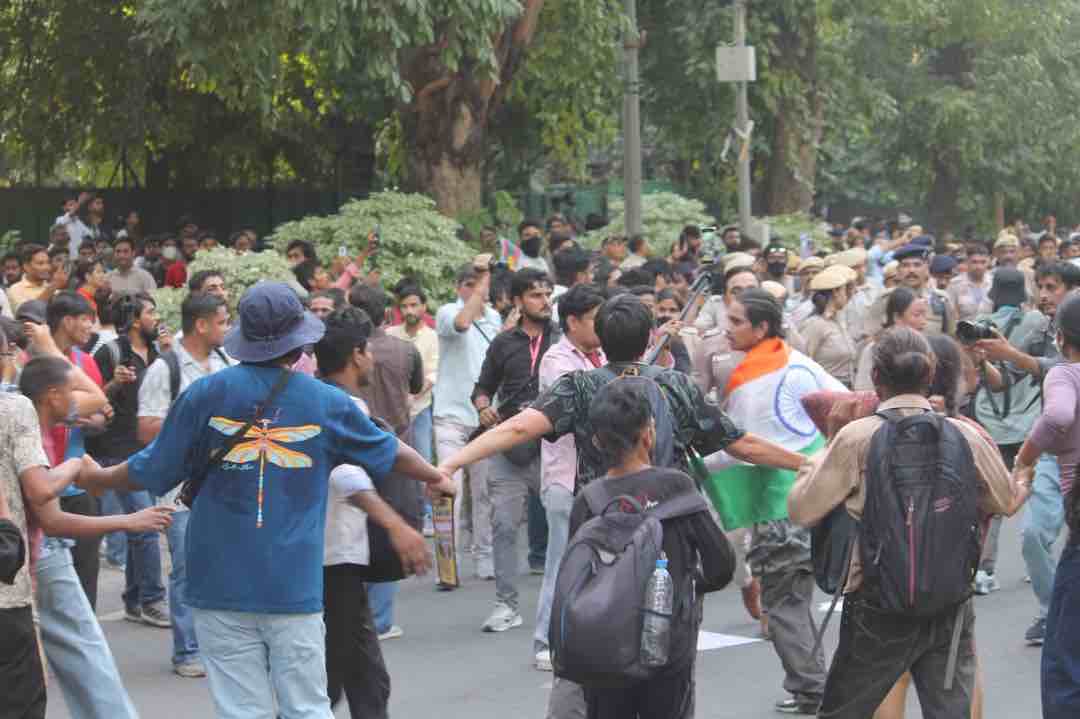
As long as the slogans of resistance have echoed in the history of our nation, ‘Azaadi’ and ‘Inquilab Zindabad’ have remained at its core. Today, however, the same chants and the same spirit of protesting that had given rise to us as a Sovereign, Socialist, Secular, Democratic, Republic, become the biggest threat to the ‘rulers’ (or in better terms, government) of our land.
The year is 2026, and it is only the second week of October; the year is yet to be over, and the people are yet to be heard. Some decades earlier it was 1975, and it was the early month of March; the Emergency had been declared, and the people were already enraged. About 79 years ago it was 1947, and the month of August; the colonial rule was soon to be over, the people were soon to be heard.
There is never a democracy, at least a true one, where there isn’t dissent. What fundamentally makes a nation a democracy is the existence of a thesis, an anti-thesis, and ultimately a synthesis, in the middle of which functions a government—one that must not only heed to its voters, but also its non-voters and dissenters. It is these dissenters, that often take shape of the opposition party, an Instagram/X page, or people marching on the streets with concrete demands that make the ruling government earn respect; not by brutally detaining the people who march with their voice and placards, but by letting people resist, dissent, and protest, while addressing them democratically.
The changing face of our democracy is probably reflected at its highest coverage in the capital city. For decades, the urban residents of Delhi have quietly witnessed the atrocities breaking across Manipur and Kashmir, along with the labouring and farming class of rural India who have by now learnt to live with internet shutdowns, gunfires, brutal detentions, complete lockdowns, and a long list of restrictions that could be debated as constitutionally wrong—the Delhites remained quiet for they never once believed the same atrocities could come knocking at their doorstep. They, just like all of us, were wrong.
Today is 10th October, 2026, and somehow it feels like the 1920s as a lot of the youth who’ve only heard of those days in the stories, histories, and documentaries of the yesteryears would say. Some have even gone to the extent of calling this a remembrance of Indira Gandhi’s 1975 Emergency, but possibly worse. Shashi Tharoor in his wordplay of affairs writes,
“Gen Z deserves better than an undeclared Emer-GenZ.”
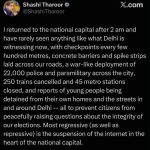
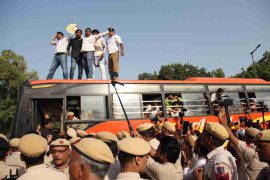
Delhi is officially, on papers, locked down—45 metro stations have been closed, X numbers of individuals from across the city have been detained, leaders of opposition parties like CJP, CPI(M), AISA, and more have been detained, incoming trains have been cancelled, and roads have been closed throughout the city with the Delhi Police doing the best job they have ever done in making sure order, safety, and ruliness is maintained. If this isn’t a declaration of Internal Emergency, one is to wonder what truly is.
Irony remains here, that the citizens who leave the comfort of their homes to walk on the streets amidst the brutal sun and police, are here protesting for answers on the integrity of elections—the same medium through which the current government remains elected by a majority, as they continue to maintain.
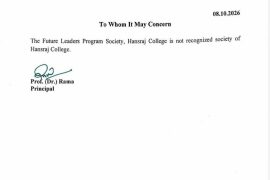
Just like the Delhi Police, even the University of Delhi has tried its best to keep its students in the classroom. While Zakir Hussain College (Evening), Satyawati College (Evening), Shaheed Rajguru College of Applied Sciences, and SBSC have let its students stay at home and attend online classes, women’s colleges of Delhi that happen to be regarded as “apolitical spaces” have once again risen to the occasion—Maitreyi College assured double attendance for all students who came to classes while Lady Shri Ram College witnessed more discussion on cancelling its Garba Event than on addressing concerns of offline classes. The issue here is more than just students wanting to attend the protest—DU doesn’t just have hostellers or students occupying nearby PGs, it has a larger number of day scholars who commute from as far as Faridabad and Ghaziabad to the city. With roads closed, main metros restricted, buses a less than feasible option, and Rapidos unable to function without a massive fare hike, the concern is about reaching college on time before the teachers shut the door on your face for an 8:45 A.M. lecture.
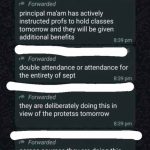
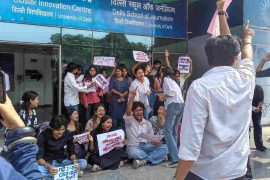
Yet, despite the fear of RAF and CAPF being called in, the attendance bribery offered to students, and the detention of leaders right from their residence or the airport the morning of the protests, people are on the streets. They, however, are confused.
If there’s one thing India should have learnt from its history of protesting, it is that a disorganised movement has no outcome. On the 4th of October, the protestors walking from India Gate to Jantar Mantar, after losing its leader, Neha Bora and her fellow AISA comrades to the detaining police force began to scramble—they ran after the detaining buses shouting and in a spur of confusion ended up getting detained themselves. 10th October, one can only hope, has been different.
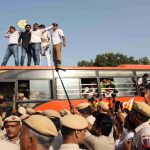
Abhijeet Dipke, founder of CJP—detained.
Neha Bora, AISA President—detained.
M.A. Baby, CPI(M) General Secretary—detained.
Ronak Khatri, Ex DUSU President—detained.
Arvind Kejriwal, Ex Delhi CM and National Convenor AAP—detained.
Lawyers and Journalists—detained.
Common People—detained.
While the leaders sit in buses at undisclosed locations, the public, that is, the ordinary people, many of whom have risked travelling from across the city if not other states, remain in a state of perplexity. From Jantar Mantar and ITO to Dilli Haat and Safdarjung Flyover, the people have taken to brainstorming new routes with the city’s auto bhaiyas and rickshawalas being the biggest supporters of the mass resistance. As disorganised as it may be, the people—both the ones sitting in detention vans since 11:30 AM and the ones running from the police and sitting down wherever the protest location next evolves—are angry. In fact, they are furious, tired, and hopeless. They demand a change, one that should be larger than simply a resignation but systematic, and shouldn’t vanish the minute one demand is met. In July it was for NEET. In October it is for Anti-CEC and SIR, and in the future, the right to protest shouldn’t be one that is met with brutality and disapproval, but one that is welcomed with peace, dialogue, resolution, and hopefully a Prime Minister’s Press Conference with media houses that are yet to be bought—a utopia, one day we hope our nation achieves.
As 10th October slowly closes and midnight approaches, one is to wonder, if at the stroke of midnight, Delhi will awaken to lesser restrictions and more freedom to dissent. If at every moment of dissent the government calls machinery of the state like the Police and Army to back it up at the cost of brutality towards its dissenting citizens, who will suffer—their non-dissenting citizens. If this is indeed the State’s ‘divide and rule’ policy: that they shall use the “inconvenience” caused by the protesting public to the non-protesting crowd, then one is to wonder about the success rates of it.
Today the protest may die down. Tomorrow it will rise again. Today might’ve been a Saturday with fewer offices and colleges open. Monday will be a weekday with more offices and colleges open.
One can only hope that the people stay, no matter the level of brutality, detention, and hiding away of leadership. One can only hope that this rage at being attacked, simply for being on the streets demanding accountability for a wrong, can be cultivated into a peaceful resistance that is met with systematic changes and not the sacrifice of only one member of the ruling party. It is through these hopes that protests like these sustain, and when a country finally awakens after years of being silent, one can expect the government to finally realise that its people will be exhausted, not by the protests, but by their lack of empathy, response, and accountability.
Image Credits: Aaratrika for DU Beat
Aaratrika Ghosh

Comments are closed.