Tag

CJP

Browsing

Delhi’s autumn protests, from DU women’s safety marches to the ‘Cockroach’ movement, were called scattered, unserious and futile. But the actual question is whether an ‘ideal protest’ really exists, or if the question itself is flawed.

Protest is one of the biggest elements of the Spirit of Democracy, and this concept is not alien to our land, be it the British era or the Indira era. And naturally, protests follow every government. But in the end, every protest in India eventually meets the same three questions. Why was it so scattered? What did it actually stand for? And what exactly has changed?

In September and then early October this year, protests in Delhi got all three: They were called unserious, disjointed, ideologically vague and, because no minister resigned the next morning, pointless. It is a tidy verdict. 

But at the same time, it is also built on quite an assumption: there is an “Ideal Protest” somewhere out there, organised, focused and victorious, against which the real ones fall short. Almost utopian. But before looking at what happened, it is worth asking whether that benchmark exists at all.


Case 1: The Marches

On 21st September, A 17-year-old girl was gang-raped by three men who posed as police personnel at Astha Kunj Park near Kalkaji Mandir. Women students from several Delhi University colleges held a march in solidarity with the victim. The march began at the gate of Kamala Nehru College and was open to all women and gender minorities. Students from Lady Shri Ram, Gargi, Miranda House and Kamala Nehru took part.

The charge of “no coherent ideology” is hard to sustain here. The slogan was Hum Auratein Azaad Hain, and the argument was specific: measures that restrict women’s mobility in the name of safety “cage” them rather than make public spaces safer. That is a position, and an old one in the Indian context of feminism. The collective Pinjra Tod, for example, has fought hostel curfews with written charters of demands and all-night sit-ins.
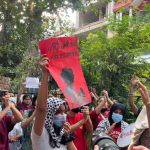
Female students and faculty members from across DU Colleges join the solidarity march (Credits: Nibedita for DU Beat)

The march also did something unglamorous that is easy to miss. Afterwards, students held open consultations on Siri Fort Road to draft a “Charter of Demands for Delhi Citizens”. A protest that builds a drafting process into its own aftermath is not improvising. Five days later, National Law University Delhi students and faculty held their own march, asking for better street lighting, police patrolling and accessibility around campus. Those are the most concrete, most winnable demands of the whole season.

Outcomes are harder to pin down. Three days after the march, the Supreme Court took suo motu cognisance of a series of rape and sexual assault cases across Delhi-NCR, saying they underlined a systematic failure by authorities. Nothing in the coverage links the two events, and it would be dishonest to claim one caused the other. But the timing shows the issue had reached the highest court within a week. The charter’s final text and any official response were not reported in the coverage I reviewed, so that part of the story is still open.


Case 2: The Anti-CEC protests

The protests demanding Chief Election Commissioner Gyanesh Kumar’s resignation look different. They are led by opposition parties alongside student groups tied to the Cockroach Janta Party (CJP) movement, over a revision of electoral rolls that has removed more than 130 million names, with millions appealing. The Election Commission and the government deny any political motive.

Here the “disjointed” charge has more bite, because the coalition is wide. Starting October 2, AISA led protests on the streets of Delhi. On 4 October, AISA’s national president Neha Bora was detained near Ashoka Road as marchers tried to reach Jantar Mantar without police permission. Days later, the INDIA bloc held its own protest at Rajghat. Student groups, party workers and a national opposition do not share a single script. Whether that is incoherence or simply what a coalition looks like is the question.
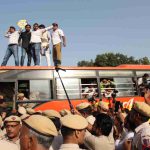
Scenes from the 4th October Protest (Credits: Mananya for DU Beat)

The state’s response is itself evidence. Ahead of the 10 October protests, Amnesty International India criticised the “lockdown-like” restrictions, including planned Metro closures, sealed borders, and thousands of additional armed personnel. Nobody deploys that much machinery against a protest they consider irrelevant.

And judging these protests by outcome so soon is premature. The same movement spent roughly two months and several rounds of tear gas and baton charges before Education Minister Dharmendra Pradhan resigned on 25 July, which AP called the government’s first major concession to it. Delhi’s own history agrees. The 2012 protests produced a 71-point charter of demands from a DU-linked forum within days, and are now remembered as having led to several criminal law reforms. Reform arrived long after the crowds went home.


The Gen Z register

Part of the “unserious” charge is about form. These protests don’t look like the marches older critics remember, and they were not built to.

The clearest case is the Cockroach Janta Party. After a remark by Chief Justice Surya Kant that Newslaundry reports as likening unemployed youth to “parasites” and “cockroaches”, Abhijeet Dipke launched a satirical party on 16 May, its name a pun on the BJP. The movement then adopted the insult. Protesters carried “Main Bhi Cockroach” signs and wore cockroach masks, and Newslaundry described posters that were memes lifted off the screen and set on paper. When the party’s X account was withheld in India, a new one appeared within minutes, announced with a poster reading “Cockroach is back”.

Critics were quick. Newslaundry notes the old stereotype of this generation as apolitical, lazy and unserious, and opponents, many of them Modi supporters, dismissed the party as an online gimmick aligned with the opposition, citing Dipke’s past association with the Aam Aadmi Party. The scepticism was not only partisan: Newslaundry’s account of the movement’s debut sets older liberal cynics beside the hopeful.
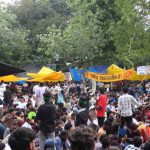
Protests by CJP over NEET Cancellations
CJP Protests at Jantar Mantar Over NEET Cancellation (Credits: Mananya for DU Beat)

But the jokes were a delivery system, not the demand. Foreign Policy reports that the movement mobilised through memes, Reels and humour, and one Delhi participant said social media made the protest feel like a conversation, not a lecture. The test of seriousness is the result, and reports that a movement that began as a call for education reform and grew into a broader protest over unemployment and accountability won its first major concession in July.

“Gen Z” is not one register, either. The DU marches ran on a different grammar: the Hum Auratein Azaad Hain banner, a rhyming chant about breaking apart the society that keeps women bound, open consultations and a charter. Students of the same age used satire in one protest and earnest verse in another, so tarring both as “unserious” lumps together two different strategies.

The trade-off is real. Humour spreads fast and is the easiest form to wave away, yet police evidently did not treat it as a joke: Al Jazeera reported that CJP members said they were detained as protests continued.

The slogans did the same work as the jokes. At the movement’s first Delhi protest on 6 June, supporters chanted “Cockroaches are coming, Dharmendra Pradhan is going!”, a rhyme, a name and a demand in one line, while another placard joked about waiting for an exam that doesn’t leak. Yet the offline playbook was conventional: AP described weeks of demonstrations, sit-ins and hunger strikes before the July resignation. The memes were the recruiting poster; the hunger strike was the protest.


“Season 2” and a sealed city

The 10 October protest at Jantar Mantar was blunted before it began, and the way it was blunted is the story. The CJP’s founder had called it “Season 2”. Delhi Police refused permission, saying the application arrived on 7 October against a 10-day notice requirement and pointing to alleged violations at an earlier protest. The city was then locked down with about 25,000 police and paramilitary personnel, a notice of closure of 57 metro stations, which, after the Apex Court’s intervention, was later reduced to 45 Metro stations, and several trains were cancelled.

On the day, Abhijeet Dipke, Ashutosh Ranka and Sourav Das were detained as their plane landed. Former chief ministers Arvind Kejriwal, Mamata Banerjee, Pinarayi Vijayan and Manik Sarkar were also detained as they tried to join, and AISA president Neha Bora was picked up while leading a march from INA. Detention figures climbed through the day and conflict: about 1,500 by mid-morning, then a Tribune live-blog headline of 7,000 over a body text saying 3,000. Treat all of them as unconfirmed. The BJP called the protest a flop.
Protests and crowd at Jantar Mantar on 4th October
Protesting crowd at Jantar Mantar on 4th October (Credits: Aaratrika for DU Beat)

On Sunday, a court released Dipke and the two others on condition of no breach of peace for a year, and with central Delhi sealed, turnout stayed small and people who started slogans were detained. By crowd size, the BJP has a point. By every other measure it doesn’t: a party that began as a joke took a 25,000-strong deployment to contain and put four former chief ministers behind the same barricades. It also exposed the weak point of an online-first, leader-centred movement. Detain the leaders, seal the venue, and the street goes quiet. The CJP itself called the arrests an attempt to cripple its leadership.


A Domino Reaction

Read as separate events, these protests might look scattered. Read in order, they look like a chain reaction. An important point to note is that after the first CJP protests, multiple small protests also took place at the Jantar Mantar, with each one lowering the cost of the next. That is an interpretation, not a documented fact, and the sequence below is where it has to hold up.


Date (2026) Protest
16 May Dipke launches the Cockroach Janta Party online after the Chief Justice’s remark
25 July Education Minister Dharmendra Pradhan resigns, the first major concession to the movement
25 Sept DU women’s colleges march after the Aastha Kunj park case
28 Sept The Supreme Court takes suo motu cognisance of Delhi-NCR sexual assault cases
30 Sept NLU Delhi students and faculty march for safer public spaces
4 Oct AISA and other groups march towards Ashoka Road; leaders detained
7–8 Oct Rahul Gandhi is detained repeatedly and the INDIA bloc protests, as CJP members report detentions
10 Oct Jantar Mantar is sealed; opposition and CJP leaders are detained


Now, an important question—What links? 

First, precedent. Noted that the government has rarely yielded to sustained public pressure, with the 2021 farm-law withdrawal the notable exception. The July resignation showed young protesters that a street campaign can extract a concession, and every later protest inherits that proof. 

Second, the shared grievance: exam leaks, public space, and the electoral rolls are different issues carrying the same message: that institutions are not answering this generation. 

Third, the state’s response. Heavy-handed policing, which Amnesty called lockdown-like, turns each crackdown into a reason for the next protest, and it draws in the opposition parties that now stand beside the students.

The limits matter. Nothing in the coverage reviewed for this piece shows the women’s-safety marches feeding into the CEC protests, and the Supreme Court’s notice doesn’t appear to respond to the marchers. The honest picture is closer to neighbouring fires fed by the same dry grass than to one line of dominoes. That still makes spillover a useful way to measure a protest, as the next section argues.


Ways to count scores of Protests

If “did it win?” is the only question, nearly every protest fails on the day. A fairer scorecard has more columns:

  • Concrete outcomes: were demands met, whether a policy change or a resignation?
  • Agenda-setting: did the issue enter public debate and the courts, and stay there?
  • Infrastructure: did it leave behind charters, coalitions or networks that can act again?
  • Participant formation: did it politicise the people who showed up? A first-year at her first march is an outcome too.
  • State response: what do bans, barricades and detentions reveal about how the protest was perceived?
  • Time horizon: judged after a week, a year, or a decade?
  • Spillover: did it make the next protest easier to start, for the same people or for others?

By these measures, the DU marches score well on agenda-setting, infrastructure, and formation, and are unproven on outcomes. The CJP protests score high on state response and agenda-setting, and it is too early to say on the rest. Neither is a failure. Both are mid-sentence.


Can there be ideal protests?

Short answer: NO! Because the virtues contradict each other. A tightly led protest is easy to message but at the same time easy to decapitate. A leaderless one is resilient enough but might be hard to negotiate with. A narrow demand might be achieved or fulfilled with easier efforts, while a broad one has the potential to change a country. Disruption gets attention but can lose public sympathy, and politeness does the reverse. Humour travels furthest and is the easiest to dismiss, while solemnity is taken seriously and reaches fewer people. In order for a protest to maximize one of these, the only way is by sacrificing another.

That is why “ideal” is the wrong word. A better question is whether a protest fits its purpose. A march meant to put an issue on the agenda and start a charter did its job if the issue got on the agenda and the charter got started. A campaign meant to force a resignation has to be judged on whether the resignation happens, and sometimes it does, after two long months.

The perfect protest is a retrospective fiction, tidied up by history in writing once the mess has been long gone to be witnessed by the readers. The real ones are loud, plural and unfinished. The honest critique is not that they failed to be perfect, but a more specific question: what were they trying to do, and can we see it working?


Image Credits: Aaratrika for DU Beat

Read Also: When The Capital Shuts Down Over People Protesting, Where Does Azaadi Go?


Aridaman Singh
[email protected]
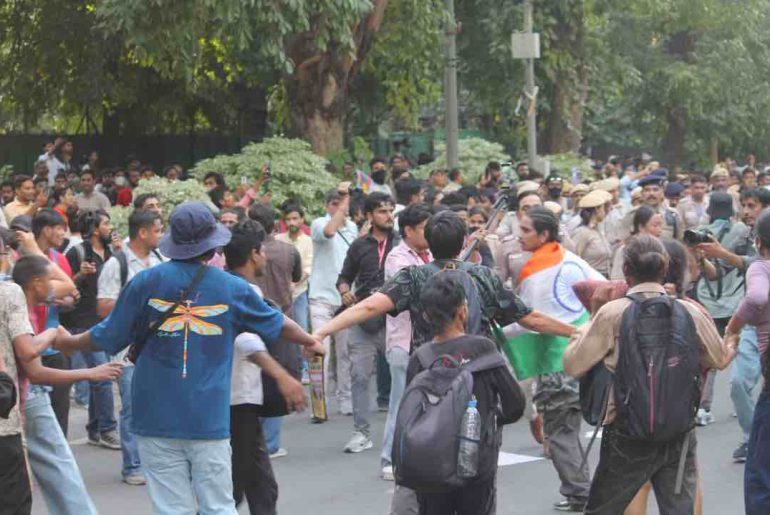
As long as the slogans of resistance have echoed in the history of our nation, ‘Azaadi’ and ‘Inquilab Zindabad’ have remained at its core. Today, however, the same chants and the same spirit of protesting that had given rise to us as a Sovereign, Socialist, Secular, Democratic, Republic, become the biggest threat to the ‘rulers’ (or in better terms, government) of our land. 

The year is 2026, and it is only the second week of October; the year is yet to be over, and the people are yet to be heard. Some decades earlier it was 1975, and it was the early month of March; the Emergency had been declared, and the people were already enraged. About 79 years ago it was 1947, and the month of August; the colonial rule was soon to be over, the people were soon to be heard. 

There is never a democracy, at least a true one, where there isn’t dissent. What fundamentally makes a nation a democracy is the existence of a thesis, an anti-thesis, and ultimately a synthesis, in the middle of which functions a government—one that must not only heed to its voters, but also its non-voters and dissenters. It is these dissenters, that often take shape of the opposition party, an Instagram/X page, or people marching on the streets with concrete demands that make the ruling government earn respect; not by brutally detaining the people who march with their voice and placards, but by letting people resist, dissent, and protest, while addressing them democratically. 

The changing face of our democracy is probably reflected at its highest coverage in the capital city. For decades, the urban residents of Delhi have quietly witnessed the atrocities breaking across Manipur and Kashmir, along with the labouring and farming class of rural India who have by now learnt to live with internet shutdowns, gunfires, brutal detentions, complete lockdowns, and a long list of restrictions that could be debated as constitutionally wrong—the Delhites remained quiet for they never once believed the same atrocities could come knocking at their doorstep. They, just like all of us, were wrong. 

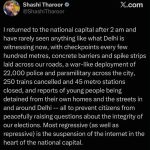
Today is 10th October, 2026, and somehow it feels like the 1920s as a lot of the youth who’ve only heard of those days in the stories, histories, and documentaries of the yesteryears would say. Some have even gone to the extent of calling this a remembrance of Indira Gandhi’s 1975 Emergency, but possibly worse. Shashi Tharoor in his wordplay of affairs writes,

“Gen Z deserves better than an undeclared Emer-GenZ.”

Image Credits: Shashi Tharoor on X

Delhi is officially, on papers, locked down—45 metro stations have been closed, X numbers of individuals from across the city have been detained, leaders of opposition parties like CJP, CPI(M), AISA, and more have been detained, incoming trains have been cancelled, and roads have been closed throughout the city with the Delhi Police doing the best job they have ever done in making sure order, safety, and ruliness is maintained. If this isn’t a declaration of Internal Emergency, one is to wonder what truly is. 

Irony remains here, that the citizens who leave the comfort of their homes to walk on the streets amidst the brutal sun and police, are here protesting for answers on the integrity of elections—the same medium through which the current government remains elected by a majority, as they continue to maintain.

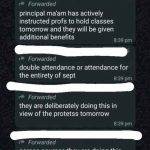
Just like the Delhi Police, even the University of Delhi has tried its best to keep its students in the classroom. While Zakir Hussain College (Evening), Satyawati College (Evening), Shaheed Rajguru College of Applied Sciences, and SBSC have let its students stay at home and attend online classes, women’s colleges of Delhi that happen to be regarded as “apolitical spaces” have once again risen to the occasion—Maitreyi College assured double attendance for all students who came to classes while Lady Shri Ram College witnessed more discussion on cancelling its Garba Event than on addressing concerns of offline classes. The issue here is more than just students wanting to attend the protest—DU doesn’t just have hostellers or students occupying nearby PGs, it has a larger number of day scholars who commute from as far as Faridabad and Ghaziabad to the city. With roads closed, main metros restricted, buses a less than feasible option, and Rapidos unable to function without a massive fare hike, the concern is about reaching college on time before the teachers shut the door on your face for an 8:45 A.M. lecture.

Screenshot of a Maitreyi College Official Group Chat (Credits: AISA Maitreyi)

Yet, despite the fear of RAF and CAPF being called in, the attendance bribery offered to students, and the detention of leaders right from their residence or the airport the morning of the protests, people are on the streets. They, however, are confused.

If there’s one thing India should have learnt from its history of protesting, it is that a disorganised movement has no outcome. On the 4th of October, the protestors walking from India Gate to Jantar Mantar, after losing its leader, Neha Bora and her fellow AISA comrades to the detaining police force began to scramble—they ran after the detaining buses shouting and in a spur of confusion ended up getting detained themselves. 10th October, one can only hope, has been different. 

Scenes from the 4th October Protest (Credits: Mananya for DU Beat)

Abhijeet Dipke, founder of CJP—detained.

Neha Bora, AISA President—detained.

M.A. Baby, CPI(M) General Secretary—detained.

Ronak Khatri, Ex DUSU President—detained. 

Arvind Kejriwal, Ex Delhi CM and National Convenor AAP—detained.

Lawyers and Journalists—detained.

Common People—detained.


While the leaders sit in buses at undisclosed locations, the public, that is, the ordinary people, many of whom have risked travelling from across the city if not other states, remain in a state of perplexity. From Jantar Mantar and ITO to Dilli Haat and Safdarjung Flyover, the people have taken to brainstorming new routes with the city’s auto bhaiyas and rickshawalas being the biggest supporters of the mass resistance. As disorganised as it may be, the people—both the ones sitting in detention vans since 11:30 AM and the ones running from the police and sitting down wherever the protest location next evolves—are angry. In fact, they are furious, tired, and hopeless. They demand a change, one that should be larger than simply a resignation but systematic, and shouldn’t vanish the minute one demand is met. In July it was for NEET. In October it is for Anti-CEC and SIR, and in the future, the right to protest shouldn’t be one that is met with brutality and disapproval, but one that is welcomed with peace, dialogue, resolution, and hopefully a Prime Minister’s Press Conference with media houses that are yet to be bought—a utopia, one day we hope our nation achieves. 

As 10th October slowly closes and midnight approaches, one is to wonder, if at the stroke of midnight, Delhi will awaken to lesser restrictions and more freedom to dissent. If at every moment of dissent the government calls machinery of the state like the Police and Army to back it up at the cost of brutality towards its dissenting citizens, who will suffer—their non-dissenting citizens. If this is indeed the State’s ‘divide and rule’ policy: that they shall use the “inconvenience” caused by the protesting public to the non-protesting crowd, then one is to wonder about the success rates of it. 

Today the protest may die down. Tomorrow it will rise again. Today might’ve been a Saturday with fewer offices and colleges open. Monday will be a weekday with more offices and colleges open. 

One can only hope that the people stay, no matter the level of brutality, detention, and hiding away of leadership. One can only hope that this rage at being attacked, simply for being on the streets demanding accountability for a wrong, can be cultivated into a peaceful resistance that is met with systematic changes and not the sacrifice of only one member of the ruling party. It is through these hopes that protests like these sustain, and when a country finally awakens after years of being silent, one can expect the government to finally realise that its people will be exhausted, not by the protests, but by their lack of empathy, response, and accountability. 


Read Also: Delhi Police Detain CJP Leadership, Dhruv Rathee, Leftist Leaders, Lawyers, and Journalists Amidst the Jantar Mantar Anti-CEC Protests

Image Credits: Aaratrika for DU Beat


Aaratrika Ghosh

[email protected]


Two Delhi University students remain hospitalised after the July 20 Jantar Mantar protest, as eyewitness accounts and medical findings draw attention to the injuries sustained.

Days after Delhi Police baton-charged thousands of demonstrators marching towards Parliament as part of the Cockroach Janta Party’s “Chalo Sansad” march, at least two Delhi University students remain hospitalised with serious injuries, raising questions about the extent of force used to disperse the July 20 protest. While Delhi Police have consistently denied using pellet guns, multiple eyewitnesses and medical reports have disputed that claim.

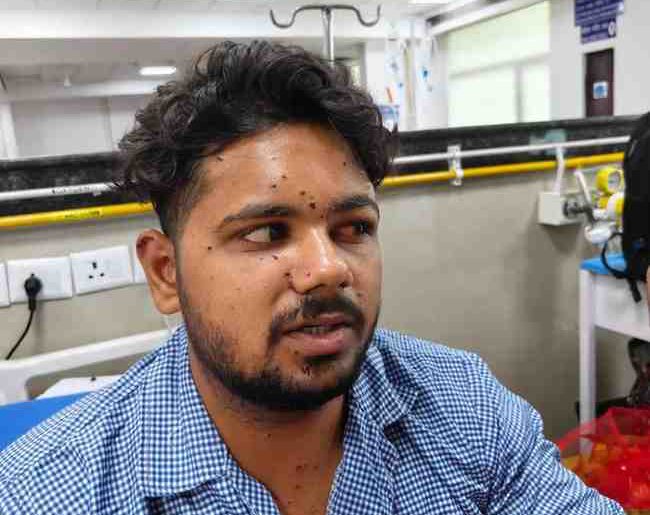
Sahil Lochab, a Delhi University School of Open Learning student preparing for the SSC Combined Graduate Level examination, may lose vision in his right eye after what his family alleges was a pellet gun injury sustained during the march. Lochab underwent surgeries at Lady Hardinge Medical College and Safdarjung Hospital before being shifted to the AIIMS Trauma Centre, where doctors reportedly removed a pellet lodged in his eye that had caused a corneal perforation, along with others from his lung and the tissue surrounding his heart. His family was initially told there was only a one per cent chance of his sight returning. Doctors have since said his prognosis remains “guarded”, meaning the likelihood of vision recovery remains uncertain.

Twenty-one-year-old Sakshi, also a Delhi University student, was caught in a crowd crush near Jantar Mantar after police allegedly pushed demonstrators into an already congested area following the use of tear gas, according to protesters. She was carried unconscious to a police vehicle after demonstrators alleged officers at the scene were reluctant to transport her to hospital. Admitted to the intensive care unit (ICU) at Ram Manohar Lohia (RML) Hospital and placed on ventilator support, she was extubated on July 23 after hospital authorities said her condition had shown “steady improvement”. They added that she was conscious, breathing independently, and that MRI scans of her brain and spine were normal.

Protesters on July 20 have described police charging at people who were simply filling water from a cooler, triggering a stampede. One eyewitness who was present when Sakshi was found unconscious, said her face had turned blue and that she was bleeding near one ear. Bystanders, guided by others in the crowd, attempted cardiopulmonary resuscitation (CPR) and, when that appeared unsuccessful, administered mouth-to-mouth resuscitation. The witness also alleged that protesters restrained a police officer whom they believed was responsible for her injuries, and described difficulties in locating an ambulance before she was eventually taken to hospital in a police vehicle.

Delhi Police have said around 60 protesters and 118 police personnel were injured in the clashes. They also reported that more than 20 police vehicles were damaged and that 70 protesters were detained. Officers, including Head Constable Balram, Inspector Nand Kishore Singh, ACP Vivek Bhagat, and Head Constable Babu Lal, alleged they were separated from their units and assaulted by crowds.

Delhi Police have repeatedly and categorically denied using pellet guns during the protest, stating the force neither possesses nor uses them and warning against circulating “false and misleading” information. However, medico-legal case (MLC) reports for at least three injured protesters, including Lochab, 25-year-old Sheikh Irshad Mansoori, and a 28-year-old Outlook journalist, reportedly describe “suspected gunshot injury” or “pellet injury marks”, and hospital sources have said the pellets recovered were metallic rather than plastic or rubber. Pellet guns and shock batons form part of the Rapid Action Force’s (RAF) riot-control equipment. However, no official evidence has conclusively established whether pellet guns were fired during the protest.

Leader of the Opposition Rahul Gandhi, speaking to reporters in Parliament,  accused the government of suppressing students’ voices and said the police action against them was “completely wrong,” renewing the Opposition’s demand for Prime Minister Narendra Modi to apologise and for Education Minister Dharmendra Pradhan to resign.

Sheetal Mishra

[email protected]

Also Read: DU Sets Up Anti-Ragging Control Rooms

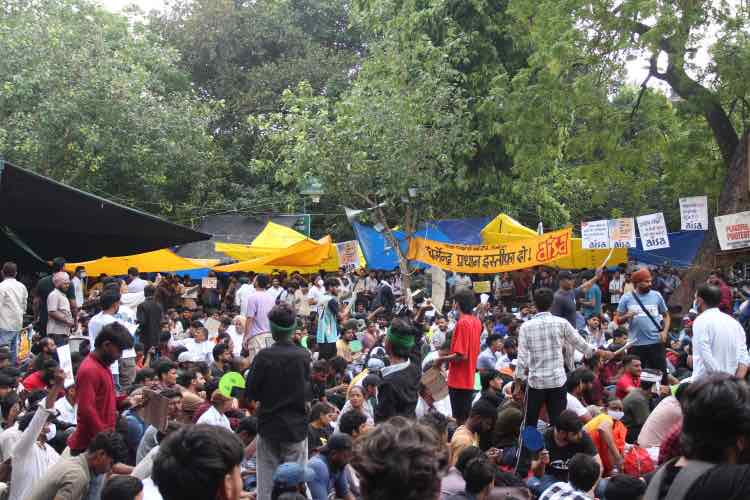
CJP protest’s fifth day at Jantar Mantar swapped slogans for lectures. Educators addressed demonstrators, while the demand for a National Student Commission was reiterated. 

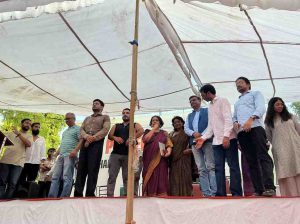
The CJP protest at Jantar Mantar entered its fifth day on Wednesday, with educators Prof. Dr Vijender Chauhan, Delhi University; Vikramjeet Singh and Abhinay Sharma addressing demonstrators. Organisers reiterated their demand for the establishment of a National Student Commission, stating that the protest would continue until the government responds.

Dr Chauhan emphasised the need for diversity within the movement and the bureaucracy.  Speaking to DU Beat, Dr Chauhan said,

Real change won’t come from a crowd that all look the same. Without that diversity, the fight simply can’t be won.  “

Singh’s remarks focused on education funding and the credibility of national exams. He said the NEP 2020 and global benchmarks recommend public education spending of around 6% of GDP, against actual spending of 2.5%-4%. He linked the funding gap to poor school infrastructure, teacher shortages, faculty vacancies and a weak research ecosystem, which he said disproportionately affects rural and marginalised students. 

Sharma’s remarks ranged more broadly, touching on other national issues, including media coverage, the Andaman Islands and renewed calls for the Union Education Minister’s resignation. 

The protest, which began earlier this month, continues to demand the establishment of a National Student Commission of India. CJP says it won’t leave until the government agrees. At this time, the government has not publicly responded to the pressure group’s demand.

The CJP protest at Jantar Mantar continued into its fifth day with cultural performances alongside the day’s lectures, with performances by artists, musicians and poets at the site. During the rainfall on Wednesday evening, protesters were seen dancing together at Jantar Mantar. 

While talking to DU Beat, one protestor called it a “controlled blast”, alleging it has allowed people to express their anger without tangible outcomes. Although the CJP promised 50% women’s participation, the organisation has yet to announce an official woman spokesperson nineteen days after its first protest.


Image Credits: Mayank for DU Beat

Read Also: AADTA-led Teachers across DU Stage Protest for Regularisation of Ad Hoc Faculty


Mayank Kushwaha

[email protected]