
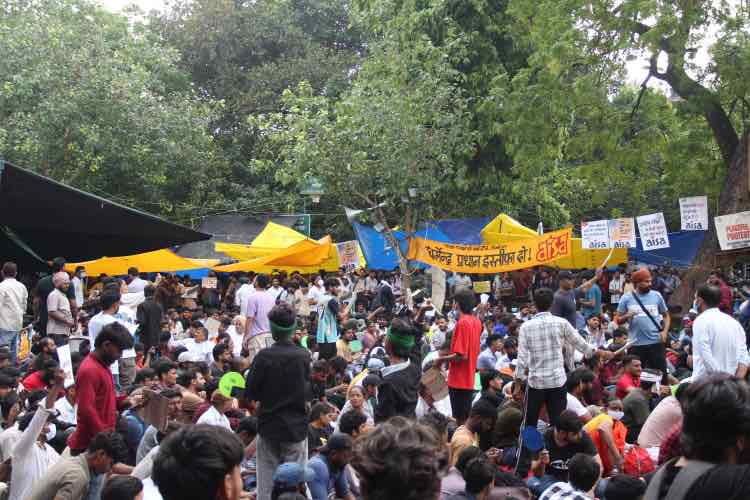
Delhi’s autumn protests, from DU women’s safety marches to the ‘Cockroach’ movement, were called scattered, unserious and futile. But the actual question is whether an ‘ideal protest’ really exists, or if the question itself is flawed.
Protest is one of the biggest elements of the Spirit of Democracy, and this concept is not alien to our land, be it the British era or the Indira era. And naturally, protests follow every government. But in the end, every protest in India eventually meets the same three questions. Why was it so scattered? What did it actually stand for? And what exactly has changed?
In September and then early October this year, protests in Delhi got all three: They were called unserious, disjointed, ideologically vague and, because no minister resigned the next morning, pointless. It is a tidy verdict.
But at the same time, it is also built on quite an assumption: there is an “Ideal Protest” somewhere out there, organised, focused and victorious, against which the real ones fall short. Almost utopian. But before looking at what happened, it is worth asking whether that benchmark exists at all.
Case 1: The Marches
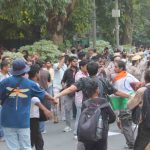
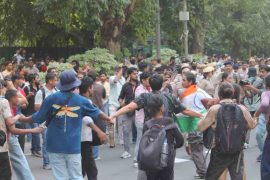
On 21st September, A 17-year-old girl was gang-raped by three men who posed as police personnel at Astha Kunj Park near Kalkaji Mandir. Women students from several Delhi University colleges held a march in solidarity with the victim. The march began at the gate of Kamala Nehru College and was open to all women and gender minorities. Students from Lady Shri Ram, Gargi, Miranda House and Kamala Nehru took part.
The charge of “no coherent ideology” is hard to sustain here. The slogan was Hum Auratein Azaad Hain, and the argument was specific: measures that restrict women’s mobility in the name of safety “cage” them rather than make public spaces safer. That is a position, and an old one in the Indian context of feminism. The collective Pinjra Tod, for example, has fought hostel curfews with written charters of demands and all-night sit-ins.
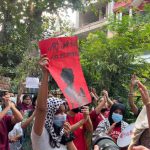
The march also did something unglamorous that is easy to miss. Afterwards, students held open consultations on Siri Fort Road to draft a “Charter of Demands for Delhi Citizens”. A protest that builds a drafting process into its own aftermath is not improvising. Five days later, National Law University Delhi students and faculty held their own march, asking for better street lighting, police patrolling and accessibility around campus. Those are the most concrete, most winnable demands of the whole season.
Outcomes are harder to pin down. Three days after the march, the Supreme Court took suo motu cognisance of a series of rape and sexual assault cases across Delhi-NCR, saying they underlined a systematic failure by authorities. Nothing in the coverage links the two events, and it would be dishonest to claim one caused the other. But the timing shows the issue had reached the highest court within a week. The charter’s final text and any official response were not reported in the coverage I reviewed, so that part of the story is still open.
Case 2: The Anti-CEC protests
The protests demanding Chief Election Commissioner Gyanesh Kumar’s resignation look different. They are led by opposition parties alongside student groups tied to the Cockroach Janta Party (CJP) movement, over a revision of electoral rolls that has removed more than 130 million names, with millions appealing. The Election Commission and the government deny any political motive.
Here the “disjointed” charge has more bite, because the coalition is wide. Starting October 2, AISA led protests on the streets of Delhi. On 4 October, AISA’s national president Neha Bora was detained near Ashoka Road as marchers tried to reach Jantar Mantar without police permission. Days later, the INDIA bloc held its own protest at Rajghat. Student groups, party workers and a national opposition do not share a single script. Whether that is incoherence or simply what a coalition looks like is the question.
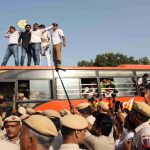
The state’s response is itself evidence. Ahead of the 10 October protests, Amnesty International India criticised the “lockdown-like” restrictions, including planned Metro closures, sealed borders, and thousands of additional armed personnel. Nobody deploys that much machinery against a protest they consider irrelevant.
And judging these protests by outcome so soon is premature. The same movement spent roughly two months and several rounds of tear gas and baton charges before Education Minister Dharmendra Pradhan resigned on 25 July, which AP called the government’s first major concession to it. Delhi’s own history agrees. The 2012 protests produced a 71-point charter of demands from a DU-linked forum within days, and are now remembered as having led to several criminal law reforms. Reform arrived long after the crowds went home.
The Gen Z register
Part of the “unserious” charge is about form. These protests don’t look like the marches older critics remember, and they were not built to.
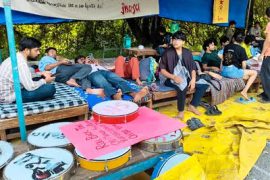
The clearest case is the Cockroach Janta Party. After a remark by Chief Justice Surya Kant that Newslaundry reports as likening unemployed youth to “parasites” and “cockroaches”, Abhijeet Dipke launched a satirical party on 16 May, its name a pun on the BJP. The movement then adopted the insult. Protesters carried “Main Bhi Cockroach” signs and wore cockroach masks, and Newslaundry described posters that were memes lifted off the screen and set on paper. When the party’s X account was withheld in India, a new one appeared within minutes, announced with a poster reading “Cockroach is back”.
Critics were quick. Newslaundry notes the old stereotype of this generation as apolitical, lazy and unserious, and opponents, many of them Modi supporters, dismissed the party as an online gimmick aligned with the opposition, citing Dipke’s past association with the Aam Aadmi Party. The scepticism was not only partisan: Newslaundry’s account of the movement’s debut sets older liberal cynics beside the hopeful.
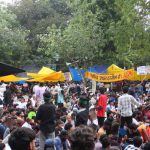
But the jokes were a delivery system, not the demand. Foreign Policy reports that the movement mobilised through memes, Reels and humour, and one Delhi participant said social media made the protest feel like a conversation, not a lecture. The test of seriousness is the result, and reports that a movement that began as a call for education reform and grew into a broader protest over unemployment and accountability won its first major concession in July.
“Gen Z” is not one register, either. The DU marches ran on a different grammar: the Hum Auratein Azaad Hain banner, a rhyming chant about breaking apart the society that keeps women bound, open consultations and a charter. Students of the same age used satire in one protest and earnest verse in another, so tarring both as “unserious” lumps together two different strategies.
The trade-off is real. Humour spreads fast and is the easiest form to wave away, yet police evidently did not treat it as a joke: Al Jazeera reported that CJP members said they were detained as protests continued.
The slogans did the same work as the jokes. At the movement’s first Delhi protest on 6 June, supporters chanted “Cockroaches are coming, Dharmendra Pradhan is going!”, a rhyme, a name and a demand in one line, while another placard joked about waiting for an exam that doesn’t leak. Yet the offline playbook was conventional: AP described weeks of demonstrations, sit-ins and hunger strikes before the July resignation. The memes were the recruiting poster; the hunger strike was the protest.
“Season 2” and a sealed city
The 10 October protest at Jantar Mantar was blunted before it began, and the way it was blunted is the story. The CJP’s founder had called it “Season 2”. Delhi Police refused permission, saying the application arrived on 7 October against a 10-day notice requirement and pointing to alleged violations at an earlier protest. The city was then locked down with about 25,000 police and paramilitary personnel, a notice of closure of 57 metro stations, which, after the Apex Court’s intervention, was later reduced to 45 Metro stations, and several trains were cancelled.
On the day, Abhijeet Dipke, Ashutosh Ranka and Sourav Das were detained as their plane landed. Former chief ministers Arvind Kejriwal, Mamata Banerjee, Pinarayi Vijayan and Manik Sarkar were also detained as they tried to join, and AISA president Neha Bora was picked up while leading a march from INA. Detention figures climbed through the day and conflict: about 1,500 by mid-morning, then a Tribune live-blog headline of 7,000 over a body text saying 3,000. Treat all of them as unconfirmed. The BJP called the protest a flop.
On Sunday, a court released Dipke and the two others on condition of no breach of peace for a year, and with central Delhi sealed, turnout stayed small and people who started slogans were detained. By crowd size, the BJP has a point. By every other measure it doesn’t: a party that began as a joke took a 25,000-strong deployment to contain and put four former chief ministers behind the same barricades. It also exposed the weak point of an online-first, leader-centred movement. Detain the leaders, seal the venue, and the street goes quiet. The CJP itself called the arrests an attempt to cripple its leadership.
A Domino Reaction
Read as separate events, these protests might look scattered. Read in order, they look like a chain reaction. An important point to note is that after the first CJP protests, multiple small protests also took place at the Jantar Mantar, with each one lowering the cost of the next. That is an interpretation, not a documented fact, and the sequence below is where it has to hold up.
| Date (2026) | Protest |
|---|---|
| 16 May | Dipke launches the Cockroach Janta Party online after the Chief Justice’s remark |
| 25 July | Education Minister Dharmendra Pradhan resigns, the first major concession to the movement |
| 25 Sept | DU women’s colleges march after the Aastha Kunj park case |
| 28 Sept | The Supreme Court takes suo motu cognisance of Delhi-NCR sexual assault cases |
| 30 Sept | NLU Delhi students and faculty march for safer public spaces |
| 4 Oct | AISA and other groups march towards Ashoka Road; leaders detained |
| 7–8 Oct | Rahul Gandhi is detained repeatedly and the INDIA bloc protests, as CJP members report detentions |
| 10 Oct | Jantar Mantar is sealed; opposition and CJP leaders are detained |
Now, an important question—What links?
First, precedent. Noted that the government has rarely yielded to sustained public pressure, with the 2021 farm-law withdrawal the notable exception. The July resignation showed young protesters that a street campaign can extract a concession, and every later protest inherits that proof.
Second, the shared grievance: exam leaks, public space, and the electoral rolls are different issues carrying the same message: that institutions are not answering this generation.
Third, the state’s response. Heavy-handed policing, which Amnesty called lockdown-like, turns each crackdown into a reason for the next protest, and it draws in the opposition parties that now stand beside the students.
The limits matter. Nothing in the coverage reviewed for this piece shows the women’s-safety marches feeding into the CEC protests, and the Supreme Court’s notice doesn’t appear to respond to the marchers. The honest picture is closer to neighbouring fires fed by the same dry grass than to one line of dominoes. That still makes spillover a useful way to measure a protest, as the next section argues.
Ways to count scores of Protests
If “did it win?” is the only question, nearly every protest fails on the day. A fairer scorecard has more columns:
- Concrete outcomes: were demands met, whether a policy change or a resignation?
- Agenda-setting: did the issue enter public debate and the courts, and stay there?
- Infrastructure: did it leave behind charters, coalitions or networks that can act again?
- Participant formation: did it politicise the people who showed up? A first-year at her first march is an outcome too.
- State response: what do bans, barricades and detentions reveal about how the protest was perceived?
- Time horizon: judged after a week, a year, or a decade?
- Spillover: did it make the next protest easier to start, for the same people or for others?
By these measures, the DU marches score well on agenda-setting, infrastructure, and formation, and are unproven on outcomes. The CJP protests score high on state response and agenda-setting, and it is too early to say on the rest. Neither is a failure. Both are mid-sentence.
Can there be ideal protests?
Short answer: NO! Because the virtues contradict each other. A tightly led protest is easy to message but at the same time easy to decapitate. A leaderless one is resilient enough but might be hard to negotiate with. A narrow demand might be achieved or fulfilled with easier efforts, while a broad one has the potential to change a country. Disruption gets attention but can lose public sympathy, and politeness does the reverse. Humour travels furthest and is the easiest to dismiss, while solemnity is taken seriously and reaches fewer people. In order for a protest to maximize one of these, the only way is by sacrificing another.
That is why “ideal” is the wrong word. A better question is whether a protest fits its purpose. A march meant to put an issue on the agenda and start a charter did its job if the issue got on the agenda and the charter got started. A campaign meant to force a resignation has to be judged on whether the resignation happens, and sometimes it does, after two long months.
The perfect protest is a retrospective fiction, tidied up by history in writing once the mess has been long gone to be witnessed by the readers. The real ones are loud, plural and unfinished. The honest critique is not that they failed to be perfect, but a more specific question: what were they trying to do, and can we see it working?
Image Credits: Aaratrika for DU Beat
Read Also: When The Capital Shuts Down Over People Protesting, Where Does Azaadi Go?
Aridaman Singh
[email protected]


Comments are closed.