
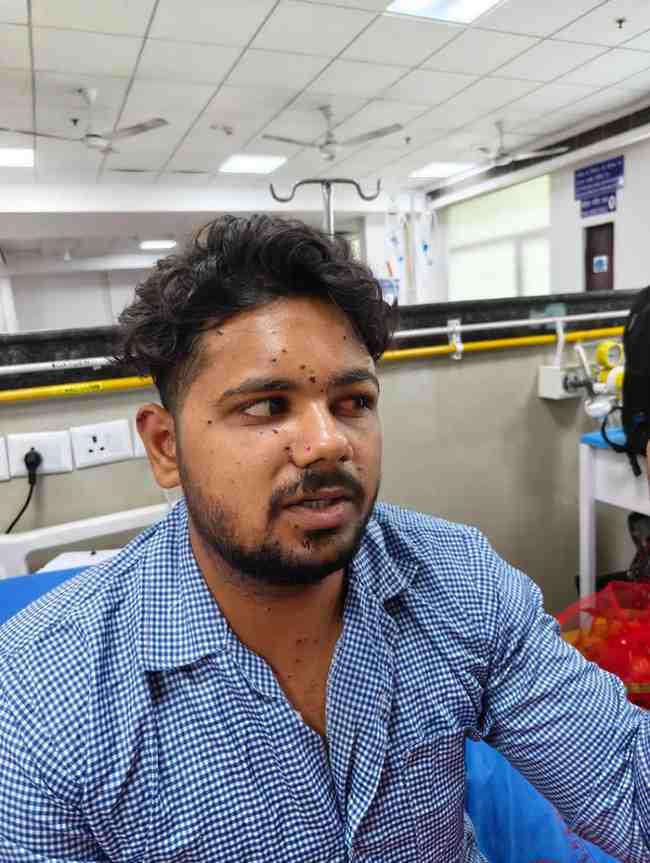
Two Delhi University students remain hospitalised after the July 20 Jantar Mantar protest, as eyewitness accounts and medical findings draw attention to the injuries sustained.
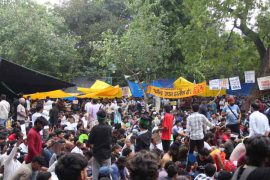
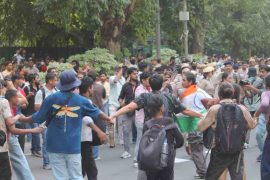
Days after Delhi Police baton-charged thousands of demonstrators marching towards Parliament as part of the Cockroach Janta Party’s “Chalo Sansad” march, at least two Delhi University students remain hospitalised with serious injuries, raising questions about the extent of force used to disperse the July 20 protest. While Delhi Police have consistently denied using pellet guns, multiple eyewitnesses and medical reports have disputed that claim.
Sahil Lochab, a Delhi University School of Open Learning student preparing for the SSC Combined Graduate Level examination, may lose vision in his right eye after what his family alleges was a pellet gun injury sustained during the march. Lochab underwent surgeries at Lady Hardinge Medical College and Safdarjung Hospital before being shifted to the AIIMS Trauma Centre, where doctors reportedly removed a pellet lodged in his eye that had caused a corneal perforation, along with others from his lung and the tissue surrounding his heart. His family was initially told there was only a one per cent chance of his sight returning. Doctors have since said his prognosis remains “guarded”, meaning the likelihood of vision recovery remains uncertain.
Twenty-one-year-old Sakshi, also a Delhi University student, was caught in a crowd crush near Jantar Mantar after police allegedly pushed demonstrators into an already congested area following the use of tear gas, according to protesters. She was carried unconscious to a police vehicle after demonstrators alleged officers at the scene were reluctant to transport her to hospital. Admitted to the intensive care unit (ICU) at Ram Manohar Lohia (RML) Hospital and placed on ventilator support, she was extubated on July 23 after hospital authorities said her condition had shown “steady improvement”. They added that she was conscious, breathing independently, and that MRI scans of her brain and spine were normal.
Protesters on July 20 have described police charging at people who were simply filling water from a cooler, triggering a stampede. One eyewitness who was present when Sakshi was found unconscious, said her face had turned blue and that she was bleeding near one ear. Bystanders, guided by others in the crowd, attempted cardiopulmonary resuscitation (CPR) and, when that appeared unsuccessful, administered mouth-to-mouth resuscitation. The witness also alleged that protesters restrained a police officer whom they believed was responsible for her injuries, and described difficulties in locating an ambulance before she was eventually taken to hospital in a police vehicle.
Delhi Police have said around 60 protesters and 118 police personnel were injured in the clashes. They also reported that more than 20 police vehicles were damaged and that 70 protesters were detained. Officers, including Head Constable Balram, Inspector Nand Kishore Singh, ACP Vivek Bhagat, and Head Constable Babu Lal, alleged they were separated from their units and assaulted by crowds.
Delhi Police have repeatedly and categorically denied using pellet guns during the protest, stating the force neither possesses nor uses them and warning against circulating “false and misleading” information. However, medico-legal case (MLC) reports for at least three injured protesters, including Lochab, 25-year-old Sheikh Irshad Mansoori, and a 28-year-old Outlook journalist, reportedly describe “suspected gunshot injury” or “pellet injury marks”, and hospital sources have said the pellets recovered were metallic rather than plastic or rubber. Pellet guns and shock batons form part of the Rapid Action Force’s (RAF) riot-control equipment. However, no official evidence has conclusively established whether pellet guns were fired during the protest.
Leader of the Opposition Rahul Gandhi, speaking to reporters in Parliament, accused the government of suppressing students’ voices and said the police action against them was “completely wrong,” renewing the Opposition’s demand for Prime Minister Narendra Modi to apologise and for Education Minister Dharmendra Pradhan to resign.
Sheetal Mishra
Also Read: DU Sets Up Anti-Ragging Control Rooms

Comments are closed.