Tag

Delhi

Browsing

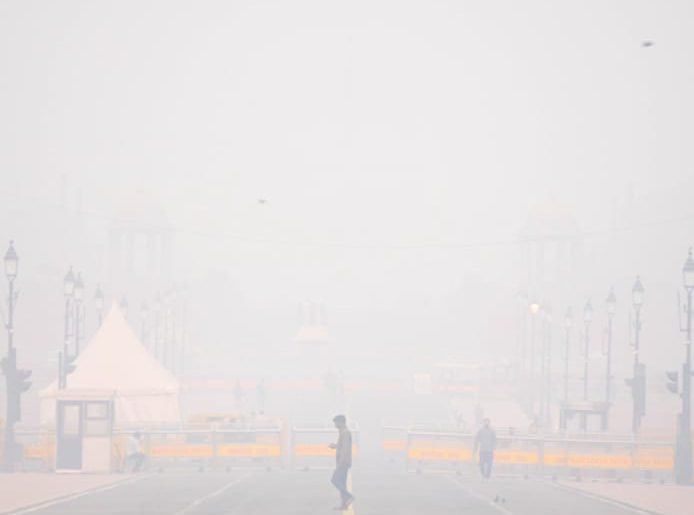
As the capital is once again swept under smog this year, students are compelled to worry about their health, class attendance, constant coughing and semester-end exams simultaneously.

Every year, as the AQI in Delhi reaches new heights, students studying in the city must attempt to normalise hazardous environmental conditions.

In conversation with DU Beat, Jigisha Sharma, a second-year student from Miranda House, said, “For a university that has a whole course about Fit India, they aren’t very keen on keeping their students fit and away from the pollution of Delhi. Instead of taking any action to tackle the situation, the government is blatantly trying to hide it from the masses, further worsening the situation for both the city and her residents.” 

Himanshi Singh, another Miranda House student, said, “Having lived my entire life in another city, I was aware that Delhi had pollution problems, but actually experiencing it is something else entirely. The air feels heavy and almost unbreathable, and stepping outside for even a few minutes leaves you coughing or with a sore throat. It’s scary how normal this has become for everyone here. What really bothers me is how we’re all expected to just carry on with our routines, like attending classes and travelling long distances, as if this level of air toxicity is something we can simply adjust to.

Colleges and the university administration seem indifferent, which feels unfair to students who are genuinely struggling with the health impact of this air. Especially for those of us who’ve just moved to Delhi, it’s physically and mentally draining to adapt to this environment. Because right now, it feels like we’re being forced to breathe poison and pretend it’s fine. Every year, the AQI spikes, people complain, and then everyone moves on until it happens again.”

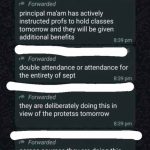
Last year, the University had declared a transition to online classes when the AQI had reached alarmingly high levels. However, despite GRAP Stage 3 being implemented this year and the AQI reportedly touching 764 in Delhi-NCR, which can be officially categorised as “hazardous”, there has been no official notification from the administration regarding any relief to be provided to the students in the form of breaks, transition to the online mode, or leniency in the attendance policy. 

Read Also: The Trade-off Between Half Dust and Half Deity

Image credits: Ayushmaan for DU Beat

Manya Marwah

[email protected]

When the time comes for the deity of the Earth to redeem its dues, the dust flows and concedes into spaces of the capital, halting the economy to a stop.

This city has become a rousing tale of being a debonair con artist—the black and white of society and politics extends to perpetual pitch-black darkness with economic sense, hitting rock bottom. Our tears come way before any words—thanks to the divine air quality after Diwali, and the richness in our voices has been lost to the excruciating agony of credit card bills, shopping lists, and destitute bank accounts, topped off with the smoke that fills our lungs—especially with the post-Diwali festivities of smog-covered skies and the antics of mitigation. 

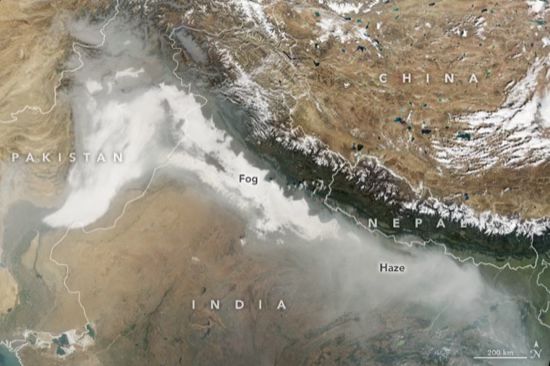
Delhi, very recently, successfully achieved its aim of becoming one of the top cities in the world, but on a different scale. It is now the most polluted city in the world according to the IQAir rating, which was sadly a long-foreseen event. The major contributor to this fate is our favourite post-Diwali concoction—vehicle emissions, industrial pollutants, stubble burning and an endless conversation about these issues, but to no redemption. All of this is supplemented by the onset of winters and the harsh cold air, making Delhi a smog-covered chamber. Recent images by NASA show how potent this smog looks from space, and that should be enough to scare our hats off. 

The government boasts its goal of achieving Net Zero Emissions by 2070, announced at the COP26 summit, yet the progress can only be described as largely superficial. Recent estimates show that pollution hits India’s collective GDP hard, with the effective percentage ranging from 3% to 9% annually. This is a substantial loss compared to the pollution levels in other metropolitan cities and their relative impact. The primary drivers are, of course, increased health care expenses, reduced worker productivity and premature deaths. 

The economic-environmental trade-off is catching on as the whole country suffers because of its capital’s ‘tragedy of the commons’. Clean air—a classic example of a public good—no longer remains publicly available, and economic inequality persists in our society more than we allow ourselves to believe. With the affluent being able to afford clean air through expensive air purifiers and work-from-home lifestyles or as an escape from the city for a post-Diwali getaway, the free air costs the common people their lives. There are hundreds and thousands of unorganised workers, especially in India, who cannot afford to leave the outdoors, let alone find clean air indoors. 

“Everyone has a thousand wishes before a tragedy, but just one afterwards,” said Fredrik Beckman—completely unaware of its relevance today. The tragedy today originates not only from self-interest that drives us towards it, but also from the total lack of accountability, as the proximity of oneself to this issue remains undefined. It’s a testament to how the core economic concept of efficiency is what causes the greatest economic losses; stubble burning might be efficient for the farmers in Haryana and Punjab to clear the fields, but its impact can be seen on the book vendor on the streets of Delhi, who are unable to breathe. 


Sustained implementation of regulatory measures is a far cry; the best we can hope for is at least a few pre-emptive measures that control this rise. All the reactive, quick-fix solutions right now act as a bandage on a bullet wound. Recently, new efforts were made to try cloud-seeding to induce artificial rain to clear the smog that covers Delhi. The government spent crores just to get a drizzle of rain, notably with a technique which can only be used in very specific conditions, which are extremely rare to coexist at the same time. On top of that, its effects are small, almost unnoticeable, and it does not help solve the root cause of the issue. Yet these pollution mitigation efforts, which cost a huge chunk of the GDP, are set into place, and it’s the same story every year. Guess we never fail to find a head that fits the crown. 


In a world where trading carbon credits has now become a core business function, the soul of Delhi cannot be cured with a mere promise on paper. We need actionable steps taken as precautions, and soon. The AQI has crossed the 400 mark, stepping into the severe category, and it is affecting not only India’s economic position in the global market but has also started to serve as a long-term foreign investment deterrent for Delhi; a characteristic that is currently driving the Indian markets to high growth is becoming a cautionary tale for its capital. 


The poor air quality has caused a death rate of 15% in 2023 due to respiratory diseases; that is, 17,188 people in Delhi who died just because of the toxic air that we’re all breathing. It means 1 in every 7 deaths is due to the largest health risk of pollution levels in Delhi. This not only leads to a loss of human capital and productivity but is just one of the tangible measures due to which foreign investors have started hesitating before investing here. The economic instability caused by the sudden imposition of GRAP every year is another cause, combined with increased spearhead costs and problems with talent attraction and retention. 


Colloquially, our cultural worship practices disregard the environmental degeneration due to them with “traditional incumbency”, and Delhi was fain to follow—until now. Today, future progress lies at the feet of Delhi’s air quality. So, until we start honouring the air we breathe, prosperity will remain an illusion—half built, half alive, half dust, half deity. 


Read Also: Protesters Detained at Kartavya Path as Delhi’s Air Pollution Crisis Deepens 

Image Credits: NASA Earth Observatory

[email protected] 

Shreya Bhushan


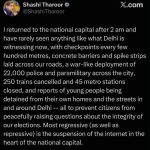
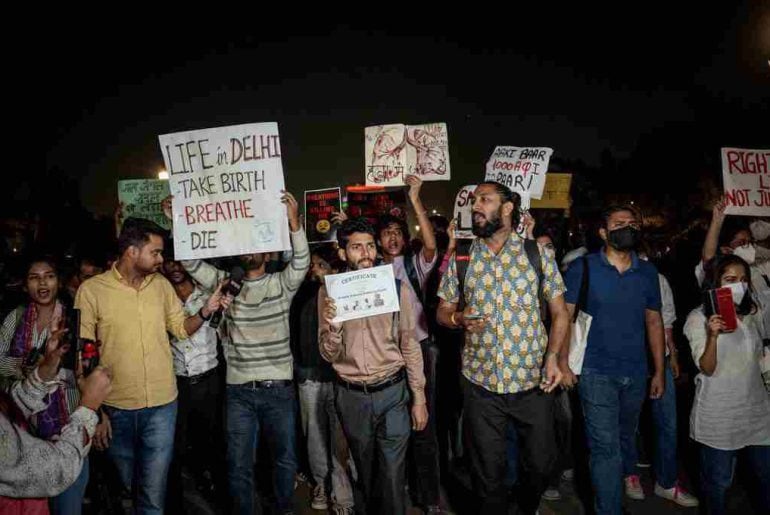
Citizens and students protesting Delhi’s hazardous air quality were detained at Kartavya Path after police blocked a march at India Gate, raising concerns over civil liberties.

On 9 November, around 5 p.m., students, citizens, and environmental activists gathered at Kartavya Path to protest the worsening air quality in Delhi. The demonstration, announced as an open call by individual organisers, drew support from groups such as the All India Students’ Association (AISA), Himakhand, and several other collectives.

The protest came amid a sharp spike in air pollution across Delhi, with AQI levels crossing 400 in several areas, categorised as severe by SAFAR. This rise has been accompanied by a surge in respiratory illnesses, particularly among children and the elderly. Protesters demanded greater accountability from the Delhi government and urgent measures to address the public health crisis.

Organisers said police prevented the demonstration from being held at India Gate, citing the absence of official permission. Protesters then moved to Kartavya Path. According to a report by Scroll, one organiser alleged that they had been warned days earlier that an FIR might be filed against them if they proceeded without a permit.

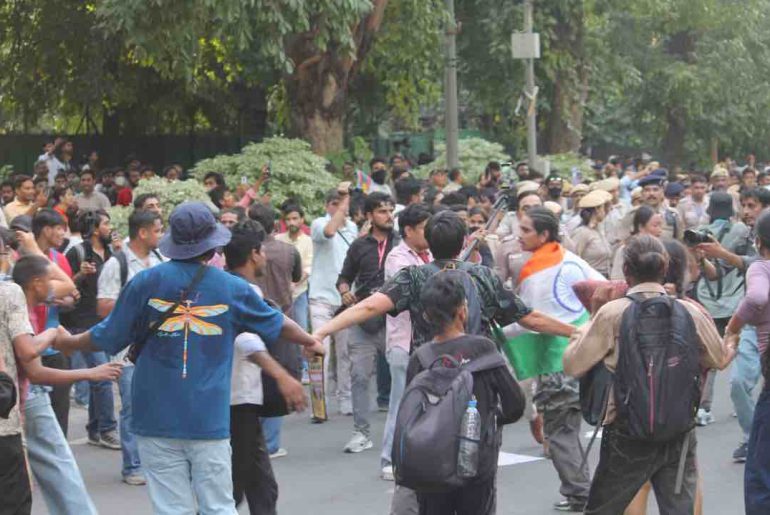
Police detained several people, including women, minors, and media personnel. Protesters reported being “thrashed around and dragged”, and many were injured. While female constables were present at the site, protesters claimed they were not present in the buses during detention—even when women were being transported.

Those detained described being driven around in buses before being taken to a police station, where they were allegedly kept in an open area resembling a “baseball court”. They said they were repeatedly asked for identification, which they refused to provide, and were threatened with legal consequences. Detainees were released around 11:30 p.m. after police recorded their names.

Even after the initial detentions, protesters regrouped for a second demonstration demanding the release of those held. These protesters were also detained, and, according to one account, later released near the Delhi border. Some participants noted that another protest,  for stray dogs, was taking place at the same time and location, yet saw no comparable police action.

Meanwhile, ANI quoted DCP Devesh Kumar Mahla as saying that Jantar Mantar is the designated site for protests, not India Gate. Protesters contested this, arguing that the designated site is heavily barricaded, inaccessible to the public, and that permission to protest there is routinely denied.

The events of 9 November underscore growing public anger over Delhi’s hazardous air, malfunctioning pollution monitors, and the perceived inaction of authorities. With respiratory illnesses rising and protective measures out of reach for many, the city’s toxic air continues to raise serious concerns about public health and quality of life.

Read More: NEP’s Three-Language Formula for Schools

Photo credits:  Muhammad Shahamath, Maktoob

Reva Rawat

[email protected]

On Friday, the Delhi Government declared Chhath Puja on 27th October to be a public holiday. However, Delhi University has not declared an official holiday, sparking student outrage. While some colleges like Sri Venkateswara have offered academic leniency, the broader university administration remains unresponsive.

Chhath Puja, a government holiday, as declared by Delhi Chief Minister Rekha Gupta, has yet again, been disregarded by the Delhi University, stirring up major discontent and controversy. While the capital city will be observing a holiday on 27th October, i.e., Monday, which marks the third and most important day of the festival, the Delhi University administration has retained the occasion in its list of restricted holidays, and has despite past outrage and a government-mandated closure of holidays, not kept it a holiday for its students. 

Chhath Puja is widely celebrated across Bihar, Jharkhand, and Uttar Pradesh by worshipping the Sun God or ‘Chhathi Maiya’. The Chief Minister, in her declaration, said, Through the worship of the Sun and Chhathi Maiya, Chhath conveys a message of purity, environmental protection and gratitude towards nature.” The erstwhile Delhi CM Atishi had declared a similar government holiday last year as well. 

This year, the official University mid-semester Diwali break was scheduled from 19th October till the 26th of October—incorporating Chhath Puja within this break would simply mean extending the holiday just by one day. This remains one of the major points of contention amongst University students celebrating the festivity as a 3rd year points out, 

I’m really disappointed that DU didn’t consider extending the holidays for Chhath Puja. It’s such an important festival for so many of us from Bihar and Eastern UP, and most of us travel back home just for these few days. One extra day would’ve made a huge difference because the travel itself takes so long. It feels like the university doesn’t really understand how significant this festival is for us emotionally and culturally.”

Such outrage has previously been noted amongst the students on multiple other occasions, such as on Maharishi Valmiki Jayanti earlier in the month, which was an officially declared public holiday by the Delhi Government.

However, classes for most Delhi University colleges were not officially cancelled. Students have argued that since DU is a Central University, and thus comes under the jurisdiction of the Central Government, it is unfair to assume that classes would be cancelled for the University. Despite this, students who have celebrated the Chhath Festival throughout their lives are disappointed towards the lack of sensitivity of the University administration and their inactivity in recognising and encouraging inclusivity for students of all backgrounds.

“A one-day extension would have shown some inclusivity towards students who celebrate Chhath. It’s a big deal back home for us,” a second-year Delhi University student said, 

It’s unfair that so many of us have to miss the celebration this year because classes resume immediately. Even a single-day extension would’ve allowed us to be with our families without worrying about the travel or attendance, especially when fulfilling the attendance criteria is imperative.”

This is not to say that all colleges within DU are completely indifferent to this public holiday declaration. The administration of Sri Venkateswara College has informed its faculty that no class tests, assignment submissions or practical tests are to be scheduled between the 27th and 31st of October, “to ensure that students are able to participate in the festive celebrations without academic inconvenience”, as intimated through an email that was sent to the teachers. A post by DUTODAY mentioned that many colleges across Delhi University are expected to adopt similar measures, subject to the respective departments and colleges. 


Read also: Sri Venkateswara Asks Faculty to Avoid Tests Post-Diwali Break; Some Say Assessments Still On


Image source: The Indian Express


Manya Marwah

[email protected]

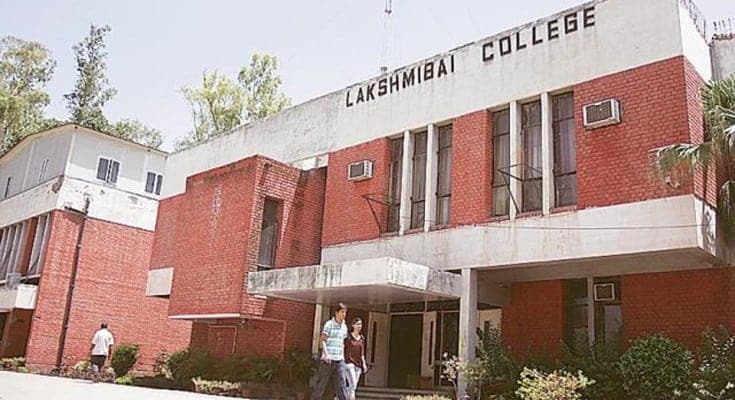
Delhi University’s Lakshmibai College introduced NCC units last year to act upon the harassment complaints made by the students around the campus of the women’s college. The units, named after Hindu Goddesses Durga, Kali and Chandi may be discontinued after a year of their implementation due to changes in the authority and differing views on the subject. 

No new enrolments in the units have been observed in this academic year, and the initiative is being planned to be discreetly peeled away from the college guidelines. 

The regiments, introduced by the then principal, Pratyush Vatsala, were an attempt to  empower young women, teachers and students and convert the campus into a safe space for every individual. 

The selection for these units was made out of the college’s NCC wing, and the students had to go through a rigorous interview process. The chosen applicants were assigned one of the units along with their own uniforms consisting of the coloured themes of red, white and black. The college ensured weekly self-defence training of the members for their own safety and equipped them with bicycles to certify timely appearance in case of any such events reported.

The initiative was met with mixed responses throughout the campus upon its launch. Similar emotions are being stirred up again with the circulation of news of its termination.

A third-year student, who was a participant of the regiment, told The Times of India,Now that the principal has changed, the system seems to be fading away. There have been no interviews or enrolments this year. We are not happy about it because such incidents of harassment are still a daily reality for us around the college.” She added, “Though a police cab is always stationed outside, the units gave us confidence to act when needed. It was an encouraging move and had a positive impact.” 

During its initiation, the move was described by the college administration as a proactive step in making the campus safer, but the action drew criticism along the lines of accountability. Few believed that this would lead to the students taking the law into their own hands rather than relying on the authorities or the institute. 

A faculty member expressed their concerns about the potential risks and said that the idea might unintentionally put students in harm’s way. 

Image Credits: Collegedunia

Ananya Agarwal
[email protected]

Read Also: Sensitization Programme for NSS Volunteers and NCC Cadets Under Swachhta Hi Seva – 2025

Trigger Warning: Sexual Assault

Amidst growing concerns about student safety in Delhi schools, the alleged sexual assault of a five-year-old girl in her school bus casts a stark light on the issue, revealing the fragility of the safe and secure campuses boasted by prominent private schools in South Delhi. 

In August 2024, a five-year-old girl, from South Delhi was sexually assaulted in her school bus, allegedly by a 19-year-old Kenyan national currently studying in Class 11. The student was only suspended on 7th February 2025 after 100-150 parents peacefully protested outside the school premises. It has also been reported that the alleged perpetrator’s mother is a counsellor to the Kenyan High Commission. The First Information Report (FIR), registered under the Protection of Children from Sexual Offences (POSCO) Act, confirmed that he holds diplomatic immunity, which necessitates a waiver for legal proceedings to proceed. The concerned authorities have been contacted as two more FIRs have been lodged against the same individual.

While the incident occurred last year, it has received little media attention, and the school’s name remained largely undisclosed until recently when an alumnus of the school posted about it on their Instagram account.

Speaking to DU Beat, the alumnus emphasised on the tactics used by the school to curtail the situation without dispensing justice to the victim. Instead, they have advised the parents to change their daughters’ school.

They [school administration] are using everything to stop it. Even teachers from different branches don’t know about this.” he added

The parents allege that the local police and the school deliberately mishandled the case.  

When we first approached the school authorities regarding the matter, they told us the student involved was a 16-year-old Nigerian. Our daughter was called to the school to identify him, but he was absent that day and the teachers told us that he had gone for a field trip”  said the parents of the student while talking to The Times of India

Since then, they repeatedly tried to seek justice through the school’s administration, but these efforts have been largely unsuccessful. 

We are still waiting for justice …my daughter without any fault of her missed her school and the culprit freely was attending school and molesting more other girls which they reported to the teachers but they didn’t do anything.” the parents added

This trend of school administrations evading accountability is neither new nor isolated and sets a dangerous precedent where power and privilege outweigh social justice.


Read also: Nepali Student’s Alleged Suicide Sparks Protests at KIIT; Over 500 Students Forced to Leave the Campus


Yashika Jain 

[email protected]

Recent heavy rainfall in the capital on June 28 has exposed severe infrastructural issues, particularly at the Arts Faculty, where the reading room experienced significant water leakages and short circuits. Additionally, other esteemed educational institutes like IIT Delhi and AIIMS Delhi are also witnessing an equally miserable fate.

As Delhi University continues its yearly ritual of exorbitant fee hikes—110% in PhD courses and 40% in annual postgraduate courses—it is important to note that the condition in which DU students have to study remains deplorable. These problems clearly reflect the university’s incompetence and disregard for student safety.

The Students’ Federation of India (SFI) DU’s Instagram page, @sfiduspeaks, posted a reel highlighting the miserable state of one of India’s premier institutions. Captioned “Save Public Education! Save Delhi University! Fee Must Fall!”, the post called for immediate action from the university to address these infrastructural issues. SFI Vijay Nagar has also demanded urgent measures to fix these problems and ensure student safety, noting that the lack of basic amenities like air conditioning in classrooms becomes unbearable when temperatures in Delhi soar to 48 degrees Celsius. The third building, made with makeshift materials like tin roofs and asbestos-lined walls, exacerbates the heat issue, creating an uninhabitable learning environment.

Simran, from SFI DU, in a conversation with DU Beat, said, “Since there is no maintenance in these reading rooms at Arts Faculty, due to heavy rain, the ceiling started to leak and then a short circuit happened, and soon fire also occurred out of nowhere. The main problem is that despite increasing fees they are not improving infrastructure and maintenance at all.”

Additionally, a press release by SFI Delhi University, dated June 27, 2024, highlighted student protests against the fee hikes in postgraduate courses. Students criticized the apathetic Delhi University administration and the ABVP-led Delhi University Students’ Union (DUSU) for their silence on the rising education costs. It showcased how fee hikes place a heavy financial burden on students, undermining the principles of publicly funded education and limiting opportunities. Despite the fee hikes in previous academic years, there has been no corresponding improvement in infrastructure. Students of the well-known Law Faculty often find their campus without even a single functioning water cooler, all while bearing Delhi’s scorching heat.

In addition to Delhi University, other premier institutes in Delhi have also been severely affected by the heavy rainfall. AIIMS Delhi experienced similar issues with severe water leakage on June 28, highlighting the widespread infrastructural problems across top educational institutions in the city.

At IIT Delhi, a viral video showed a pillar collapsing in the placement cell building following the heavy rainfall. This incident led to the disconnection of electricity in some areas for safety reasons. An official email from the Institute Engineer detailed the flooding on campus and stated that maintenance teams are working to restore services. The email requested cooperation from the campus community and apologized for the inconvenience.

These incidents at Delhi University, AIIMS Delhi, and IIT Delhi highlight the urgent need for infrastructural changes and better maintenance protocols, it’s indeed high time that these educational institutes make upgrades to ensure the safety and well-being of their student body, who have come from faraway places in the country to study in “premier institutes” in the capital. Despite significant fee hikes, these institutions have failed to invest adequately in their infrastructure, leading to dangerous and unacceptable learning conditions. As students and stakeholders wonder, “Where is our money going?”, they are now demanding accountability and immediate improvements to their educational environments.

Featured image credits: Devesh for DU Beat

Read Also: TISS Dismisses and Reinstates Staff Following Funding Assurance from TATA Education Trust

Kavya Vashisht

[email protected]

In the heart of Maharashtra’s sugarcane fields, a sinister reality unfolds as women laboring
for giants like Pepsi and Coca-Cola face exploitation through forced hysterectomies,
overshadowed by corporate profits.

About a third of the sugar produced in India, the second-largest producer in the world, comes
from the state of Maharashtra alone. Maharashtra is a key supplier of sugar to global
corporations such as PepsiCo, Coca-Cola, and Mondelez, the parent company of Cadbury. The state
prides itself on the sprawling 1.487 million hectares of lush sugar cane fields with about
203 crushing factories producing 138 lakh metric tons of sugar every year becoming the
state’s major support system. One such district is Beed, although this one in particular is one
that the state shouldn’t be proud of.

This picturesque field of Maharashtra hides a darker reality – the exploitation of women at the
hands of sugar-producing companies. While these companies reap immense profits from the
sweet harvest, the women toiling in the fields are left to endure the bitter impacts on their
health. The issue dates back almost 30 years, when the New York Times interviewed some of
the women working in the fields to find out that the vicious cycle starts with underage girls
getting married off to the men working in the field which ropes them into a contract that seems more like lifelong slavery than wedlock. The men and women are expected to work alike at the same potential for 16-hour-long shifts every day without breaks. Tampons and pads are expensive and hard to find, and without access to running water, women address their periods in the fields with reused cloth that they try to wash by hand. The fields are located in remote locations, and it’s a whole other world in itself with workers
living under tarps, and companies seeking forced hysterectomies as a way to combat the issue of
lack of washrooms on the field.

One local government report surveyed approximately 82,000 female sugarcane workers from
Beed and found that about one in five had had hysterectomies. A separate, smaller
government survey estimated the figure at one in three. Women, already marginalized and
disadvantaged, are coerced into undergoing these surgeries under the guise of ‘health
benefits’ or as a means to prevent pregnancy or period leaves from work. This reprehensible
practice not only robs women of their bodily autonomy but also perpetuates a cycle of
systematic abuse and inequality. The issue at hand unveils a centuries-old taboo enveloping
menstruation, casting a shadow of “unsanitary” perceptions upon women during their natural
cycle. This mindset, steeped in misconception and bias, tragically manifests in the coercion of
women into undergoing hysterectomies, all in the name of the illusion of “cleanliness” on the
fields.

According to the New York Times, sugar producers and buyers have known about this abusive system for years. Coca-Cola’s consultants, for example, visited the fields and sugar mills of western India and, in 2019, reported that children were cutting sugar cane and laborers were working to repay their employers. They documented this in a report for the company, complete with an interview with a 10-year-old girl. In an unrelated corporate report that year, the company said it supported a program to “gradually reduce child labor” in India possibly referring to their plans to increase hysterectomies. This Great Indian exploitation game is nothing less of a spectacle, when women working in these harsh conditions visit the nearby gynecologists with problems like forming of cysts and irregular periods, the doctors take advantage of their patients’ illiteracy and are given an ultimatum that “hysterectomy” is their only option. The whole process is orchestrated not only by the companies but also many health practitioners from the district. These major companies even have moral codes of conduct for their workers which they evidently throw out the window in a bid to make corporate profits. After facing backlash and solely because people threatened to boycott the brand, Pepsi released the most generic statement expressing their grief over the issue while Coca-Cola still hasn’t issued a statement and continues to live in ignorance.

Of the many stories that flood the Indian news channels, none have ever made reports on this
issue, it’s as if they would rather turn a deaf ear than face the truth. In conversations with
reporters from The Fuller Project, as the workers gave them a peek inside their lives, they
sang folk songs which were inspired by Bhimrao Ambedkar in unison and had only thing to
ask everyone who visits the field, a promise; that one day the world will know their plight.

Featured Image Credits: The Fuller Project

Read Also: Feminism: A Belief or a Tagline?

Saanvi Manchanda
[email protected]

In a swift response, Delhi University takes action against a staff member accused of sexual harassment, reflecting a commitment to student welfare. As students rally for justice at the Central Institute of Education, officials ensure a thorough investigation by the Internal Complaints Committee, prioritizing safety and transparency.

The University of Delhi’s Establishment Branch has terminated the employment of a non-teaching staff member who was allegedly involved in the sexual harassment of a student at the Central Institute of Education (CIE) earlier this month. The incident occurred in the Department of Education’s new building, per the student’s official complaint with the Head and Dean of CIE. The defendant is alleged to have engaged in several inappropriate behaviors, such as unwanted approaches, invasive personal inquiries, and acts that created a great deal of discomfort and fear for the student’s safety.

The student has asked for her peers’ support, expressing how the encounter violated and deeply distressed her. She also expressed fear for her safety because the harasser was walking around the department unhindered. Students came together to plan a demonstration at CIE on Wednesday to support the student’s right to justice.

The Indian Express was notified by Pankaj Arora, Head and Dean of CIE, that the Internal Complaints Committee was notified of the student’s complaint as soon as it was received on Monday. The accused, who worked for the company under a contract, was let go early on Wednesday.

We have engaged in extensive discussions with the students and have assured them that the university’s ICC will handle the matter with care.” Arora said in response to the protest.

While the ICC investigates the case, questions remain about the student’s ongoing safety and the support system available. Did the University offer counselling services or connect her with external support groups specializing in trauma recovery? Transparency regarding the ICC process would also be beneficial. What are the expected timelines for the investigation? Are there resources readily available to explain the process to students involved in such cases?

The case is presently under review by the ICC, and until the process concludes, it would be challenging to disclose specific details of the proceedings.” said DU Proctor Rajni Abbi.

The Students’ Union or other student committees at CIE likely played a crucial role in supporting the student and organizing the protest. Including a statement from a student representative would amplify the students’ voice and highlight the collective stand against harassment. The incident serves as a stark reminder of the prevalence of sexual harassment in educational settings. By creating a culture of support, ensuring a fair and transparent investigation process, and implementing robust prevention programs, universities can foster safe learning environments where every student feels empowered and respected.

Read Also: Where are you ICC: Looking at DU’s History of Sexual Harassment 

Featured Image Credits: India TV News

Divya Malhotra

[email protected]

JNU VC Santishree Dhulipudi Pandit emphasized that JNU was never anti-national, and the institution is not subjected to saffronization, following the University’s 20th ranking in QS World Rankings for development studies.

In a recent meeting with the editors of the Press Trust of India (PTI), Santishree Dhulipudi Pandit, the first female Vice-Chancellor of Jawaharlal Nehru University (JNU), addressed various aspects concerning the university’s current state and its past challenges. Ms. Pandit emphasized that despite speculations, JNU is not subjected to saffronisation or undue pressure from the Central Government in its daily operations. She asserted, “As a university, we should be above all this. JNU is for the nation, not for any particular identity.”

Acknowledging the presence of divisions on campus during her tenure, Ms. Pandit termed that period “unfortunate”. She attributed errors to both the administration and the students, acknowledging the mishandling of the situation by the leadership. 

I think that phase was bad, and there were mistakes on both sides, and because of polarization and the leadership not understanding… You have to understand that people will differ and argue. The university was never anti-national. When I studied (at JNU) it was the height of the Left’s dominance, even then nobody was anti-national.” – Ms. Pandit remarked.

Furthermore, she openly declared her affiliation with the Rashtriya Swayamsevak Sangh (RSS), stating that she neither conceals nor regrets it. 

Ms. Pandit reaffirmed JNU’s commitment to fostering dissent, discussion, and democracy, asserting that the university has never been “anti-national” or associated with the “tukde-tukde” gang. She stressed the university’s dedication to inclusivity and development, encapsulated in the seven principles of Development, Democracy, Dissent, Diversity, Debate and Discussion, Difference, and Deliberation.

Reflecting on her journey, Ms. Pandit shared details from her birth in St. Petersburg, Russia, to her upbringing in a middle-class South Indian family in Chennai. When she assumed the position of Vice-Chancellor in 2022, the University was grappling with student unrest, compounded by the aftermath of the 2016 incident involving purportedly anti-national slogans being raised on campus. 

I believe there was a phase of unfortunate ignorance on the part of the administration regarding JNU.”- she commented. 

Regarding this tumultuous phase, Ms. Pandit acknowledged mistakes on both sides and criticized the leadership’s attempt to control the situation, emphasizing the inevitability of disagreements and the importance of handling extreme viewpoints with understanding.

You have to accept that disagreements and arguments will arise. The college never held anti-national views. Even at the height of Left dominance, when I studied (at JNU), nobody was anti-national.” – Ms. Pandit reflected. 

The meeting concluded with Ms. Pandit’s reaffirmation of JNU’s commitment to its core principles and her dedication to steering the university towards inclusive growth and academic excellence.

Read Also: ABVP and Left Front Clash Ahead of JNUSU 2024 Elections

Featured Image Credits: Hindustan Times 

Divya Malhotra

[email protected]