Tag

Delhi University

Browsing

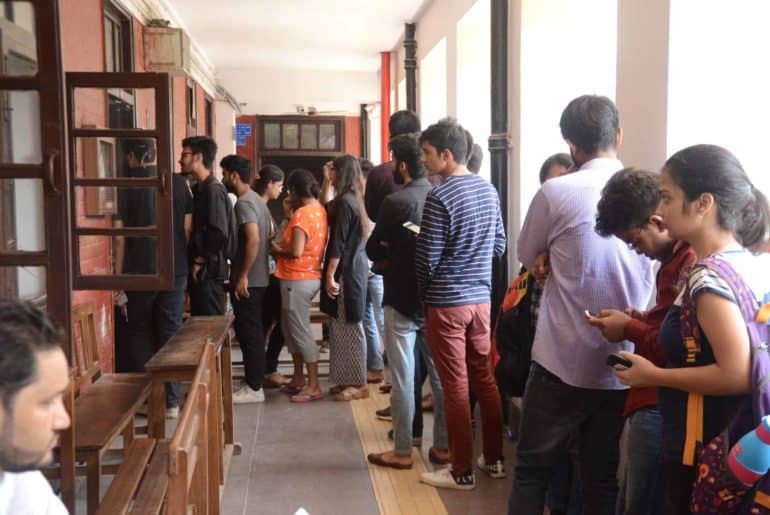
Here is a re-cap of Day 1 at Reverie 2019, the annual cultural festival of Gargi College. 

The opening day of Reverie 2019 commenced with the lighting of the lamp by the chief guest and actor, Sushma Seth, followed by her speech. Performances by Professor Ruchika Sharma, Euphony – Western Music Society, and Enliven – Western Group Dance Society ensured of the fun that is to follow at Gargi College’s Annual Cultural Fest, Reverie.

Events and competitions began soon after the inauguration. Students participated in the Talent Recognition competition and showcased their prowess in the form of dance, singing, slam poetry, and more. A number of students also participated in the English creative writing competition organised by Quilluminati, the English Creative Writing Society.
The first event in the seminar hall, Khayal, the classical solo singing competition, was supposed to begin at 11 a.m., got delayed due to the late arrival the two judges; Sriparna Nandi and Arundhati Bhatacharji, the total number of contestants that took part in the event was 11 from across University of Delhi (DU) colleges. The contestants had to perform one classical piece each and the participants were allowed to bring one instrumental player to accompany them. The minimum time limit was 4 minutes per performance. The winner of the event was Chinmay from Kirori Mal College, Abdul from Shaheed Bhagat Singh College bagged the 2nd place, and Daksh from Zakir Husain College came third.
The second event if the day in the seminar hall, featuring The same jugdes as before, Jugalbandi the semi classical duet competition saw, a total of 6 teams with two participants in each team performing a piece with one additional instrument player. The winners of the event were Minatullah and Rupanshi from Kirori Mal College, Sukriti and Sukprit tied from SGTB Khalsa College tied with Yugandha and Sakshi from Lady Shri Ram College for Women for the second position and Abdul and Hardik bagged the third prize.
The final competition of the day in the seminar hall also had the same judges with an additional judge, Mr. Debu Bhatacharya. Vadaan, the instrumental solo competition saw only 4 participants playing various different classical instruments like the tabla, harmonium, dhol etc. They had to present an instrumental piece within a maximum time of 5 minutes. The results for the same were: Anant Raman from Dyal Singh College in first place, Nabeel Khan from Zakir Husain College in second and Sarveshwar from PGDAV (morning) College in third place.

The Western Acapella competition was conducted by Euphony in Gargi’s annual cultural fest Reverie. A total of 16 teams from across different colleges had passed the online prelims competed to win the cash prizes. The event saw delay and the management had to shift their venues from the Auditorium to the seminar hall after the 11th performance owing to the demands from Sparx, the choreography society, for them to begin their own competition. The competition was judged by Mr. Joshua Peters and Mr. Maker Kashung. The acapella society from Sri Venkateshwara College came first, there was tie for the second place between societies of Jesus and Mary College and Lady Shri Ram College for Women, St Stephen’s College came in third.

Dhanak, India Group Folk dance competition organized by Nazakat saw a participation by 11 teams who had cleared their online prelims. The event was judged by Mrs. Swagata Sen Pillai, who gave the third position to Delhi Technical University, 2nd position to the Bhangra Society Sri Guru Gobind Singh College of Commerce, and Annhad, Daulat Ram College came 1st . In her speech, she said that Bhangra Society of SGND Khalsa could not win because they exceeded the time limit, whereas according to the members of the society they had not exceeded the time limit at all. While talking to DU Beat, Jaskaran Singh, President of the Bhangra society of SGND Khalsa College said that it was cleared with the organisers beforehand that their time would be counted once the dhol beats begin after the sher but somehow the judges had counted their time just after the sher began. It is to be noted that the teams from SNDT, SSG and DTU almost backed out from the competition when an allegedly intoxicated guard misbehaved with them at the entry early in the morning.

9 teams across different colleges participated in the Choreography competition organised by Sparx, called the Creative-iti. The event began after a 3-hour delay because of a domino effect of all the previous events being delayed. Capella, NSUT won the competition while the second and third place was awarded to LSR and Sparx, of Gargi College respectively. The event was judged by Ms. Surya Sharma and Deva Smita.

Day 1 of Reverie witnessed power packed performances by the participants in the Talent Show event, organised by the Students Union of Gargi College. Both solo and group performances were allowed. Students performed on latest Bollywood hits. The show also witnessed solo and duet singing. The theme of the fest: “A brave new world; an ode to Diversity” works on the basis of 3 C’s- Choice, Consent, and Conservation. These cover broad topics like LGBTQ empowerment, sexual harassment, female empowerment, equality, wildlife preservation, and protection. Individually these are significant and necessary issues of today’s world but interlacing all of them together as a theme for one of the largest annual cultural fest of Delhi University brings down its gusto.

The day came to a magnificent close with The Local Train’s performance, which swept the crowd off its feet. With songs like Choo Lo, Dil Mere, Aaoge Tum Kabhi the band ensured that the crowd didn’t lose their energy.


Feature Image Credits: Surabhi Khare for DU Beat

Prachi Mehra

[email protected]

Anoushka Sharma

[email protected]

Haris Khan

[email protected]

Sakshi Arora

[email protected]

The Delhi University Teachers’ Association (DUTA) held an Executive Meeting on Saturday, 12th January 2019.

The resolution for the same is a comprehensive account of the crisis being confronted by the teachers of the University in lieu of the Central Government’s withdrawal of government funding from public-funded universities. This was termed as a “highly misguided policy” and “commercialisation of higher education”. This has led to a delay in the announcement of revised allowances and pensions of teachers. The exploitative conditions in terms of long working hours and lack of job security and employment benefits for ad hoc teachers have also contributed to the rage and unrest among teachers.

In addition, DUTA has also directed rage and disappointment against the Vice Chancellor (VC) of the University of Delhi, and condemned him for his inaction and lethargy in carrying out timely appointment procedures for teachers. They expressed strong criticism towards the VC for capitulating to the Government’s agenda by not even allowing the tabling of the report of the sub-committee set up to facilitate the adoption of the UGC Regulations 2018. Owing to the same, several young ad hoc teachers had declared a hunger strike in effect from 4th January 2019, which has now continued for nine days in the blistering cold.

In the resolution dated 12th January 2018, the DUTA has declared solidarity with the teachers on hunger strike, and has demanded that the Government bring in a one-time Regulation for the absorption of temporary and ad hoc teachers. They have proposed a one day strike and dharna at Gate No.1, DU to highlight their demands for the re-convening of the adjourned meeting of the Academic Council. They have also announced an immediate action programme of One Day Strike along with a Long March to MHRD on 17th January 2019.

Emphasising that these consequences emanating from a reduction in Government funding will soon affect the students as well, and has called for support by all sections of the university community, including and especially students.

Feature Image Credits: The Indian Express

Nikita Bhatia

[email protected]


Delhi University to ensure centrally air conditioned campuses, due to the growing climate concerns.

Delhi University issued a statement on the 7th of January, 2019 that it will instal central air conditioners in all the college campuses. The proposal is set to be in motion from the new academic year (July onwards). On a trial basis, a few select colleges will have these installed. Depending on the affect or reaction of the college community, this measure will be taken on a full-fledged mode.

The reason, issued earlier, is the shifting climatic conditions. With the northern India witnessing a cold wave, it is expected that the summers will be as scorching as ever. Heena Garg, a student of Maitreyi College says, “The college infrastructure, especially the ventilation is a big problem in classrooms. The rooms are very stuffy and it creates a lot of problems in the hot summer months. The fans do not work properly. It results in a lot of discomfort among students.” A lot of private universities have already adopted the centrally conditioned system in their campuses. Infrastructure is still a major issue faced by a lot of Government or state based colleges.

Professor Yogesh Tyagi, the 22nd Vice Chancellor of Delhi University, expresses his views on this decision, “It is about time the Delhi University improves its infrastructural facilities. Addition of the centrally conditioned campus will be a major boost for the University and will benefit the students and staff.”

With the rising levels of pollution and lack of pure air in the Capital’s air index, a lot of households are also shifting to centrally treated air conditioning. Their growth in the Indian markets has been very restricted as compared to that of their western counterparts, where every house is already centrally conditioned. India is lagging behind in this lifestyle concern as its affordability is restricted only to the rich.

Apeksha Jain, a second year B.Com. student of Shaheed Bhagat Singh College comments, “In a city which has such extreme climates, DU’s decision for central air conditioning is a really good one. it will improve campus engagement and attraction, and improve the existing infrastructural conditions of the university.” While some of the colleges in DU provide air conditioned classes to its students, the call is for a campus wide change for the better.


Feature Image credits: Interact Classroom

Avnika Chhikara

[email protected]

The beginning of a new year is  followed by a whole new semester to look forward to. New semesters can be a lot of fun, but extremely demanding and confusing at the same time.

Right after the New Year has been welcomed, and the party shoes have been carefully taken off and kept back in the cupboard for another year, the new semester begins without much of a wait. The semester break granted seems too short, and the idea of getting back into the grind is almost painful. Sleeping seems like the best option, the cold only aggravating the situation. The freshers are now well-acquainted with college life, and do not seem to harbour the same kind of curiosity, the sparkle almost completely lost from their eyes now.

New semesters also mean the arrival of the much-awaited fest season. The usual college hopping to check out the happenings, pestering your friends from SRCC or LSR to get you passes to their fests, skipping classes to go to North Campus from South Campus.  Students who are a part of a society might find their hands full, as this is the busiest time of the year for extra-curricular activities. The various cuisines, exciting games, attractive people, and engaging performances, create an enchanting atmosphere. People from all over the country come to attend the brilliant shows put on by Delhi University colleges. No expense is spared to make fests the brilliant affairs that they are. 

However, competitions of various kinds, fests, after-parties, and the unnecessary bunking of classes eventually comes to an end. What follows is a feeling of emptiness, and a general glooms overcomes the same people, and buildings, which were once covered in gold streamers. Once individuals and institutions are striped of their decorations and party-faces, getting back to a routine becomes a task. The good old blues, associated with mundanity, kick in, and the anxiety of existence slowly creeps back in.

One finds themselves short of attendance at the end of it all, be it society or a non-society member. Academics take a backseat, and one may find themselves cursing their decisions during end semester exams, for not being more vigilant. Moreover, it doesn’t help that the semester is shorter. The duration might not seem like a huge problem at the beginning, but towards the end, when the end-semester pangs set in, you would be wishing for more time.

The only piece of solid advice here would be to relish this time as much as you can, since you are only young once. Managing your time efficiently during this period, is also imperative, along with the ‘fun’ part. After all, attending lectures, and learning new things, can also be as much fun as dancing till dawn to EDM. The goal lies in defeating the ever-present semester blues, and facing each day with as much zeal as possible.

Too many things packed into five months would just fly by in a wink and one does not really want to be seen wishing for lost time back.


Feature Image Credits: The Indian Express

Anoushka Singh

[email protected]


Dyal Singh College faces a big administrative crisis as the Principal’s office gets sealed over ongoing probe on financial and administrative irregularities.


Dyal Singh College, faces a big crisis as a part of the ongoing tussle between the Principal and the Chairman. It all started when, on September 24, 2018, Governing Body [GB] chairman Mr. Amitabh Sinha issued an order, sending the Principal on a ‘long leave’. The reason stated was alleged him of being guilty for the financial and administrative irregularities. The Principal, I.S. Bakshi was charged with serious allegations regarding the state of financial and administrative irregularities and was asked to avoid visiting campus during the inquiry against him. Despite the notice, Bakshi has been continued coming to college, chiding the allegations as “illegal” with mala fide intentions.

The tussle grew stronger when the Chairman overturned the decision of the college’s Election Committee to cancel the election of Rohan Awana, an ABVP member, as president.

Things escalated as Mr. Sinha sealed his office on Friday, claiming it had been occupied ‘without authority’. The Principal also received a letter from the college’s bank stating that no transactions will be processed with his signature, as they have been mandated by the GB to conduct all official transactions through the officiating or the acting principal.

In a letter addressed to the chairman dated October 10th 2018, the branch manager of State Bank of India, Lodhi Road stated that the appointment of the acting principal should be done in accordance with the prescribed guidelines of the Ordinance XVIII which states that in absence of the Principal, the vice-principal will act as the principal, and in the vice-principal’s absence, the most-senior teacher will take over the administration and financial duties. This stands for colleges other than those that are maintained by the Government Of India.

According to a report in Jagran Josh, the tussle between the Principal and Chairman is reportedly causing financial losses to employees. DSC teachers’ Association’s president PK Parihar stated that the money is not being transferred into their PF account because of which they are losing interest and the medical reimbursement of all, especially the pensioners, is under threat.

Following the sealing of the office, Bakshi will be allowed inside the college campus only after the convener of the inquiry committee, Mr. OP Malik, retired IPS officer and DGP, provides written information, according to recent sources on the issue.

Sources: The Indian Express, Jagran Josh

Feature Image Credits:  The Hindu, image of the notice from the college’s official website


Avnika Chhikara

[email protected]


Yogi Sadhguru paid a visit to SRCC recently, as a part of his campaign titles ‘Youth and Truth’. An analysis of the advice given by innumerable motivational speakers in The University of Delhi reaped interesting outcomes.

Sadhguru, a renowned yogi, mystic, and founder of the NGO Isha Foundation, was at Shri Ram College of Commerce on 4th September 2018. The biker and English-speaking guru was accompanied by his entourage, following a suspension of lectures and extensive police barricading, extending from SRCC till Patel Chest Institute (bit much for a yogi, perhaps?). Contrary to popular belief, he wasn’t there to preach, and true to the essence of his campaign, ‘Youth and Truth’, his session included but wasn’t limited to, genuine advice about goal setting, relationships, confidence building and parenting. Once the initial aura of celebrity had subdued, and snapchat stories had been uploaded, people started to really listen. This was probably succeeded by the realization that the speaker hardly partook in original preachings, instead, like most motivational speakers, he simply validated already existing feelings and knowledge. This is a common occurrence, and it is this validation and connection that students seek from motivational talks/speakers, in the University of Delhi.

Celebrities, leaders, motivational speakers, members of the elite academia, and those who made it big by pure chance; the students of Delhi University have stood firsthand witness to it all, via panels, seminars, conferences, conclaves and other events similar in nature.

Students flock to these events in large numbers, seeking motivation, inspiration, enlightenment, or to simply catch a glimpse of a famous entity. However, when reconsidered, it seems as if all of these speakers, regardless of their field of expertise, are making the same point. You seldom come across anything radically enlightening, rather receive recycled gyaan.  If you’ve heard the terms ‘hardwork’, ‘leadership’, ‘innovative thinking’, ‘bringing something new to the table’ and ‘being humble’ one too many times; congratulations! you have unwittingly become a victim of nebulous direction.

Everything makes sense and nothing makes sense. Vague and nebular advice is the new preaching. Nothing anybody says adds any intrinsic value to the lives of students, their leaders themselves often presenting recycled ideas while simultaneously urging students to be ‘innovative’. One reason for the same is that there is no set path to success, and students are often too delusional to realize that. Students are burdened with the desire and/or pressure to overachieve, and often this desire arises not from within, but as a result of environmentally generated competition.

Leaders and speakers are an important part of college culture, but often, making examples of the small fraction of people who ‘made it’ advertises a lifestyle that is probably already out of stock. There is no market equilibrium; the demand and supply are poles apart, and in the end, students are suffering.

Nikita Bhatia

[email protected]

The board is set, the pieces are now moving. The battle is won, but the cause is lost. Do you sense the same?

The roads are all strange these days, without the smattering of a thousand flyers and pamphlets. It is almost disappointing to not see the flyers fall around the campus. Almost consoling are the misspelt names on the Wall(s) of Democracy. As the campus finally breathes in all its silence, the screaming political sobriety is in question. So, what follows now? Is it too early to recede to our apprehensions? Some might agree, but then there was never much space for agendas in those swanky BMWs on roads so choked with flyers. Beards and gold rings drove these SUVs and sedans, and beards and gold rings drive politics now.
Politics is a progression in the sense that it has always followed patterns. There are changes, but not necessarily as we would like to have them. After a raging contest of power in the past fortnight, the election results were in favour of some, while many others were left baffled. In an endless volley of blames and shaming, we saw some candidates rise to power recently. You hope to make sense out of it, but it all reduces to a clout of pointless manifesto promises. How long before these promises are fulfilled? Will the year be enough? Anyone who is even remotely familiar with the idea of politics will know what it means in practice. Agendas are good, but for a change, we would like to see some action too. Ironically, the only action we see is the action of the fist. In multiple brawls and the loss of public property, what is damaged most is the very idea of politics. Most of our representatives think that all politics has to offer is power, and power in India is scarce anyway. Responsibility is fantastical, so we cannot use this word for our politics. Politics is always about differentiated representation because two opinions can never be alike. This is what democracy implies, after all, it is the freedom to choose a representative. However, politics has become more divisive than ever before – it is driven by everything but democratic ethics. In DUSU, caste politics prevails, for instance, and in the national perspective, the division extends to manifold realms.
This year, like most years, political outfits claimed their primary objective to be that of women safety and claimed to improve their representation, the opportunities available to them, and provide a better environment to them in general. Introduction of U-special buses has been on the card since long, and new ideas like under INR 10 thali have been introduced this year. What we fail to observe amongst these tall promises is the question of what could possibly be their plan of action here? Being apolitical is a choice, but indifference can only mean ignorance that refuses to see the truth, and ignorance seems to sit at the core of all our problems. It is only right then, to be informed, aware, active, and to fight back with our form of dissent laced with logical arguments. The agendas might find fulfilment or hope to do so still, but only with an initiative from our side and that of the elected leaders.
Power gives you the strength to change, to reinvent, and to exercise an idea for the betterment of a cause. No one is wrong to expect this from those who stand for the upholding of power, but we all know who has the last laugh.
Kartik Chauhan


The University of Delhi is planning to start a new course on entrepreneurship from the next academic session i.e. 2018-19. The course will be a three-year degree program and will be called BBA Entrepreneurship.

The standing committee on academic matters met on Monday, 20th August 2018 and welcomed the proposal to introduce a course on Entrepreneurship. The course is yet to be approved by the academic council. It will be established under the Faculty of Applied Social Sciences and Humanities.

For admission into the course, there will be a three-stage procedure. The first round will be a national level entrance test, followed by a group discussion round as the second stage, while the last stage will include personal interviews. The entrance test will be designed to check the logical and quantitative reasoning of the students. During the course of study, the students will be expected to complete two internships and submit a dissertation by the end of the third year. The course will follow the Choice Based Credit System (CBCS) and a total of 158 credits will be awarded to students completing the course.

DU Beat contacted Ms. Poonam Verma, Principal of Shaheed Sukhdev College of Business Studies (SSCBS) who made this proposal. She remarked, “The course will start from next year. The academic council and executive council of the University will pass the proposal in  reasonable time so that the admission process can get started for the next academic session. Once we get the approval, we are going to get started with it.” She informed that the course will be first of its kind in the University. Ms. Verma also spoke about the two most sought-after courses in University of Delhi- Bachelors of Management Studies (BMS) and Bachelor of Business Administration in Financial and Investment Analysis (BBA-FIA)which are available in her college. The course, BBA Entrepreneurship, will start from her college if approved. She hopes that other DU colleges also welcome the course so that maximum students get the benefit. Ms. Verma also mentioned the incubation centre in SSCBS,  which could provide a progressive and comprehensive platform to the budding entrepreneurs.

The course aligns with the Delhi government and Central government’s initiative for skill development and entrepreneurship at academic and undergraduate levels. Currently, very few universities in India offer BBA Entrepreneurship and most of them are private institutions.


(With Inputs from TOI)

Feature Image Credits: DU Beat Archives

Anoushka Sharma
[email protected]


From sheltering Chandra Shekhar Azad to jumping over the walls of confined campuses for leading a protest, DU students have a story of their own to tell about their contribution to the Indian freedom struggle.

The University of Delhi (DU), established in 1922, was supposed to be the centre of educational and cultural control for the Britishers. The University received funds amounting to INR 1 lakh per year. Since the British had the monetary power over the DU colleges, they threatened to withhold government grants and forced the college principals to take strict action against any politically active student and staff. In fact, in September 1942, the government cancelled the wheat permits of hostels of three colleges of Delhi University – Indraprastha College, Hindu College, and Shri Ram College of Commerce. Although the British didn’t give any reason for this action, it was seen as an act of vengeance against the colleges for participating in the freedom struggle.

Despite that, DU contributed actively in the form of cadre and infrastructure in the Indian freedom struggle. During the Civil Disobedience Movement, they put up the national flag on the flagstaff in campuses. Even the college buildings served as hiding places for revolutionaries and hosted crucial conferences.
Vice Chancellor’s office The building which now houses the Vice Chancellor’s office was earlier called the Viceregal Lodge. It served as the residence for five Viceroys and hosted several crucial conferences. Bhagat Singh was confined here and his trials were held in this very building too. It is also said that the Gandhi-Irwin pact came into existence in this Lodge.
Ramjas College This beautiful campus was surrendered during World War II for the use of Allied forces. Around the same time, India was taking the opportunity to revolt against the Great Britain, which had weakened due to the war. A group of Ramjas students was arrested and jailed for its involvement in the freedom struggle. Their names have been inscribed on a plaque, near the college auditorium.
The hostel students also sheltered Chandra Shekhar Azad, while he was evading the British government. They kept him in hiding, and for months disguised him as a Sikh student from Pakistan.
St. Stephen’s College Several significant leaders including Lala Hardayal, the first revolutionary, and Sir Chhotu Ram, the leader of Unionist Party of Punjab, were from the St. Stephen’s College.
Students and staff of this college protested in several ways, for example, C. B. Young, an English professor wrote a column condemning the Jallianwala Bagh massacre. In 1946, Sameeruddin Khan, a Stephanian, disrupted the morning assembly and with 50 to 100 boys, they boycotted classes, organised a protest march, and pulled down the Union Jack from the flagstaff. Charles Freer Andrews, an English teacher in the college, was close friends with Mahatma Gandhi and Rabindranath Tagore and even went to South Africa in 1914 to persuade Gandhi to come to India and lead the freedom movement.

Hindu College This college was the centre for political debate and action particularly during the Quit India Movement. Several students and teachers of the college went to prison following the movement.
Since Hindu College had a Students’ Parliament back then, it became an easier platform for many national leaders including Mahatma Gandhi, Pt. Jawahar Lal Nehru, Sarojini Naidu, and Subhash Chandra Bose to motivate and guide the youth of the nation.
Indraprastha College for Women Writing about the bravery of students of Indraprastha College for Women (also known as IP College), Dr. Aparna Basu, a professor of history at DU and author of the book University of Delhi (1922-1997), writes, “During the Quit India Movement on 10th August 1942, a vociferous gathering of Hindu College students and ladies from Indraprastha College collected outside Stephens’ and urged Stephanians to join them in a procession to support the Congress leaders who had been jailed the previous day. The crowd marched down Alipur Road, passing enroute IP College, whose authorities had shut the gates to prevent the girls from joining in. They resourcefully jumped down the walls assisted by willing Stephanian hands and the procession continued down Chandini Chowk, shouting slogans.”

Dr. Meena Bhargava and Dr. Kalyani Dutta, in their book, Women, Education, and Politics: The Women’s Movement and Delhi’s Indraprastha College, mention that the students of IP College also started a charkha association in college against the principal’s order.
Zakir Husain Delhi College Situated in central Delhi, the 326-yearold Zakir Husain Delhi College predates Delhi University by over 200 years. At the time when the British would demean our literary heritage by saying, “A single shelf of a good European library was worth the whole native literature of India and Arabia,” this college established international standards of education in the medium of Hindustani or Urdu. Its old walls have braved the Revolt of 1857. During the partition of India, the college was set on fire by the mobs but somehow the staff members managed to protect the library.
The Foundations of Delhi University Delhi University was established 96 years ago with only two faculties. Since then it has flourished to be one of India’s largest universities with 90 colleges, 87 departments, and more than a dozen centres. But what was the beginning of this enormous educational institution and what is its inspiration?
The University of Delhi came in existence in 1922 and saw the affiliation of St. Stephen’s College, Ramjas College, and Hindu College, which was closely followed by Zakir Husain Delhi College and Indraprastha College for Women. The importance of instituting DU came to the British as an exercise to mitigate the attempts by nationalists to set up their own institutions. A bill to reorganise Indian universities was passed and came into effect on 1st May 1922. We celebrate this date as the Foundation Day.
Mr. Hari Singh Gour, a distinguished jurist and social reformer, served as the University’s first Vice-Chancellor and pioneers like Mr. Daulat Singh Kothari and Mr. Panchanan Maheshwari were part of the faculty. With its motto, ‘Nishtha Dhriti Satyam’ (Dedication, Steadfastness, and Truth), the University has time and again shown its contribution and commitment to nation building. DU has produced an illustrious array of alumni across the fields who went on to become presidents, scientists, and artists.
Be it the Indian independence movement or the democratic struggles of the present times, Delhi University has been on the forefront of all important events. The University that once operated out of Ritz Cinema, Kashmiri Gate, has today expanded its web in all directions of the National Capital Region.

On a lonely day if you press your ear against the college walls, you will hear the whispers of those who came before us. They will tell you their stories of struggle against the British. It will speak of the foundation that has been made and its legacy which is in the making.


Feature Image Credits: Delhi University

Khyati Sanger

[email protected]

Niharika Dabral

[email protected]

As your initial classes begin, so does your fear and anxiety regarding your course. While having second thoughts about the chosen course is a common phenomenon amongst students, knowing how to maneuver through these doubts and uncertainties is important in order to extract the most out of the three years’ undergraduate programme in the University of Delhi (DU).

As the alarm clock resounds and a new morning invites you, your drowsy self gets up and gazes into the mirror. While you attend to your routine morning activities, your mind is shrouded by a cloud of perplexing thoughts.  College is the arena which beholds the foundations of your career. Hence, it is natural to feel minor pangs of anxiety about your chosen course and worry about your compatibility with the same.  However, you must not stress about these apprehensions,  since these are mere insecurities which will fade away very soon.

Every course offered by DU has significance, so don’t get jittery or plunge into a confused state of mind based on assumptions that your chosen course is not adequate or not good enough. Exhibit some gratification. Queuing up for admission in the sweltering and oppressive weather of Delhi to secure your seat in DU is an achievement in itself! Then why do these unwholesome thoughts come into your mind and engulf you in a bout of uneasiness? It is because you haven’t received clarity of your course yet.

The best way to acquire greater clarity would be to undertake some research and understand what exactly your subject of choice entails and what it has to offer.  You may also look for opportunities like internships associated with your field of study to get better insight into the same.

Here are a few points to bust the insecurities:

Research Extensively on Your Course

Thanks to the age of the internet, you will be able to gain access to many websites providing you the information required to conduct an extensive research on your course and the career prospects emanating from it.

Coordinate Your Future Plans With Your Course

Since it is your first year in college, don’t be too hard on yourself. While you don’t need to be ascertained about what you want to pursue in life,  you must start structuring basal ideas about how you can connect the offerings of your course to your areas of interest.

Experienced Faculty Across All Courses

If there’s one thing which makes Delhi University so great, it is the amazing and supremely qualified faculty brimful with years of experience and unparalleled expertise. Your teachers will be able to do away with your qualms once the classes begin and you delve into your syllabi.

Time Heals Everything

Last, but surely not the least, give some time to your course and to the other changes that you have encountered. As Leo Tolstoy would say, “The two most powerful warriors are patience and time.” Give it time as it is an inherent aspect of human nature to invariably take time before  adapting to something unfamiliar. So don’t be under the impression that you’re the only one skeptical about your course.  Once you take a few deep breaths, you will soon be able to comprehend what a privilege it is to get to spend three years in one of India’s most prestigious universities.


Feature Image Credits: Eflux Conversions

Avnika Chhikara

[email protected]