Tag

admissions

Browsing

One of the great reasons why Delhi University is way ahead than other universities in India is the advancement in its courses. There are courses beyond the realm of conventional and mainstream subjects like Economics and Commerce, etc. These include language and vocational courses. The language courses have been embraced as a part of academics in many colleges. For vocational courses, Delhi University took a bigger step and established an institution called College of Vocational Studies. These courses are of three years and one graduates with the complete knowledge of the subject, both theoretically and practically.

Following is a list of all the language and vocational courses in Delhi University.

Language Courses

1. B.A. (Honours), M.A., M. Phil, PhD

There are a number of languages that you can get a degree in from the above options. These include French, German, Italian, Spanish, Russian, Bulgarian, Japanese and the Chinese language.
For taking up any of these as your major, you need to clear an entrance test. For some of the languages, you also be interviewed.

The languages are divided into different departments and the contact numbers and office addresses can be found in the following links.

For Russian and Bulgarian, you need to contact the Department of Slavonic and Finno-Ugrian Studies.
http://www.du.ac.in/du/index.php?page=slavonic-finno-ugrian-studies

For French, Spanish, German and Italian, you should contact Department of Germanic and Romance Studies.
http://grs.du.ac.in/index.html

For Japanese and Chinese, Delhi University has the Department of East Asian Studies.
http://www.du.ac.in/du/index.php?page=east-asian-studies

2. Diploma/Advanced Diploma

Delhi University offers a Diploma degree in German, Portuguese, Spanish, Italian and Romanian, Swahili, Pali, Tibetan, Modern Arabic and some European languages. In the case of some languages, you need to have passed a Certificate course for Diploma. For advanced diploma, a Diploma in the same language is mandatory. The admission process of these courses starts after the regular admissions and classes start from August.

The links for the departments of these languages are as follows:-

Department of Germanic and Romanian Studies- French, German, Spanish, Italian, Portuguese, Romanian
http://grs.du.ac.in/index.html

Department of Slavonic & Finno-Ugrian Studies- European Languages

http://www.du.ac.in/du/index.php?page=slavonic-finno-ugrian-studies
Department of African studies- Swahili
http://www.du.ac.in/du/index.php?page=african-studies

Department of Buddhist studies- Pali and Tibetan
For more details: http://www.du.ac.in/du/index.php?page=buddhist-studies

Department of Arabic- Modern Arabic
For more details: http://www.du.ac.in/du/index.php?page=arabic

3. Certificate Courses

DU also offers certificate courses for those who wish to learn a language beyond their main subjects. People can apply to any of these courses right after class 12th. Graduates and post-graduates can also apply and the course lasts for an entire year. Several colleges in Delhi University offer these courses, some of which include Kamla Nehru College, Daulat Ram College, CVS, etc. The admission process of these courses starts after the regular admissions and classes start from August. You can study these languages even while studying another regular course at DU!


Vocational Courses

College of Vocational Studies offers around seven different vocational courses. Under each of these, you are provided with all the theoretical knowledge accompanied by industrial visits. You get rigorous training in the course you pursue and get a job easily right after graduating. The cutoffs for these courses range between 70-85%.

These are some of the courses that this college provides.

  • Tourism
  • Office Management and Secretarial Practice
  • Management and Marketing of Insurance
  • Small and Medium Enterprise
  • Materials Management
  • Human Resourse Management
  • Marketing Management and Retail Business

The vocational courses do not have any entrance tests and students are admitted solely on the basis of 12th Boards percentage.
If you have time on your hands and wish to do something different, then these courses offer immense opportunities. People who wish to become an entrepreneur and start a business of their own or wish to become a proficient in a certain language should definitely enroll for any of these courses.


Image source http://traitdunion-online.eu

Sudisha Misra
[email protected]

Every year hundreds of students enrol in various colleges through the Defence and Kashmiri Migrant categories, the process for which is a lot different from the usual procedure for admission to the University. Here are the important guidelines and dates to keep in mind while enrolling through these quotas this year:


1. Defence category


Children/widows of the officers and men of the armed forces including paramilitary forces killed/disabled in action or those who died/were disabled on duty, gallantry awardees are eligible for admissions to the University which reserves 5% of the seats in each course for the same.

Application forms will be obtainable from Academic Branch- 1, Room no 218, New Administrative Block, University of Delhi, Delhi – 110007 from 5th June 2015 to 15th June 2015 between 10 AM to 1 PM (Excepts Sundays). After attaching the relevant documents, the form is to be submitted at the same address. On 30th June 2015 (1PM) notification of the admission list will be put at the notice board of the New Administrative Block and the university website. Selected candidates will be issued provisional admission slips from 30th June  to 2nd July after which they have to go to the concerned colleges for final admissions.


2. Kashmiri migrants category


The Academic Branch- 1, Room no 218, New Administrative Block, University of Delhi, Delhi – 110007 would register the wards of Kashmiri migrants from 5th June 2015 to 15th June 2015 between 10.00 AM to 1.00 PM (Excepts Sundays).The Joint Registrar (Academic) will release a list of candidates for admission in various colleges on 13th July 2015 after 9 AM. Admissions will start with the release of the list and will end by 16th July.

A concession of maximum 10% in the last cut- off list for the general category candidates shall be extended to the candidates for admissions to various courses (Reservation not applicable for courses requiring entrance test).  Candidates will have to fulfil the minimum eligible criteria prescribed by the university. Candidates can refer to the Bulletin of Information (Undergraduate Courses) for the year 2015-2016 for the same.


Featured image credits: Surbhi Bhatia
Sidharth Yadav

[email protected]

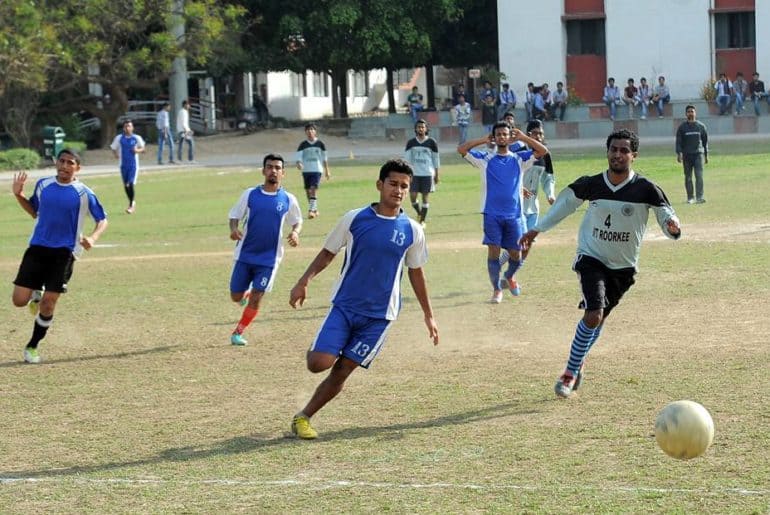
Delhi University incorporates students who are not just academically excellent, but also physically proficient. To nurture and encourage the sportspersons of the nation, the University provides a Sports Quota in its admissions to its undergraduate programme. Given below is a quick summary of the things you need to know about these trials and tests.

The University has notified each and every college to display on their websites and notice boards information regarding the number of seats under Sports Quota along with the positions/events for various Sports/Games that sportspersons will be tried for by 27th May 2015. This information has been provided well in-advance of the beginning of the regular UG admission procedure. The issue and receipt of applications/forms will be done from 28th May to 15th June. It is important for aspirants to fill the college-level form before appearing for the fitness tests and fitness trials.

Super Category

The sportspersons who have participated/represented the country in the following competitions are not subject to any trials and are infact admitted to any college they apply to.

  • Olympic Games
  • World Championships
  • Asian Games
  • Asian Championships
  • Commonwealth Games
  • Paralympic Games

Admission Procedure

1. Fitness Tests conducted by Delhi University

Three fitness tests will be conducted by DU as a preliminary examination for subsequent marking of Sports Certificates and Trials. The tests will be video-graphed and will judge one’s endurance, strength and speed. The fitness tests will be conducted in the University Polo grounds, from 18th June to 20th June, 9am onwards and the results of which will be displayed on the DU website on 22nd June 2015.

Test #1: Standing broad jump

Test #2: 1000mts. run/walk

Test #3: 50mts. dash

Note: For archery, chess and shooting, it is essential for a candidate to pass in at least one of the above mentioned tests to be able to give college trials. For other sports including cricket, football and basketball, a candidate is required to pass in at least two of the above menti0ned tests.

2. Sports Trials conducted by colleges

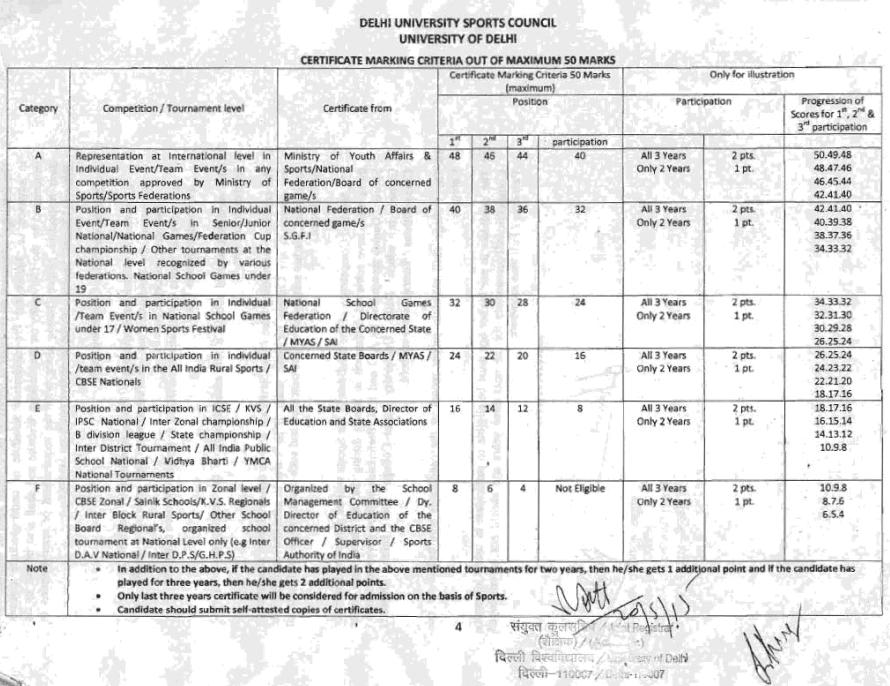
The colleges will hold trials for various sports 23rd June 2015 onwards which too will be video-graphed. The trials will hold a total of 50 marks. Minimum 18 marks out of 50 are necessary for admission to the college. The trials will be assessed on the basis of skill test, game performance test, game specific fitness, fundamentals of the sport etc. Each sportsperson will also be awarded marks out of 50 for their sports certificates. The image below indicates the marking criteria of certificates:


spotta

 Source: www.du.ac.in


Colleges set their own schedules for sports trials. Aspirants are prompted to keep checking the websites of their desired colleges for information. They may also dial or visit colleges for information. Some of the colleges that have notified their guidelines are online are:

St.Stephens College: http://www.ststephens.edu/admissions/sports.htm

Hindu College: http://www.hinducollege.org/sports_notice.asp

Moti Lal Nehru College: http://www.mlncdu.ac.in/pdf/Sports_Criteria_for_Admissions.pdf


Documents Required

The candidate should submit self-attested copies of all the certificates along with the application/form. If the candidate clears the trials, his/her name will be displayed on the college website for three days to address any grievances, after which the student will be required to submit an undertaking on judicial stamp paper of Rs.100/- declaring that he/she shall play for the University during the course of their undergraduate study. The candidate should have been active in the sport recognized by IOA and AIU for the past three years. Preference will be given to sports in which Inter-College and Inter-University Events are held.

Japji Kaur, a National level gymnast from IP College says, “It is very highly beneficial if one has a recommendation letter from a well-known sports personality of their field or their coach. Also, personal interview is where you can either move a step ahead in getting selected or simply be cleared out of the trial. Be absolutely sure in your answers and show your dedication towards your sport and the college you are trying for. Your certificates must show consistent participation in the sport or there is a good chance you won’t be selected even if you have a medal.”


For more details, follow the links below:

http://www.du.ac.in/du/index.php?mact=News,cntnt01,detail,0&cntnt01articleid=5484&cntnt01returnid=83

http://www.du.ac.in/du/uploads/Admissions/2015/ug/20052015_UG_guidelines.pdf


Featured image credits: Wikimedia Community

Ayesha Sareen

[email protected]

Indraprasth College for Women’s (IPCW) journalism course has gone through a host of changes since the introduction of the Four Year Undergraduate Programme (FYUP). Initially known as Bachelor in Mass Media and Mass Communications, it was renamed to BJMC and its entrance exam was scrapped in favour of admissions through cut-off percentages. Last year, after the scrapping of FYUP, Bachelor in Multi Media and Mass Communication (BMMMC) was reintroduced but admissions continued through cut-offs.

In a press conference on Thursday, the college announced the return of the entrance exam system for the course, which has now been renamed to BA(H.) Multi Media and Mass Communication in order to fall in line with the University Grants Commission directives on course nomenclature.

There will be two exams for admission to the course. The first entrance exam will be an objective (MCQ) test and is scheduled for 21st June. The second entrance exam will be held on 25th June. It will be a subjective test on English comprehension and creative & analytical skills.

The college will issue a list of accepted candidates on 29th June followed by payment of fees from 1st July to 3rd July.

To register, candidates can collect and deposit forms at IPCW starting 1st June. Last date to apply is 10th June. The chargeable fees for the form and the test is Rs.950 for general category and Rs.475 for other categories. Aspirants can also request postal delivery of the application form.

A student from the Class of 2015 (last batch to have taken the entrance test) suggests that entrance exams ensure that only candidates who are ready for the highly specialised course make it through the admission procedure. “It’s a welcome change,” she said, on condition of anonymity. The graduating batch reportedly also faced problems while filling application forms for PG courses due to the change of name of the course from Mass Media and Mass Communication to Multi Media and Mass Communication.

In the press conference, IPCW also announced the proposal of  a new journalism course to the University of Delhi. The course will include Fashion Communication, Disaster Management & Communication and Public Service Broadcasting among other subjects.

The University of Delhi, as scheduled, began accepting online applications for admissions to undergraduate courses on Thursday, 28th May. The admissions portal can be accessed here: http://ug.du.ac.in/2015/index.php/site/login. A step-by-step textual guide is also available on the admissions portal under the tab “Steps to Apply”.

Online admissions will continue till 15th June. Aspirants also have the option to apply offline beginning 5th June at the University-designated centres.

While filling the online form, the following few guidelines should be kept in mind to ease your process of application:

1. The website has a reputation for being slow in the initial days of applications. If you are facing similar issues, the way out is giving it time and checking the website from time to time for improvement.

2. An aspirant is only allowed to fill one form, i.e. either online or offline. Thus, it is imperative that you fill out your application with extreme care.

3. Changes to your application are possible only before payment of registration fee is made. After payment, you will not be able to modify your application.

4. Upon entering the Board roll number, your subjects and their respective marks are filled by the system itself under normal circumstances.

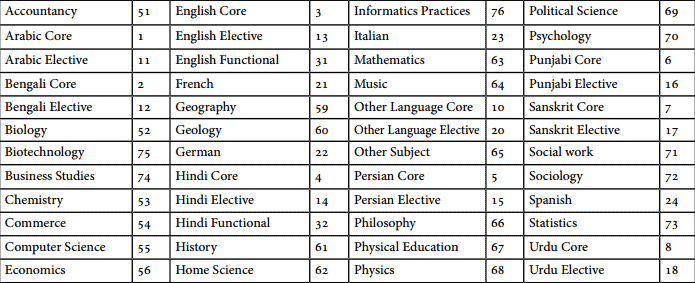
5. Subject codes assigned by DU are as follows:

Subject codes
Source: www.du.ac.in

DU’s Info Centre
Ph: 155215, E-mail ID: [email protected]

Featured graphic designed by Naman Sehgal for DU Beat

Ishaan Gambhir
[email protected]

Delhi University continued its attempts to answer queries and clear doubts of DU aspirants today during its 5th Open Day. Hundreds of aspirants have been flocking to Conference Centre, North Campus each day to resolve their queries and to get to know the intricacies of the admission procedure in the coming month.

The session was moderated by Mr.Gurpreet Tuteja, Deputy Dean of Admissions, University of Delhi. The admission committee projected a comprehensive presentation focusing on myriad queries and information that is of utmost prominence and importance. Beginning with a brief introduction about the University and affiliated colleges, the presentation further covered details about the admission procedure and reservation policies.

As applications begin tomorrow, special emphasis was given on reminding students the important dates. Online registration for Common Admission Forms begin on 28th May, 2015. Offline registration shall begin from 5th June, 2015. The cost of the forms is Rs. 100 for General and OBC Categories and Rs. 50 for SC/ST/PwD Categories. The last day for registration, both online and offline is 15th June, 2015.

Offline forms will be available on the following centers:
1. ARSD College
2. Gargi College
3. PGDAV College
4. Dyal Singh College
5. S.G.T.B Khalsa College*
6. Rajdhani College
7. Shyam Lal College
8. Maharaja Agrasen College

*Added to the list later by DU in place of SGGS College of Commerce.

The first cut off shall be released on 25th June, 2015. A period of three days would be given before the release of subsequent cut offs. “It is not mandatory for candidates to submit the offline forms to the same center they took them from. They can be deposited to any of the centers,” Mr. Tuteja announced.

With this, details regarding Sports Quota reforms as per university guidelines were discussed. The introduction of B.A. (Hons.) Multimedia and Mass Communication in Indraprastha College for Women was also announced which will also have a system of entrance examinations. More details of the BMMMC entrances are expected on Thursday.

The presentation ended with an interactive question-answer session – aspirants directly spoke to University officials.

“The session was very helpful. All our doubts were more or less cleared. Though we expect the University to be more active in online declarations which will avoid our need to attend such Open days.”, said Shubham, a B.Com aspirant from Gurgaon.

The session saw substantial turnout and was well-managed overall. The aspirants were seen satisfied post discussion with most of their queries being solved. Open Day sessions shall continue till the end of this week.

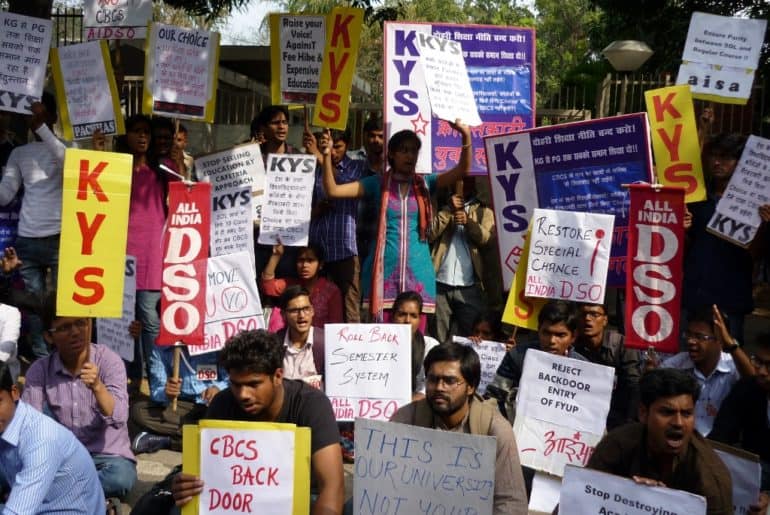
In a span of one week, 2 departments of Delhi University (DU) in their respective General Body Meetings (GBM) have decided to reject Choice Based Credit System (CBCS) and disassociate themselves from the drafting of syllabus.

Under CBCS, contents of courses are divided into ‘credits’ which students can earn “at their own pace with seamless mobility,” as the UGC has said. Under the system, a student may choose to earn some credits of even a course different from the one they applied for from another college and, potentially, another University. CBCS is dubbed by the UGC as a “cafeteria-approach of education”. The system is, according to UGC’s directive, to be introduced in the coming academic year with the new batch. It has been relentlessly opposed by teachers.

The GBM of the History department was convened on 16th May and the same of Mathematics department was called on 21st May to discuss the directive of the Jt.Registrar of DU to draft the syllabus of various courses in accordance with the proposed syllabus of the UGC. Universities are only allowed to deviate a maximum of 20% from UGC’s proposed syllabus.

The History department adopted the resolution to reject CBCS unanimously. While voting was not allowed at the Maths department’s GBM, a thumping majority backed the resolution to reject the change.

The most notable points of objection raised by teachers include the requirement of all Universities to teach a common syllabus and the risk of privatisation of education. Teachers of the history department maintain that different regions of the country have varied socio-cultural realities and learning needs and allege that the syllabus given by the UGC is diluted.

Teachers allege that the matter of CBCS was brought on the table at an Academic Council meeting under the head of “Any Other Matter” and no discussion was allowed. Going beyond alleging the DU administration for thrusting the reform upon the University, teachers of the two departments accused the Ministry of Human Resource Development (MHRD) and the University Grants Commission (UGC) for “pushing CBCS onto all Universities without discussion with the primary stakeholders, i.e. teachers and students on the desirability, feasibility and long-term implications of such a systemic change”.

Last week, DU’s media spokesperson Malay Neerav told Times of India that the University will not go ahead with CBCS if the councils do not approve of it.

Featured image credits: DUTA website

Ishaan Gambhir
[email protected]

The admission process for Bachelor in Management Studies (BMS), one of the popular courses of Delhi University at the undergraduate level, can undergo major changes.

Till last year, an entrance test, interview, and the class 12th score formed the basis of getting admission into this course. But this year, the entrance test can be removed altogether. As per the sources, such a proposal has been put forward by the Faculty of Management Studies (FMS), but still needs to be approved by the University of Delhi.

According to a senior officer of the university, if the entrance test is removed then a different criteria will have to be made for the admissions to take place according to class 12th scores since the students of all the three streams, i.e., Science, Commerce and Arts, are eligible to opt for this course. Giving equal opportunities to the students of all the streams will have to be taken care of and the rules of admission will be different for the students of the three streams.

This course was earlier called BBS but the duration of the course was made four years, last year. The responsibility of conducting the entrance test was handed over to FMS. Many questions were raised regarding the entrance test and the matter was taken to the court. There were mistakes in the answer key which was uploaded on the website.

According to some people, the course will lose its value if the entrance test gets removed as it has a lot of demand in the market. The present procedure ensures that the selection process is tough for the students. At present, fifty percent weight-age has been given to entrance test.

The university is expected to reach a conclusion regarding the matter shortly.

Source: Navbharat Times dated 17th March, 2014.

Update (20th May): Entrance exam for BMS will be held in 2014 as well. Read this article for further details.


report published in the Times of India (TOI), students will be able to get their master’s degree based on a new credit based system. This move is expected to give more flexibility to students while picking a suitable course for themselves. DU Vice Chancellor Dinesh Singh stated that few reforms will be seen effective from the approaching session itself, whereas the full set of changes will be brought and visible from 2015-16 onward. He added that the work on the PG course reforms and proposal was going on and that he may like to call it a credit based system. Students will not only have to pass in the examinations, but also may have to attain a certain minimum number of credits to clear the examination. “The expectation is that a DU student will be able to gain the credits in about a year’s time”, he was quoted saying to TOI. Singh also hinted at some changes at the FYUP level. Trans-disciplinary programmes will enable students to gain extra points during the last year of their undergraduate course, the benefits of which can be availed at the postgraduate level. He explained that re-mixing of courses would bring about more flexibility to the system and enable students to reach their higher potential. However, the basic format of the FYUP, especially the foundation courses will not be altered. Projects might be merged and more changes will be announced which will hopefully be approved by regulatory bodies. Project areas like population and internet  have been identified. The complete information is expected to be declared soon. However, this proposal for a one year PG reforms is yet to be approved by the University’s Academic and Executive Councils. Talking about the success of the FYUP, Singh admitted that there was positive feedback from the economically and socially disadvantaged strata. Girls who get married during their college years and as a result ended up wasting their studies, are now given a chance to complete their studies in the given time period of 10-years. “Trans-disciplinary knowledge has definitely gone up tremendously,” he added.]]>

After the sixth cut-off, the ground around the rocketing cut-offs for admissions into Delhi University has begun to sink in. The initial cut-offs were over-hyped with much media coverage, but here is the other side- you can get into DU even with 33% marks.

Could anyone wonder getting into DU with just 40% marks after the likes of Ram Lal Anand fixing 100% mark for admissions into one of their courses? But, here it is, Kalindi College for Women is offering Sanskrit Honours at 33% for reserved category and 45% for general category students. At the famous Daulat Ram College, Sanskrit Honours is available at 42% for all the reserved category students. Hindi Honours is available at colleges like Deshbandhu and Kalindi at 40% for reserved category students and 50% for general category students.

Besides, courses like Economics honours are available at as low as 45% for students belonging to Scheduled Tribes at Lakshmi Bai College and at 50% for Persons with Disability at Deen Dyal Upadhayaya College and Dyal Singh College(Evening). Mata Sundri College is offering Philosophy Honours at 40% and Political Science Honours at 43% for Persons with disability. Popular courses like Economics and Commerce are also available for general category students at a few colleges with lower cut-offs.

Let’s take a look at last year cut-offs. Geography Honours was available at 50% for OBC category students at Aditi Mahavidyalaya in the seventh cut-off list. Political Science and Philosophy Honours was being offered at 45% for reserved category students at I.P. College for Women in the tenth cut-off. Even, the elite courses like Economic Honours were up for grabs at Kalindi College at 55% for reserved category students in the seventh cut-off.

After the initial rush, colleges usually lower their cut-offs, as they get an idea of the actual number of students seeking admissions. Besides, the colleges do not want their seats to go vacant, so they lower the cut-offs in the succeeding lists, especially for reserved category students. Also, the cut-offs for several off-campus colleges usually go considerably down for most categories after the initial cut-off lists.

With around 47,000 students scoring over 90% in the CBSE 12th examination, there was nothing unexpected about the sky-high cut-offs for DU. But as colleges start enroling students, the high requirements are bound to go down. And for several colleges these ‘lower cut-offs’ are not a part of the ‘media hype’.

Image credit: freedigitalphotos.net