
Tag

DU

Browsing

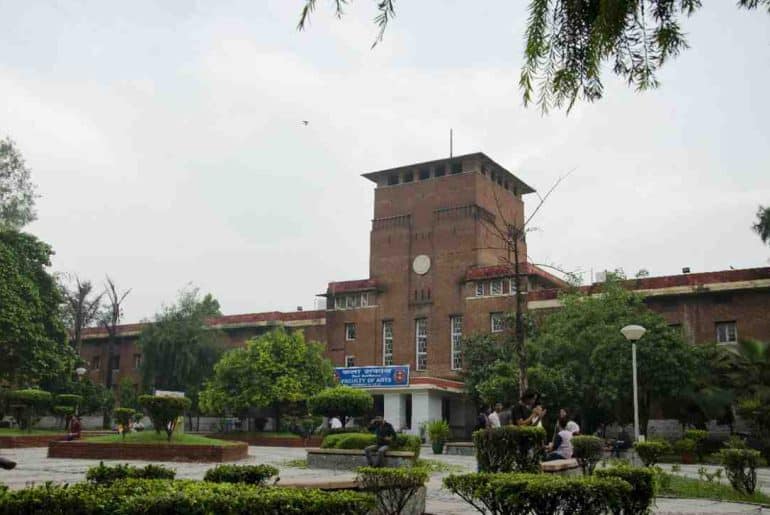
A protest organised by AISA student body took place today, on 31st July, 2025, at Ramjas College’s front gate, as the college shuts down all admissions for both of its hostels with the start of the 2025-26 academic session. 

On 30th July 2025, Ramjas College issued a notice informing students that the hostel would not be accepting admissions for the academic year 2025-2026. The notice mentions the building being under a structural stability test as the main reason for the hostel shutdown. As a response, a student protest organized by All India Students’ Association (AISA) took place today, i.e., on 31st July, 2025, at Ramjas College’s front gate from 2 pm onwards, resisting this shutdown and demanding hostel rights for all students. The students called out the action for adding to the increasing inaccessibility of affordable accommodation in DU, a move that furthers the exclusion of marginalised students.

The hostels accommodated 210 people every year and had a specific number of seats available for the reserved category students (SC/ST, physically challenged, sports persons, foreign students, etc.) to occupy.

With PG and flat rates in North Campus skyrocketing, Anjali, a Delhi University student and representative of the All India Students’ Association (AISA), says:

This model is pushing students toward unaffordable private accommodations and chipping away at the public character of DU. With lakhs of students arriving from across India, hostels are not a luxury; they are a right. We will fight tooth and nail to defend that right for all.”

She also explains how this isn’t just an isolated event but a visible pattern for exclusion:

What’s happening at Ramjas is not new; it’s part of a disturbing pattern across Delhi University. Hindu College Boys’ Hostel has remained shut since the lockdown. KMC dismantled seat allocations for PG students. And now Ramjas has shut down both hostels just as freshers arrive.”

Hindu College’s Boys Hostel is being demolished and rebuilt with the promise to accommodate more students since 2023. LSR College hostel has also remained closed for “maintenance reasons” since March of 2023.

Anjali further talks about how, despite having space for building affordable hostels for students, the university land is being used for private constructions:

This is a strategic move to exclude students from marginalised backgrounds. AISA has long fought for student accommodation. Back in 2016, we launched the “Room of My Own” campaign and submitted a list of vacant DU-owned land that could be used to construct hostels. Yet in 2019, a 39-story private building was being made on university land in front of Vishwavidyalaya metro.”

While the hostels are aged and rundown, it is the responsibility of the university, according to the UGC guidelines, to ensure that students from all sections of society studying here have affordable and safe living situations. The decision to close down the hostel directly contradicts this mandate. 

With multiple college hostels currently non-operational, concerns over affordable and inclusive student housing remain unaddressed.

Read also: Legal proceedings initiated against Ramjas College Professor accused of Sexual Assault; POCSO Act invoked

Image Credits: AISA 


Gaurika Bahl

[email protected]

With just days before reopening, students and teachers remain in the dark, syllabi remain unnotified, decision-making bypasses experts, and institutional autonomy is under threat.

With less than two weeks to go before Delhi University reopens, teachers and council members are raising concerns over the rushed, unclear rollout of the NEP. The University is set to introduce over 82 postgraduate courses under the new PGCF and begin the fourth year of the UGCF for the first time. But shockingly, the syllabi for these new courses haven’t even been notified yet.

Associate Professor of  Physics at Miranda House Abha Dev Habib, and also Secretary of the Democratic Teachers’ Front, posted a detailed statement on Facebook titled “Killing a University!.” She wrote,

Courseworks and syllabi for the UGCF courses for semester VII and VIII, which concern over 60,000 students have not been notified even as these were passed by the EC of 23 May and 12 July 2025. Without information on time, how labs will be prepared or students informed of Elective papers or teachers will prepare for new courses, nothing concerns the University anymore,”

Dr. Mithuraaj Dhusiya, elected member of DU’s Executive Council, shares the same alarm.

DU is still not prepared for the 4th year NEP-UGCF in terms of infrastructure, manpower and academic syllabus. It is extremely shocking that both students and teachers don’t know yet what they would be studying or teaching in the 4th year,”

And such problems go beyond syllabus interference as Rudrashish Chakraborty, an Associate Professor at Kirori Mal College and an elected member of the DUTA Executive says,

The colleges are looking at a situation where theoretically there is a potential increase of 33% students in the institutions with no promise of extra funds. This is a very well-planned effort to dismantle the largest public-funded University in the country”

What’s most alarming is that recent syllabus changes aren’t coming from within departments, but are being imposed by people with no expertise in the subjects, highlighted by Professor Rudrashish Chakraborty:

These outsiders are neither experts nor even belong to the subjects concerned, they act as paratroopers in Standing Committee meetings at the behest of the University administration.” He points out that academic decisions are being overridden, and “no self-respecting academic is allowed to survive in the University of Delhi without compromising on his/her academic integrity.” Referring to the resignation of the Head of the History department,

Abha Dev Habib warns,

Committees have been set up to dictate terms on syllabi already passed by AC-EC. This is unconstitutional and is the result of excessive interference by BJP-RSS.”

Media coverage in recent months has highlighted growing concern among faculty over DU’s readiness to implement NEP-based curriculum. According to India Today, faculty members have also raised alarm about rising teaching loads. Faculty members are expected to engage in 40 hours of work weekly, yet there has been no new staff recruitment. Abha Dev Habib told India Today Education, “The UGC regulations, 2018, clearly specify 14–16 teaching hours. Forcing teachers beyond that violates norms,”

With only days remaining before the university reopens, the situation remains uncertain for thousands of students and their professors alike.

Read Also: Uncertainty Shadows The Fourth Year of Delhi University’s NEP Rollout.

Image credit:  Arush for DU Beat


Juhi Bansal

[email protected]

Delhi University asks CW quota candidates to submit ECC and documents by July 28 for UG admissions 2025-26.


The University of Delhi has released notification for candidates applying under the Children/Widows (CW) of Armed Forces Personnel supernumerary quota for undergraduate admissions for the academic year 2025-26. A tentative list of eligible candidates has been published, and those included must complete their document verification by submitting the Educational Concession Certificate (ECC) and other required documents no later than 11:59 PM on Monday, July 28, 2025.

 The notice explicitly states that this date will be the last and final opportunity for CW candidates to submit the necessary documentation. No extensions or special requests will be entertained after the stipulated deadline.

All CW category applicants aspiring to secure admission under this quota must check their eligibility and priority classification, which ranges from Priority I to V, as detailed in the attached Annexure I available on the official DU Admissions 2025-26 portal.

Required Documents by Priority

The type of documents required for verification varies depending on the candidate’s priority status:

Priority I:

Pension Payment Order (PPO) and subsequent PPOs (if any)

Service/Discharge Book issued by respective records

Battle Casualty Certificate


Priority II:

PPO and subsequent PPOs (if any)

Complete Service/Discharge Book

Battle Casualty Certificate

Proceedings from the Invalidment Medical Board


Priority III:

PPO and subsequent PPOs (if any)

Service/Discharge Book


This categorisation ensures that concessions are granted in a structured manner to the most deserving candidates based on the nature of service and sacrifice made by their family members in the armed forces.

The document submission process must be completed online through the official University of Delhi admission portal, under the “Undergraduate Admissions 2025-26” section.

This move is part of the university’s broader commitment to honouring the contributions of armed forces personnel by providing educational support to their wards and widows. However, university officials have urged candidates to act promptly and accurately, warning that incomplete or delayed submissions will lead to disqualification.

Candidates and parents are advised to keep a close eye on official communication channels and ensure that all documents submitted are authentic, complete, and legible.


Read Also: Delhi University CSAS UG ADMISSION 2025 – First Allocation List Released; Check Here!


Image source : Devesh for DU Beat


Madhav Choudhary 

[email protected]

DU student activist Rudra has been reported missing; fears of illegal detention rise amid reports of custodial torture and police crackdowns on activists.

Concerns are mounting over the disappearance of Rudra, a 20-year-old student of Philosophy (Honours) from Zakir Hussain College, Delhi University, who has been untraceable since the morning of July 18, shortly after arriving in the capital. His disappearance follows a disturbing pattern of alleged illegal detentions and custodial torture by the Special Branch of the Delhi Police, involving seven other student activists earlier this month.

According to friends and fellow activists, Rudra boarded the Howrah-New Delhi Duronto Express from Kolkata on July 18. He contacted a friend around 7:40 AM, confirming that he had arrived at the New Delhi Railway Station. That call was his last known communication. Since then, there has been no word from him, and his whereabouts remain unknown.

In an interview with Maktoob Media, Rudra’s friends stated, 

Rudra is a very bright student and a diligent activist who has the best interests of people at heart….. What has been happening is an unprecedented attack on resisting voices, and a direct fascistic attack on democracy.

With no information from the police or authorities, Rudra’s family and comrades fear that he has been detained incommunicado—similar to the six previously missing student activists, who were eventually found to be in police custody days later. These detentions, unacknowledged at the time, have since been linked to allegations of severe custodial torture.

The Campaign Against State Repression (CASR) issued a statement,

While in custody, the activists were subjected to torture that directly violates the right to life and dignity under Article 21 of the Constitution. They were stripped naked, beaten, electrocuted, and subjected to degrading treatment including having their heads submerged in toilet bowls.

The six previously detained individuals include Gurkirat, Gaurav, and Gaurang from bsCEM; Baadal and Ehtemam from Forum Against Corporatization and Militarization; and Samrat, a psychologist from Haryana.

Rudra’s Class Representative issued a statement to DU Beat:

Although he was not very regular to the class, he read a lot. He posted about the articles he read on social media. It seemed like he was affiliated to the communist student activist groups. As CR, I’ve talked to him regarding assignments and tests. He was particularly quiet.

Human rights organisations and student groups have condemned what they describe as an orchestrated crackdown on student activists, involving arbitrary detentions, lack of due process, and third-degree custodial torture. According to multiple reports, the seven released activists were held in undisclosed locations and subjected to degrading and violent treatment.

Currently, any details regarding Rudra’s whereabouts are still awaited. 


Read Also: bsCEM Student Activist Gurkirat Detained by Delhi Police on 16th July: Released Later Same Day 

Image Source: Maktoob Media 


Madhav Choudhary 

[email protected]

The Delhi University CSAS UG portal is now open, and the first allocation list of colleges has been released. Students can check their allotted college and course on the official website.

The CSAS portal for undergraduate programs released the 1st list for seat allocation at 5 P.M. on 19th July. Students can check their allotted college and course based on their preference list through the official website.

To view their allocation, students must enter their CUET UG application number and password. Thereafter, they must enter the login information to see the allocated college after carefully verifying the information. The candidates can further download information regarding their allotted college and course.

Along with the option of accepting the assigned college and course, students can also avail the option of upgrading. The second round of allocation with upgraded and fresh lists is expected to be out by 28th July. 

The schedule for the upcoming admission process is as follows,  

Event  Date
Declaration of FIRST CSAS Allocation List  5:00 pm Saturday, July 19, 2025
Candidates to ACCEPT the Allocated Seat 5:00 pm Saturday, July 19
till 4:59 pm Tuesday, July 22, 2025
College to VERIFY and APPROVE the online applications 5:00 pm Saturday, July 19
till 4:59 pm Tuesday, July 22, 2025
Last date of ONLINE PAYMENT of FEES by Candidates 5:00 pm Saturday, July 19
till 4:59 pm Tuesday, July 22, 2025
Display of vacant Seats on the dashboard of the candidates 5:00 pm Thursday, July 24, 2025
Window to Re-order Higher Preferences 5:00 pm Thursday, July 24
till 4:59 pm Friday, July 25, 2025
Declaration of SECOND CSAS Allocation 5:00 pm Monday, July 28, 2025
Candidates to ACCEPT the Allocated seat 5:00 pm Monday, July 28
till 4:59 pm Wednesday, July 30, 2025
College to VERIFY and APPROVE the online applications 5:00 pm Monday, July 28
till 4:59 pm Wednesday, July 31, 2025
Last date of ONLINE PAYMENT of FEES by Candidates 5:00 pm Monday, July 28
till 4:59 pm Friday, August 1, 2025

For more information you can refer to Delhi University’s official notice: https://admission.uod.ac.in/userfiles/downloads/18062025_CSAS-UG_compressed.pdf

Students are requested to stay updated and read the Bulletin of Information on the official website of the admission portal. Stay tuned for more information regarding Colleges and Courses.


Read Also: Jesus and Mary College Discontinues NCWEB Teaching Centre; Current Students Shifted to Deshbandhu College Centre

Image Source: India Today

Arya Chaudhary
[email protected]


Padma Shri historian Dr. Meenakshi Jain, former professor at Gargi College, nominated to Rajya Sabha by President Droupadi Murmu, for a six-year term starting July 21, 2025.


Dr. Meenakshi Jain, Former Professor of Gargi College, University of Delhi, is among the four individuals nominated to the Rajya Sabha by President Droupadi Murmu on 12th of July. She was serving as an associate professor at the Department of History, Gargi College

Her writings as a historian include, among many others, Ram and Ayodhya, The Battle of Rama, Medieval India, Sati-Evangelicals, Baptist Missionaries, the Changing Colonial Discourse, her most recent book, Vishvanath Rises and Rises in 2024, and the NCERT history textbook. Her work highlights alternating perspectives regarding medieval history, Indian culture and historiography coming from British times. She was conferred with the Padma Shri in 2020, the fourth highest civilian award in the field of literature and education.

“At a time when the nation is reclaiming its cultural confidence at the global stage, her presence in Parliament will ensure that policy debates are more informed’’, said Himanshu Kumar, a third year student at Hindu College recalling when she came to his annual department event. 

In response to a question about her future role in public life beyond the university as a Member of the Rajya Sabha, she stated,

I have not yet even joined so I think it inappropriate to comment on anything this soon.”

The other individuals nominated are public prosecutor Ujjwal Nikam, Indian politician C. Sadanandan Master, and former Foreign Secretary Harsh Vardhan Shringla. She will assume office from 21st of July, 2025 along with other members. Her tenure will  continue till July, 2031. From teaching college students to now serving the public, she has made a significant mark on history. 

Read Also: Delhi High Court Condemns Delhi University Over Treatment of Ad-Hoc Faculty; Orders Regularisation for 2 Professors

Featured Image Source: News18


Arya Chaudhary
[email protected]

In a recent order, the Delhi High Court bashed Delhi University’s appointment of ad-hoc faculty to substitute regular employment of professors, while ordering regularisation for 2 ad-hoc professors. 

In the past decade, the number of ad-hoc faculty appointments by Delhi University has skyrocketed, and along with that their treatment of such faculty has deteriorated significantly. On 11th July, the Delhi High Court in response to an appeal by two of Delhi University’s ad-hoc faculty, severely questioned the University for “consciously using ad-hoc appointments as a substitute for regular employment”. 

The ad-hoc professors from the Department of Germanic and Romance Studies, namely Namita Khare and Mehak Talwar, petitioned in 2022 against the University’s revised guidelines for the recruitment and shortlisting of Asst. Professors that covertly excluded long-serving ad-hoc teachers, despite them qualifying the eligibility norms under the UGC guidelines. 

Questioning Delhi University’s failure to recruit regular faculty while extending the petitioner’s tenure, the High Court bench of judges, Justice C.H, Shankar and Ajay Digpaul stated

The petitioners were not engaged for a finite project or stop-gap arrangement, but entrusted with core instructional and administrative responsibilities within a permanent academic framework.”

On a typical basis, Delhi University hires ad-hoc professors on quarterly contracts which are renewed with “breaks” to avoid legal obligations. However, under this system, many teachers have taught full-time for over decades without consideration for a permanent position, despite having performed the same duties as a regular employed faculty. Commenting on the same, the bench further observed

The petitioners’ continued exclusion from the zone of regularisation, despite fulfilling all eligibility conditions and having rendered long and meritorious service, is violative of Articles 14 and 16 and cannot be sustained.”

As of 2022, Delhi University has over 4200 ad-hoc appointments that makes up for 40% of its total faculty strength and in the past 2 years over 2000 ad-hoc teachers have been allegedly displaced. In an interview with the Indian Express, an ad-hoc professor at Ramjas stated that he had seen no progress in career, increments or medical benefits under DU’s system of ad-hoc appointments. Regularisation for such appointments, is thus, the need of the hour to ensure equitable treatment and fair service. 

A press release by the Democratic Teachers’ Front (DTF), Delhi University welcomed the regularisation order – 

The High Court order for regularization should be used to bring much awaited relief to serving adhoc teachers and those displaced.”

Rajib Ray, the President of DTF, recommended the regularisation of the remaining ad-hoc faculty as well as previously displaced teachers whose entire service should be counted towards all stages of promotion and retirement benefits. 

The High Court’s judgment, reflects the Supreme Court’s 2024 Jaggo Judgment, which recognised the need for regularisation measures for ad-hoc appointees who have performed indispensable services for a prolonged and uninterrupted period. 

DUTA Executive Member, Prof. Rudrashish Chakraborty further stated, 

The DU administration is guilty of exploiting the adhoc teachers during the best years of their life and then throwing them out through selection committees. This humane judgement will force the University administration to ensure the regularisation of the ad-hoc teachers in the rest of the colleges wherever interviews will be held and also to absorb those teachers who were displaced.” 

Given the current state of ad-hoc teachers at Delhi University with lack of increments, promotions or medical benefits, the HC judgement is expected to bring relief and hope for the improvement of working conditions and their shortlisting for permanent positions. Recently, the DU Vice Chancellor, Yogesh Singh has agreed to send an official representative to the University Grants Commission (UGC) as the ad-hoc faculty demands recognition of past service and provision of promotion and retirement benefits. 

Read also: DU sends UGC rep as teachers demand recognition of past service

Image Source: DNA India

Aaratrika Ghosh

[email protected]

New details have emerged about the case of the missing 19 year old student from Delhi University; investigation remains ongoing following the discovery of the student’s body.

Almost a week after a 19-year-old student, Sneha Debnath from Atma Ram Sanatan Dharma College, University of Delhi went missing, her body has been recovered following a 72-hour search by the Delhi Police under the Geeta Colony flyover in the Yamuna river on Sunday.

Debnath, originally from Sabroom in Tripura, had moved away from her family to Delhi in order to pursue higher education. She had resided in Paryavaran Complex, South Delhi, as of late and the discovery of a suicide note by her family in her college hostel points towards an alleged suicide attempt by the student. 

Sneha’s family and hostel authorities discovered a handwritten note in her room on July 13th, which seemed to indicate suicidal intent. The note, which is now under the jurisdiction of the Delhi Police for further investigation, read-

I just feel like a failure and burden, and it was getting unbearable to live like this. There is no foul play. It was my decision.” 

Eyewitness testimonies remained hazy, and Debnath’s body was eventually discovered under the Geeta Colony flyover in the Yamuna river and identified by the authorities.

The case had emerged on July 7, when Sneha had told her mother that she was going to meet a friend (Pitunia) at Sarai Rohilla Railway Station at 6:45 am to bid her goodbye for a train. Her family attempted to contact her two hours later, at 8:45 a.m., but all in vain, as her phone appeared to be switched off.

Pitunia admitted to not having met with Sneha earlier in the morning, and that Sneha had instead taken a cab to Signature Bridge, a known suicide spot where no CCTV cameras are functional – an issue that was brought up by her father in the past week, given that it hindered the search for his daughter.


“It is unacceptable that no CCTV cameras are working in a high-risk area like Signature Bridge. My sister was missing, and we have no leads because the only concrete form of evidence, video footage, is not available… We demand accountability from the Delhi Police and government, and immediate steps to fix this negligent failure.”
– Debnath’s family 


The cab driver in question confirmed dropping her near the bridge, and the National Disaster Response Force (NDRF) joined forces with the Delhi Police to conduct an extensive search across a 7-kilometre radius from Noida to Nigam Bodh Ghat. 

Sneha’s family, including her ailing father, a retired Army Subedar Major undergoing dialysis, had earlier expressed anguish over the delayed FIR, filed more than 48 hours after she was reported missing. He had taken to making emotional appeals on social media through posts that were popularised largely by students of Delhi University, eventually drawing the attention of Tripura Chief Minister Manik Saha, who instructed state police to coordinate with Delhi authorities and assist in the search. The Tripura CMO had earlier posted online:

I express my grief over her death, and my sympathy is with the bereaved family. I ask the authority of Tripura Bhavan, New Delhi, to render all possible help to the family.”

Image Credits: ANI

Aastha Singh

[email protected]

Key proposals for Delhi University’s biggest infrastructural development are currently underway with over 1900 crores dedicated to projects that include a new co-ed college, installation of solar plants and a university-wide surveillance machinery.


Delhi University is currently moving towards one of its biggest infrastructural pushes in many years, with an allocation of over 1900 crores for projects that are approved or already in process. The major developments are noted to be the creation of a new college at Fatehpur Behri, an IP-based system of surveillance and the installation of solar-powered panels. 

According to the Times of India, these proposals have already been cleared by the finance and building committee. However, they are yet to be finally approved by the executive council, which has slated a meeting on 12th July. 

In June, Delhi University Vice Chancellor, Yogesh Singh confirmed the creation of a new college in Fatehpur Behri with modern 21st-century courses. Delineating the University’s plans, he stated, 

We intend to open a college there by next year. Gram Panchayat has already allotted us the land. However, the college may not be exclusively for girls.


According to reports, 272 crores have been allocated as funding for the new college that is yet to be named. Further elaborating on the educational initiatives under the University, Singh added that a project titled, Veer Savarkar College is currently underway with an estimated timeline of 2026. 

Additionally, a 9.2 crore funding for an Internet Protocol-based surveillance system has been sanctioned to improve safety across Delhi University’s North and South campus colleges. In the light of defunct CCTV cameras across Delhi, this initiative is expected to tackle concerns of security in and around these college grounds. 

Infrastructurally, the University is currently in the process of installing solar-powered systems through the Renewable Energy Service Company (RESCO) alongside a 200-crore working women’s and girls’ hostel at the Dhaka Complex. Serious construction failures, such as salty water and poor concrete cover at the girls’ hostel, along with drainage upgrades at the Sports Complex and Tutorial Block, are expected to follow through. A proposal indicates the construction of a stainless-steel stormwater system to structurally stabilise Delhi University’s Rugby Sevens Sports Complex. 

Ongoing projects under the 1900-crore funding include renovations at the Faculty of Management Studies, new classrooms and faculty rooms for the Department of Commerce, refurbishment of the convocation hall and redevelopment of the vice-regal lodge. An in-principle approval has also been granted for a new cultural activity centre near Shri Shankar Lal Hall.

Under the Higher Education Financing Agency (HEFA), Delhi University has successfully secured funding of 195.6 crore for the creation of a Faculty of Technology building and 120 crores for an academic complex at Surajmal Vihar. 

Given the extent of infrastructural development planned and targeted by the University, a top-level project monitoring committee is expected to be formed under Prof. Balaram Pani, Dean of Colleges. However, the extent of development upon the already approved projects is under question, with a reported physical progress of less than 10%, as reported by the Times of India.

Read also: Delhi University Faces Backlash for Linguistic Misrepresentation in CSAS UG Admission Form

Image Credits: Devesh for DU Beat 

Aaratrika Ghosh

[email protected]

Delhi University’s 2025–26 fee hike exceeds the 10 per cent cap, with charges like the Development Fund and EWS Welfare Fund rising up to 200per cent. Students and faculty voice concerns over steep hikes and lack of infrastructural improvements or transparency.


The University of Delhi has revised its fees for the 2025-2026 academic session. Despite its annual policy on fee hikes stating that fee revisions cannot exceed 10 per cent, this year’s fee hike was more than double what was stated in the policy.

This decision has come in light of similar fee hikes that have occurred from 2022 onwards in courses provided by Delhi University.

The University Development Fund has grown by around 67 per cent, highlighting a steady upward trend in student fees. Alongside this, the University Facilities and Services Charges have surged upwards as well by an intense 200 per cent, and the EWS (Economically Weaker Section) Welfare Fund has increased by 150 per cent, a move that was approved by the vice chancellor using emergency superpowers through a notification on 3rd April.

From Rs 900 in 2022 to Rs 1,000 in 2023, Rs 1,200 in 2024, and Rs 1,500 in 2025, the University Development Fund has increased in size. From Rs 500 in 2022 to Rs 1,000 in 2023, Rs 1,250 in 2024, and Rs 1,500 this year, the facilities charges also went up. The Welfare Fund started off at Rs 100 in 2022 and has since increased to Rs 150 in 2023, Rs 200 in 2024, and Rs 250 today.

The University Development Fund increased by 25per cent this year, from Rs 1,200 to Rs 1,500. A 20 per cent increase was made to the university’s facilities and services charges, which went from Rs 1,250 to Rs 1,500. In the meantime, the EWS Welfare Fund saw a 25 per cent boost in just one year, going from Rs 200 to Rs 250.

The cost of the BEd and MEd programs is Rs 8,931 and Rs 9,046, respectively. The cost of law courses such as LLB and LLM is Rs 8,087. Technical courses like MCA and MSc Computer Science are more expensive, costing Rs 23,007 and Rs 22,887, respectively.

Students studying commerce will pay Rs 16,900, while those pursuing an MA in social work will come in at Rs 21,901.

Standard fees for students of undergraduate and postgraduate programs differ depending on the choice of stream and course, ranging from Rs. 8,000 to Rs. 20,000. PhD candidates would pay a fee of Rs. 8,087, while MBA programs vary—IB and HRD streams cost Rs. 52,279, while a full-time MBA costs Rs. 60,818.

The consistent fee hike has sparked concerns amongst students and faculty of Delhi University alike, with Prof. Pankaj Garg, chairman of the Indian National Teachers’ Congress (INTEC), stating,


Students are being charged hefty fees by the university under the guise of the University Development Fund and University Facilities and Services Charges. The university, however, does not create any infrastructural facilities for the college; in government universities, this practice should not be permitted. Colleges should be allowed to retain the funds.”

As of April 12, there has been no response from Vice Chancellor Yogesh Singh on the revision of the fee hike schedule.


Read Also: 72 Hours and Still No Trace: The Disappearance of Sneha Debnath Demands Urgent Action


Image Credits: Hindustan Times

Aastha Singh

[email protected]