Tag

DU

Browsing

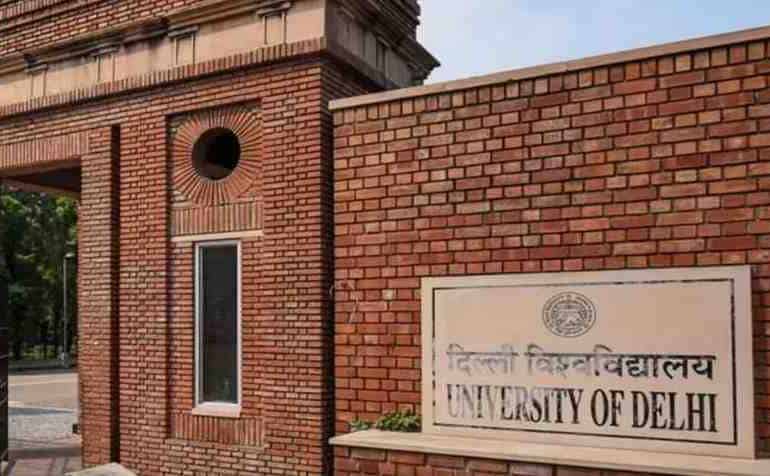
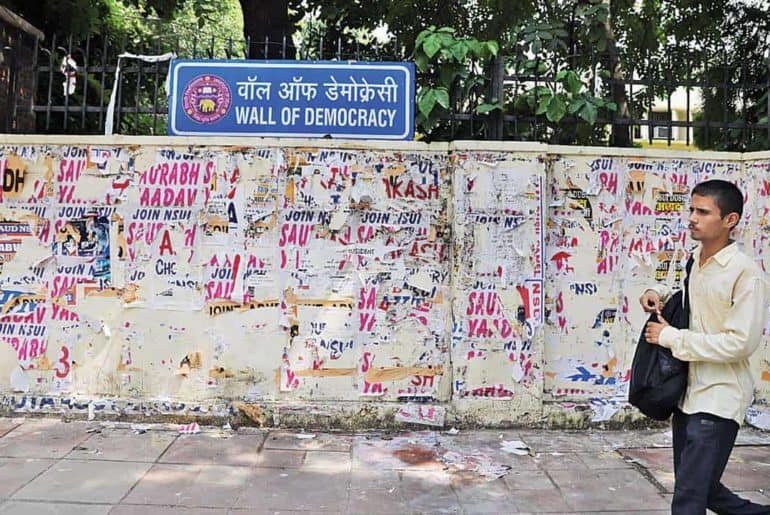
Delhi University (DU) is reconsidering its rule requiring candidates in the DU Students’ Union (DUSU) elections to submit a ₹1,00,000 bond. Introduced on August 8 as part of new poll guidelines to curb campus defacement ahead of the September elections, the rule forms part of a wider framework aligned with court orders and Lyngdoh Committee recommendations. These directives also mandate an anti-defacement affidavit, limit rallies and loudspeaker use, and impose penalties for violations. The bond requirement has drawn sharp criticism from student organisations, who say it imposes an unfair financial burden, especially on candidates from underprivileged backgrounds. A senior DU official told The Hindustan Times that the University is reviewing the provision in light of these objections.

According to the guidelines, “Each contesting candidate shall be required to execute a bond of Rs. 1.00 Lakh for the offence of any defacement/violation of provisions of these Guidelines by themselves or their supporters, at the time of filing nomination for any post of DUSU.” 

Speaking to The Hindustan Times, Chief Election Officer Raj Kishore Sharma said that during a meeting with students and representatives of student organisations, participants expressed unwillingness to pay the bond. Following the discussion, the election office asked them to submit written representations to the university administration by August 16. The matter will be reviewed again before a final decision is taken.

The backdrop to these new regulations lies in the 2024 DUSU election, when widespread vandalism during campaigning led the Delhi High Court to intervene. As a result, vote counting was delayed by nearly two months, pending the removal of defaced property and its restoration. 

Last week, university officials reaffirmed a zero-tolerance stance on defacement, limiting campaign materials to handmade posters, imposing expenditure limits, and promising to set up “walls of democracy” in colleges as approved spaces for election displays. They also agreed, following student suggestions, that these “walls” would be formally recommended for both college-level and university-wide elections.

Sharma further affirmed, “Following last year’s incidents, the university submitted a set of reform suggestions to the court aimed at preventing defacement this year, which included the ₹1,00,000 bond requirement. However, in view of the opposition from students, we have yet to take a final decision.”

The university has notified the schedule for this year’s elections—the DUSU elections will be held on September 18, with counting scheduled for September 19. The notification also sets September 10 as the deadline for filing nominations along with a ₹500 demand draft, affidavit, and ₹1 lakh bond, followed by scrutiny and the publication of nominated candidates the same day. The withdrawal deadline is September 11, after which the final list will be released. Voting will run from 8:30 a.m. to 1 p.m. for day classes and 3 p.m. to 7:30 p.m. for evening classes.

With the deadline for filing nominations less than a month away, the fate of the ₹1 lakh bond provision remains uncertain. Student bodies await the administration’s final decision, which could determine whether the upcoming polls proceed under the contentious rule or with revised guidelines. For now, preparations for the September 18 elections continue under the shadow of last year’s controversies and the university’s push for cleaner, regulation-bound campaigning.


Image Credits: Deepanshi for DU Beat

Neeraja Unnikrishnan
[email protected] 

Read Also: DUSU And Central Council Elections 2025-2026: Official Timeline Announced

On the morning of 14 August, Delhi saw heavy rainfall, causing waterlogging, leaked ceilings, broken panels, traffic around DU colleges and even a tragic death. Students faced difficulty in reaching colleges and even walking around campuses because of ankle-deep water flooding, affecting both the indoors and outdoors of college buildings.

Delhi-NCR witnessed heavy rains on Thursday, 14 August, causing waterlogging. Amidst the relentless downpour, one of the major victims of the waterlogging were DU colleges. Areas near colleges like Zakir Hussain College faced extreme waterlogging. Despite the installation of water pumps to drain the water, the area still remained jammed. The road near Shaheed Bhagat Singh College, Jesus and Mary Marg of JMC, Siri Fort Road of Gargi College was completely waterlogged, blocking the entrance. Delhi College of Arts and Commerce and Deshbandhu College had a similar fate, with water flooding up to students’ ankles and leaking ceilings in classrooms.

The Science Block (APJ Abdul Kalam Block) of Deshbandhu College was flooded with ankle-deep water despite being situated at a relatively elevated area from its surroundings. Indoor areas of the college weren’t spared from the rainfall’s wrath, leading to leaked ceilings and broken panels in some classrooms.

A student from Deshbandhu College said, 

It took hours of continuous sweeping to get water out. The ceiling of certain classrooms in the Porta Block has broken panels, which allow water to enter the classrooms. The first bench of the entrance P-2 (Porta Block) was bathed in water.

The situation around Deshbandhu College even turned tragic, as due to heavy rainfall, a large tree fell on a bike in Kalkaji, killing a 50-year-old man and leaving his daughter fatally injured. Delhi College of Arts and Commerce likewise suffered because of water flooding. The ground floor of its old building was entirely filled with water, including the washrooms, canteen, classes, and open areas too. The main college campus was submerged in water above the ankles, and no precautions were taken to lessen the effects at the time. Jam-packed roads made it almost impossible for students to enter their college, let alone their classrooms.

Almost all colleges which were waterlogged in or around the campuses made travelling to and from colleges very time-consuming, difficult, and dangerous. Due to waterlogging, autos were charging way higher than usual, and while on the road, water entered even inside autos. Areas like Siri Fort Road near Gargi College were flooded to an extent where vehicles weren’t able to reach near the main college gate, leaving students stranded either far from college or at metro stations, with no help and cancellation of classes on the spot due to dangerous circumstances. 

Eventually, as the weather worsened, the India Meteorological Department issued a red alert in some areas, the tragic Kalkaji accident becoming one of the prompting factors. The condition of Delhi and DU colleges in particular raised questions about drainage systems and the safety of students.

Read Also: Delhi High Court Quashes JMI Professor’s Termination Over Breach of Natural Justice

Featured Image Credits: Shazia for DU Beat 

Umang

[email protected]


University of Delhi has revealed the official calendar for the election of office bearers of the Delhi University Students’ Union (DUSU) and Central Council members for the academic session 2025-2026. The announcement marks the beginning of one of the most dynamic and politically vibrant seasons of the academic year, with the election process scheduled to take place in September. 

The official notification issued by the Registrar sets 10th September, 2025, as the deadline for the submission of nomination papers, which must be filed by 3:00 p.m. and accompanied by a demand draft of Rs.500, alongside an affidavit, and a bond of Rs. 1 lakh. Scrutiny of nomination papers will take place the same day at 3:15 p.m., with the list of duly nominated candidates to be published at 6:00 p.m. For DUSU positions, nomination papers must be put in a sealed box located at the Office of the Chief Election Officer, Conference Centre, University of Delhi, North Campus. For Central Council elections, nominations must be filed with the respective college or department. Nomination forms can be accessed and downloaded from the official Delhi University Website. 

Candidates who wish to withdraw their nominations must do so by 11th September, 2025, before noon. The final list of candidates running for office will be published later that day at 5:00 p.m. The polling day is set for 18th September, 2025, followed by the counting of votes which will take place the next day on Friday, 19th September, 2025.

The voting process will be conducted in two stages. Students enrolled in day classes will vote during the window of 8:30 a.m. to 1:00 p.m. and those in evening classes must vote from 3:00 p.m until 7:30 p.m.

The notification further aligns itself with the Code of Conduct, DUSU Constitution, and court orders from the Supreme Court of India and the Delhi High Court. It reiterates that the procedure would be carried out in compliance with the Delhi Prevention of Defacement of Property Act (2007) and the National Green Tribunal guidelines. 

With the schedule now in place, the university is set to witness a charged election season, as student organisations and candidates prepare to campaign for leadership positions in one of the country’s most closely watched student political arenas. 

Image Credits: Sushil Kumar Verma

Navya Chandok
[email protected]

Read Also: DU Issues Anti Defacement Measures; Mandates 1 Lakh Bond Rule For DUSU Poll Candidates

The daily journey to Delhi College of Arts & Commerce (DCAC) is becoming harder, riskier, and more frustrating for students, as key roads around the college remain broken and unsafe. Despite these conditions being a long-standing problem, no steps have been taken by the relevant authorities to address them.

One of the latest disruptions is the digging of the lane leading to Mini Market, the only nearby eatery frequented by students. The path has been broken for the construction of a mall, leaving the area littered with debris and obstructing movement to the market which is a vital stop for students looking for affordable food options close to campus. 

The road problems, however, extend far beyond Mini Market. The two main routes students take to college and back are in a poor state. The Metro route, popular because of its relatively short distance, is inconvenient to take as students walking or commuting along it face uneven surfaces that make it difficult to navigate, especially during the monsoon when potholes get filled with water. On top of this, the stretch is known for repeated incidents of catcalling and harassment, making it particularly unsafe for women students. Tinkle Singh, a second year student says:

We always have to walk in groups to the metro and taking an auto everyday is not financially viable. It’s not just the potholes, it’s also the stares and comments that make it unsafe.”

The only road between DCAC and ARD Complex, a key residential area where many students live, has also been in disrepair. Potholes, dust, and an uneven road surface have become part of the daily commute, affecting both pedestrians and those travelling by auto. Anjali, a third year student of DCAC and a residential of ARD says:

The street near the roundabout sees pathetic puddles and it is almost impossible to commute without an auto when it rains.”

Additionally the road has seen no significant repair work in almost 2 years, and with no proper footpaths or lighting, it poses safety risks at all hours. The problems are compounded by the lack of traffic regulation. Speeding vehicles are a common sight, and even the potholes acting as the speed breakers do little to slow them down. 

Despite repeated inconveniences, there has been no sign of improvement from the civic authorities responsible for road maintenance. No repair work has been initiated, and no safety measures such as CCTV cameras or patrolling have been introduced on these paths. The only official action so far has come from the college itself, which issued a notice saying:

“Students who walk from Metro to College and College to Metro are hereby advised to travel in groups as a park, construction site and other isolated areas fall in the route.”

For students, this lack of response is not just an inconvenience – it is an everyday challenge that impacts their ability to attend classes safely and on time. 

Picture Credits: Juhi Bansal for DU Beat

Juhi Bansal
[email protected]

Also Read: AAP’s Revamped Student Wing Gears Up For DUSU Elections

Delhi University officially secures its position in the prestigious list of Higher Education Institutes of India by receiving the highest NAAC grade, ‘A++’, on 9th August, 2025.

The National Assessment and Accreditation Council (NAAC) recently bestowed upon Delhi University (DU) and Lucknow’s King George’s Medical University (KGMU) its highest accreditation grade of A++. 

In the latest assessment, which was also the second cycle of evaluation, Delhi University was honoured with a CGPA of 3.55, reaffirming its position as one of the prominent institutions of the country. KGMU became the second medical institution in Uttar Pradesh to receive this excellence, earning a CGPA of 3.67. 

In a public statement Delhi University proudly said,

This achievement reflects the collective dedication of our faculty, students, staff, alumni, and stakeholders.”

Before having received this certification, DU has had many of its individual institutions honoured with the same long before. 

Shri Ram College of Commerce, the leading institution of DU was awarded with an A+ grade in the year 2016, with a CGPA of 3.65. In the second round of evaluation, it moved up to A++ accreditation with a CGPA rating of 3.75 now.

Two of Delhi University’s women colleges, namely Lady Shri Ram College and Miranda House have been awarded A++ in their second round of evaluation, with LSR bagging a CGPA of 3.75 in 2023. Similarly, Miranda House received the accreditation with a CGPA of 3.61. Joining the other acclaimed colleges, St. Stephens too received an accreditation of A++ in the year 2023 with a CGPA of 3.76 alongside Hansraj that bagged a grade of 3.71 CGPA. Other colleges like Ramjas, Kirori Mal, and Hindu also have an A+ grade conferred upon them. 

The National Assessment and Accreditation Council (NAAC) was established in 1994 by the University Grants Commission of India (UGC). It is an autonomous body that assesses and evaluates the quality status of a higher education institution and inspects the performance of the said educational body related to education, faculty, research, infrastructure, curriculum coverage, governance and much more. The council uses a seven-point grading system to evaluate colleges ranging from A++ to D. The accreditations are valid for a period of five years. 

Although established in the year 1922, Delhi University received its first NAAC grade of A+ in the year 2018 with a CGPA of 3.28. The University worked its way up to the 6th position in the NIRF ranking amongst Universities in India and 15th position overall. 


Read Also: Delhi University Relaxes Criteria for Minor Subject Selection Under UGCF


Image Source: DU Squad


Ananya Agarwal

[email protected]

If you missed earlier rounds of DU admissions, the mid-entry window gives you another shot. Apply by August 10, update your preferences, and grab a seat in Round-III.


The University of Delhi (DU) is set to flag off the registration process for mid-entry undergraduate admissions on August 8th, 2025. According to the press release, the link to the application will be open by 5 PM, along with the display of vacant seats.


Through this provision, candidates who either failed to apply for CSAS UG 2025 Phase I and/or could not complete Phase II, and are desirous of participating in the admission process, can now participate. They can do so by paying a mid-entry fee of Rs. 1000, which is non-refundable.


Only candidates who were rejected in Round I or Round II due to incorrect subject mapping, unmet program-specific eligibility, or invalid documents can use the mid-entry option to correct their subject mapping and update their preferences. Candidates who have not been allotted any seat till Round II are also eligible to edit their preferences during this period.


The mid-entry window will remain open from 5:00 PM on Friday, August 8, 2025, to 4:59 PM on Sunday, August 10, 2025.


All candidates seeking consideration in Round III must carefully review the vacant seat matrix and submit their preferences within the above timeframe. Ensure that preferences are saved and submitted by 5:00 PM on Sunday, August 10, 2025, as only those will be considered for further seat allocation.


The third round allocations will be based on the data of candidates available as of 5:00 PM on Sunday, August 10, 2025, and the minimum allocation marks and ranks for this round will be entirely independent of those in the earlier rounds.


The third CSAS allocation, Round I of performance-based programs, and ward quota results will be published on August 13, 2025, while Round I results for CW, ECA, and sports categories will be announced on August 15, 2025.


Candidates can accept their allocated seats between August 13 and August 17, 2025, while colleges can verify and approve the online applications from August 13 to August 18, 2025. The last date for candidates to make the online fee payment is August 19, 2025.


The University has announced that this year’s undergraduate admission process will conclude by August 19, 2025. Candidates are advised to regularly monitor the official admissions portal for updates. Meanwhile, classes for the new academic session have already commenced, welcoming both first‑year students and those entering the fourth year of the Four-Year Undergraduate Programme (FYUP).


Read Also: DU Gates Open with Spirited Momentum – Over 70,000 Souls and as many Smiles


Image Credits: Devesh for DU Beat


Neeraja Unnikrishnan

[email protected]
At DU’s North Campus, student political parties ABVP and NSUI launch welcome campaigns for incoming freshers. Amidst flags, enthusiasm, congestion, and concerns over ethical campaigning, another year of student politics begins. 

At around 10:30 on Monday morning, the roads of Delhi University’s North Campus were flooded with saffron and white flags as the Akhil Bhartiya Vidyarthi Parishad (ABVP) and National Students’ Union of India (NSUI) parties welcomed freshers to a brand-new academic year. An ABVP procession made its way through the streets as NSUI representatives attempted to attract a new following amongst the fresh faces that had emerged across campuses.

The signature saffron flag associated with the ABVP party was spotted outside several north campus colleges, including Shri Ram College of Commerce (SRCC), Daulat Ram College, and Miranda House, bearing slogans welcoming the incoming first-year students to Delhi University. The flags were accompanied by helpdesks to guide students through the process of joining the party as a volunteer. Representatives handed out brochures and flyers to passersby, as well as ABVP-branded bookmarks to interested students in addition to addressing any queries they had. A procession of ABVP members waved their flags through the Patel Chest and surrounding areas. ABVP members such as Aryan Maan, Bhoomika and Prabal Pratap Singh have been posting pictures and reels on Instagram over the last few days for the purpose of welcoming the new batch. 

NSUI was not far behind in their efforts to celebrate the arrival of new students on campus. Guidance desks were organised outside various colleges, and blue and white banners waved in and around the Faculty of Law campus. Tokens such as pens and booklets highlighting NSUI’s agenda were distributed to students who expressed interest in joining the party. When asked about the intentions behind putting up such kiosks, NSUI party representatives operating the Miranda House helpdesk conveyed that they enjoyed helping students and spreading cheer about the good work that they believe their party does. Their duties as helpdesk representatives ranged from signing up new members to the party, helping them through the registration process, and adding them to the respective communication channels thereafter. 

A student who asked to remain anonymous expressed frustration at the sudden congestion and traffic that took over the streets of North Campus in the morning, especially at a time when most students and faculty had to reach their respective colleges for classes and meetings, blaming it on both parties’ incessant campaigning.
A spectator to the ABVP procession praised Delhi University’s active and engaging political ambience, calling it impressive and an ode to the inclusive democracy that India stands for. “A true enjoyment of life,” they said. However, they pointed out the excessive wastage of paper and resources that goes into such campaigning, ultimately littering the campus and ruining its aesthetic. They also highlighted the importance of ethical campaigning, and condemned involuntary interceptions and forced registrations, which sometimes become the case. As long as all practices remain fair, they call such demonstrations a celebration of student rights. 

All in all, it is evident that both parties are gearing up for another round of relentless student activism and campaigning. As for the widespread malpractices and defacement of property observed during last year’s Delhi University Students’ Union (DUSU) elections, Delhi University Vice-Chancellor Yogesh Singh clarified that more limitations will be enforced during the next DUSU elections.”Nobody should deface walls. What happened during elections in the past: huge amounts of money and muscle power, is not expected. We don’t want to repeat these things, and next time, we will see a change,” the Vice-Chancellor told PTI. 

In addition to this, Delhi University’s official website released an advisory to prevent defacement of institutional property on 31st July. It mentions that practices condradictory to this advisory can lead to suspension, expulsion, or even debarrment from contesting elections.

Read also: Rise in Threats Amid DUSU Elections – AISA Activist Abducted and Attacked

Image credits: Manya Marwah

Manya Marwah

[email protected]

On August 5, Delhi CM Rekha Gupta inaugurated a new academic block at DU’s Social Centre School, urging stronger ties between DU colleges and government schools. U-Special buses return; Delhi’s new education fee regulation bill was also highlighted.

On 5th August, the Chief Minister of Delhi, Rekha Gupta, inaugurated the new academic block of the Delhi University (DU) Social Centre School in Maurice Nagar. The new building consists of four stories and consists of 21 classrooms and laboratories. The construction of the building was said to be completed in 21 months with a budget of र27 crores. DU’s Vice Chancellor Yogesh Singh said it was constructed on a 16,754 sq. m plot and has a total built-up area of over 3,700 sq. m.

Speaking at the inauguration ceremony, which was held at DU’s Vice Regal Lodge, she stated that despite progress achieved in education, more leaps are yet to be achieved. She proposed that each college of DU should be linked to at least 2-3 government schools for better mentorship and motivation for the students in the schools. “Government schools should become the priority, and private schools should be the second, and if children still have to struggle for admissions from primary to post-graduation, then the system needs to improve,” she said. 

She further notified the return of U-Special buses especially catered to DU students, which was a popular transport option back in the day.

Delhi Education Minister Ashish Sood, speaking as the Guest of Honour at the ceremony, stated that the new academic block represented future citizens of a “Viksit Bharat,” not just bricks and stones. He explained the Delhi School Education (Transparency in Fixation and Regulation of Fees) Bill, which was tabled in the Legislative Assembly on the same day. The bill grants parents a say in deciding fee hikes of schools, as they are equal stakeholders in the education system.

For the 18 lakh children who study in government schools of Delhi, we will work to provide smart classrooms, AI-enabled labs, etc. in every government school under the leadership of Chief Minister Rekha Gupta ji. He said that nothing happens by changing one school; we will bring change in every school.”

He encouraged the colleges to join the “Kude se Azadi” (Freedom From Waste) Cleanliness Campaign by identifying one spot near their campuses to transform and urged them to aim for a world record on August 31 for the largest cleanup drive.

DU South Campus Director Prof. Rajni Abbi and Registrar Dr. Vikas Gupta were also amongst the attendees of the ceremony.


Read Also – DU’s Bharati College Sets New Benchmark with AI-driven Digital Marketing Course

Image Credits – The Indian Express

Divyanshi Dusad 

[email protected]

The third round of undergraduate admissions under the Common Seat Allocation System (CSAS) begins today, 2 August, from 5 pm onwards. It will provide for upgradation, applications for mid-entry, and special category admissions.

In a notification released earlier today, the University of Delhi announced that the third phase of undergraduate admissions would begin today. Candidates who have been admitted in the earlier rounds of CSAS can apply for an upgrade and reorder their college-course preferences from today, 2nd August 5 pm onwards until 4:59 pm tomorrow, 3rd August. The result for the same is scheduled to be released on August 5, and the last date to pay the respective fees for the colleges is August 7.

The University has also notified the window for mid-entry applications. Candidates who want to participate in CSAS (UG) and could not complete either of the earlier rounds are eligible to apply for mid-entry after paying a non-refundable fee of Rs. 1000. The mid-entry window is scheduled to open on August 8, 5 pm and will remain open until 4:59 pm, August 10. The vacant seats will also be displayed on August 8.

Furthermore, candidates who got rejected in the previous rounds due to errors in subject mapping, non-fulfilment of program eligibility or invalid documents will be provided the option to correct their subject-mapping and edit their preferences. Candidates who have not received any allocations in previous rounds can avail the option as well.

The allocations for the third round of CSAS are scheduled to be declared on August 13, along with allocations for the first round of performance-based programs (Music, BFA, Physical Education, Health Education & Sports) and Ward Quota. This will be followed by allocations for CW, ECA and Sports, scheduled for August 15. While candidates accept their allocations from August 13 to August 17, colleges have been allotted until August 18 to verify the applications. The third round is scheduled to wrap up by August 19, which is the last day for fee payment.

Mangalya Singh

[email protected]

Read Also: CUET and the Gender Equation: Why Fewer Women are Entering Delhi University

Featured Image Credits: Siva for DU Beat

Delhi University’s push for a fourth year under FYUP has left chaos in its wake with missing infrastructure, mounting workload, and no exit in sight. Has the university confused rhetoric with reform in its rollout?

With a notification dated July 31, 2025, Delhi University formally enforced the fourth year of the Four-Year Undergraduate Programme starting August 1. What should have been a thoughtful academic transition has arrived as a poorly managed surprise, marred by missing infrastructure, insufficient faculty, and an undefined syllabus. For over a year, Vice Chancellor Yogesh Singh has endorsed FYUP as a transformative, student-centric reform aligned with the National Education Policy (NEP) 2020. But students and teachers alike reveal a rushed, unclear rollout, exposing the lack of structure and support that has left students in the crossfire.

According to the notification, the Executive Council met on July 12, 2025, to deliberate on the implementation of the fourth year, recommending that colleges operate from 8 AM to 8 PM to optimise resource usage. While students may choose from a basket of courses, actual availability depends on faculty norms. Faculty deployment will follow existing rules, with guest faculty hired if needed. Though extra staff workload is acknowledged, no clear compensation is outlined. The Council stressed that only experienced, regular faculty should teach the fourth year. Citing UGC Clause 15, the notification reiterates that full-time teachers must work 40 hours a week over 30 weeks annually, including five hours daily on campus and two hours for mentoring, with 16 teaching hours weekly for Assistant Professors and 14 for senior ranks.

Dr. Mithuraaj Dhusiya, an elected member of the Executive Council, highlights the serious concerns raised by DU’s latest notification:

“Directing colleges to adopt 8 AM to 8 PM daily classes is extremely dangerous from the safety perspective of students and teachers. Further, it just shows that DU is not prepared for the 4th year on both counts: infrastructure and manpower. It also insults newly appointed teachers by implying that only senior teachers can teach the 4th year. Teaching is based on areas of specialisation, not age.”

The last-minute advisory, released a day before the Fourth Year began, raises concerns about the university’s planning process. Abha Dev Habib, Secretary of the Democratic Teachers’ Front and Associate Professor at Miranda House, points to glaring gaps and questions the impossible timelines handed to colleges: 

“Does the University know that teaching distribution and timetables have to be made during vacation itself if classes have to start from day one? New courses have been introduced at the undergraduate level without any workshops or preparatory training for teachers. While some colleges may be able to manage depending on their faculty’s specialisations, the University has made no systematic effort to ensure a smooth rollout.”

Beyond academics, the policy has drawn sharp criticism from faculty for its regressive undertones. Rudrashish Chakraborty, Associate Professor at Kirori Mal College and DUTA Executive member, cautions about serious institutional risks:

“The 8 AM–8 PM schedule now has official sanction, pushing a draconian, anti-teacher, and anti-student timetable, especially in colleges lacking basic space. There is also no clarity on how this will affect evening colleges; will they function from 8 PM to 8 AM, or will they be dismantled entirely? The advisory also formalises the exclusion of research supervision from regular workload, paving the way for the overburdening Draft Regulation 2025. The requirement of two hours daily for mentoring 15 students per teacher attempts to quantify meaningful engagement and defeats its purpose. Reserving 4th-year teaching for senior faculty creates a divisive hierarchy. And with many Delhi government-funded colleges still awaiting appointments, ad hoc teachers are now cut out entirely. This not only adds insult to injury but also makes the actual conduct of the fourth year logistically difficult.”

In the end, the most pressing concern remains the lack of choice. With Delhi University’s August 1 deadline behind us, the Four-Year Undergraduate Programme has effectively become a one-way tunnel. Students who may have legitimate academic, financial, or personal reasons to opt out are now left with no transparent pathway to do so. This move erodes student autonomy but also betrays the very spirit of flexibility and choice that the National Education Policy claimed to uphold. What was promised as reform has curdled into rigidity, trapping students in a system that denies their agency. It begs the question, can a system that suppresses dissent and eliminates choice truly claim to educate, let alone empower?

Featured Image Credits: Siva For DU Beat

Neeraja Unnikrishnan
[email protected]
Read Also: Delhi University Relaxes Criteria for Minor Subject Selection Under UGCF