Author

Reeba Khan

Browsing

Why does humanity fall into despair? Or is the fall inevitable? Is the depravity that looms over our existence the creation of few deranged individuals, or is it the work of humankind en masse, carried out through the banal indifference we normalise?


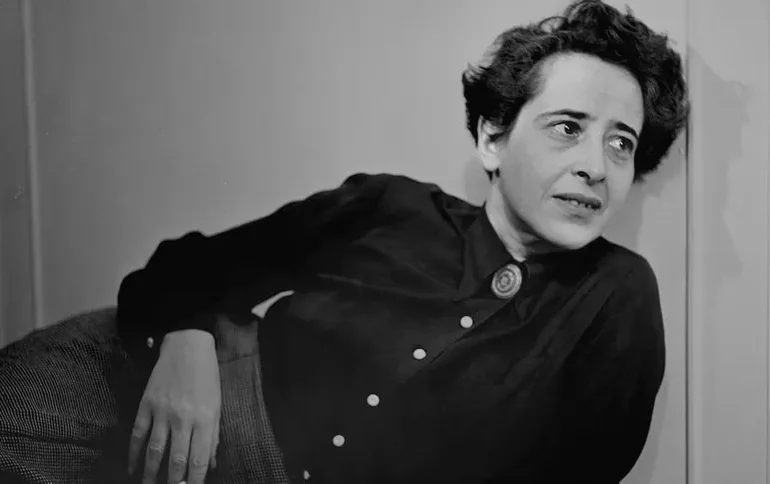
When Adolf Eichmann, Hannah Arendt writes, stood trial, he displayed a chilling indifference towards the crimes he had orchestrated. She observed something more unsettling than fanaticism—absence of thought. An obedient bureaucrat—a thoughtless “cog”—appeared as a normal functionary. He claimed no hatred or grand ideology, for he was merely doing his job, a routine he had become accustomed to. For Ardent this emptiness of thought is what made him the greatest criminal of the 20th century. The architect of the Nazi Final Solution, Eichmann lacked any intentionality or emotions while committing the crimes. This evident lack of hatred and a sense of indifference speaks of the perils of thoughtlessness. It speaks to us of the “banality of evil” that to this day continues to haunt us.


Eichmann had stated in his testimony that he always tried to abide by Immanuel Kant’s categorical imperative. “Act only according to that maxim whereby you can at the time will that it should become a universal law.” Yet Ardent believed Eichmann had failed to recognise the principle of reciprocity and coincided a man’s actions with general law. This stirs a question that moves beyond history. If the idea that categorial imperative demands that one act only on the principles that we would will to be the universal law, what does our passivity and collective silence reveal? What does blind obedience to laws, to authority, speak of?


The modern world is consumed by thoughtlessness. And thoughtlessness does not mean a lack of knowledge. One can be knowledgeable and still be thoughtless, similarly one does not require knowledge to think and speak up against the evils that we humans perpetuate. A thoughtless human, thus, is no better than a fanatic. For Ardent the reductive tendency to equate thought to knowledge has been the root of modernity’s greatest catastrophes. It becomes the failure to reflect, to question and turn ordinary humans into cogs in the machinery of atrocity and equally complacent.


The evils perpetuated by society can be analogised to the narrative of the anime Attack on Titan. The titans—“other” than humans, monstrous creatures—were the cause of violence, of oppression and destruction of humanity, or so it seemed. But as the story unfolded, the evils that were externalised were the cause of the structures that humans had created. The titans became the reflection, a result of the evils that humans possess. However, framing evil as inherent within the human-constructed systems does not absolve individuals of responsibility. In a world that is devoid of empathy, evil can not be defined solely by the acts of violence. The indifference towards human suffering constitutes evil that is banal and ordinary. Evil thrives within our inaction, within our indifference to be moved by the sufferings that are structural and perpetuated through the mechanism of normalisation.


The constraint to our moral reflections and responsibilities, also comes from the phenomenon of Rationalisation, disenchantment, and scientism. Arendt draws on Max Weber to explain this phenomenon. According to her, rationalisation is the domination of human life by impersonal abstractions and structures. This means that rather than inaction, the reorientation of action towards abstract rules without any personal judgement thus leads to subjugation of the personal thought by impersonal and seemingly “objective” order. 


Disenchantment works as the eradicator of definite values. While the modern world thrives with scientific knowledge and the accumulation of facts, it also robs the world of meaning because it essentially displays that nothing exists beyond the phenomena. The scientific world eliminates the possibility of knowing the world from an unscientific mode of understanding. This does not deprive us of freedom directly but makes our freedom devoid of any meaningful orientation. Scientism reinforces this detachment by claiming that everything is already in motion and determined and denies the will and moral agency. Scientism fosters perspectives that are detached from first person analysis and replaces them with third person, perverting the human engagement and undermining the possibility for humans to perceive themselves as agents or perceive value in the world. Collectively these forces lead to a dismissal of reflective thought, strip us of our reactive moral attitudes and create conditions through which humans participate and or tolerate evil.


Democracies today act as the institutions that rationalise the routine procedures, by appearing participatory all while enacting a system of detachment and compliance. Our engagement within our states is structured by the procedural norms, limiting our action. In this sense, the mechanism itself that is to safeguard the agency of the people becomes the site fostering a sense of indifference and passivity as civic ethics.


While people continue to face repression and atrocities, our compliance comes in forms of detachment and passivity. But our survival, the very ability to think and reflect—is not predetermined. Our voices, as we breach through these walls of passivity, challenge the indifference and the banality of evil that exists around us, in us. From Nepal to Bangladesh, to the hope that still stirs within the children in Gaza and Sudan, we as humans possess the capacity to resist indifference, to question structures that perpetuate suffering, to rage against the dehumanisation of our own, to become human again.


Reeba Khan

r[email protected]

Image Credits: Irish Times

DU Beat Print | Volume 19 Issue 06

We are nothing but a collection of anecdotes that crack through the grand historical narratives and subtly place our existence and our identity as a memoir of our lived realities.


Festivals reaffirm a sense of belonging, of threading oneself to a community larger than the self. Anthropologist Victor Turner considers these festivals as anti-structures, that exist out of the regular structure of the society—a time out of time— and the social roles we perform. He believes that when people step out of their ordinary roles, enter the “betwixt and between,” a fleeting sense of oneness, blurring the boundaries and hierarchies, binds the people together. Festivals, thus become the communitas, where we shed ourselves of the ordinary and become a collective.   


Festivals with a touch of spectacle exist in Kashmir as well. Eid, Navroz, Urs gatherings, and all that makes up the communitas. But as I traverse through the conditionality of what and how festivals ought to be, I am reminded of the ordinary. I could talk about festivals and rituals that make up the communitas but the liminality of the ordinary that binds me to my homeland overpowers my sense. What am I if not the speck of ordinary rituals that cloud my memories, that arouse my sense of belonging? Of being one of the many souls that carries the grief and peace of the land I will forever hold close?


The warmth of festivities can never harbour the warmth that emanates from the rituals that are consciously and unconsciously performed during Chillai Kalan. The harshest part of winters in Kashmir consists of three months which is divided into three periods: Chillai Kalan, Chillai Khurd, and Chillai Bache. Chillai Kalan is the 40-day period of harsh winter that begins from December 21st and ends on January 31st. This period is marked by a collective ritual of Kangers, Pherans and hot cups of Nun Chai. Kanger (earthen pot) softens the winters, as it glows with warmth and keeps the chill at bay. After the 40-days of Chillai Kalan, Chillai Khurd (small cold) takes command. Although shorter than Chillai Kalan, it lingers as if winter can not loosen its hold all at once. It is followed by Chillai Bacche (baby cold), which signals the onset of spring and the numbness of harsh winters melting down. The winter period, more than a season, becomes a festival of forbearance, memory, and patience. The unconscious habit of tugging off the sleeve of the pheran, to hold the kanger inside, is a ritual which continues through generations without ever being taught. Memory, thus, does not limit itself to the individual, it is sustained collectively as an archive of remembrance. And these fragmented anecdotes, that are invisibilised under the spectacle of grand festivals, is what we are made of.


Pierre Bourdieu, a French Sociologist, talks about Habitus, in his theory of practice. This is what I link to the rituals that consciously or subconsciously become a part of us and our dispositions. For him, habitus is a “system of continuous and transferable dispositions”. These dispositions are the individual’s positions and tendencies in ways that he thinks, acts, feels, and which are internalised through socialisation. Dispositions are the non-conscious principles that direct practice and even the reactions of individuals. According to him, the dispositions that we acquire during childhood, become our primary habitus and thus last longer and are decisive. This thus means that our bodies unconsciously carry our history, culture and identity. The body becomes the archive of history threading back memories that can never be erased. We become the sites of memory. The ordinary that we live becomes the steward of belonging. Our existence in the ordinary, conscious and unconscious becomes a deliberate attempt to hold on to each other. 


Thus, holding on and carrying these rituals is in no way a passive act. Our collective memory ensures the continuity of collectivities. These memories that we carry through shared rituals and festivals of some sought, might be a recollection of the past but it also a reconstruction of the present. And perhaps, that is the greatest festival of all, one that goes beyond the shimmer of extravagance. It tethers us back to the land that faces the oppression of being rewritten, of erasure. We are just people, a collection of fragments, stitched into the ordinary of everyday life as we find ourselves. 


“To be, or not to be, that is the question” and we choose to be. 


Image Credits: Reeba for DU Beat

Reeba Khan

[email protected] 


Delhi University holds the utopia close, the utopia of a future that thrives even in fractured realities. In cracks of imagination, the consciousness tries to hold ground, the “Not-yet” lingers, waiting to spill the past into the present, yielding the unfinished dreams. The naivete of optimism and the glaring reality of pessimistic thoughts will merge, coming alive with hope of utopia.

The “banking” model of education, Paolo Freire writes, reduces the students to passive recipients of established and sanctioned knowledge, becoming the upholders of truths deposited into them. In such a system they become the collectors who safeguard the accepted ideas, carry them forward and continue the cycle.
This erodes the possibility of invention and reinvention of ideas, as knowledge becomes a gift bestowed upon them by the knowledgeable. This system is accompanied by the projection of an absolute ignorance onto the students, a decisive characteristic of the “ideology of oppression”, one that allows the teacher—the knowledgeable opposite of the ignorant student—to legitimise their existence.

This creates a hierarchy, benefiting those in power as students internalise the hierarchy, abandoning the idea of ever challenging it. They adapt to the world as it is and the disoriented reality deposited onto them. Education thus becomes a form of conformity rather than the liberation of minds and societies. A pedagogy of domestication that is presented as emancipation. This system serves the interest of those in power, of the oppressor—one that has no intent in revealing the world or transforming it. When reforms in education institutions are accepted with credulity, when dissent and debates are treated as threats, and education in itself is commodified, knowledge becomes inert, and hope becomes an indulgence rather than a necessity.

The post-colonial hangover of the nation had kindled a fire of critical understanding, of reasoning and producing knowledge to intervene and transform the system rather than becoming a subdued interpreter of it. It was established on the idea of learning from history, rather than fragmenting it and slowly obliterating it from our consciousness and collective memory.

The glorious institutions were to serve the nation and become the space for reimagining society beyond the colonial traces. So what has changed? Or was it a utopia that could never truly materialise? Were political dissent and criticism of the administration once welcomed but stifled now? Or is it that the opposition exists now in ways it did not before, thus inciting relentless attempts of suppression and surveillance?

While we contemplate the complexities of numerous such possibilities, the anticipation of the “not-yet”—a nation that is still in the making—itches to be scratched. Ernst Bloch, in his work The Principle of Hope, talks about the various manifestations of “not-yet-being”. The not-yet conscience of human and the not-yet becoming of history. He talks about the possibility of the world becoming something and having the tendency, the latency, to something. For him, the world that continues to strive for something is the amalgamation of a utopian intention, the idealistic world. He writes about the kernel of hope, the human spirit that dreams of the utopia, and this dream occupies an important place. However, in the process of talking about the hope of the future, the utopia, he talks nothing of the future. Rather than trying to predict or prefigure the next step, he dives into the past. He insists that even during moments of decay, the utopian impulse will survive. The barriers between past and future can come undone, and the unfinished dreams of the past spill into the present.

“The barriers erected between the future and the past collapse by themselves; the future is not now visible in the past, while the past is avenged and collected as a heritage of the publicised past, and the minnow becomes visible in the future.” He does not try to sink into a contemplation of the past but tries to make the past into a living source for revolutionary action, for a praxis orientated towards the achievement of utopia. He reminds us that history is not sealed but waiting to be reawakened. He defines Marxism as utopia, but it does not insinuate that he denies the scientific character of Marxism. For him, the revolution is inseparable from a unity between reason and hope, sobriety and imagination. Thus, the “cold” and “warm” currents of Marxism need to come together.

The cold, being the rational, analytical critique of existing systems, and the warm, the utopian longing for a transformed world. The “warm current” of Marxism is what Bloch calls “militant optimism”— an “active hope in achieving utopia.” But he distinguishes this optimism from “flat automatic optimistic faith in progress”. For him, the extensive indulgence in false optimism can become the “new opium” of the masses, and thus he insists on the “non-guaranteed character” of utopian hope. As Bloch talks about the ‘Not-yet’ and all the possibilities that exist within the decades of historical moments that have passed, a system that tries in every way to replicate the banking system closes off the ‘Not-yet’ by treating reality as fixed by those in power to do so.

The DU that was envisioned by countless young dreams and the DU that exists presently in all its glory in countless minuscule ways might try to diminish the anticipatory consciousness, the yearning for collective transformation. Yet the resistance, in different forms, cracks through the past and submerges in the present and continues to hold bricks from falling apart.

From the 1970s student protest against the Emergency that met arrests and censorship to the Pinjra Tod movement in 2016 that envisioned gendered freedom on campus, the principle of hope continues to thrive. DU that was before and that is now, in this sense, does not become two different timelines but rather becomes moments in the same unfinished utopian dream. In the suppression and surveillance, this utopia sits quietly between lecture notes, continuing to scream through the protest chants, in hopes that a generation of students will live that utopia. These micro-utopias reflect the insistence that “Not-yet” is alive in action. But how far can it go? If we shed the passivity of thought and idea, what might we dare to dream? What worlds might flow through? Will the oppressed ever dare to intervene and recreate what has been ordained as the reality of time? Can collective amnesia ever be reversed if we don’t dismantle the sanctioned truths? When we act as mere recipients of knowledge and upholders of the status quo, can the utopian impulse truly stretch its reach?

Image Credits: Pinterest

reeba khan

[email protected]

We remember, and we memorialise the grief—for it needs to be heard. Let’s sing and let them hear the voices through words that are hard to digest. In Kashmir, music is art, and it is survival. From MC Kash to Zanaan Wanaan, the weight of memory lives.


Music for me is a memory that connects me to the summers I have spent in Kashmir. But when I think of summer in Kashmir, I am not reminded of the brisk water of the streams we once swam in or the occasional cool breeze that quells the burning heat of the sun. My memories of summer are fogged by visions I struggled to make sense of—blood, bullets and bodies. That year, summer in Kashmir was no different. Protests in Kashmir were high—initially against the killing of three young men in the north-Kashmir town of Machil. However, the worst was yet to come. What unfolded would become one of the bloodiest massacres in Kashmir’s history. Protests had escalated after the killing of 17-year-old Tufail Ahmad Mattoo, struck by a teargas canister fired by the police while returning home from a tuition class on 11 June 2010. In the protest, 118 civilians—mostly young Kashmiris—were killed.

However, the weight of these memories would not be expunged by state power and media narratives—for this time they will be etched in history by sounds of resistance.

In the aftermath of the bloodshed, the tunes of grief vibrated throughout the valley. A young man from the streets of Srinagar inscribed his grief and gave it a voice. Bypassing the curfewed lanes and dodging the piercing gaze of the state watchdogs, MC Kash—Roushan Illahi—wrote his third song—one that was about to become the anthem of Kashmir’s fight for self-determination. This youth, neither an armed rebel nor a stone-pelter was about to distort the neatly crafted violent Islamist stereotype by the states. Being perceived and presented as violent, religious warmongers, the people were demonised by the state narratives, thus robbing them of their political and cultural agency. Protest songs in Kashmiri and Urdu had always been part of the movement; however, the language barrier did not let it traverse beyond the mountains. And then a cultural rebel, MC Kash, came with zero warnings. He became the face of hiphop in Kashmir and sung in the language that would cross oceans. His songs filled the cultural vacuum that was created due to decades-long unrest, voiced the voiceless and drew parallels with the struggle of Palestine.

“I Protest” by M.C. Kash expressed the collective oppositional resistance against the state. The last part of the rap names all the people who were killed that year. I Protest recorded the reality of Kashmir; it memorialised the injustices meted out against the valley.

“We won’t go down. When we bleed alive in the struggle, even the graves will speakA Whole Village Gang-Raped, A Cry Still Lingers These are the Tales From the Dark Side of a Murderous Regime…”

MC Kash started a cultural phenomenon that has been taken forward by numerous Kashmiri artists that emerged in the 21st century amidst the tumultuous situation in Kashmir. These Kashmiri artists have absorbed every circumstance that has been etched in their visions. 

and forged a culture that has enabled them to articulate their deepest feelings, hopes, and dreams. Kashmiri artists could fill their verses with the beauty of Kashmir, but their songs instead talk of grief—for in Kashmir, even the most breathtaking landscapes are shadowed by barbed wires and bloodstained streets.

It is interesting to note that Mridula Sharma, a research scholar at the University of Manchester, talks about the contrast in the Kashmiri protest songs to the commercially produced protest songs in India, like Azadi from Gully Boy. The ending of Azadi dilutes the vision of the song and highlights the hollowness of the interest in claiming freedom as presented by the song. Also worthy to note is that the word Azadi has historically been used during protests in Kashmir and has been the slogan of the Kashmiri Movement. But the protest culture in the mainland has appropriated the word, disassociated it from its political context and sanitised the political struggle for commercial consumption by turning it into a marketable slogan. The song Azadi ends with “Give me Freedom”, rendering the call for freedom symbolic rather than actionable, thus turning it into a passive, consumer-friendly version of dissent.

Kashmiri songs of resistance, even in the wake of brutalities, censorship and state suppression, have approached the art with an optimistic outlook. The songs are mostly enriched with hope, a powerful refusal to succumb to despair over the ongoing violence. An example of such protest songs is Kashmir: Bella Ciao by Zanaan Wanaan (Kashmiri Women Collective). The song, an adaptation of an Italian resistance song, reclaims the linguistic and cultural identity even in the wake of censorship and suppression. It ends with the reassuring claims of martyrdom being successful.


IMAGE CREDITS: kashmirlife.net


Reeba Khan

[email protected]


“No sugar in my chai, please; there is a sweetness to knowing that all empires crumble,” says Ather Zia, a Kashmiri author and professor of anthropology. A palatable sweetness does not settle well on tongues that are accustomed to the salty richness of memory and the uncompromising identity too familiar with the land it belongs to.

While the shimmering pot of boiling Nun-chai sits on the stove, my father leaves in the early hours of dawn to buy some freshly baked Tchot (Kashmiri bread) from the kandur (baker) in the neighbourhood. The savoury warmth, not immediately apparent from its delicate pink colour, relieves the subtle chill of the fading winter. There is something personal about the savoury taste of nun-chai that refuses to be easier to swallow. With every sip, the taste settles somewhere between comfort and awakening. An awakening of the deeply personal connection to the history that has been whispered through the sips of these cups of nun-chai. Served at every occasion, from weddings to funerals, it holds too much of Kashmir. With a little less milk, or a little too much of tyoth (boiled nun-chai sans milk), it tastes bitter. Or maybe it is meant to have a hint of bitterness—not for the fainthearted.

The nightly Sufi gatherings in Kashmir used to be accompanied by the brewing samovar (copper kettle) of nun chai. But with the insurgency and routine of crackdowns and encounters, such occasions became rare in Kashmir. The tumultuous period of the 1990s was also marked by the inability to perform even the simplest acts, like buying tchot from the neighbourhood baker. Purchasing more bread than usual could raise suspicion, an implication of aiding militants. Under the constant threat of raids and invasions, even drinking tea has become an act of resistance.

The tea leaves used in nun-chai don’t grow in Kashmir. The origin of nun-chai in Kashmir can be traced back to Yarkand, in Turkestan, where the Atkan chai is made with salt, milk, and butter. It is also believed that the 14th-century Sufi saint popularly known as Shah-e-Hamdan brought the nun-chai to Kashmir. The Atkan Chai is quite similar to the one made in the Ladakh region, Gur Gur Chai. Even with contested origins, nun chai has been indigenous to Kashmir and a part of the Kashmiri culture predating the tea culture in India that became famous with British colonialism.

Kashmir’s cultural and linguistic identity, as it exists today, has profound ties to Persia and Central Asia. However, within the South Asian and Western academic discourses, conventional Kashmiri studies have been approached from the position of a more skewed narrative of the bilateral dispute between India and Pakistan. This framing has discernibly positioned the Kashmiri movement for self-determination as a proxy war, an interstate conflict between India and Pakistan, rather than a struggle rooted in Kashmiri history, identity, and agency. The dominant modes of knowledge production on Kashmir adopt a very state-centric geopolitical narrative that seeks to make sense of the region from a statist perspective—whether it be India’s, Pakistan’s, China’s, or the United States’. By confining Kashmiri history and culture to South Asia, there is a blatant erasure of other geographies—such as Central Asia and Persia—that have been cardinal to Kashmir’s cultural, linguistic, and aesthetic legacies. Despite its deep-rooted historical and cultural connections, Kashmiri culture, including its culinary habits, has been too restricted to the South Asian context, while Kashmiris themselves draw meaningful parallels with Central Asian heritage.

The erasure of Kashmir’s distinct identity has also been assisted by the commercialisation and rebranding of its important cultural symbols like Pheran, Pashmina, and nun-chai. The Kashmiris that migrated to Punjab and Pakistan during the 18th century took with them their cultural traditions, including nun-chai. Significantly, the preparation of nun-chai within these regions was altered to cater to a sweeter palate, making it unrecognisable to Kashmiris who know that the essence of Nun Chai lies in its saltiness. Thus emerged the name Sheer Chai, or pink tea. Sheer Chai is what has gained prominence in the Indian subcontinent, but only by stripping the historical and political weight carried by it.

This might not seem significant at first glance, as culinary practices naturally adapt to regional tastes. However, when regions are as politically charged as Kashmir, where every cultural and traditional element becomes a symbol of an identity under threat, these critical narratives become essential. The rebranding of nun chai is not just about tea; it is about the gradual omission of Kashmiri culture and the selective commodification of its culture in a way that estranges it from its history and people.

Image Credits: Youtube

Reeba Khan
[email protected]

Han Kang’s literary success uncovers biases in English-dominated translation discourse. While connecting cultures, translation at times marginalizes non-Western authors, as debates over translators’ agency highlight unequal perceptions. Her case underscores the tensions between English’s global literary authority

With the advent of American hegemony and the century that followed, English has conspicuously ridden the high of being inescapable—a language that follows you everywhere, a golden ticket to the magnificence of the world. The (un)official lingua franca that assimilates into the native cultures, seeps into the literature, and infiltrates the native languages. The power and hegemonic control that English holds is so natural, that it almost seems (is) inevitable to distance oneself from its hold. 

In his address to the American Defence Society in 1919, Theodore Roosevelt asserted the importance of English as the only language that has room in America, infusing American nationalism with English and warning against America turning into a “polyglot boarding house.” However, as it turned out, rather than English being threatened by foreign languages, over a century, the foreign (native) languages are at the risk of being lost in the global paramountcy of English. 

The force of English is such that everyone has jumped on the bandwagon to adopt English as their own. Tim Parks, a writer and translator, argued that the European nations are anxious that the adoption of English words in their languages may be seriously reshaping their language. Scientific papers are being written in English, which also results in some concepts being difficult to express in the vernacular. The European novels are not only assimilating the English style but are also constructed such that they are easily digestible in an anglophone context. 

After Han Kang, a South Korean writer, won the Nobel Prize for literature in 2024 and became the first female writer from Asia to achieve this feat, accolades followed her English translator among the Anglophone readers of the work. The frenzied discussion on the role of translation that followed her win is quite fascinating. Translation definitely is an art in itself that has allowed communication across communities and paved the way to “discover” different literary works and acknowledge the intellectual and artistic profoundness those works hold. The growing culture among translators to create a space for their art might come with the stance that they hold possession of a huge part of the source author’s work. And, with the historical impact that the English language has had on literature, the English translation, for better or for worse, being pronounced as the breakthrough for the literary work, might create a sense of disassociation for the source authors with their text and the text from its original circumstance. 

 After “The Vegetarian” won the Man Booker Prize in 2016,  Debora Smith, the British translator of the work came under fire in Korea for “poorly” translating the work. People pointed out the inconsistencies within the translation. The charges that followed mostly stemmed from what Smith added to the original text rather than what she omitted. Smith, according to critics, created a whole different body of work. It is also interesting to notice that when Jon Fosse, a Norwegian Writer, or Annie Ernaux, a French writer won the 2023 and 2022 Nobel Prize in Literature, respectively, the discussion around the translators was not as profound as it is in the case of Han Kang. Also, when Mo Yan, a Chinese writer, won the Nobel Prize in 2012 accusations were levied against his Swedish translator and an academy member for fixing the Nobel Prize which they heavily benefited from.

Both instances can be seen as two sides of the same coin, creating a conscious yet unconscious sentiment that Asian (Orientalist) writers cannot hold agency over their art—a perception that is not extended to European writers.

The dominance of English as a global lingua franca has undeniably shaped the way literature is created, consumed, and valued. Translation, while connecting cultures and expanding the literary horizons, has also brought into question the agency of non-Western writers over their works. The intricate connection between language, power, and cultural narratives reveals a glaring disparity in how Asian and European writers are perceived in the literary world.

Read Also: Educational Institutions: Secular or Saffron?

Image Credits: The New York Times

Reeba Khan

[email protected]