Tag

Delhi University

Browsing

Literathon is a cross country event being launched by INDIAreads Online Library and Bookstore to promote the habit of reading among students through greater engagement with books and authors. It has been conceptualized to make not just books, but even their writers more accessible. The idea is to provide students with an opportunity to listen to their favourite authors, quiz them about their best-selling titles, discuss strategies, ideas and debate upon current issues. Every Literathon will consist of a series of events ranging from talks, creative writing workshops and interactive sessions to book launches, book reading sessions and book bazaars. There will be a host of online and on the spot competitions to enable students to interact with fellow book lovers and to discuss and debate upon their favourite and not so favourite works.

The Inaugural event of the Literathon, co-hosted with the Delhi School of Economics, will be held at the Conference Hall, Delhi University on July 28, 2012. Best-selling author Rashmi Bansal (of the Stay Hungry Stay Foolish fame) will share the secrets of entrepreneurship along with international management consultant Deepak Gandhi. Padma awardee and Planning Commission member Syeda Hameed will join her co-author Gunjan Veda for an interactive session on Youth as agents of Change. The two will also read from their new book, Beautiful Country: Stories from Another India which was recently released by Dr. Montek Singh Ahluwalia.

The highlight of the event is the launch of Bansal’s new book Poor Little Rich Slum, which she has co-authored with Deepak Gandhi. All the four authors will be available for signing books after their talks.

The event will also see an all-day Book Bazaar with exclusive discounts and various on-the-spot competitions like Tag-It (find a tag line) and a photo contest called Pic-a-Caption as a run up to the event and will soon be followed by other competitions including a quiz.


You could follow this link for more details, http://www.facebook.com/?ref=logo#!/Literathon

As the new batch of students started attending college from today, the 23rd of July, Delhi University has gone all out to enforce stringent anti-ragging measures, hoping to continue with the success of last year’s efforts when no ragging incidents were reported.

The DU website already declares its ‘Zero Tolerance to Ragging’ with posters informing students that ragging is strictly prohibited in all college, department and hostel premises. It also includes instructions on the Ragging Complaint Mechanism and the Anti-Ragging Helpline Number. Such posters have also been put up in metro stations. As per the University guidelines all colleges have set up individual Anti Ragging Cells and Squads to control and prevent such activities within the institutions.

The Delhi Police is also doinge their bit. Constables have been appointed outside colleges and specific metro stations to ensure ragging doesn’t take place even outside the campuses. Special attention has also been paid to colleges for girls, near which women cops will be stationed.

These measures are in addition to existing rules such as not allowing guests to stay at the hostels for the initial weeks, permitting students to enter their college only with Identity Cards and displaying anti ragging banners within the campus.

The University Grants Commission’s Regulations on curbing the menace of ragging include a long list of acts that constitute ragging. It includes any form of bullying, trauma, violence, abuse or embarrassment that may affect a student physically, sexually, mentally, emotionally or financially. The penalties for such activities have also clearly been mentioned. They include suspension, expulsion and cancellation of degree. In the year 2009 two students from Kirorimal College were expelled for ragging a junior, and a Mathematics student of Ramjas College was expelled last year.

Hoping to encourage healthy relations between seniors and juniors, many colleges are also organising induction programs during the initial days of the session.  It is an opportunity for freshers to talk to their seniors about the college, course and faculty.  A lot of freshers feel that such interactions are crucial in college life and most don’t consider ragging a problem unless taken too far.  “Unless it’s extreme, ragging is just light hearted fun. If the seniors stay within the limit, I don’t think it’s too serious an issue “, said a fuccha for English Honours at Kamala Nehru College.

As is evident, Delhi University is leaving no stone unturned to ensure that students remain safe and protected and so that they can start their first few days on a happy note.


So you have made it to one of the colleges in North Campus and now you’re wondering what is beyond the big names and the college crowds in the place. You, dear fresher, don’t really have to worry about it at all. As awesome the crowds and colleges would be, you’ll just fall in love with North Campus and its little places. Here are some of the places you just *have* to check out this semester Kamla Nagar: Kamla Nagar is almost synonymous with the student crowds that throng it regardless they attend college or not. From McDonald’s to KFC’s to CCD’s to momo shops…you find it all! (Not a Pizza Hut though, unfortunately) Check out the latest trends in the Levi’s to Tommy Hilfiger’s in Kamla Nagar or just the cool street-side shopping experience. If you are a bookworm, you can easily sneak in an hour or two in the bookshops which have some good literary titles. If you are a party animal, check out ‘Wildfire’. Or maybe you are someone who loves to enjoy solitude. Well, then you can always sit in the chairs they put up near Barista Lavazza while the noise makers go to Malkaganj. ‘The Ridge’: Now if you don’t know what ‘The Ridge’ is, you will know soon enough. It is quiet, very green and clean too. Far from the crowds, here you can watch some playful monkeys, and cool off after the classes are over. Chances are you will end up watching animals while you jog! Arts Fac: Though it is generally a place where people go for their official work plus postgrad classes, the Arts Faculty, or popularly Arts Fac, is one of the most under-rated spots to hang out in the North Campus. Sit in the lawns, read, eat, watch people argue and then you can always take a walk around the campus that just inspires a calming effect on you. Also, you can have some Mishti Doi from the Mother Dairy stall just outside. D-School: Delhi School of Economics, fondly known as D-School is one of the best places to read, have cheap good food and listen to some old pensioners discuss the political affairs of the nation (loudly) in the evening. The J.P. Tea Stall is another feature in the D-School campus where most people can be found when they have nowhere to go. The Metro Station: Let’s face it north campus is cool because it has its own metro station. That, again, is nothing less than a hangout spot for students. You can find food, crowd, trees and a place to sit and talk with friends. Apart from these places, notable omissions from this list are Uncle Tom’s Maggie and the different college canteens because you will find Maggie everywhere in the campus. With this list of hangout places, this semester will certainly be a breeze for you; they just get cooler with time!   Priyam Goswami [email protected]]]>

‘After two years of disappointment, justice had finally been done to the brand name Venky is’. This was the general opinion after Nexus 2012, the annual cultural festival of Sri Venkateswara College came to an end. This year’s event stood out in a number of aspects from its previous arrangements, having 5 professional shows being just one of them.

From a spectator’s point of view, the three days were certainly eventful. I list the 10 things you couldn’t have missed at Nexus 2012:

Rangoli competition


  1. The Rangoli’s. Every other fest is marked by a beautiful Rangoli to greet the participants, and Nexus 2012 was no different. Made at the centre of the foyer, it made for a pretty sighting. So much so that not even a single person stepped over it, careful of not disturbing its beauty.
  2. Celebrating Delhi’s 100 years. A number of events showcased this year’s theme of celebrating Delhi’s 100 years as capital of India. Upon entering the college, you could see a cutout of the Lotus temple placed in front of the entrance. Apart from that, the Rangoli competition, Collage making among others incorporated the same.
  3. The photographs, which were pinned to the walls in front of the seminar hall, in the lobby, in the foyer, almost everywhere were a hit with the audience as well.
  4. Security. After the hap hazard handling of the audience during Celeb nights the previous year, the security handled the situation very well this time round. Though at one point of time the Delhi Police authorities did not allow anyone to enter the college including the participants. What followed were the typical Dilliwallah dialogues – ‘Sir, organizing authority mein hun mai, XYZ se puch lo aap’, ‘ Bhai gate pe hun, entry karwa de meri’ among others.
  5. The organizers. Dressed in their suits running from one end to another with a walkie-talkie in their hand, responding to the numerous requests from sponsors, celebrities and the participants.
  6. The impromptu b-boying to some videshi numbers was a huge crowd puller. The back spin, turtles, hand glide, six steps were among the various moves these performers pulled out of their magic hat. You can find the video on DU Beat’s facebook page.
  7. Even though Parikrama rocked, strangely enough there were seats deployed for a ‘concert’, and the audience was supposed to be sitting during numbers like Highway to Hell and But it Rained. While the audience in the front often got up, some cranky fellows sitting at the back who had apparently come for a movie started cribbing. One of them even said – ‘Baith jaoo oyee, warna aag laga dunga sab mein’. He was with a girl, so the crowd let it be.
  8. The rattled expressions on your face when you were thoroughly stumped by the questions in the Delhi Quiz, wondering if you have been living in a parallel universe for the past 12 years.
  9. Razzmatazz, the western dance competition was marked by a few technical stoppages, but kudos to the teams which kept on performing even with minimal sound and were rightfully cheered on by an appreciating audience.
  10. Finally, after the enthralling performances by Parikrama and Advaita, next was the turn of Shibani Kashyap. But, even her ‘Sajnaaaaa ‘performance could not match up to the levels set by the two bands. If this was not enough, a shimmering dress and a pointless Guitar prop did not help her case, entertaining none the less.


Shashank Gupta

In another act of right-wing protestation, members of the ABVP and BSKS threatened to disrupt the screening of Jashn-e-Azadi, a documentary on Kashmir earlier this Thursday over its alleged delineation of a pro Kashmir independence sentiment. The screening was organised by the Delhi School of Economics’ Sociology department.

In previous incidents, Pune’s Symbiosis University cancelled the screening of the film after protests from the RSS-aligned Akhil Bharatiya Vidyarthi Parishad. ABVP even protested the teaching of the Ramanujan text in 2008 by vandalizing the office of Prof. S.Z.H.Jafri, the then history department head. The Bhagat Singh Kranti Sena (BSKS), infamous for one of its members attacking Prashant Bhushan over his statement on Jammu and Kashmir, tweeted “Bhagat Singh Kranti Sena & other Nationalist’s Groups will stop today Sanjay Kak’s Jashn-e-Azadi (anti Army & pro Kashmir azadi movie) screening at Delhi School of Economics, DU(sic).”

Rohit Chahal, Pradesh Mantri of ABVP Delhi, who was incarcerated temporarily in 2008 for his involvement in the violence outside Prof. S.Z.H. Jafri’s office in protest of the teaching of the Ramanujan text said, “The permission for the movie screening was cancelled by the University, also Jashn-e-Azadi hasn’t even got clearance from the Censor Board, so how can they show it. The movie hurts regional sentiments, depicts the Army to be responsible for the tribulations in Kashmir”

Denying reports of any ABVP protesters barging into the screening and breaking the police cordon, he further went on to say, “The police allowed us to go in. There were ABVP members who were already inside and we peacefully protested in the campus. We would have anyway been permitted to go in as the screening was organised by the All India Students’ Association”

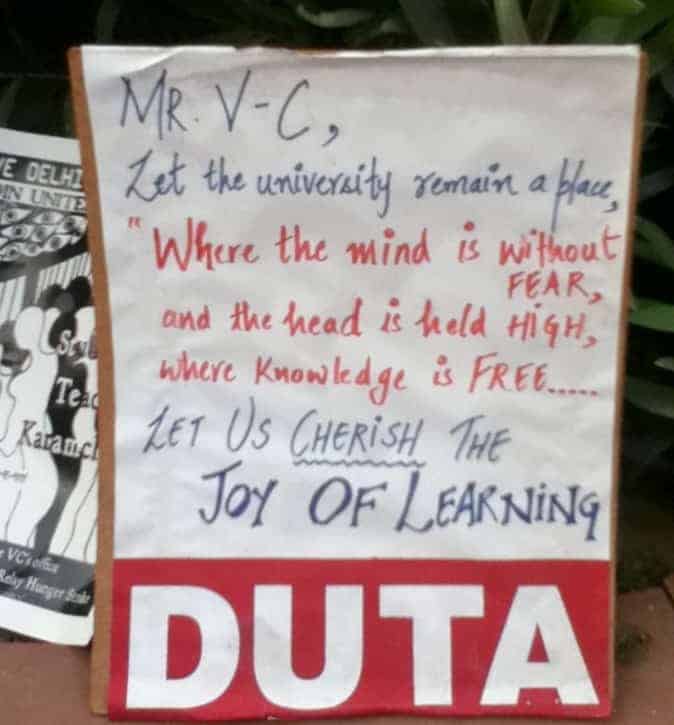
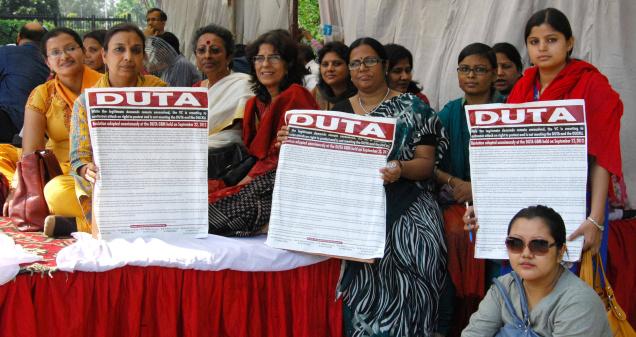
The Delhi University Teachers’ Association staged a protest in LSR today. They were protesting against the idea of establishing a Meta University floated by the VC, and of a four-year undergraduate programme, through the media, without placing the proposal before the Academic and Executive Councils for proper evaluation of the desirability or feasibility of such policy changes. Teachers from various DU colleges gathered outside the college cafeteria handing out pamphlets to get the support of students.

While the teachers are still upset over the recently introduced semester system and its effects on students as well as teachers, they feel this new proposal is despotic  and undemocratic.

In their written appeal to students, DUTA says that, “The experience of semesterized courses in the last one and a half years has confirmed our worst fears about severe academic dilution and adverse effect on teaching processes. Teachers are being forced to instruct students through modules that do not allow the time to engage with different levels of competence of different students, nor do these modules allow teachers to communicate a sense of fundamentals and depth of any academic discipline. To cloak the disastrous impact of semesterisation on the performance of students, the DU administration has resorted to irrational inflation of marks which has put a question mark on the credibility of our results which will result in devaluing our degree.”

Teachers already had been feeling undervalued as their opinions and protests were not taken into consideration during the finalizing of the University’s decision to semesterize undergraduate courses. According to Ms. Vijaya Venkatraman, who teaches Spanish at the GRS faculty of arts, “The semesterisation process saw the abolishment of democratic functioning in DU. DUTA protested but  no one paid heed, and just as we had feared, semester system led to simplification of exams and inflation of marks. Our second year students are worried that they wont be able to survive the competition in the job sector, which is like a blot on our reputation. The VC has decided to add this sudden ‘grandeur’ to the University without even taking the collective opinion of teachers.  We, as professionals, are sad that we can no longer operate our teaching the way we want to, which is why we want students on get on board with us for our cause.”

The teachers’ collective is demanding expansion of Government funding in higher education to meet the growing demand for the same. It is also resisting large-scale commercialization of higher education, as they believe that the role of education is to strengthen social and national integration of the country.

You can read DUTA’s charter of demands at: http://gaurnaveen.files.wordpress.com/2012/01/draft_charter-of-demands.pdf


According to Abha Dev Habib, of the DUTA, the “once so called ‘reform’ forced on the teaching community at the behest of the MHRD, the semester system at the undergraduate level has been categorically and unequivocally rejected by the teachers. The experience of semesterized courses in the last one and half years has confirmed our worst fears about severe academic dilution and adverse effect on teaching-processes and co-curricular activities. This has crippled the intellectual, cultural-emotional and holistic growth of students. The worst affected are students from disadvantaged backgrounds.”

It is being believed that to cloak the disastrous impact of semesterization on the performance of students, the DU administration has resorted to irrational inflation of marks which has put a question mark on the credibility of our results and will result in devaluing of the degree. The new moderation formula has worked against all students thus having the teachers at DU exercised over this marks scam.

The marks scam has purportedly happened at three levels:

(i) Meetings were held in many Departments to unofficially decide a reduced syllabus for setting exam papers. The question papers were made as easy, the format of the exam papers was changed giving students maximum chance.

(ii) The examiners were instructed to mark leniently.

(iii) The last straw on camel’s back was to moderate all marks by the same token. Earlier moderation was case-wise. This time, blanket moderation was done, without a prior and proper tabulation of results, and analysis of the same.

Nandita Narian of the Maths Department at St. Stephen’s College, who was also an examiner, tells how earlier in the meeting in the Maths Department, the syllabi were unofficially reduced and later there was imminent pressure from the DU Exam Branch to mark students leniently.

The proposal to semesterize the postgraduate courses was passed in Academic Council meeting of February 2008 and the decision was implemented from July 2009. The results of postgraduate courses, which have not been tampered by the DU administration to that extent, reconfirm the opinion that the semester system works against the inclusion policies. The failure rate has increased in the postgraduate Departments as students with disadvantaged backgrounds fail to cope in the semester system.

These issues have also been highlighted in the Memorandum of Protest by the examiners of the History department who have written to Dr. Jaggi, the Controller of Examinations saying that this “ we protest against this un- academic way of moderating results that has diluted academic standards and has made a mockery of the evaluation process undertaken seriously and sincerely by us.” and the memo was signed by 14 examiners of the same department.

Click on the following links for more information

Moderation Patterns in DU Final Exams– By Abha Dev Habib

Memorandum of Protest _History


Ensuing soon after the declaration of the Semester 1 results by Delhi University for their course, was the row over the preternaturally high scores that the students had managed to achieve this time around, raising question marks over the veracity of these scores and their value.

In a recent development, teachers from the Department of Economics and the Department of Germanic and Romance studies have filed protests in the office of the Controller of Examinations against these apparently bloated results. The results in the Economics (H) exam went up to as high as 99% and in the Germanic and Romance studies exams to 96.6% and 86.6% in the respective papers

“We strongly protest against this un-academic way of moderating results that has diluted academic standards and has made a mockery of the evaluation process undertaken seriously and sincerely by us,” the letter reads.

These reports have been confirmed by Saikat Ghosh, DUTA Executive Member who goes onto explain that the crux of the problem with these results lies that they have been moderated to such an extent that they have not been deemed correct and thus is in fact detrimental to the faith placed in the result evaluation procedure of DU.

He expounds that usually, the moderation as a process is a meticulous and intricate one, which involves the tabulation of marks in the primary step of the evaluation ladder which is followed up with identification of the ‘border- line’ cases. Once the red- ink separates these results from the hordes of the other scores, the marks that these particular exam- takers had secured in their Internal Assessments is taken into account and if the student is found worthy of a couple or more of grace marks, then they do get added on to his or her result. It is not a blanket formula, applied to all and sundry, something that the results this semester end seem to contradict. Also the principle for moderation has to be adopted by the Academic Council of the University of Delhi and only then is credence accorded to it.

As Mr. Ghosh informs us, the issue with the moderations this time has been that the tabulation had never been done and the teachers seem to have been told to moderate results freely by the Controller of Examinations, Dr. Jaggi, who in turn has passed the buck onto the Vice- Chancellor saying that the order had indeed come from higher quarters. “We have ample reason to believe that the results have been fudged” asserts Mr. Ghosh.

The DUTA has demanded an impartial probe into this matter and will adopt a resolution regarding the same in its General Body meeting on 31 January, 2012.


Post graduate students of MA/MSc Mathematics and BSc Physical and Life Sciences held a demonstration outside the VC’s office earlier this Friday to protest the irregular conduct of classes and push for an inquiry into the semester results. They alleged that a faculty member teaching ‘Measure Theory and Integration’, had been absent since the start of the current semester and that the students had already lost three weeks. The students also conveyed that their seniors had also suffered because of the same teacher in the last semester.

“The department is yet to take any steps”, Prof. Bal Kishan Das, the HOD of Mathematics of Delhi University was quoted saying. “The issue is on record of the university and they are looking into the matter. The department heads can only report things to the university, they can’t take any further steps.

“The department is conscious of the students’ requirements and demands. I had personally assured the students that they will not have to suffer. But they seem to have lost their cool.”

On asking the reason why the teacher hasn’t turned up 3 weeks into the semester, he said, “The teacher seems to be having some issues with the department. But I had mentioned this earlier as well that these things should be sought out as a different issue altogether”

Everybody is supposed to perform their specific duties, which they are, except for this particular teacher. Every time the issue was brought to notice, the department took cognizance of the situation and came out with a solution. There was a little gap, yes. But ultimately something was done to fix the problem.”

Another protest outside the VC’s office saw a strength of around 200 students of the third semester of BSc Physical and Life Sciences. The students demanded an inquiry into the semester results where 73% of the students had not cleared the exam. The students were accompanied by the DUSU President, Ajay Chhikara.

“The result has been extremely poor. Only 22-23% of the students have passed. And what is surprising is, that the students whose results showed that they had passed till morning, the website suddenly showed them as ‘failed’ by the night. This clearly goes to show that the results have been regulated. Therefore, we are protesting against this”, said Ajay Chhikara.

He further said, “The same problem had occurred last few times as well, with this very course. The syllabus is quite heavy and has not been moderated according to the semester system. I also feel that more importance and priority was given to the first semester results as the university wanted to show the success of the new ‘semester system’. And because of this the second years have been neglected, which can have a heavy impact on their futures.”