Tag

Delhi University

Browsing

Juxtapose, DUbeat weekly wits

Graphic Credits: Gurman Bhatia

Dance Society or the Dramatics Society? Two of the most prominent and active societies of Delhi University colleges. Today Juxtapose gives you an opportunity to pick your favourite and reason it out with the opponents.

So hit the link and get started!

Remember the time when one weekend in a month (or two) neared like impending doom? Remember the circulars, placidly inviting all the dear parents for a “healthy” interaction with the teachers, about how their children were doing at school? I remember dying a little bit inside every time we got one of those. I also remember trudging along nervously, as I would lead my parents up the stairs, to the dark chambers of classrooms and staff-rooms where the teachers waited for the next victim to be slaughtered, while a friend would pass by with a throat-slitting signal and a whispered “yaar aaj to lag gai.” I remember sitting there awkwardly, being talked about in grave tones of concern like I wasn’t even there, having everything from my marks, habits, activities, uniform and even my friends being discussed and dissected. I wasn’t that bad a student, so I would alternate between taking my mom to the teachers who would praise me and those who were sure to land me a lecture on the way back.

Come college, I thought all that was over. But now after I’ve settled down into the comfortable routine of doing things my way, without having to worry about having my activities discussed later, DU decides to burst my bubble. Delhi University’s reported proposal to form a parents’ coordination committee sounds to me like taking a huge leap backwards in the process of student development. What has been supposedly proposed for better administration and policy making seems like not just another way to poke moral reprobation on students’ campus activities, but also as destroying the fundamental difference between college and school life.

When you become a college kid, you’re suddenly in a zone where you’re the only one looking out for yourself. There’s no one you’re really accountable to, be it about your attendance, your studies or the kind of friends you make. Your choices are your own and you’re the one who has to face the consequences. College is also probably the time when most of us learn to become responsible and somewhat independent, be it paying the fee (which I’ve experienced by now to be an extremely harrying process in DU), filling the forms on time or maintaining your attendance and proxies to be able to scrape through and give the exams. Part of the vibrancy and culture of college, which distinguishes it from school, is that when we’re dissatisfied, we can raise our voices because we know what we say counts, and the administration is accountable to US. If parents are going to be introduced in the college scene, for more “accountability” towards the students, what are the students going to do? We’re adults now, we hardly need parents as mediators. But I guess by the end of the year we might be seeing parents hawking around campus and parent-teacher meetings being held, in a back-to-school atmosphere where all that college will be left signifying would be a lack of uniforms.

One lovable thing about Delhi is that it belongs to one and all.  It is a delightful mixed bag of all cultures. It is perhaps one of the only cities where you’ll probably find a Bengali, a Gujarati, a South Indian, an Assamese, and a Bihari – all sitting on one table. Similarly enough Delhi University has its wings spread out in all directions, people from all over the country aspire to graduate from DU.

Over the years, DU has managed to create its very own set of regional stereotypes. Why does one have to be a “bong” a “gujju” a “mallu” a “bhaiyya” or a “chink”? A sense of ‘otherisation’ trickles in with the casual labelling people do to those who aren’t from Delhi. There is absolutely no reason why we should reduce ourselves and others to our regional identities.

If you’re from anywhere outside Delhi, you’re expected to know everything from the language to the myths, the fluency, the music, the dance, the recipes and even the soil type. The stereotype goes like this- if you’re a Bengali, you’re supposed to know all about Satyajit Ray and Tagore, you’re supposed to know which halvai sells the best and most authentic mishti doi and sondes, you’re expected to know ten different ways of frying fish; if you’re a south Indian, you’re expected to know all the dances, you’re expected to pick out the best kanjiverem silk by its texture, you’re expected to know how to fry dosas; if you’re a Kashmiri, you’re expected to be romantic, poetic, and (ridiculous as it may sound) even pretty; and if you’re from the northeast, then you’re expected to love momos and know all about tattoos and piercings  and affordable fashion.

It is considered unnatural for someone from Haryana to be anything but rowdy, just like it is considered natural for jaats to be the gundaraaj of the ilaaqa. The “Delhi Boy” memes would probably explain better. There are “tips” for each region as well, be it “Bongtips” “Rajasthan tips” or “Delhitips”. Sadly enough, the generation of iPods has adopted the trend of categorisation, which has further led to regional stereotyping.

Perhaps regional jokes, region-wise tips, memes, etc don’t mean much harm, but somewhere in the middle of all the casual labelling, the jokes, the general assumptions, etc have smudged the thin line between assertion of one’s regional identity, and limiting oneself to it. Somewhere in the midst of all this, we are forgetting one very important fact-that anyone can do anything, or be anything.

The English Department of Lady Shri Ram College for Women organised a talk by the much-acclaimed author, William Dalrymple, on 27th September. The excitement was palpable in the room overflowing with students as they eagerly awaited the arrival of the author for a talk on Travel writing. Others stood at a Penguin Publishers stall outside, buying his books in the hope of getting a signed copy from him.

William Dalrymple was greeted with hearty and enthusiastic applause as soon as he stepped into the room, slightly flustered and out of breath. The talk proceeded smoothly as everyone listened in rapt attention to his elaboration on the significance of Travel Writing and its relevance in today’s time. This was followed by the author reading a couple of excerpts from his books such as City of Djinns, based on Delhi and his most recent novel Nine Lives, a book about nine individuals on their path towards spirituality and salvation. He also read out a couple of paragraphs from his current favourite Travel book titled The Wild Places, by Robert Macfarlane.

With a great sense of humour coupled with an equally wonderful portrayal of sensitivity, Dalrymple managed to capture the imagination of every person sitting in the room. “Thank you Sir, we felt like we were travelling with you and experiencing your adventures first hand as you narrated them to us,” was one such heartfelt comment from the audience. A busy round of question and answer followed the talk, where students and staff members quizzed him on varied topics such as his inspirations, the language barrier, stereotypes present in various cultures, until there was absolutely no time left to answer more queries. The two hours ended with hoards of students rushing towards his table as he signed personal copies of his books. The talk succeeded in leaving its audience with a sense of wanderlust after William Dalrymple’s vivid descriptions and poetic narration.

Image source: The Hindu

]]>

The English department of DU has recently been ranked among the top 100 places to study english, by the QS World University Rankings. Ranked in the 51-100 group in QS’s annual survey, DU happens to be in the same league as Durham University, Dartmouth University, Pennsylvania State University, University of Sussex and the like, having beaten the likes of Nottingham and Purdue.

The English departments of three other Indian Universities, namely JNU, University of Calcutta and University of Hyderabad, also made the list, but, unlike DU, they were ranked in the 151-200 rank group. Other institutions of higher education seem to have failed to make a mark and were missing from the top 200 in overall university rankings. the QS World University Rankings is one of the three most influential and widely recognized international university rankings, apart from the Times Higher Education World University Rankings and the Academic Ranking of World Universities.

MA students are thrilled and have been glowing with pride over the news. “It is definitely a high for us students, also considering that no other Indian institute features that high in the list. Our department professors truly deserve the credit for this, specially for their research inputs.” says Kritika Mathur, a student pursuing her masters in english at DU.   Graphic credits: Sahil Jain]]>

The English department of DU has recently been ranked among the top 100 places to study english, by the QS World University Rankings. Ranked in the 51-100 group in QS’s annual survey, DU happens to be in the same league as Durham University, Dartmouth University, Pennsylvania State University, University of Sussex and the like, having beaten the likes of Nottingham and Purdue.

The English departments of three other Indian Universities, namely JNU, University of Calcutta and University of Hyderabad, also made the list, but, unlike DU, they were ranked in the 151-200 rank group. Other institutions of higher education seem to have failed to make a mark and were missing from the top 200 in overall university rankings. the QS World University Rankings is one of the three most influential and widely recognized international university rankings, apart from the Times Higher Education World University Rankings and the Academic Ranking of World Universities.

MA students are thrilled and have been glowing with pride over the news. “It is definitely a high for us students, also considering that no other Indian institute features that high in the list. Our department professors truly deserve the credit for this, specially for their research inputs.” says Kritika Mathur, a student pursuing her masters in english at DU.


Graphic credits: Sahil Jain

Last month, the court had issued a notice to DU authorities after a PIL was filed by the Indian Council of Legal Aid and Advice, seeking to introduce a biometric system to register the attendance of lecturers and other teaching staff of the university. The PIL said that the attendance system should be introduced to ensure that a teacher “adheres to the teaching hours and days prescribed by the UGC and the university rules”. As per the UGC norms, the workload of teachers should not be less than 40 hours a week for 180 teaching days, apart from being available for at least five hours daily in the college. The working hours actually put in by a lecturer in Delhi University daily are just about three and half hours per day currently.

The affidavit filed by the registrar said: “The University of Delhi is committed to adopt and implement measures which are favourable and beneficial to the university system as a whole, such as the biometric system of attendance for its teachers in order to ensure their presence in colleges and ensure the participation of all teachers in the teaching/learning process.” Emphasising on the perquisites of teachers the affidavit read, “The teachers after the implementation of sixth pay commission have lucrative pay packets and are expected to fully justify the trust and confidence reposed by the society on them by working tirelessly for the betterment of the taught so as to prepare them for facing the challenges of life with confidence and knowledge.” The plea also stated that it seemed that the university was not implementing the biometric system under pressure from teachers’ unions. The university had tried to introduce the system in 2009, but had to hastily withdraw the order after Delhi University Teacher’s Association (DUTA) went on strike in protest.

This time around however, Delhi University has assured the Delhi High Court that it would adopt and implement the biometric attendance system for teachers to ensure punctuality. Following the assurance, the court disposed of the plea saying, “On the assurance given by the university, the court hopes and expects that biometric system of attendance would be introduced expeditiously.” The teachers are not expected to stall the move, which is aimed at uplifting the standards of teaching facilities.


Sakshi Gupta
[email protected] 


If Mr. Dinesh Singh were a Pokémon, he would surely be from the same family as the cumbersome and exponentially lazy Slowpoke. Like his far cuter counterpart, the Vice Chancellor of Delhi University took a while to wake up and realize that he was digging his own grave by not paying heed to any of the furious questions hurtled at him by the agitated youth studying in the capital. With issues such as safety, accommodation, and elections hanging by an incredibly thin thread, Dinesh Singh finally took matters into his own, highly slippery hands and addressed the students on 1st September.

If replying to tricky questions was an art, none could have been better than our beloved Vice Chancellor. Every controversial question was tackled with a diplomatic smile and a not-so-subtle subject change. Since safety was of utmost importance, girls were promised a hostel with free travel facilities as well as the installation of CCTV’s all around the campus. Looks like programmes such as Big Boss are not enough to satisfy the TRP-hungry show producers and their equally bored audience. Next in line is a peek into the lives of the young and frustrated DU Students.

With some great ideas in the pipeline, such as mobile canteens and easy access to Wi-Fi, it is quite a shame that this pipe is similar to Delhi’s sewage line constructed during the colonial times; untouched and never to be modified. Dinesh Singh was obviously daydreaming when he announced that disabled-friendly modes of transport would be provided in the form of DTCs and Metros, forgetting that the college campus itself would still be a nightmare for those facing difficulties. He also seems to have taken Dalrymple’s description of Delhi as the city of Djinns quite seriously, with his strong belief in an invisible hostel that has already been magically constructed for girls in South Campus, in a location that shows it is still clearly under-construction.

If I were bestowed with the honor of being made the Vice Chancellor of DU, I would dye my hair and get a face-lift to make sure my dynamic audience has its eyes glued on me instead of snoring at the back. Then the words that come out all airbrushed from my lips might as well be ignored. While mentioning the proposition that the football teams in DU would be getting a special training in New Zealand, I wouldn’t add the extra advantage being offered to the women’s soccer team being sent free of cost. This hidden information exists for the sole reason that, brilliant though the opportunity sounds, Dinesh Singh conveniently forgot to mention that the facilities for women’s soccer are relatively new and still under development in many colleges. So unless there was a secret agreement between New Zealand and India regarding the exchange of their excess population of sheep in return for female textile workers disguised in soccer cleats and sweat absorbing shorts, It is hard to see how this would boost the morale of rising sport stars without motivating them to train first.

My humble request to our Vice Chancellor would be for him to invest in an expensive hearing aid, so that his ears don’t fail him when questions regarding various important issues are shot at him. However, if I were in his place I would definitely arm myself with a shield, just in case one well-aimed arrow leaves me struggling to form coherent sentences.


Words just don’t do justice to the colourful and vivacious spectacle of the youth carnival, which saw visitors arrive in droves to join the cultural extravaganza organised by AIESEC in collaboration with RC Cola on September 1st.

The pinnacle of the event was the GLOBAL VILLAGE; an international carnival where Foreign graduates and post graduates from the AIESEC fraternity of about 110 countries and 2100 Universities expressed themselves.

“This kind of interaction and cultural exchange is be a step in the right direction. AIESEC should be congratulated on organising this and I would also like the interns who have come to our country to experience the diversity of our culture”, said a fresher.

The carnival kicked off with some really innovative and fun filled activities like battle of bands, AIESEC artist’s day, hog-athon and floor canvas. The fashion parade was all glam and glitter for onlookers with participants donning costumes from across the world. Budding artists who consider graffiti a powerful tool of expression, spray-painted to their hearts’ content in the graffiti wall session. The street play was received with much enthusiasm by the audience as the artists splendidly put forth a social message through their sharp dialogues and brilliant acting. Following this, Jasleen Royal’s impromptu performance made everyone sing along with her.

They had definitely saved the best for the last as Parikrama brought the house down with its vibrant signature music. It was truly a carnival that celebrated youth.

-Sakshi Gupta


It’s election time again and all Delhi University political parties are coming out of hibernation. They really wanted to make a mark and what a way they chose.

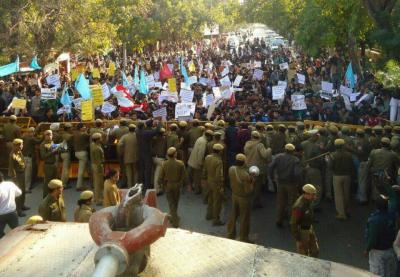
On 31st August, a girl from Indraprastha College for Women was molested in North Campus. The incident happened in the afternoon on the road opposite Daulat Ram College when a DUSU rally passed by. The girl was in a rickshaw when she got caught in the middle of the procession, was pulled down the rickshaw and harassed by several men.

While this incident happened, several policemen were on duty and did absolutely nothing to help her. One of her close friends described this behavior of the police as preposterous and inhuman. When the university authorities were contacted the first question asked was whether the girl was wearing decent clothes or not. “I was shocked to hear them ask me this question and felt like strangling them through the phone” said another of her classmates.

On 1st September, the college union and several of her close friends along with the victim went to the Commonwealth Sports Complex in North Campus to talk to the Vice Chancellor. The VC had already heard of the event as it went viral on the social network and denied entry to each and every student of IP College. Special orders were given to the guard to not allow the students inside. The students waited outside for half an hour. Finally when the principal Ms. Babli Saraf intervened, the students were allowed inside and given a chance to speak their demands. The students wanted action to be taken on the behavior of the policemen and wanted all such rallies banned. The VC promised to look into the matter and insured that some action would be taken.

Later on the same day, the proctor issued an order banning all rallies and demonstrations in North Campus. Also, not more than four people will be allowed to canvas the area at a time. This probably must be the fastest that DU authorities have responded after filing of a complaint. One of the contesting parties ABVP however, was quoted saying that it will “go ahead with a rally in North Campus in favour of women’s safety despite the ban.”