Tag

Slider

Browsing

When the time comes for the deity of the Earth to redeem its dues, the dust flows and concedes into spaces of the capital, halting the economy to a stop.

This city has become a rousing tale of being a debonair con artist—the black and white of society and politics extends to perpetual pitch-black darkness with economic sense, hitting rock bottom. Our tears come way before any words—thanks to the divine air quality after Diwali, and the richness in our voices has been lost to the excruciating agony of credit card bills, shopping lists, and destitute bank accounts, topped off with the smoke that fills our lungs—especially with the post-Diwali festivities of smog-covered skies and the antics of mitigation. 

Delhi, very recently, successfully achieved its aim of becoming one of the top cities in the world, but on a different scale. It is now the most polluted city in the world according to the IQAir rating, which was sadly a long-foreseen event. The major contributor to this fate is our favourite post-Diwali concoction—vehicle emissions, industrial pollutants, stubble burning and an endless conversation about these issues, but to no redemption. All of this is supplemented by the onset of winters and the harsh cold air, making Delhi a smog-covered chamber. Recent images by NASA show how potent this smog looks from space, and that should be enough to scare our hats off. 

The government boasts its goal of achieving Net Zero Emissions by 2070, announced at the COP26 summit, yet the progress can only be described as largely superficial. Recent estimates show that pollution hits India’s collective GDP hard, with the effective percentage ranging from 3% to 9% annually. This is a substantial loss compared to the pollution levels in other metropolitan cities and their relative impact. The primary drivers are, of course, increased health care expenses, reduced worker productivity and premature deaths. 

The economic-environmental trade-off is catching on as the whole country suffers because of its capital’s ‘tragedy of the commons’. Clean air—a classic example of a public good—no longer remains publicly available, and economic inequality persists in our society more than we allow ourselves to believe. With the affluent being able to afford clean air through expensive air purifiers and work-from-home lifestyles or as an escape from the city for a post-Diwali getaway, the free air costs the common people their lives. There are hundreds and thousands of unorganised workers, especially in India, who cannot afford to leave the outdoors, let alone find clean air indoors. 

“Everyone has a thousand wishes before a tragedy, but just one afterwards,” said Fredrik Beckman—completely unaware of its relevance today. The tragedy today originates not only from self-interest that drives us towards it, but also from the total lack of accountability, as the proximity of oneself to this issue remains undefined. It’s a testament to how the core economic concept of efficiency is what causes the greatest economic losses; stubble burning might be efficient for the farmers in Haryana and Punjab to clear the fields, but its impact can be seen on the book vendor on the streets of Delhi, who are unable to breathe. 


Sustained implementation of regulatory measures is a far cry; the best we can hope for is at least a few pre-emptive measures that control this rise. All the reactive, quick-fix solutions right now act as a bandage on a bullet wound. Recently, new efforts were made to try cloud-seeding to induce artificial rain to clear the smog that covers Delhi. The government spent crores just to get a drizzle of rain, notably with a technique which can only be used in very specific conditions, which are extremely rare to coexist at the same time. On top of that, its effects are small, almost unnoticeable, and it does not help solve the root cause of the issue. Yet these pollution mitigation efforts, which cost a huge chunk of the GDP, are set into place, and it’s the same story every year. Guess we never fail to find a head that fits the crown. 


In a world where trading carbon credits has now become a core business function, the soul of Delhi cannot be cured with a mere promise on paper. We need actionable steps taken as precautions, and soon. The AQI has crossed the 400 mark, stepping into the severe category, and it is affecting not only India’s economic position in the global market but has also started to serve as a long-term foreign investment deterrent for Delhi; a characteristic that is currently driving the Indian markets to high growth is becoming a cautionary tale for its capital. 


The poor air quality has caused a death rate of 15% in 2023 due to respiratory diseases; that is, 17,188 people in Delhi who died just because of the toxic air that we’re all breathing. It means 1 in every 7 deaths is due to the largest health risk of pollution levels in Delhi. This not only leads to a loss of human capital and productivity but is just one of the tangible measures due to which foreign investors have started hesitating before investing here. The economic instability caused by the sudden imposition of GRAP every year is another cause, combined with increased spearhead costs and problems with talent attraction and retention. 


Colloquially, our cultural worship practices disregard the environmental degeneration due to them with “traditional incumbency”, and Delhi was fain to follow—until now. Today, future progress lies at the feet of Delhi’s air quality. So, until we start honouring the air we breathe, prosperity will remain an illusion—half built, half alive, half dust, half deity. 


Read Also: Protesters Detained at Kartavya Path as Delhi’s Air Pollution Crisis Deepens 

Image Credits: NASA Earth Observatory

[email protected] 

Shreya Bhushan


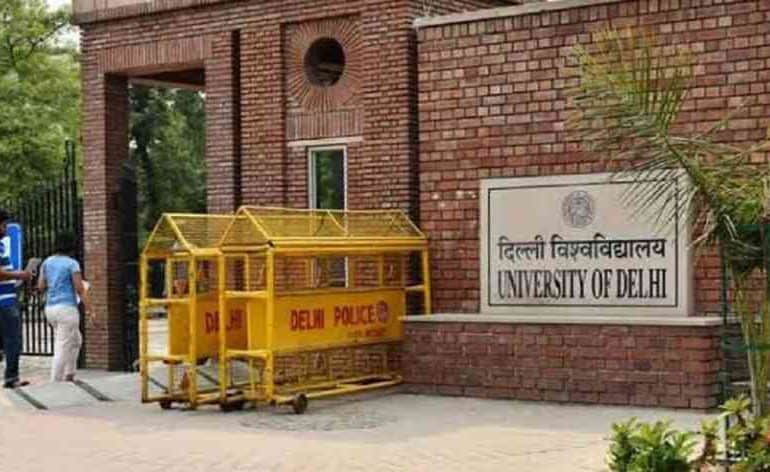
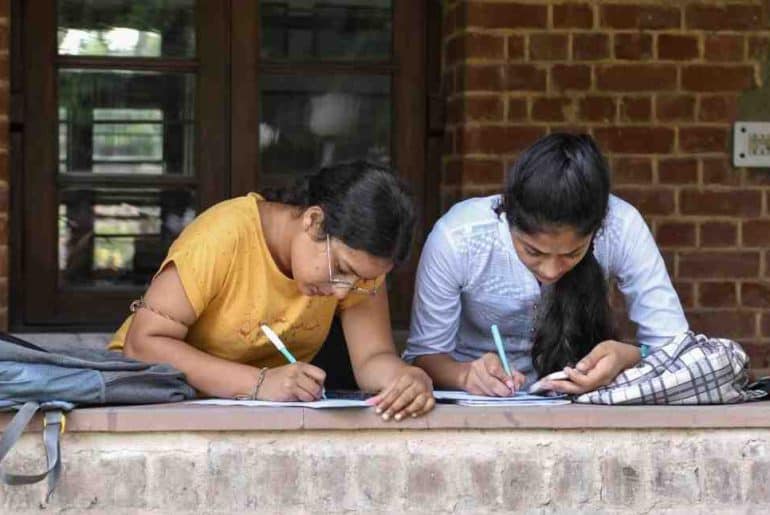
The University of Delhi’s examination portal has left students distressed as enrolment numbers remain missing and subject-selection errors persist. Despite the portal being active since August, no official clarification has been issued, leaving thousands uncertain about form submissions ahead of the upcoming examination deadlines.

The University of Delhi’s examination form portal, which has been open for this session since August, has once again sparked student frustration. This time, a wave of technical glitches has left first-year students unable to access their enrolment numbers, while many across batches report issues with subject selection — raising concerns as form submission deadlines approach.

The University’s website outlines a multi-step process for filling the exam form: Firstly, logging in using enrolment credentials. Then, selecting the active examination session, choosing papers via the course-selection menu, and finally, paying the fee online, and waiting for college verification. While this digital system was intended to streamline work for the university’s 7-lakh-plus student body, it has also introduced new layers of technical dependency that are proving unreliable during peak usage periods.

For several first-year students, the problem begins at the very first step. The enrolment number field on their dashboard remains blank, which prevents them from completing the rest of the form. Without an enrolment number, the students in no capacity are now able to complete the submission process, pay their fees, or receive their confirmation slip, and ultimately, this would lead to a delay in releasing their admit card.

The portal of the University explicitly states that fresh students (“fresh/new student” category) may need to wait until their college/department forwards verification before their exam roll number is generated. In practical terms, this means first-years often find themselves waiting — yet many say the wait is already unreasonably long.

Aanya, a first-year B.A. (Hons.) student openly expressed her frustration, saying:

“It’s been over two months since the portal opened, but my enrolment number is still not visible. Our college told us to keep checking the portal, but nothing has changed. I’m worried that I won’t be able to fill out the form before the deadline.”

The problem, however, does not stop there. Many second and third-year students have reported errors in the subject-selection section, which either fails to load entirely or displays incorrect paper combinations. In some cases, the subjects listed on the portal don’t match those actually opted for during the semester.

Many students anonymously expressed their dissatisfaction, saying:

“When I finally logged in, the subjects shown were from last semester. I tried multiple browsers, even visited the computer lab, but nothing worked. The university hasn’t issued any clarification, and that’s what frustrates us the most.”

While deadlines for examination form submission have already been extended multiple times this semester, no official statement has been released by the Examination Branch addressing the technical lapses. Students say the silence from authorities has left them anxious, especially as colleges begin internal assessments and pre-exam preparations.

People are also worried about possible late fees, wrong exam entries, or missing admit cards if mistakes keep happening close to the exam date. For first-year students who are still getting used to the university’s online systems, the lack of clear communication has been particularly stressful.

The Examination Branch has not yet released an official statement explaining the cause of these technical issues or offering a timeline for their resolution, despite multiple student complaints and the delayed deadlines in previous cycles.

In previous years, the University issued advice to submit well before the last date to avoid any last-minute technical issues. But for this year’s batch, many feel that the system has already fallen behind. Some students have shared screenshots of the portal with blank enrolment fields, subject codes not appearing, and submission blocked.

Despite repeated attempts by students to seek answers from their respective colleges and the university’s Exam Branch, no fix or timeline has been announced. For now, the only message circulating is to “keep checking” — advice that does little to reassure students as exam deadlines draw near.

Thousands of students are still in limbo, waiting, refreshing, and hoping that their exam forms won’t be another victim of DU’s digital problems until the university sends out an official update or fixes the problems.

Read Also: Final Year of College & Still No College ID Cards

Image Credits: Devesh for DU Beat

Naincy
[email protected]


Third-year Journalism students at Kamala Nehru College continue to face administrative delays, remaining without their college ID cards since admission.

In a surprising case of administrative neglect, the entire batch of third-year Journalism students at Delhi University’s Kamala Nehru College (KNC) continues to remain without college ID cards, more than two-and-a-half years after their admission. While their juniors in the same department have already received their cards, around 45–50 students from the 2022 Journalism batch are still waiting.

As per the usual college process, students receive their ID cards within the first semester of their first year of study. However, this batch claimed to have never received any, despite repeatedly approaching the administration. “We have gone to the admin office at least a hundred times”, said a third-year student. “Every time, we are told it’s some system or data issue. The excuse has remained the same for three years.”

According to the students, the administration initially cited a “technical issue” with student records, saying that names and roll numbers had been mismatched in the database. “We were told that because of wrong information flow, like father’s name or roll number mix-ups, the cards couldn’t be printed”, one student said. “But that was in the first year. It’s third year now, and nothing has changed.”

Students allege that this delay has caused multiple inconveniences. During events such as the Diwali Mela and college fests, campus entry is restricted to those carrying valid ID cards. “We weren’t allowed entry even with our library cards”, said the student. 

When the matter was raised in a student-principal meeting a few months ago, the principal reportedly downplayed the issue, saying that everyone had received their ID cards and that students could get them printed from the college machine. However, the administration did not act even after that.


Students claim that, despite the principal’s attempts to communicate with the administrative office, no concrete action has been taken. They continue to be informed about system issues or mismatched details with no proper follow-up.

Journalism department students have begun documenting their complaints collectively, hoping that the administration will finally address the issue before they graduate.  Currently, there is no clear timeline for when or whether the college administration will resolve the ID card delay, leaving nearly an entire graduating batch without a basic document of identification from their own institution.

Read Also: Protesters Detained at Kartavya Path as Delhi’s Air Pollution Crisis Deepens

Image Credit: Anshika for DU Beat

Anjali Kumari Jha

[email protected]

Citizens and students protesting Delhi’s hazardous air quality were detained at Kartavya Path after police blocked a march at India Gate, raising concerns over civil liberties.

On 9 November, around 5 p.m., students, citizens, and environmental activists gathered at Kartavya Path to protest the worsening air quality in Delhi. The demonstration, announced as an open call by individual organisers, drew support from groups such as the All India Students’ Association (AISA), Himakhand, and several other collectives.

The protest came amid a sharp spike in air pollution across Delhi, with AQI levels crossing 400 in several areas, categorised as severe by SAFAR. This rise has been accompanied by a surge in respiratory illnesses, particularly among children and the elderly. Protesters demanded greater accountability from the Delhi government and urgent measures to address the public health crisis.

Organisers said police prevented the demonstration from being held at India Gate, citing the absence of official permission. Protesters then moved to Kartavya Path. According to a report by Scroll, one organiser alleged that they had been warned days earlier that an FIR might be filed against them if they proceeded without a permit.

Police detained several people, including women, minors, and media personnel. Protesters reported being “thrashed around and dragged”, and many were injured. While female constables were present at the site, protesters claimed they were not present in the buses during detention—even when women were being transported.

Those detained described being driven around in buses before being taken to a police station, where they were allegedly kept in an open area resembling a “baseball court”. They said they were repeatedly asked for identification, which they refused to provide, and were threatened with legal consequences. Detainees were released around 11:30 p.m. after police recorded their names.

Even after the initial detentions, protesters regrouped for a second demonstration demanding the release of those held. These protesters were also detained, and, according to one account, later released near the Delhi border. Some participants noted that another protest,  for stray dogs, was taking place at the same time and location, yet saw no comparable police action.

Meanwhile, ANI quoted DCP Devesh Kumar Mahla as saying that Jantar Mantar is the designated site for protests, not India Gate. Protesters contested this, arguing that the designated site is heavily barricaded, inaccessible to the public, and that permission to protest there is routinely denied.

The events of 9 November underscore growing public anger over Delhi’s hazardous air, malfunctioning pollution monitors, and the perceived inaction of authorities. With respiratory illnesses rising and protective measures out of reach for many, the city’s toxic air continues to raise serious concerns about public health and quality of life.

Read More: NEP’s Three-Language Formula for Schools

Photo credits:  Muhammad Shahamath, Maktoob

Reva Rawat

[email protected]


Friends’ Corner, the Mental Health and Counseling Cell of Hindu College, hosted one of its flagship annual events Persona on Saturday, November 8. Blending science, creativity, and self-expression, the one-day event delivered a meaningful experience that struck the perfect balance between learning and relaxation, especially right before exams.  

The day began with a thought-provoking speaker session on Understanding Schizophrenia and Cannabis Addiction  led by Consultant Neuropsychiatrist Dr. Aakanksha Malhotra. Her session opened with a lively quiz that instantly set the tone for interaction and curiosity. Students participated enthusiastically, asking insightful questions and engaging deeply with the themes of mental health and substance use. Dr. Malhotra’s clarity and warmth made the complex subject accessible and left the audience with lasting takeaways.  


Image Credits: Friends’ Corner

The event then moved to the college Amphitheatre for an Art Therapy session with psychotherapist Ms. Kritika Makkar and artist-advocate Ms. Aalijah Ali. Through lighthearted games, painting, and guided reflection, the duo led participants to explore themes of self-acceptance, letting go, and holding on to what truly matters. The session’s relaxed, joyful energy created a safe space for expression where color and creativity became tools for introspection.  


Next came a deeply engaging Drama Therapy session facilitated by Creative Arts Psychotherapist Ms. Kritija Saxena. Using storytelling and movement, she encouraged participants to uncover different layers within themselves. The session was equal parts thought-provoking and liberating, beautifully showcasing the power of theatre in emotional exploration.  

Image Credits: Friends’ Corner

The final session of the day was Dance Therapy with Ms. Jyotsna Ramachandran, who guided participants through movement and rhythm to release stress and reconnect with themselves. What started as simple motions soon turned into a collective wave of energy and freedom. The amphitheatre echoed with laughter, music, and joy as participants embraced the therapeutic power of dance.  


Adding a touch of creativity to the celebration, Friends’ Corner also put up a lively face-painting and sticker stall ,  while Youth for Mental Health (YMH)  hosted an interactive installation that drew students in throughout the day. 

Image Credits: Friends’ Corner

Every session radiated warmth and openness, filled with laughter, moments of quiet reflection, and a few bursts of delightful chaos. With exams around the corner, Persona 2025 arrived as the perfect pause students needed. Many attendees called it “the perfect de-stress before exams” and thanked the Friends’ Corner team for creating a space that was both healing and heartfelt. 

Image Credits: Friend’s Corner (Hindu College)

DU Beat

The classroom has turned into an assembly line of submissions, and teachers, overwhelmed by grading requirements, have little time left for meaningful mentorship or feedback.

Education has long been regarded as a process of intellectual discovery—of thinking deeply, questioning boldly, and learning meaningfully. Yet, this ideal is steadily eroding. Across universities and schools, students now live within an unending cycle of evaluation—internal assessments, projects, presentations, assignments, and the list goes on. The logic behind this system seems sound: frequent evaluation is meant to encourage consistent learning, reduce exam stress, and provide teachers with an ongoing understanding of student progress. However, beneath the promise of fairness and engagement lies a troubling paradox—when everything is assessed, very little is actually learned deeply.

The shift towards continuous assessment has been one of the most significant changes in modern education policy. From the National Education Policy (NEP) 2020 in India, the trend is clear: move away from high-stakes final exams and towards a “holistic” evaluation system that values participation, projects, and internal assessment. On paper, it sounds progressive—a model that rewards effort and creativity rather than last-minute memorisation. But in practice, this model has created a culture of constant performance, where students are perpetually producing rather than reflecting.

One of the major drawbacks of this system is the disappearance of depth. Instead of allowing students to spend weeks exploring a concept or topic, reading beyond the syllabus, or revising and refining their understanding, the system demands quick, measurable outputs. Every week brings a new deadline, a new rubric or stylesheet, and a new mark. Students, caught in this cycle, quickly learn the art of strategic compliance—doing just enough to meet the criteria without engaging deeply with the material. The intellectual curiosity that education is meant to nurture is replaced by a survival instinct: What’s the word limit? How many marks is this worth?

This is not laziness; it is adaptation. When evaluation becomes omnipresent, students prioritise what is measurable over what is meaningful. In such an environment, thinking deeply—the hallmark of genuine learning—becomes a luxury few can afford.

The continuous assessment model has also reshaped the teacher’s role. Instead of acting as facilitators of thought, teachers often become administrators of evaluation. With dozens or even hundreds of students to assess weekly, providing detailed, personalised feedback becomes almost impossible. The lack of time for thoughtful evaluation has profound consequences. Feedback, when rushed or generic, loses its value. It neither guides improvement nor encourages reflection. What should have been a dialogue between learner and teacher turns into a transaction. This mechanisation of feedback erodes the relationship between teacher and student as co-thinkers. 

The push for continuous assessment is not merely educational. It reflects a managerial mindset prioritising accountability, data, and efficiency over critical inquiry. Pressured to show measurable outcomes, institutions reduce education to quantifiable deliverables. Learning becomes performance, not understanding; students turn into data points, teachers into evaluators. This technocratic approach, appealing for its promise of transparency and productivity, flattens intellectual depth, replacing curiosity with compliance. By reducing growth to checklists and metrics, efficiency begins to matter more than thought, and deep, reflective learning becomes a luxury modern education can no longer afford.

At the heart of this crisis lies a more basic issue—the disappearance of time. Both students and teachers are caught in a perpetual rush. There is no pause between one assessment and the next, no breathing space for reading beyond the syllabus, developing skills, pursuing their hobbies, interests, etc.

Deep learning, however, requires slowness. It requires the patience to wrestle with difficult ideas, to make mistakes, to reflect and return. The constant churn of assessments denies this possibility. Students move from one topic to another without the chance to consolidate their understanding. What remains is surface learning—fragmented knowledge held together by deadlines rather than comprehension. This commodification of learning undermines intrinsic motivation. The joy of discovering something new, of following a thought simply because it is interesting, is replaced by a transactional mindset. Over time, students internalise a dangerous belief: that knowledge is not something to live with, but something to complete and move past.

None of this is to argue for a return to the anxiety-inducing system of one-shot final exams. Continuous evaluation can, in theory, support learning if implemented thoughtfully—with fewer assessments, better feedback, and more emphasis on reflection rather than output. To reclaim depth in education, institutions must reimagine assessment as a process of dialogue, not surveillance. Teachers need time and trust to mentor rather than manage. Students need space to think, fail, and revise without the constant fear of being graded. Education must once again become a space for intellectual risk-taking, where questions matter more than answers and where thinking slowly is valued as a form of courage, not inefficiency.

Read Also: NEP’s Three-Language Formula for Schools

Image Credits – Hindustan Times

Richa Choudhary

[email protected]

Education Minister Dharmendra Pradhan has asserted that at the core of the National Education Policy lies the goal of “decolonising education and achieving aspirations, creating pride in our languages, culture and knowledge.” As students of critical thinking, we must then pause and ask what this decolonisation means, and how it translates into practice through the much-celebrated Indian Knowledge System (IKS).

In the past few years, the Indian Knowledge System (IKS) has emerged as one of the most discussed features of the National Education Policy (NEP) 2020. Dedicated IKS divisions have been set up under the AICTE, research fellowships and conferences funded in its name, “centres of excellence” announced, and institutes from medical colleges to IITs have introduced courses on ancient sciences, philosophy, and Sanskrit traditions.

Before we engage with its ideological and philosophical implications, it becomes necessary to pause and ask what exactly is being invoked under the label ‘Indian Knowledge System’. The policy framework presents IKS as both a recovery of ancient wisdom and a modern research frontier, but the term itself remains conceptually opaque. What even is a knowledge system? Strangely, if one turns to the official portals or documents, there exists no clear definition of what the term actually means or, more crucially, what it leaves out. After all, the act of defining what can be considered “knowledge” and then further, what can be considered Indian knowledge, demands at least some coherent framework or guidelines.

Broadly speaking, there have existed two dominant ways of understanding knowledge. The liberal-humanist view treats knowledge as universal, objective, and value-neutral, a pursuit aimed at describing what is, rather than prescribing what ought to be. Within this framework, truth stands apart from the knower’s culture, faith, or geography; the scientist in Delhi and the scientist in London, in principle, operate within the same rational order. A person, then, can question the validity of necessarily categorising knowledge as ‘Indian’. Does the vague geographic idea of a place serve an extraordinary function that needs to be specially discussed and highlighted? The liberal imagination of knowledge would argue not. Knowledge, in this view, is meant to transcend the boundaries of nation and identity, aspiring instead to universality.

A student having inherited a postcolonial legacy would intervene here to say that knowledge systems have never been innocent; they have always already been implicated in power. We are all, in some sense, children of the Foucauldian analysis, which taught us that knowledge does not simply describe reality; it creates the conditions through which reality can be known, named, and governed. Building on this insight, thinkers like Edward Said and Gayatri Chakravorty Spivak have shown how colonialism imposed its own epistemic order where the West stood for reason and science, and the non-West for myth and superstition. Within this framework, modern science itself becomes a kind of “local knowledge” of the West, whose dominance owes as much to power as to proof.

This theory has since been expanded and meticulously studied by postcolonial scholars in India after Independence. As a newly liberated nation embarked on its journey of self-actualisation and sought to craft an identity distinct from its colonial past, the question of knowledge remained ever-present. Thinkers like K.C. Bhattacharya, Ashis Nandy, and Partha Chatterjee turned their gaze inward, arguing that political freedom without intellectual swaraj in the realm of ideas remains incomplete. They contended that India continued to think within categories inherited from colonial rule, and that genuine decolonisation required re-imagining the very foundations of knowledge itself.

Placed within this lineage, the contemporary Indian Knowledge System discourse promoted by the NEP presents an intriguing yet troubling paradox. This project of decolonising knowledge seeks to replace Western intellectual dominance with indigenous, Vedic frameworks, grounded in what proponents call Hindu spiritual exceptionalism. Its aim is to “decolonise the Hindu mind” and achieve “epistemic decolonisation” by overcoming a colonial consciousness that allegedly obscures India’s true traditions. 

The movement’s intellectual core is the promotion of Indian Knowledge Systems (IKS), presented as an alternative to Western epistemology. Thinkers like J. Sai Deepak frame this through the language of “onto-epistemology and theology (OET)”, arguing for a revival of a distinctly Bharatiya OET rooted in Vedic thought and a “reversal of the gaze” that subjects the West to dharmic critique. This discourse blends postcolonial theory with nationalist ideology, borrowing academic terms like “epistemic violence” and “coloniality” to reject Western rationality, secularism, and universal human rights as alien or “Abrahamic”. It also advances pseudoscientific historical claims (e.g., ancient aeronautics or pre-Newtonian gravity) to assert the scientific validity of Vedic “inner sciences”.

However, the one thread that ties the IKS ambassadors and the western power it is supposedly fighting against is the obsessive fascination with the ancient past of the Orient. They both have constructed mythologies that fuel their knowledge production and propagation of a spiritual civilisation frozen in its former glory, the most insidious consequence of which is its denial of its complex social reality. The same discourse that claims to decolonise knowledge often erases caste, gender, and regional differences. Pro-Hindutva scholars argue that the caste system is a colonial hallucination, a Western invention meant to malign Hindu narratives and so on. 

Importantly, and this is what worries me the most, the project treats knowledge as fundamentally isolated and self-serving. The debate between the power relations and the objective nature of knowledge is too complex to try to reconcile here, but knowledge has always been a collaborative enterprise. The history of ideas, if anything, is the history of cross-pollination: Indian numerals found form in Arabic transmission, Buddhist philosophy shaped Chinese thought, Greek logic left its traces in medieval scholasticism, and Persian aesthetics coloured our own literary imagination. The IKS narrative, in propagating a rigid, self-contained idea of India, endangers this very fabric of intellectual life. 

In claiming to decolonise Indian education, the NEP enacts the opposite by fixing it to a static, glorified past. It leaves no room for self-critique, no space to ask what was excluded, who was silenced, or how our understanding might change. It is as if India’s intellectual peak has already occurred somewhere in the Vedic age, and everything that follows can and should only be imitated. What does that say about our present capacity to think, to add, to question? Can a society that sees knowledge as already complete ever produce anything truly new?

Read Also: DU Cancels a Seminar from DSE’s Longest-Running Colloquiums, Convenor Resigns

Image Credits: The Times of India

Yashika Jain

[email protected]


First introduced in the 1960s, the Three-Language Formula was introduced as a part of India’s national education policy to promote national integration and multilingual competence. 

Aiming to foster linguistic harmony and facilitate easy communication across state borders, the Three-Language-Formula and its execution did not match the rule’s implementation. It asked students to learn three languages—their native tongue, English and offered the choice between Hindi and Sanskrit. Many critiqued it for being another example of the disguised imposition of languages like Hindi and Sanskrit.

In 2020, the formula was revitalised with the aim of providing multilingual instruction in primary schools. In the National Education Policy (NEP) of 2020, the student’s mother tongue was stated to be kept as the medium of instruction up until Grade 5, although the recommendation for it extended to Grade 8 and beyond. Despite stating that no language will be imposed on the student body, a ‘three-language formula,’ with a combination of English and two native Indian tongues is to be taught.

“Research clearly shows that children pick up languages extremely quickly between the ages of 2 and 8, and multilingualism has great benefit to young students with a focus on learning their mother tongue in early years…and with skills developed for reading and writing in other languages in Grade 3 and beyond,” the policy document explained. Despite the lack of obvious issues on the surface, many believe that NEP 2020 lays down the groundwork for the imposition of languages like Hindi and Sanskrit in ways that are difficult to detect but easier to find once one looks deeper into the mechanism of enforcement.

By stating that implementation is entirely a matter of subjectivity dependent on states, schools and institutions, NEP 2020’s policy on language bypasses the possible situations in languages like Hindi, and Sanskrit can take priority for educators as they see fit. In addition to this, the failure to acknowledge that learning to read and write requires deliberate effort from not just the children but the adults teaching those children as well, puts undue pressure on school teachers who are stretched thin working in schools that are short-staffed.

The official policy document made informal comparisons to other languages in an effort to assert, as it stated, “the importance, relevance, and beauty of the classical languages and literature of India [which] also cannot be overlooked.”

It added, “Sanskrit, while also an important modern language mentioned in the Eighth Schedule of the Constitution of India, possesses a classical literature that is greater in volume than that of Latin and Greek put together.” It went on to highlight the, “vast treasures of mathematics, philosophy, grammar, music, politics, medicine, architecture, metallurgy, drama, poetry, storytelling, and more (known as ‘Sanskrit Knowledge Systems’).” 

The policy document was critiqued by many for emphasising Sanskrit over other languages in the Eighth Schedule of the Constitution, while simultaneously emphasising the language’s ‘classical literature’ over everyday usability and the number of speakers.

This formula was met with widespread criticism by many who believe that Sanskrit is being allotted undue institutional support, despite being spoken by only about twenty-five thousand individuals in the country. The central government spent more than ₹2532.59 crore on the promotion of Sanskrit between 2014-15 and 2024-25, seventeen times the combined spending of ₹147.56 crore on the other five classical Indian languages: Tamil, Telugu, Kannada, Malayalam and Odia. This information was obtained by Hindustan Times through a Right to Information (RTI) application and from public records.

The policy’s vision is “to instil among the learners a deep-rooted pride in being Indian, not only in thought, but also in spirit, intellect and deeds, as well as to develop knowledge, skill, and values, and dispositions that support responsible commitment to human rights, sustainable development and living, and global wellbeing, thereby truly a global citizen.” It does not account for enriching students with the knowledge of languages that are most relevant to the globalised chain of command, instead relying heavily on the nostalgic reproduction of a forgotten past, and righting the wrongs of an inexistent history.

Read Also: The Epistemic Project of the Nation: Decolonisation, Hindutva, and the Question of Knowledge

Image Credits: The News Minute

Aastha Singh
[email protected]


To mark 150 years of “Vande Mataram”, nationwide celebrations were held, with mass singing of the full version of the national song, highlighting the celebrations along with an address from the Hon’ble Prime Minister. Colleges across DU, including the Delhi School of Journalism and the Delhi College of Arts and Commerce, tuned in to the celebrations.

The year 2025 marks 150 years of “Vande Mataram.” This milestone was celebrated with mass singing of “Vande Mataram” across several public spaces, including the University of Delhi, colleges such as the Delhi College of Arts and Commerce, and the Delhi School of Journalism, on 7 November 2025. Nationwide celebrations will be held until 7 November 2026. An Inaugural Ceremony was held at the Indira Gandhi Indoor Stadium at 10:00 am, in the presence of the Hon’ble Prime Minister of India, Shri. Narendra Modi. Arrangements were made to telecast the Prime Minister’s address. 

At the Delhi School of Journalism, the celebrations commenced at 10:00 am with a mass singing of the full version of “Vande Mataram,” after which the entire institution tuned in to the Prime Minister’s address through YouTube LIVE, which brought to light the historical significance of the song. The Prime Minister also talked about how the song evoked a sense of patriotism in civilians and soldiers alike, increasing the enthusiasm of the country’s protectors on the battlefield. As the address was brought to an end, the students and faculty of DSJ once again sang the “Vande Mataram.” The program concluded with the distribution of sweets to all students and faculty members.

At the Delhi College of Arts and Commerce, students expressed pride in being able to sing the national song as one. Mohammed Asad, a second-year B.A (Hons.) A journalism student at DCAC said, “I am grateful beyond words to the college for this opportunity. This event also marks how our freedom fighters fought for the freedom of our country.” At DSJ, a student who chooses to remain anonymous said, “Everyone was singing the song together as it should’ve been..the whole of DSJ came together to sing the song, and that symbolised unity.”

Read more: JNUSU 2025-26: Left Unity dominates the Union

Image Credits: The Indian Express

Souparnika.S.R

[email protected]

The Delhi High Court directed police to expedite protection for ex-DUSU president, Ronak Khatri, who reported receiving ₹5 crore extortion and death threats allegedly from gangster Rohit Godara via WhatsApp.

The Delhi High Court, in its hearing on Thursday and in a  bench consisting of Justice Ravinder Dudeja, ordered Delhi Police to expedite the request for police protection seeked by former Delhi University Students’ Union (DUSU) president Ronak Khatri, after he alleged that he received extortion and death threats from gangster Rohit Godara. He stated that  “to expedite the request for police protection” as sought by him, as he “perceives threat to (his) life”.  Additionally, the court instructed that until a decision regarding police protection is made, the beat constable must regularly visit Khatri, “at least once for the next two weeks to ensure his well being”.


Khatri stated that he received a WhatsApp message from a phone number traced to Ukraine, demanding ₹5 crore and allegedly sent at the behest of Godara. Following this, an FIR was lodged at the Narela police station. Khatri further informed that he is “not able to campaign and step out of my house”.


In response to this, the Delhi Police informed the court that Khatri has received the local Station House’s and the beat constable’s contact number. Khatri’s application for police protection and security has been forwarded to the DCP (Outer North), who has further  forwarded it to the Special Cell.  The police stated that since the threat assessment is still pending, the Special Cell will make the final decision on whether Khatri will be provided protection.

The Court, while addressing Khatri’s case, stated that:

This Court being the constitutional court is expected to further the constitutional protection of citizens. Since the petitioner perceives threat to his life, the DCP Outer North and DCP Special Cell are directed to expedite the request for police protection.

It  further directed that “beat constables and SHO be duly counselled to attend the call if made by (Khatri)”.

Read Also – DUSU Executive Committee Dates Released

Image Credits- The Print 

Divyanshi Dusad

[email protected]