
When the time comes for the deity of the Earth to redeem its dues, the dust flows and concedes into spaces of the capital, halting the economy to a stop.
This city has become a rousing tale of being a debonair con artist—the black and white of society and politics extends to perpetual pitch-black darkness with economic sense, hitting rock bottom. Our tears come way before any words—thanks to the divine air quality after Diwali, and the richness in our voices has been lost to the excruciating agony of credit card bills, shopping lists, and destitute bank accounts, topped off with the smoke that fills our lungs—especially with the post-Diwali festivities of smog-covered skies and the antics of mitigation.
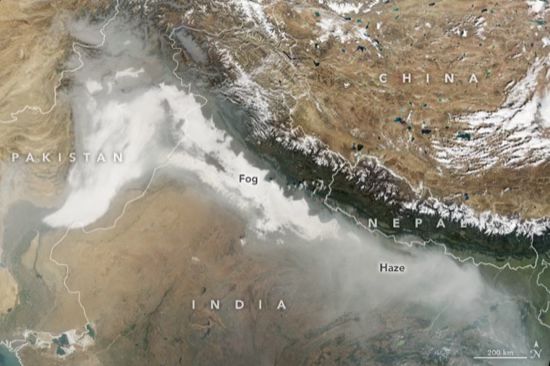
Delhi, very recently, successfully achieved its aim of becoming one of the top cities in the world, but on a different scale. It is now the most polluted city in the world according to the IQAir rating, which was sadly a long-foreseen event. The major contributor to this fate is our favourite post-Diwali concoction—vehicle emissions, industrial pollutants, stubble burning and an endless conversation about these issues, but to no redemption. All of this is supplemented by the onset of winters and the harsh cold air, making Delhi a smog-covered chamber. Recent images by NASA show how potent this smog looks from space, and that should be enough to scare our hats off.
The government boasts its goal of achieving Net Zero Emissions by 2070, announced at the COP26 summit, yet the progress can only be described as largely superficial. Recent estimates show that pollution hits India’s collective GDP hard, with the effective percentage ranging from 3% to 9% annually. This is a substantial loss compared to the pollution levels in other metropolitan cities and their relative impact. The primary drivers are, of course, increased health care expenses, reduced worker productivity and premature deaths.
The economic-environmental trade-off is catching on as the whole country suffers because of its capital’s ‘tragedy of the commons’. Clean air—a classic example of a public good—no longer remains publicly available, and economic inequality persists in our society more than we allow ourselves to believe. With the affluent being able to afford clean air through expensive air purifiers and work-from-home lifestyles or as an escape from the city for a post-Diwali getaway, the free air costs the common people their lives. There are hundreds and thousands of unorganised workers, especially in India, who cannot afford to leave the outdoors, let alone find clean air indoors.
“Everyone has a thousand wishes before a tragedy, but just one afterwards,” said Fredrik Beckman—completely unaware of its relevance today. The tragedy today originates not only from self-interest that drives us towards it, but also from the total lack of accountability, as the proximity of oneself to this issue remains undefined. It’s a testament to how the core economic concept of efficiency is what causes the greatest economic losses; stubble burning might be efficient for the farmers in Haryana and Punjab to clear the fields, but its impact can be seen on the book vendor on the streets of Delhi, who are unable to breathe.
Sustained implementation of regulatory measures is a far cry; the best we can hope for is at least a few pre-emptive measures that control this rise. All the reactive, quick-fix solutions right now act as a bandage on a bullet wound. Recently, new efforts were made to try cloud-seeding to induce artificial rain to clear the smog that covers Delhi. The government spent crores just to get a drizzle of rain, notably with a technique which can only be used in very specific conditions, which are extremely rare to coexist at the same time. On top of that, its effects are small, almost unnoticeable, and it does not help solve the root cause of the issue. Yet these pollution mitigation efforts, which cost a huge chunk of the GDP, are set into place, and it’s the same story every year. Guess we never fail to find a head that fits the crown.
In a world where trading carbon credits has now become a core business function, the soul of Delhi cannot be cured with a mere promise on paper. We need actionable steps taken as precautions, and soon. The AQI has crossed the 400 mark, stepping into the severe category, and it is affecting not only India’s economic position in the global market but has also started to serve as a long-term foreign investment deterrent for Delhi; a characteristic that is currently driving the Indian markets to high growth is becoming a cautionary tale for its capital.
The poor air quality has caused a death rate of 15% in 2023 due to respiratory diseases; that is, 17,188 people in Delhi who died just because of the toxic air that we’re all breathing. It means 1 in every 7 deaths is due to the largest health risk of pollution levels in Delhi. This not only leads to a loss of human capital and productivity but is just one of the tangible measures due to which foreign investors have started hesitating before investing here. The economic instability caused by the sudden imposition of GRAP every year is another cause, combined with increased spearhead costs and problems with talent attraction and retention.
Colloquially, our cultural worship practices disregard the environmental degeneration due to them with “traditional incumbency”, and Delhi was fain to follow—until now. Today, future progress lies at the feet of Delhi’s air quality. So, until we start honouring the air we breathe, prosperity will remain an illusion—half built, half alive, half dust, half deity.
Read Also: Protesters Detained at Kartavya Path as Delhi’s Air Pollution Crisis Deepens
Image Credits: NASA Earth Observatory
Shreya Bhushan



Comments are closed.