Tag

dusu

Browsing

Video and audio clips of a vandalised DUSU office surfaced on the 14th of July. ABVP members claimed NSUI involvement and took to social media to condemn the alleged heinous act. The University of Delhi has set up a 4-member board to investigate the vandalism at DUSU office and an FIR has been registered.  

As political tensions further burgeon between the incumbent DUSU President, Tushar Dedha from Akhil Bharatiya Vidyarthi Parishad (ABVP) and Abhi Dahiya, DUSU Vice President, representative of NSUI, a case of ruthless vandalism at the DUSU office has left the DUSU members smarting and has invited a grim prognosis for the suspected vandals. The office of the President, Tushar Dedha; Secretary, Aparajita; Joint Secretary, Sachin Baisla and the visitor’s room have been ransacked by whom ABVP members alleged were NSUI goons, possibly led by Mr. Abhi Dahiya. 

DU Proctor Rajni Abbi has revealed in conversation with Indian Express on Sunday that ongoing investigations have discovered several liquor bottles in Mr. Dahiya’s office. The ABVP has also alleged that the violent act had been carried out under the influence of alcohol, at around 3AM the same morning. The ABVP has taken to social media to expose the extent of damage caused to the public eye, wherein claims of NSUI goons having urinated on the “Roll of Honour” Nameplate, thrown out statues of religious icon Ram and the framed portrait of leader Swami Vivekananda have been documented. RSS-affiliated ABVP in a statement floated on Sunday condemned the Congress’s student wing –

“Between 3-4 AM this morning, NSUI goons broke into the Delhi University Students’ Union office, causing chaos. They broke the doors of the offices of President Tushar Dedha and Secretary Aparajita, vandalised the office, and threw out statues of Lord Ram and pictures of great leaders like Swami Vivekananda.” 

In an interview with Press Trust of India (PTI), secretary Aparajita confessed

“As the only female student representative working at this level, I feel unsafe in my own office.”

DUSU Vice-President Abhi Dahiya has released a statement on his Instagram on Monday, following the allegations, accusing ABVP goons to have likewise vandalised his office “first” in retaliation for his attempt last week to uncover the “fraudulent means” used by the Mr. Dedha to gain admission in DU, and the “false affidavit” submitted by him in order to contest elections. He claimed that the incident was orchestrated as an act of diversion from the critical issue of the fabricated documents, urging that there be a thorough investigation into the matter and entreating students to not get carried away by the propaganda fuelled by ABVP. “This act of vandalism and fear mongering not only damages DUSU property but also threatens the safety and integrity of our student community” he wrote on social media. 

An official intimation conveyed the decision of the varsity’s administration to set up a 4-member panel comprising Delhi University Proctor Rajni Abbi, Dean of Students’ Welfare Ranjan Kumar Tripathi, Delhi University Students Union (DUSU) staff advisor Surender Kumar, and Joint Proctor Geeta Sahare, to probe into the matter. The panel endeavours to submit its report within seven days. 

Read also : Controversy Erupts Over Tushar Dedha’s Presidential Candidature as DUSU VP Files Complaint

Featured Image Credits : ABVP Delhi Instagram Page      

Aayudh Pramanik

[email protected]

DUSU Vice President, Abhi Dahiya, filed a complaint with the Delhi University Vice-chancellor on Friday, 5 July 2024, against the DUSU President Tushar Dedha alleging that, “he produced a false affidavit to contest elections.” However, Tushar Dedha has denied such allegations.

On Friday, 5 July 2024, DUSU (Delhi University Student Union) Vice President – Abhi Dahiya, filed a complaint against the DUSU President Tushar Dedha, with the Delhi University Vice-chancellor, alleging that the latter used “illegal means” to get admission to the University and produced a false affidavit to contest elections.

(Image Source: Abhi Dahiya via Instagram)

Incidentally, this is not the first time a DUSU President has been (allegedly) “exposed” for using illegal means to secure admission into the University. In 2018, the former ABVP-led DUSU President Ankiv Baisoya was involved in a similar incident. Following the NSUI presidential candidate Sunny Chillar’s challenge to Baisoya’s elections on the same grounds, the then-DUSU President resigned from his position and has been sacked by the ABVP. This occurred when his bachelor’s degree from Thiruvalluvar University in Tamil Nadu was found to be fraudulent. 

Abhi Dahiya, in conversation with DU Beat, spoke out about the issue:

“The current DUSU President, Tushar Dedha has used ‘illegal means’ to gain admission within Delhi University. As per the records, the DUSU President holds two examination marksheets of intermediate class (Standard 12)- one from CBSE in Arts examination and the other from Madyamik Siksha Parishad Uttar Pradesh in Science Stream. How is it possible for one person to pass from two boards at two different places with two different streams? We urge the University to take stringent action against him as he does not deserve to remain the President for another minute, let alone an entire year.”

In his official complaint filed to the Vice-Chancellor of Delhi University, the Vice President of Delhi University’s Student Union cites that:

“As per the record received, he (Tushar Dedha) has two examination certificate/marksheets of intermediate class (12th), one from CBSE in Arts stream having roll number 9130384 and the other from Madyamik Siksha Parishad Uttar Pradesh in Science stream having roll number 0322496 District/School code 06/1328 both passed in year 2016 as a regular student.That as per the rules of both CBSE and Uttar Pradesh Board. It is mandatory for the regular student to have 75% attendance to appear in the 12th board examination and also, he has not passed equivalent Examination from any other Board.  However, in case of Mr. Tushar Dedha, he holds two marksheets from two different Boards, both passed in year 2016 which is in total of Examination by-laws of CBSE and Madyamik Siksha Parishad Uttar Pradesh Board and therefore, both the mark-sheets are void.”

While speaking to DU Beat, Abhi Dahiya also notes that:

Such illegal means have fooled the students of the University who put a lot of faith in their elected candidates while voting and we are looking forward to the University administration to take appropriate measures post the complaint by NSUI.”


Image Credits: Abhi Dahiya on  X

The DU Beat team was unable to reach Tushar Dedha, but he took to his Instagram on 6 July, 2024, in response to the allegations:


“NSUI cannot digest the fact that a student hailing from a village, hailing from a backward class, not only contested elections for the post of DUSU President, but also won. My admission to the UG and PG programs at the university is fair, authentic and legal. They can approach any organisation for verification, and all their allegations would prove to be baseless. On the contrary, there are many student leaders of NSUI, against whom there have been allegations and ongoing investigation of fraudulent admissions and paper leaks. The fact that NSUI has remained silent on cases of 19 paper leaks in Congress-ruled Rajasthan, goes on to show their hypocrisy.”


Besides NSUI, several student political-parties of the left-bloc have taken their stance related to the issue.SFI Kamla Nagar Joint Secretary Aditi, spoke to DU Beat, reiterating SFI’s stance on the matter:


“The fact that this fraudulent action ‘escaped’ the eyes of the DU administration that is otherwise so strict about the document verification process, to the point that it puts the futures of so many common students at risk over issues in documents, does not seem like a mere coincidence. This issue also brings into question the authenticity of the educational qualifications of other DUSU office bearers and candidates. Students do not want frauds as their leaders. The DU administration should stop supporting the fraud of ABVP-led DUSU and penalise the goons who take admission using illegal measures to contest elections”

In a consolidatory stance, AISA (All India Students Association) took to its social media pages to question the ‘DU Admin and ABVP Nexus’ and alleged that: 

While DU Admin goes ahead with implementation of NEP through fee hikes, FYUP, SEC, VAC, seat cuts, fund cuts, graded autonomy and bulldozes social justice and gender justice, it lets its stooge ‘Akhil Bharatiya Violence Parishad loose on students resisting their exclusion and marginalization.”

Tushar Dedha graduated in BA Programme from Satyawati College in 2019 and is currently pursuing his post-graduation in MA (Buddhism) from Delhi University. Adding to the uproar of student political leaders on social media, NSUI National President, Varun Choudhary shared a copy of the complaint and Tushar Dedha’s marksheet on X and alleged:

“DUSU President Tushar Dedha made a fake 12th mark sheet from UP Board and CBSE Board in 2016 and ABVP gave him a student union ticket in 2023. ABVP and SCAM party leaders are relying on fake mark sheets. The DU administration should immediately take strict action.”

While the debacle brews on, DU Registrar Vikas Gupta cited to The Indian Express that:

The issue has reached us and we will take a look into it on Monday.”

As per recent updates, the complaint demands that the results of DUSU Presidential elections be declared null and void and Dedha be sacked from his position. However, Dedha denied any wrongdoing and said he will file a defamation case.

Read Also: The Politicised Pareshani of DUSU 2023

Featured Image Credits: Arush Gautam for DU Beat

Gauri Garg 

[email protected]

Priyanka Mukherjee 

[email protected]

On March 8, 2024, the ABVP – led DUSU (Delhi University Students Union) announced an initiative where 10 women would assume the role of DUSU President for one day each, commencing from the first day of Navratri, April 9.

Having begun on the first day of Navratri i.e. April 9, 2024, the ABVP-led Delhi University Students Union (DUSU) announced a commendable initiative where 10 women students will be chosen for the role of DUSU President for a day each.

The names of the 10 students were selected from a competition wherein the participants were asked to write an article on “The Role of Women in Making Viksit Bharat”. Tushar Dedha, DUSU President, took to his Instagram on April 5, sharing the official list of names of the 10 selected students which included Isha Awana (Department of Hindi), Akshita Johar (Ramjas College), Sophiya (Swami Shraddhanand College), Anshita Chauhan (Daulat Ram College), Deeksha Lingayath (Sri Venkateswara College), Ankita Anand (Centre for Hindu Studies), Zainab Nigar (Hansraj College), Shyama Arunbhai Trivedi (SPM College), Preeti Singh Nain (Kirori Mal College), and Sakshi Patel (Satyawati College), who served as the first DUSU President on April 9, as a part of the campaign. She is a third year B.A. Programme student hailing from Jabalpur, Madhya Pradesh, and aims to help financially weak students through her position.

Preeti Singh Nair, the second DUSU President under the campaign, spoke to DU Beat about her selection and how it aims to empower women while increasing their participation in politics to bring about a change not just at the University level but even at the national level in the future.

We have the incredible opportunity to learn about DUSU’s functioning and receive valuable insights into student politics. This campaign in itself sends an important message as it aims to empower women students to hold political offices at the national level, as it gave every selected student the space to put forth major problems in our colleges before the union. Personally, I felt incredibly happy, although surprised, to have received this opportunity out of more than 5000 students who had participated in the competition. Having witnessed the lack of inclusive and accessible spaces for PWD (persons with disabilities) students in most DU colleges, including mine, I wish to use this opportunity to bring about major changes and take a stand to make our campuses inclusive and accessible for all. – Preeti Singh Nair, the second DUSU President 

In conversation with the media, Tushar Dedha, added that these one-day DUSU presidents will have all the powers of the chair to take decisions and issue any notice concerning students during their term.

On each day of the Navratri, a woman will head the DUSU as its President, exhibiting Nari Shakti. We have taken this initiative to promote women’s representation in student politics. 

Read Also: After WRB, Gender-Based Representation in DU’s Student Unions Too?

Featured Image Credits: Arush for DU Beat

Gauri Garg

[email protected]

A law student from DU has initiated a demand for 50% seat reservations for female candidates in the Delhi University Students Union (DUSU) and other representative bodies, garnering diverse reactions across the student body.

Following the recent passage of the Women’s Reservation Bill in Parliament, which seeks to allocate 33% of seats for women in the legislature, the University of Delhi (DU) is also witnessing a push for a similar change. There has been a recent rise in demands to reserve seats for gender minorities in Delhi University’s student elections and other college-level elections. Students and social activists have submitted a memorandum to the University highlighting their concerns and demands, which include various ways to enhance representation in University student politics and also increase seats for better participation.

This movement was initiated by a law student from the DU Faculty of Law, Shabana Hussain, along with advocates Ashu Bidhuri, Kuldeep Kumar, and Ajit Kumar, and other students of Delhi University. They met with the Dean of Delhi University to present their demands for gender reservation in University politics.

Here is an excerpt from the memorandum submitted by them, mentioning the aforementioned students’ and advocates’ demands:

      • The reservation of 50% of female student seats in the four office-bearer positions in the DUSU elections, starting from the next session (2024–25). These seats should be exclusively contested by female students on a rotational basis each year.
      • Beginning from the next session (2024–25), for the college union elections, which consist of six seats (President, Vice President, Secretary, Joint Secretary, and two Central Councillor posts), it is proposed that four office-bearer seats be allocated on a rotational basis as described in Demand No. 1. Additionally, one of the two Central Councillor seats should be reserved for a female student.
      • Currently, in the DUSU Executive Council elections, there are two seats reserved for women. The demand is to increase this reservation to five seats for female students, effective from the current session (2023-2024).
      • In the DUTA (Delhi University Teachers’ Association) elections, 50% of the seats should be reserved for women.
      • All colleges within Delhi University should be affiliated with the DUSU elections, starting from the upcoming session.

In conversation with DU Beat, Shabana emphasised her inspiration for starting this initiative, which stemmed from the groundbreaking Women’s Reservation Bill passed in Parliament. She firmly believes in the importance of empowering women at the grassroots level, and she sees women’s representation at the University level as playing a pivotal role in achieving this goal.

While female representation is on the rise, it often translates to tokenism, where women are being given roles for the sake of inclusivity. I want to change this mindset. I believe there are many capable and aspiring female candidates at the University who could take up leadership roles. Female students suffer from a lack of confidence due to the absence of role models in this sphere. We need visible women in politics and decision-making to illustrate that women hold valuable positions in these spheres. I believe that reservation can bring these faces to the forefront, ultimately leading to a transformation in leadership roles. It’s about moving away from tokenism, thereby inspiring the next generation of girls.

– Shabana, a law student advocating for the gender-based reservation of seats.

However, there are still many students who believe and argue that representation ought to come, but based on merit rather than reservations. Tackling this concern, Shabana adds,

I’m not advocating for permanent reservations. Rather, it is an opportunity to cultivate leadership skills in young girls, assisting them in their journey towards becoming future politicians. Today, politics is often dominated by money and muscle power. Reservation is necessary to bring women to an equal footing, enabling them to compete for positions on par with their male counterparts. Reservations can be removed once these goals are met.

Through discussions with other students across the University, it became evident that these concerns are mutual. Particularly, gender-minority students overwhelmingly support these demands, emphasising a collective resonance with the need for change and inclusivity in the University’s political landscape.

It is imperative that we have reservations for women in DUSU. The first reason is that, over the years, we have hardly seen female representation within DUSU. The last woman president of DUSU was in 2008, which is nearly 15 years ago. Female students hardly stand up for top positions. Until and unless we have proper and equal representation in a student body that speaks for the concerns of all the students at DU, how do we expect all problems to be equally highlighted?

– A journalism student at Delhi University

In a political landscape often dominated by muscle and power, several gender-minority students believe that a gender-minority leader in DUSU could understand their problems more sensitively and work towards resolving them more efficiently than any other candidate. In a scenario where several crucial issues, such as the safety of women on campus, remain pressing concerns, a strong gender-minority leader may be our next best hope.

When women representatives take the seats, women as a collective gender have faith in their own opinions. They have a voice. Not to forget that many of the colleges in the university are women colleges.

– A second-year student from the Delhi College of Arts and Commerce (DCAC)

However, there are other key concerns about the implementation of such an act. A final-year student at Kirori Mal College highlights,

Reserving 50% seats for female candidates is a challenge since representation in University-level politics, particularly at DU, is a complex issue that goes beyond a simple gender divide. It includes an interplay of caste, class, and gender dynamics. It’s not uncommon for various political parties to seek votes along these lines, and as a result, women often end up as symbolic heads rather than actively engaging in impactful decision-making.

Emphasising intersectionality and the essentialism of sex-based reservation, they further added,

I believe all aspects and concerns for equality go hand in hand. When we talk about reservation and representation for gender minorities, there has to be greater inclusion and acceptance for students from the LGBTQ community as well.

Shabana is urging other students to join her in the campaign for gender-based representation in the University system, as she relentlessly advocates for quicker changes at the level of student unions and politics. Seat reservations in DU’s University-level elections might be a historic development that sets the foundation for other colleges around the country to adopt similar policies. However, it is crucial to make sure that the objectives put forth by students like Shabana are accomplished effectively in order to do away with tokenism and make marginalised communities, whether gender-based or otherwise, the ones with equal footing and power.

Read also: Under the Shadow of DUSU Elections: A Stage for Sexual Harassment and Caste-Based Politics

Featured Image Credits: Shabana Hussain

Priya Agrawal
[email protected]

The Delhi University Students Union election inch closer, after a three-year long hiatus, amidst bouts of violence, forced entry in colleges and aggressive campaigning, certain issues like the lack of women’s representation seem to have lasted the stop-gap. There still only seems to be two women’s colleges even part of the election process, one being Miranda College. Moreover, even after elections, women do not seem to occupy high roles, and are known for being “dummies” for other male candidates. This article aims to look at the larger narrative behind women and student politics, how it has evolved and what it means for national politics.

 The evolution of student politics can be traced to the pre-independence, wherein most mass student mobilizations were to protest against the introduction of the English language as a medium of instruction in universities across India. Eventually, student unions merged with the larger independence movement. However, the use of violence in campus politics has been a pervasive issue since its inception as it was often the only way to express their grievances, in what was a political system which frequently ignored the needs of the youth.

For the illiterate and the literate without any contacts, a quick of venting anger and grievances was to resort to violence (Arnon & Altbach 1973: 164)”

Due to the nationalization of campus politics and the flow of funding from national parties, the two stages – the campus and the nation have become reflective of one another, wherein the factionalism on the lines of caste, class and gender in national politics can be seen in student politics as well, due to the monetary links formed between the two. This too often leads to violent outbursts.

It is no surprise that the transference of women’s underrepresentation can also be seen in campus politics, given the lack of female representatives on the national level as well. In the coming elections, most women’s colleges won’t be represented as they’re not a part of the student union.  This is an issue that extends beyond Delhi University, with several state colleges facing the same issue. The women’s wing of Arunachal Pradesh’s student union claims that parental and social pressure plays a part, many afraid of the dangers of campus politics, which are notoriously violent. This institutionalization of force in student politics, which is traditionally associated with masculinity, is also an ideological barrier which dissuades women from even trying to make it to higher positions within the union. Similarly, in Panjab University, party vice-presidents raise the same grievances, stressing on the lack of importance given to female candidates despite the presence of women’s wings, which are mostly tokenistic. They also highlight how this lack of representation is detrimental to women’s causes within campuses, like creating safe spaces, provision of feminine hygiene products etc.

Moreover, since visibility creates such a big part in campus elections, the lack of women being present during campaigns is also detrimental to their cause. Given the proximity of the student elections, and more so India’s national elections, it is important to note how such issues of underrepresentation are magnified as we move up the administrative ladder. If we cannot adequately represent women’s issues within the student body, how can we do so on a national scale?


Read also. https://dubeat.com/2023/07/23/women-in-politics-or-the-lack-thereof/

Image credit. Deves


Chaharika Uppal

[email protected]

DU politics can be seldom described as “Chacha Vidhayak hain humare,” but no one is interested in addressing the people they are about to serve, or at least promise to serve.

Try describing Delhi University (DU), and you will realise that politics is inseparable from it. When we turn the pages of history, we see DU emerge as a political hub that we never knew existed. These pages of history stand as proof that the protest culture, which is still so ingrained in DU students, emerges from a time where all that mattered was the notion of freedom, and to live and breathe independently. However, in 2023, all of this can be described as “bigoted irony.”

And as we take a sip of tea, here we are, days away from experiencing the Delhi University Students’ Union (DUSU) elections, which are back after a hiatus of three years. While all the organisations are busy preparing for it, however nobody is actually dwelling on the reason behind these elections.

Being one of the greatest democracies in the world, “democratic politics” plays an instrumental role in shaping our nation. While mainstream politics may be at the core of this country, DUSU breathes at the core of this mainstream alignment. If we try to draw parallels between the two, the story may turn out to be much more similar than what we comprehend. The result of both political scenarios is the same: the common man and the common students are the ones who suffer.

Political campaigns and rallies are an important part of the “election culture,” but in a varsity that is as dynamic as DU, it becomes quintessential to address the solutions to the problems that are eroding its structure. When men climbed the walls of Indraprastha College for Women (IPCW) and Miranda House, or when a ceiling fan fell on a student of Lakshmibai College, the contesting student organisations did voice the students’ concerns, but only a few did, and those few completely took away the focus from the students to themselves.

Arguments may be presented that when any political outfit addresses a problem, it may get politicised, but when the parties and organisations clearly act in a way that adds to their advantage, I think we lose the main reason for even having elections and choosing the candidate that should have “represented students.”

So, when everyone around is so focused on the elections and the candidates, the question about the students is completely neglected. DU’s political atmosphere includes everything except for the concerns of the students. With or without the elections, most of the students of the varsity feel that it does not matter who comes to power, as they will be neglected either way.

Vijeyta Panjwani, a student of Miranda House, expressed that while organisations like the All India Students’ Association (AISA) and the Students’ Federation of India (SFI) pick up on student concerns, others like the National Students’ Union of India (NSUI) or Akhil Bharatiya Vidyarthi Parishad (ABVP) tends to be missing in action. However, the entire matter often gets politicised, and the focus shifts away from the core problem and the students.

The ones who stood up for Students

When things did not go as planned at IPCW’s annual fest Shruti 2023, a few student organisations did take up the issue and protested for it. The students at the college went through a traumatic experience. When asked about the entire thing, they do recognise the efforts that were put in by the political outfits, but at the same time, they felt that soon the matter became something that was only concerned with the politics and not what the men did with the students of the college or how some students were locked up or were asked to leave their own college while outsiders were still in.

However, the contesting candidates have a different tale to tell. While the students may feel neglected, according to these candidates, that might not be accurate, and as one of them expressed, “We are humans too. We can’t take up each and every problem, but try to take up as many as possible,” for which I can give them a little credit. Nevertheless, when we take a look at the broader picture, not everything meets the eye.

Aditi Tyagi, a SFI state committee member who is contesting for the general secretary’s position, explained that each issue that emerges in the campus space is political. According to her, the organisations work as a bridge to get the media focused on student issues, and in the process, it might look like that issue has been politicised. She believes that without these outfits, student issues might never come up. Aditya, a member of AISA who is contesting for the secretary’s position, on the other hand, said, “Issues did not get politicised earlier. Now they get as a result of the idea to dominate each issue under the current organisation that is in power.”

One side of the politics is all up to take up the student concerns, and though it comes at the cost of politization, the other side dictates a tale that is no less than blatant hypocrisy.

Will they Stand with the Students?

One does not have to dig into the past to see what went wrong when we take a look at organisations like ABVP and NSUI. The campus space has been engulfed with sloganeering, pamphlet throwing, and, of course, the endless SUVs and huge banners, and “coincidentally,” they all belong to just two of the outfits: ABVP and NSUI.

NSUI is a name that does not resonate with a lot of students on campus since, according to the latter, they were nowhere to be seen over the months. However, the organisation has claimed that they have always stood up for the students, especially women-centric issues, though they could not point out any specific incident other than the gruesome act that took place in Manipur. The question about the students of DU still hangs dry for them.

Hitesh Gulia, a NSUI member who is contesting for the president’s position, has a vision to resolve the issues of fee hikes and women’s safety and wants to start a global youth festival. When asked about their absence in comparison to other organisations, Gulia pointed out that they are the first ones who pick up any issue that arises in the campus, but he could not particularly pin-point anything concrete except for the OBE protest, which happened earlier last year.

If we take a look at the campaigning of the ABVP, firecrackers were burned in Shayam Lal College and Deshbandhu College, fights broke out in Ram Lal Anand College, Ramunujan College’s gate was broken, and male candidates broke into Miranda House; this may not be too appealing to earn the votes of the students. However, the organisation claims to function in the most democratic way and has assured that they were always and would be with the students, though they have also claimed with sheer confidence that no matter what, they would again come back to power.

While other organisations did express their “concerns” about how the ones in power do not resonate with students, intimidate them, and do not look like one of them, the ones in power stood by their seemingly “strong moral grounds.” Speaking with Ankita Biswas, who is a part of ABVP but whose nomination did not get clearance, she stated that the organisation works for the students around the year, irrespective of the fact that the students may feel otherwise.

When asked about the recent incident in Miranda House where ABVP members scaled up the gates, including herself, she explained, “Our supporters get enthusiastic, and in that moment, they might do such things. As for Miranda House, the administration made us stand out for over 1.5 hours and did not allow us to carry out our campaign, which is a part of this democratic process.” Ashish Kumar Singh, another ABVP member, further explained that, as per the directions of the organisation, they are allowed to take just three cars for three candidates in colleges for campaigning. When asked about it, Biswas remarked, “What is wrong with it?” Well, it is safe to say that ABVP’s supporters are a little too zealous, which “might have” caused a little too much trouble for the common students.

No matter which ideology an organisation is inclined towards, all of them have one thing in common, and that is their assertion that they are with the students and they will be with the students, irrespective of these elections. Students have, however, lost their confidence in this democratic practice, and as for me, I still had a few questions left, but all I got from the karyakarta (s) was, “Muddhe muddhe pe depend karta hai, ab mai kya hi karu?

Read Also: Under the Shadow of DUSU Elections: A Stage for Sexual Harassment and Caste-based Politics

Featured Image Credits: Ankita Baidya for DU Beat

Ankita Baidya

[email protected]


The arrival of DUSU campaigning has heightened the tension in the University campus. Several reports of misconduct and threats have surfaced on the internet, posing a risk to the safety of regular students and residents.

On Saturday, September 16th, the AISA (All India Students’ Association) stated ‘outsiders’ had been spotted within the university campus and that a student had also been attacked. Aman Rawat, an activist for AISA, was allegedly confused for another candidate, Aditya Singh, and was abducted, threatened, and physically assaulted by some strangers, according to a video clip the organisation uploaded on social media.

Aman, an AISA activist and a law student, was approaching the traffic circle near Daulat Ram and Ramjas College when he was confronted by a group of unknown people. Aman can be seen in the video discussing the incident and mentioning how he was threatened, saying, ‘They recognized me as an ASIA Activist and started beating me, they warned me that AISA activists should stop campaigning or else they will face the same thing.’ He further said that those who attacked him realized they had confused him for Aditya Singh, the candidate for secretary from AISA. However, they continued to assault him.

He was brought to a Black SUV car that was covered in ABVP posters, and that’s how we found out who is behind this because we can’t identify these outsiders who are doing campaigning for ABVP in the campus.” – Anjali, AISA DU secretary.

Anjali adds that this is not the first time their student activists have faced threats. “Numerous incidences involving intimidation of students at various colleges have taken place, particularly of female candidates who receive texts even on Instagram.

Additionally, she emphasizes one of AISA’s key goals, which is to protect the gender minority and particularly prevent trespassing and harassment events that frequently happen at females’ institutions like IPCW and Miranda. One of their demands in this regard is for a gender sensitization community against sexual harassment. The student organization calls for a campus free from danger and fear.

While the organization has filed an official complaint in the nearby police station, they are dissatisfied with how the administration and police refuse to take the appropriate actions.

This incident is not the only one; a third-year student was seen in another social media video with what appeared to be a gun during campaigning at Kirrori Mal College. According to a statement made by the student group, neither the college security nor the police took any legal action against the offender.

According to The Indian Express, the principal of the institution, Dinesh Khattar, stated that the gun-like device was a lighter and was in the possession of the proctorial board. Additionally, he assured that the students will face harsh punishment.

AISA, however, asserts that the student is an ABVP member. Aiyesha Khan, the AISA candidate for president, states in a video released on their Instagram account that there has been an upsurge in these kind of incidents across the university’s campus and in the surrounding areas.

The campus has been hijacked by outsiders, and there have been cases of assault and intimidation since the beginning of the DUSU elections. While preaching about free and fair elections, the University and Delhi police refuse to take proper action.” – Ayeisha Khan in the Instagram video clip posted by AISA.

There are alleged violations of the election rules and outside involvement, according to numerous student groups. Several acts of violence were reported during the elections in 2019 as well. The student groups argue that the ABVP maintains musclemen to threaten their activists. On the other hand, the ABVP has denied these accusations.

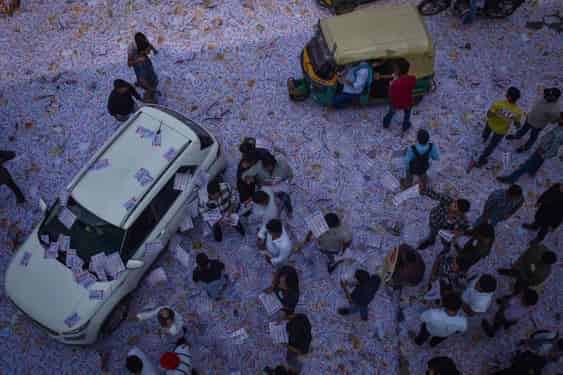
The campus stays crowded and tense as the election approaches, with roads covered in pamphlets and candidates passing in convoys. With the increase in these instances, there is growing concern about student safety, particularly for female students, and the security of women-only spaces.

In all, many groups demand quick and strong action against such mistreatment and violence in the university, as well as an election free of muscle and money.


Read Also – https://dubeat.com/2023/09/09/under-the-shadow-of-dusu-elections-a-stage-for-sexual-harassment-and-caste-based-politics/

Additional Source – https://www.newsclick.in/delhi-university-student-activist-explains-why-dusu-election-matters

Image Credits – Google Images

Priya Agrawal

After a tumultuous pre-election campaigning season, the nomination period for DUSU and college Student Union elections has proven to be no less happening. Amid similar scenes being reported in Hindu College, SSCBS, and Sri Guru Nanak Dev Khalsa College, ‘Venky’ or Sri Venkateswara College (SVC) saw students protesting against the administration to demand an explanation for the grounds on which their election nominations were cancelled.

On September 14, 2023, the administrative body of Sri Venkateswara College (SVC) released the provisional nomination list of candidates for election of Executive Committee of SVC Students’ Union & Central Councillors. This document listed 5 provisional candidates against the post of President, of whom two candidates—Arth Ohlan and Kartikey Tomar—were supported by the Akhil Bharatiya Vidyarthi Parishad (ABVP) according to our sources. The very next day, however, a corrigendum was issued by the college, removing Kartikey’s name from the list.

Even though the very first list claimed the candidates being “found valid provisionally, after the scrutiny for various posts”, the nomination of Kartikey Tomar was cancelled in the second list reportedly on the grounds of not meeting the attendance criteria. In conversation with DU Beat, Kartikey revealed the explanation he received from the college administration for the cancellation of his candidature.

Nominal list mein mera naam tha, usmein meri attendance poori thi. Par doosri list mein mera naam nahi thi aur admin ka kehna hai ki tumhari attendance poori nahi hai. Ya to meri attendance poori pehle nahi thi ya meri attendance kam karwai gayi hai.

(My name was there on the nominal list and my attendance was complete at that time. But my name was not there on the second list and the admin told me that your attendance was not sufficient. Either my attendance was not sufficient in the first place or my attendance has been reduced by someone.)

He blamed the college administration and election committee for committing such a blunder, if it was a case of the attendance criteria falling short. The latter part of his statement here is referring to a protest that happened on the college premises on the morning of September 15, where he and other sources alleged that “pass-out students” had protested to cancel his nomination. The same was mentioned in a complaint mail sent by Kartikey, addressed to the DU Registrar, Dr Vikas Gupta, Dean of Colleges, Prof. Balaram Pani, DU Proctor, Prof. Rajni Abbi, among other University officials. It read,

My name (Kartikey Tomar) was there in the list. But today a group of opposition students protested in front of the college administration and finally the election officer favored them and finally reduced my attendance by 1%.

One of our sources claimed that these protesting students had belonged to a youth organisation called ‘Happy Club’. We were able to get in conversation with one of the students from Happy Club, and they told us that suspicions arose over Kartikey Tomar’s attendance when they talked to his fellow batchmates.

Classmates ko idea rehta hai kisne kitne lectures attend karein hain… Jab humko doubt hua to humnei strongly is baat par demand rakhi. Administration ne humari sunkar cross-check kiya aur fir list badal di.

(Classmates tend to be aware of who has attended how many classes… When doubt arose, we strongly raised this demand. The administration listened to us and cross-checked (the attendance), after which they changed the list.)

They also informed us that the candidates from Happy Club have won both the posts of Vice-President and Secretary unconstested.

The provisional list of candidates is supposed to provide a final window to candidates to withdraw their nominations. ABVP activists from the college informed that they had submitted the withdrawal of Arth Ohlan’s nomination on their own volition, since the latter “was a second-year student and we thought it would be better for him to contest as President next year”. However, with the cancellation of Kartikey’s nomination, ABVP is left with no valid candidates on the final list for the post of President of Sri Venkateswara College Students’ Union.

In view of the same, Saturday, September 16, saw sloganeering and protests by ABVP activists in the Sri Venkateswara college premises. Protesting students gathered outside the administration office and messages circulating on social media also claimed that students had locked professors and staff inside a room. While the validity of the latter claim could not be fully confirmed, one of the protestors present on-ground did strangely admit during our conversation,

Ek hi professor hain jo apni marzi se ander baithe hain. Bas hum unhein bahar nahi aane de rahe.

(There is only one professor sat inside willingly.  We are just not letting them come out.)

They also said that the door had been locked by the guards from the outside.

This is not the first time an incident like this is happening. Reports have been floating around of candidate’s nominations being cancelled allegedly without satisfactory explanations and students protesting against the same. The latest updates on the situation in SVC have informed that the Hostel Warden and another professor of the college advised the protesting students to send a mail to the Grievances Redressal Cell, along with assuring that their demands will be formally heard on Monday morning. Students wait in anticipation for the redressal of their grievances.

Read also: Death of Democracy? Protests at Hindu College as Multiple Student Union Nominations Rejected

Featured Image Credits: EducationWorld

Sanika Singh
[email protected]

DUSU launches ‘One Day DUSU President’s Scheme’ to foster leadership skills and provide a platform to students. Under the scheme students from the varsity will get to head the students’ body for a day. 


The Delhi University Students’ Union (DUSU) on Monday, July 10th, announced a ‘One Day DUSU President’s Scheme’ under which the students from the varsity will get to head the students’ body for a day. The programme was announced at a Student Leader’s Meet, organised by DUSU on the occasion of National Student’s Day.   

Students will have a unique opportunity to serve as DUSU president for a day under the scheme, which requires students to fill out a Google form, indicating their leadership skills in various sectors, including sports, academics, environment, art and culture, among others. Photos and videos must be attached with their respective projects as proof. The review of the application, shortlisting of candidates, and the final interview will be done by the Executive Council. During the interview, the candidates can discuss projects, showcase their abilities as well as present their vision. 

After the evaluation by the Executive Council, the selected students will be publicly announced by the Council, recognising their leadership skills and contributions. The initiative is aimed at fostering and encouraging leadership skills and participation and provides a platform for students to contribute to the decision-making process within the university. 

Student leaders play a crucial role in continuing the great legacy of DUSU leaders who have spearheaded student movements and served as inspirations for youth in India today. We hereby launch the One Day DUSU President scheme to give a platform to common students and our aspiring leaders to head the students’ union. The responsibility of student leaders is to lead by example and contribute to the betterment of society,”

said Akshit Dahiya, DUSU president, in conversation with The Indian Express.


Read Also: “Circle of Suspicion”: AISA Activists Put on House Arrest During PM’s Visit to DU


Image Source: The Hindu


Vanshika Ahuja 

[email protected]

If we turn the pages of our history, we will realise that our freedom struggle was an essential chapter in the history of the University of Delhi. It has been about 80 years since Mahatma Gandhi gave us the slogan “Do or Die”, and within weeks of the pronouncement of the slogan at the Bombay Session of 1942, protests started to take shape across the colleges of DU. From burning down an electric sub-station (by the students of Ramjas College) to marching in protest on 10 August 1942, against the authorities who jailed the Congress leaders the previous day (students of Hindu College, Indraprastha College, and St, Stephen’s College), DU was the political hub during the time. So, this culture of protest so firmly entrenched among DU students even today can be traced back all the way to our country’s struggle for independence.

Established in 1922, a time when India was engulfed by its struggle for freedom, both students and teachers were active participants in the anti-British movement. However, soon, the students realised a need for a union. It was in 1947, under the founder of the Delhi School of Economics, Vijayendra Kasturi Ranga Varadaraja Rao (V. K. R. V. Rao), when a provisional committee consisting of presidents of all the colleges was bestowed with the responsibility to draft the Delhi University Students’ Union (DUSU) Constitution and take necessary steps for the creation of this institution. On 9 April 1949, DUSU came to life and was inaugurated by our first Prime Minister, Pt. Jawaharlal Nehru. Since its inception, DUSU has become the first step toward the political scenario of the larger part of the country. Students belonging to various groups, having a range of ideologies, contest to be part of its panel. Some of the most notable student organisations that it represents are the Akhil Bharatiya Vidyarthi Parishad (ABVP), the National Students’ Union of India (NSUI), Students’ Federation of India (SFI), Chhatra Yuva Sangharsh Samiti (CYSS), All India Students’ Association (AISA), and many more.

Delhi University is as well known for its politics as well as for its historical significance and educational culture. Its political atmosphere is so important that at times, even mainstream political parties take keen interest in it. Nevertheless, it is worth noticing how the culture of protest and dissent was born in the sensitive pre-independence independence and how it has transformed since then to take its present form. Are the organisations doing their jobs correctly or are they just practicing dissent in the name of vote-bank politics? This is one of the most crucial questions we must seek the answer to.

The ABVP, a right-wing student organisation affiliated with the Rashtriya Swayamsevak Sangh (RSS), has had the most successful run in DUSU history in recent years. The root cause of this success can be traced back to the period of the Emergency in 1975, when DUSU once again became a centre of political resistance. Arun Jaitley, a former member of ABVP and Bhartiya Janata Party (BJP), was elected as the president of DUSU in 1974. He is known to have played the most instrumental role in bringing reform to DUSU. Until 1973, colleges used to elect 10 DUSU councilors, who further used to elect the panel of DUSU. However, from 1973 this policy was transformed into ‘one-student, one-vote’, turning the system from an indirect to a direct democracy. Also, Jaitley is famously known for being the first satyagrahi against the imposition of an internal emergency. In 1977, Vijay Goel, who was affiliated with ABVP, became the President of DUSU. His focus during the campaign was the excesses that occurred during the emergency.

More recently, Nupur Sharma, a former BJP national spokesperson, was elected DUSU president as the ABVP candidate in 2008. This broke the ABVP’s eight-year wait for power in the DUSU, which had been dominated by NSUI. That year, the other three posts (Vice President, Secretary, and Joint Secretary) went to the NSUI.

If we look at the last 10 years, the NSUI has only held the President’s seat only twice. This does beg the inevitable question of why the ABVP has found so much success. During the internal emergency, it can be credited to the country’s political atmosphere, which helped in garnering support. In its initial days, it is safe to say that people were more focused on work than their political inclinations and other interests. But what about today? Is it functioning the way the students desire or is it enjoying an undue dominance? Is it standing for the students and working for their demands, or are they too invested in getting memorandums signed in the name of vote banks? On the other hand, the left-wing parties, which emerged as a force to content with in DU politics quite recently, have centred their existence around fighting for or against various issues through protests and rallies. In this respect, their innovation and resourcefulness is beyond compare.

But the larger question remains: are any of the organisations working for the students, or has their functioning been overcome by their self-interest and blinded by lofty goals of perhaps being a part of the ‘real deal’?

But what is the real deal now, apart from the “glorious” past that DUSU holds? Since 2019, DUSU elections have not been held and even for this year as I type this out, there is no clarity or instruction about them. For a Student’s Union that has not seen elections in the past three years, to term this period as worthy of congratulations to the DU fraternity is a disaster in itself that reflects what sort of bizarreness surrounds DU politics today. At nearly every step the recommendations of the Lyngdoh committee (set up by the Ministry of Human Resource Development (MHRD) in 2006 as per the direction of the Supreme Court to reform students’ union elections and to get rid of money and muscle power in student politics), are sidelined. Even a short conversation with those batches who have witnessed the famous DU elections is enough to know the huge amounts spent to buy students’ votes with freebies.

Every party in this arena carries its burden of faults. With major players being invisible throughout the year, some parties have engaged themselves in constant show politics. earning a name for themselves as “far protestors”. Be it any event or protest, you are most likely to see the same faces appearing everywhere, carrying faulty lies around.

But what’s the real issue here? Are parties facing problems in mobilising the students of DU? Or has its flame died down? Maybe it has just become a mere shell of what it used to be with constant clamping down on dissent at the college level. Though efforts by left parties in the form of reading circles can’t be ignored, ABVP too has attempted to mobilise students. But the fault of parties lies majorly in being unable to maintain a connection with the students. Even with these events and attempts to get closer to the students’ community, student parties cling to rigid ideologies rather than adapting to the circumstances, often barring those without political influence from engaging in what remains of student politics at the university. Indiscriminate fights and beatings do the rest of the work of turning students away from politics, with only 39% voting recorded in the last elections.

One of the biggest shortcomings of the DUSU is the exclusion of various colleges, especially ‘women’s colleges’, whose students have been visibly political in their stance. The absence of political presence on these campuses is clear exclusion by the administration and the silence of student parties over this issue makes clear their lack of concern over diverse representation in their parties, which is often stressed upon by them to win brownie points.

With fringe protests occurring only for some matters chosen specifically to grab as much attention as possible, the majority of student issues largely remain ignored. So, it is the right time to question what is being done of the legacy DUSU had in the name of power and politics and, more importantly, to start a conscious and organised movement to politicise (or rather, repoliticise) DUites.


Image Credits: Times of India

Ankita Baidya

[email protected]

Kashish Shivani

[email protected]