Tag

dusu

Browsing

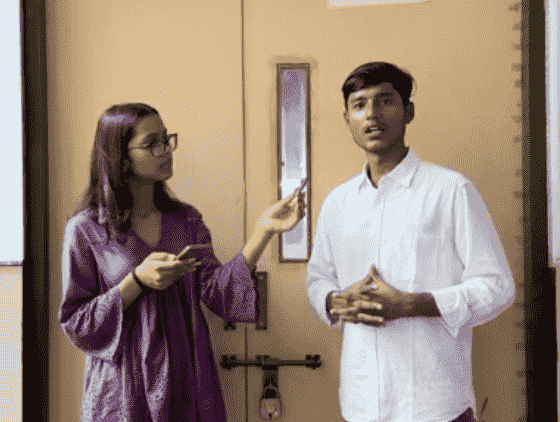
DU Beat in Conversation with Abhinandana Pratyashi

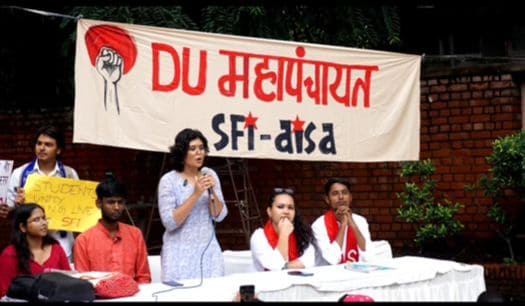
Abhinandana: So, hello everyone! My name is Abhinandana, and I am from North East, Assam. Assam is very popular for its floods, right? You must know Assam like that, but it is much more than that, because today I have become the first ever North Eastern Tribal person to contest for DUSU. I did my schooling in Assam, and I was the state topper both years. Now, I’m in Hindu College, pursuing Sociology Honours. I’m from SFI (Student Federation of India). 

Neeraja: Thank you for the introduction! I would like to start with, what do you think is the biggest challenge that DU students face right now? And how do you think you could improve on it?

A: See, the biggest challenge that Delhi University is facing right now is the hegemony of muscle and money politics that we see everywhere, right? We understand how the status quo prevails. People who are part of the hierarchy never want anybody else from below or outside the hierarchy to come and take space. And this is what that is personally, and that’s why socially and organizationally happening to me as well. Being a queer and being a Northeastern person, right? So, all these muscle and money politics and organizations that we see around ourselves, they are so visible. They have the money to visibilize themselves, right? So, they always take power over issues that are much more grounded. Those issues that need to be addressed, right? Like, for example, any of these issues that SFI is picking up. We can talk about fee hikes, we are talking about metro passes, and we are talking about women’s safety. But all of these issues, most of the time they are either co-opted by people who are not really affected by them or like just overpowered by muscle and money politics. So, this is like the biggest issue that we have right now. And the only way to challenge this or to combat this is with ground-level work. Unless there is proper education, there won’t be agitation.  And unless there is agitation, there won’t be an organization. And only when we have an organized mobilization of people, and only then, can we have some real change. And which is visible right now. So, right in front of me in my team, that’s Sneha, right? Sneha is standing right there. So, Sneha, without muscle and money politics, without the visibility of muscle and money politics, she was contesting last time; she gained 9000 votes.  And the person who won instead of her gained around 12,000 to 13,000. Look at the margin; this is a very small margin. So, this is the ground-level work we are talking about while combating the muscle and money politics that we see around ourselves.

N: Absolutely, thank you so much. Can I know some insights into the key pointers within your election manifestos?

A: Election manifestos, see, we are very grounded in the common student problems. First of all, the fee hike. Not many can afford to pay the fee that we are seeing right now. And that too, that is hiking, right? So, in Hindu College, in sociology honors, I am paying above 25k. If I had not had the scholarship that I have right now, I would not have even dreamt about coming to Hindu College and studying. I would have had to drop my education. And this is happening everywhere. Like in the Law Faculty, the fee before the new education policy, 3-4 years back, was Rs. 3000; now it is Rs. 8000. We see this constant fee hike. And in equivalence to that fee hike, we don’t even have basic to basic facilities. Like I said, I am from the North East, and Hindu College does have a girls’ hostel. But even there, I did not have the chance to get a seat in the hostel. So, if a girl from the North East is not getting a seat, then who will? You know the very popular case about the Hindu college boys’ hostel? It’s been privatised to such an extent that it’s been under construction for the past five years. In comparison, it took six years to build the Burj Khalifa.  And this is a problem everywhere. We are talking about affordable hostels so that the children do not have to commute so far, so that the students are not exploited by the PG mafia, the flat mafia. So, affordable education, first of all, means there is no fee hike. There should be a choice of accommodation. There should be a choice. There should be good and cheap food in the canteen. There should be a metro pass. See, a common student like us cannot afford to have our commuting prices go as high as 60 rupees in a single day. 100 rupees in a single day. That means, in a month, that is 3000 rupees, 2000 rupees. And you will see that the organizations with muscle money politics are roaming in big cars, BMWs, Thar, etc. What difference will it make to them that a common student like us cannot pay so much, right? So, this is one of the biggest issues we have been picking up in our manifesto. Because the students should at least get a concessional metro pass. Because it is simply very visibly non-affordable for our students, right? And apart from that, if we go to some branches of the points, Northeastern representation, of course, queer representation, of course. Because this is our space. Queer people say that half the sky isn’t enough. Of course, it’s not enough for us. We want representation. We want at least some kind of reservation. In the Hindu College Parliament, we have reservations. We are demanding the reservation of queer individuals, not just women, right? Not just cis-hetero women, but queer individuals, like I said. Along with that, basic issues, basic humanitarian issues. That xenophobia shouldn’t be there. That homophobia shouldn’t be there. That transphobia shouldn’t be there. So, these are some of the issues we are talking about. Like, basic to basic issues we are talking about in our manifesto.

N: That sounds amazing.  As you said, there are increasing financial crises that are happening. Like, the metro price hike, a fee hike, and hostel unavailability. How are you going to advocate for someone who is, like you said, the common student?

A: See, this is a very relevant question. Because this is seen everywhere. You must know that when we were contesting, the contestants who were contesting for the election had to sign a bond for 1 lakh. Right? So, a common student who comes from a marginalized background, the background I come from, I can’t even dream of contesting and having some representation in Delhi University Students’ Union. Because if you are signing a bond for 1 lakh, how will I pay the money? The people who are roaming around in cars can, of course, pay for it. But the one who is coming from a marginalized background, the already ostracized, is being continually ostracized. When you are putting up such bonds, when you are putting up such demands. So, this is a success of the panel that we are standing in, SFI AISA, our coalition of progressive organizations. So, you must know that the High Court has taken back this bond. Because we protested, we submitted a memorandum. So, when you ask how we combat these financial issues, that is combating. Combating can only happen through organization.  As I said, until there is no education, there will be no agitation. Without agitation, there will be no organization. People will have to organize on these common issues. Not just this 1 lakh bond. See, the rule passed by the Lyngdoh Committee this time, that people can’t throw around pamphlets. Because these pamphlets name people, reminding them, who can do that? The one who has muscle and money power, who has such funds, who has resources. So, people like us, coming from an ostracized background, have very little chance. Right? If we can’t have pamphlets flying around, how will people remember our name? How many times can we campaign, going from person to person? We can’t hire people to give away flyers. You must have seen, outside the college, people wearing Doraemon’s costume, Nobita’s costume, distributing flyers. We can’t hire such people. So, this time the Lyngdoh Committee has passed, so you can’t have such defacement. It can’t happen anymore. So, this is something that is, on a very minute level, combating the muscle and money politics, combating the financial discrepancy that we see. And, like, that’s why we are moving towards a more egalitarian election this time.

N: Like you said, this is something that might be personal to you also. DU has a diverse student culture across campuses, cultures, etc. How do you think you can represent people from all factions if you get elected?

A: See, even if you are from Bihar or if you are from Manipur, everyone is getting a free hike. Just because you can afford it, doesn’t mean you should have to. Because education is a fundamental right. Student mobility is a fundamental right. Students’ safety on campus is a fundamental right. So, the question of diversity pushes it further in a better direction. Here, fighting elections in a diverse environment, it’s much more inspiring because we see that, even after having a diverse background, these people are facing the same issues. So, it reinstates our power, in the idea, in the concept of the common student. Free hikes are happening with everyone. When a woman is exploited here, it’s not just about what background she is coming from; on the way, anyone can be catcalled. Right now, the background I come from, if a classmate from a different background comes from the North-East, she will be called a chinky here. I am queer, visibly queer, if a rich queer, or a poor queer, whose visible representation is queer, they will be hurled with homophobic slurs. So, I understand how class can have an impact on the discrimination we face, but just because of class differences, there is no discrimination against anyone. It’s not like that. Discrimination can be in different hierarchies. Like, a Dalit woman is more exploited, right? But that doesn’t mean that an upper-caste woman is not being exploited. So, in SFI, we believe in the organisation, until all of us are free, none of us are free. So, when I talk about diversity, diversity is one of the most positive things that we can have, when moving, when we are talking about our common student issues. 

N: What are some of the specific, achievable targets with which you can show your progress to students? How can you measure it, and how can you show it, in a specific sort of way?

A: When we say achievements that we have had as a common students’ organisation, first of all, I can talk about Hansraj. In Hansraj, the administration got land to make a girls’ hostel, right? And this is the case, everywhere. I mean, there is a space in SRCC, there is land in MLNC, to make a hostel, but the hostel is not being made. So, when this happened in Hansraj, then the admin said, No, we will make a cow shed here. Then, SFI, the common students’ organisation, protested that yes, you can make a cow shed. Of course, you are doing a good deed. Do a good deed outside the college. What is the right inside the college? What is the fundamental right of the girls? To make a hostel so that students are not exploited by the PG mafia. Expensive, unsafe PGs should not be there. Today, because of these protests, in Hansraj, a girls’ hostel has been set up. This is the power of a common students’ organisation. In JNU, you will see that the SFI AISA union has won many times in JNU. A left panel always wins in JNU. In JNU, you will see, every single student has access to the hostel. What they pay in a month for the room rent is 10 rupees. This is the power of a common students’ organisation. In Miranda, you will know, Miranda’s hostel fees are very popular for their low cost, right? And why is that? When in the middle of the night, the fee in Miranda went up 5000, right? See, 5000 might not mean much to people with BMWs and Thars, but 5000 means a lifetime to us. When it went up, SFI protested,in the middle of the night, and the fee was lowered, I mean, so this is the power of a common student’s organisation. And we were talking about concessional metro passes, right? At Hyderabad University, SFI has formed a union. Now, every single student in Hyderabad University has a concessional metro pass. They get 60% off. The 80 rupees we pay here, they pay 35 or 40 rupees there. This is the power of a common students’ organisation. So, when you say achievable things, when we talk about achievements, it is also an inspiration for us, that yes, when a common students’ organisation comes to power, things can happen. Now, I am from Hindu College. In Hindu College, there was a very regressive culture, V-Tree Pooja, Virgin Tree Pooja. When I came in my first year, in Virgin Tree, they used to hang water-filled condoms. They used to paste pictures of women whom they wanted to break their virginity with. When I came in the first year, my picture was also pasted there. It’s clearly a type of harassment, right? So, along with SFI, I had protested, and today, V-Tree Pooja doesn’t happen there anymore. This is the power of a common students’ organisation. Be it fee hike, be it affordability, accessible hostels, metro passes, or be it misogyny. All of these fights have been achieved, all of these things have been achieved, with SFI being in the union, without SFI being in the union. Because, whether it is an election or not, whether you are a common student or not, if you are a common student, then you have to fight, always.

N: Absolutely. Thank you so much for the interview!


Read Also: Campus Promises: ABVP, NSUI, and SFI–AISA Manifestos 2025

Neeraja Unnikrishnan

[email protected]


With DUSU election day less than a week away, tensions rise as Delhi’s largest student body puts forth its demands and expectations from the parties it votes for. Infrastructural upgrades, increased hostel seats, and campus hygiene remain the most widespread demands.


Stakes are high as tensions and excitement rise over the upcoming Delhi University Students’ Union (DUSU) elections which are to be held on September 18th, 2025. The counting of votes is scheduled for the following day, on September 19th 2025. The DUSU elections serve as a platform that acts as a stepping stone for students into politics, either as representatives or voters. With the University of Delhi having the largest student body in the capital, the parties involved in the DUSU elections certainly have a significant weight on their shoulders.

Students have put forth multiple demands with increased hostel availability and campus hygiene being top concerns. First year philosophy student, K.Sameepya from Indraprastha College for Women stated that the administration is quite detached from the students.

“If you want to connect with [the administration] there are a lot of things you kind of have to jump through. And even then it is actually quite difficult to connect with any of them.”

A first year student from SRCC remarked on the need for improved safety outside colleges, particularly women’s colleges. She also raised concerns about the lack of campus hygiene, talking about the state of the restrooms on campus saying,“with the current conditions of the washrooms, you wouldn’t even want to step in there.” Akanksha Singh, a first year student from Ramjas College talked about how the restrooms do not have proper doors – “So, even dogs sometimes come and go in the washrooms on the ground floor.” The availability of hostels, especially for first year students and students from out of state, needs to be increased according to several students.

The release of the manifesto was also a concern. Akanksha Singh, among other students, expressed their frustration over candidates simply “barging into classrooms” before introducing their names and blatantly asking for votes. Candidates generally give little information about their past work, promises and what they stand for, skipping to directly asking for votes. Students say that it is difficult to vote for people they don’t really know they can trust.

The 2025 DUSU elections are likely to be the most competitive yet with the introduction of the fourth year for undergraduate degrees by the NEP. This implies that third year students are no longer considered “final year” students and are hence eligible to compete for positions such as President and Vice-President, increasing the overall competitiveness of the entire process. Further, the 2025 elections will follow stricter guidelines with bans and limitations on loudspeakers, banners, and posters. Posters are to remain handmade and put up in only certain locations. This is expected after the vote counting for the 2024 elections was withheld upon the involvement of the High Court due to alleged defacement of public property.

The presidential candidates for this year’s elections include Aryan Maan for the Akhil Bharatiya Vidyarthi Parishad (ABVP), Joslyn Choudhary for the National Students’ Union of India (NSUI), and Anjali for the SFI(Students’ Federation of India)-AISA(All India Students’ Association). With the highly competitive atmosphere of the DUSU elections, each candidate is likely to give the other a run for their money. 


Read Also: Protest at Motilal Nehru College against Student Election Nominations


Souparnika.S.R

[email protected] 


Image Credits: Jansatta

With the Delhi University Students’ Union elections approaching, major student organisations have released their manifestos announcing promises, reflecting issues, and revealing both overlaps and contrasts in priorities.

There are significant variances as well as obvious parallels between the ABVP, NSUI, and SFI-AISA coalition manifestos. The goals of these three parties are to solve persistent problems in Delhi University politics, such as women’s safety, campus infrastructure, and affordability. However, each uniquely presents its strategy, answering critiques of earlier DUSU terms and reflecting its ideological foundations.

Student health and welfare have been foregrounded more strongly this year. ABVP explicitly promised, “subsidised health insurance schemes for students”, a measure that responds to recurring demands for affordable healthcare after years of rising living costs. NSUI brought the conversation into the gendered domain, with its women’s manifesto pledging, “helpline numbers, menstrual health awareness, sanitary pad vending machines, and proper gender sensitivity measures.” The SFI-AISA alliance combined health and gender justice, promising menstrual leave and insisting on institutional structures like, “elected Internal Complaints Committees and gender sensitisation cells in all colleges”.

The only organisation to make a specific commitment on digital access is ABVP, which has pledged “free Wi-Fi access for university students.” Although the Left alliance and NSUI did not use the same language to emphasise Wi-Fi, they both emphasised infrastructure and accessibility in more general terms, implying a move away from band-aid technological solutions and towards structural reforms.

The affordability debate remains central, carrying forward unresolved issues from past years, such as fee hikes and opposition to the National Education Policy (NEP). The SFI-AISA alliance has taken the clearest stance, stating that it has, “pledged to oppose fee hikes” and presenting its programme as ‘a true student-centric manifesto.’ NSUI echoed this with calls for, “public funding for equitable education” and a rejection of NEP-linked restructuring. ABVP, while not quoted as directly opposing fee hikes, emphasised subsidised schemes and improved facilities.

Women’s safety and inclusion, an issue repeatedly raised after incidents on campus in previous years, has again appeared prominently. NSUI’s separate women’s manifesto is notable in its detail, listing concrete measures like, “helpline numbers, menstrual health awareness, sanitary pad vending machines, and proper gender sensitivity measures.” The SFI-AISA alliance, in line with its activist tradition, focused on structural reform: “elected Internal Complaints Committees and gender sensitisation cells in all colleges.” ABVP’s framing was broader, with its candidate speeches highlighting campus safety and “accessibility audits for students with special needs.”

Finally, housing and hostels continue to be a major theme, reflecting perennial shortages and past protests by outstation students. ABVP’s manifesto directly included, “construction of new hostels to accommodate growing student needs.” NSUI’s broader call for inclusive infrastructure implicitly covered hostel provisions, while SFI-AISA explicitly folded hostel expansion into its demands for resisting privatisation. 

While all parties echo recurring demands like safety, hostels, and digital access, their manifestos also respond to past gaps, some promising continuity, others pledging fresh reforms to long-standing student concerns.


Image Credits: Manan for DU Beat

Anjali Kumari Jha
[email protected]

Read Also: ASAP, The New Student Wing of AAP, Refrains from Contesting DUSU Polls Days Before the Election

Amidst the roar of Motilal Nehru College’s student elections, the college witnessed a protest led by the students against unfair candidate nominations. 

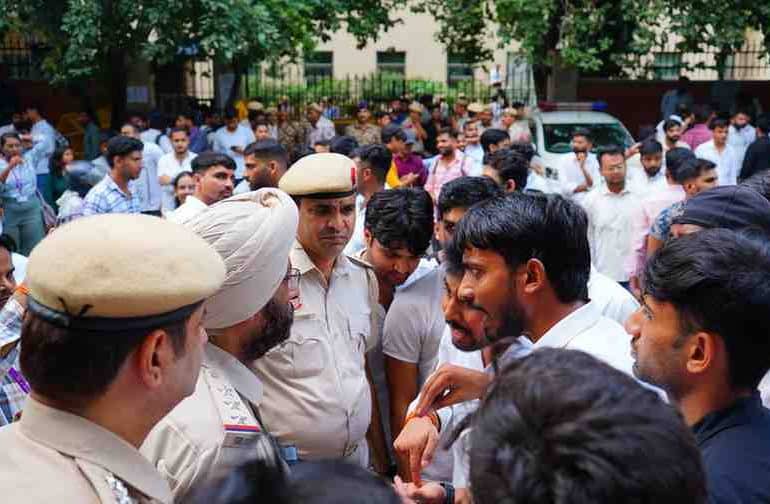
On 10th September 2025, the gates of Motilal Nehru College were closed for the teachers and the faculty by a student-led protest due to unfair intervention in student elections. The displeasure was stirred up as the students had been working on their election campaigns for the past two months, but the final list, released that day, contained only 7 names for 6 posts. This number was selected from an application of 107 students. The President candidature was permitted to a single student from the swarm of 14 nominees. This, the student protesters said, was an unjust treatment of the hopes and efforts of the students. The protest, which began at 6 in the evening, was carried out till late in the dark with the demonstrators refusing food or water. Instead of hearing the concerns of the protestors, the principal called forth police authorities, which led to a female candidate getting pushed by a male officer.

The authorities claimed attendance to be the criteria for selection. According to the official Delhi University regulations, the candidates require 50% attendance to clear their nominations, but MNLC changed it to 75% weeks prior to the elections. This became the main reason for the discourse in the student body. The students also displayed their discontent upon the appointment of a first year for the post of Vice President.

A student from the college told DU Beat,

The candidate for the position of Vice President is running unopposed even though he has been in the college for just a month, without the knowledge of any rules, or even stepping a foot in the campus all thanks to knowing people at high positions and having connections.

The protest began immediately after the release of the official list, with the students locking the gates of the college to prevent anyone from leaving the campus. The students raised their voices outside the principal’s office and the admin block also, but to no avail. The principal’s office was blocked by the protestors, and while they stood on their stance outside in the heat, the faculty refused to take any actions. The candidates went inside the office to clarify the situation with the principal but returned disheartened. The police arrived at 10 at night to break up the mob and to escort the Principal safely outside. The candidates decided to protest in front of the police vehicles but were controlled by force. It was unanimously decided to continue the protest overnight. College premises were occupied by police authorities, SSB and police vans in the morning after the gates were bolted by the protestors again. The principal arrived at around 11, finally allowing entrance into the college and had another meeting with candidates but no changes were agreed upon. This has led to all the student groups—ABVP, B.O.S.S, Ignite and other Independent candidates—coming and standing together. 

Read Also: SFI and AISA Forge Alliance for DUSU Elections, Vow to Challenge ‘Money and Muscle Power’

Featured Image Credits: MNLC on Instagram

Ananya Agarwal

[email protected]


On Monday, 1st September 2025, the RSS-affiliated Akhil Bharatiya Vidyarthi Parishad (ABVP) launched its new, eco-friendly “Clean Campus, Green Campus” campaign for the Delhi University Students’ Union (DUSU) elections.

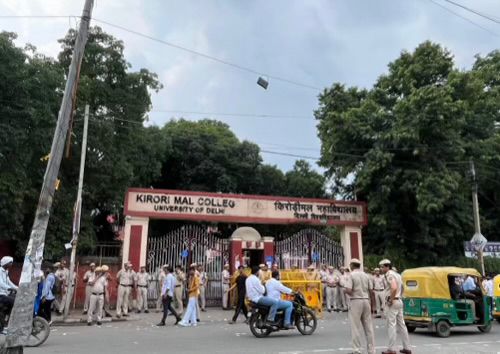
The campaign featured a bicycle rally that commenced at Vishwavidyalaya Metro station and proceeded to several North Campus colleges, including Ramjas College, Hindu College, Kirori Mal College and Daulat Ram College, before concluding at the Arts Faculty.

The campaign aligns with the efforts of the student union to keep the electioneering process “environment-friendly and campus-friendly”. According to ABVP leader Harsh Atri, the union will keep introducing thoughtful, eco-friendly campaigning practices such as bicycle rallies and clean-up drives. These endeavours complement the ABVP’s goal to keep the entire process of campaigning clean, transparent, and peaceful. The union is allegedly reaching out to students and strictly adhering to the Delhi High Court guidelines in its campaigning practices. 

The emphasis on responsible campaigning is well expected, as the 2024 DUSU elections had brought about legal trouble due to the violation of court directives and the Lyngdoh Committee’s guidelines for defacement of public property, leading to the halting of vote counting by the High Court until all defacement was undone and the restoration of public property had been completed.

On Thursday, 28th August 2025, the ABVP released a list of 11 probable candidates for the 2025 DUSU elections, which are set to take place on 18th September 2025. The final list of four candidates for the central panel will be released on Thursday, 11th September. The counting of votes will take place on 19th September 2025 under strict measures in order to avoid any form of defacement or disruption.

Featured Image Credits: @RohitDedhaABVP on X

Read Also:  ABVP and NSUI Welcome Freshers: A New Year of DU Student Politics

Souparnika
[email protected]

Delhi University tells the Delhi High Court it is scrapping the ₹1 lakh bond rule for DUSU poll candidates. Students now only submit an affidavit and security bond after petitions argued that the clause was arbitrary, exclusionary, and unconstitutional.

The Delhi University on Friday informed the Delhi High Court that candidates contesting the Delhi University Students’ Union (DUSU) elections will no longer be required to deposit ₹1 lakh bond, as earlier mandated by an 8 August notification. The university said that the provision was withdrawn following widespread criticism and legal challenges.

Representing the University, counsel Rupal Mohinder submitted before Justice Mini Pushkarna that election candidates will now only need to provide an affidavit and a security bond at the time of filing nominations. The clarification came during the hearing of a petition filed by two students, Anjali and Abhishek Kumar, challenging the 8 August notification that introduced the ₹1 lakh deposit rule.

The contested notification was issued with the stated objective of preventing university defacement and public property during elections scheduled for 18 September. The university argued that the hefty bond was intended to avoid a repeat of last year’s incidents, when widespread defacement forced the High Court to delay the counting and declaration of results by nearly two months after the September 2024 polls.

However, petitioners, represented by advocate Raja Choudhary, contended that the rule was arbitrary, discriminatory, and unconstitutional under Article 14 of the Indian Constitution. They argued that the provision disproportionately affected students from middle class and rural backgrounds, effectively excluding them from the electoral process. The plea further pointed out that the rule contradicted the Lyngdoh Committee recommendations, which assign joint liability to candidates for defacement rather than imposing individual financial burdens.

“The impugned clause subverts the democratic ethos of student unions, turning elections into an elitist arena, contrary to judicial mandates for inclusivity,” the petition stated. It was also alleged that the registrar lacked the authority to introduce such a condition.

The 8 August notification drew sharp criticism from several students’ groups. The Akhil Bharatiya Vidyarthi Parishad (ABVP) earlier this month submitted a memorandum to the university administration opposing the deposit requirement. The group demanded immediate withdrawal of the provision and warned of large-scale campus agitation if it was not revoked.

Student leaders argued that the rule went against the spirit of campus democracy by restricting participation to those who could afford the steep bond. Many have also questioned the practicality of such a measure, claiming that it would not address the root causes of poster wars and graffiti.

Taking note of the university’s submission, the High Court disposed the petition filed by the two students. The court’s acknowledgement effectively removes this contentious requirement, allowing the electoral process to continue without financial hurdles for candidates.

The DUSU elections, scheduled for 18 September are a significant event in Delhi University’s political calendar and are often seen as a reflection of broader student politics across the country. With the withdrawal of the bond requirement, the focus is expected to return to key campus issues such as affordability of education, hostel facilities, and the quality of academic programs.

The university administration has yet to clarify which alternative steps, if any, will be taken to curb defacement during elections. For now, candidates will contest under the revised rules, with only one affidavit and security bond required at the time of nomination filing.

Read Also – DU Not Bound to Share PM Modi’s Degree Records, Says Delhi HC

Featured Image source – Hindustan Times

Richa Choudhary

[email protected]

In a troubling incident the night of August 18, a group of around 20–25 unidentified individuals forcefully entered the Delhi University Students’ Union (DUSU) office. They broke open the main gate, attacked security staff, smashed glass doors, overturned chairs, damaged tables, and even destroyed an air conditioner, according to Delhi University officials. Campus authorities have confirmed that police are investigating the case, and the vandalised office has been sealed for now.

A day later, the Congress-affiliated National Students’ Union of India (NSUI) condemned the act, calling it “cowardly” and blaming the RSS-backed Akhil Bharatiya Vidyarthi Parishad (ABVP). NSUI national president Varun Choudhary alleged that ABVP had a long history of campus violence and creating unsafe spaces, particularly for women students. He described the vandalism as a “clear display of ABVP’s frustration.”

ABVP, however, rejected the charges, accusing NSUI of staging the attack to gain attention ahead of polls. In its statement, the student wing said,

Groups that are unable to work on the ground or connect with students resort to propaganda.

ABVP further alleged that the vandalism was a “media stunt” designed to tarnish its image.

Choudhary, meanwhile, said NSUI would continue to campaign on issues of affordable education, timely scholarships, social justice, and women’s safety under the banner of “Mohabbat Ki Dukan.” 

This is not the first time student politics at Delhi University has seen such flashpoints. From the defacement of DUSU offices in past years to violent clashes during presidential campaigns, incidents of hostility have increasingly overshadowed the democratic spirit of campus elections. In 2023, the election season was marked by allegations of physical intimidation and misuse of money power. Many students now argue that the real issues — ranging from affordable housing and better transport to the lack of hostels and deteriorating infrastructure — rarely find space in these campaigns. Instead, the narrative is often dominated by national party rivalries that play out on campus grounds.

All this paints a clear picture: DUSU politics have shifted from simply political debate to increasingly performative and destructive spectacles. Rather than fostering constructive dialogue, recent developments suggest that winning appears to have become more about leveraging force or acts of power.

Read Also: DU Cracks Down on Poster Politics Ahead of Election Season

Featured Image Credit: DU Beat

Juhi Bansal

[email protected]

As the much-anticipated DUSU elections dawn upon Delhi University, the administration’s decision to impose a mandatory ₹1 Lakh bond on contesting candidates has triggered a storm of protest. What the administration portrays as a measure of accountability is being widely condemned as a deliberate financial barrier that strikes right at the heart of campus democracy. For decades, DUSU has stood as a microcosm of Indian democracy, producing leaders who went on to shape national politics. By attaching a steep financial cost to participation, the administration risks rewriting that history. 

The policy has ignited rare partnerships as long-time rival student organisations come together to protest. While major organisations like ABVP and NSUI have historically housed high-profile candidates and expensive campaigns, they, too, have accused the new policy of being undemocratic and regressive. NSUI President Varun Chaudhary termed it a ‘political weapon’ that works in favour of their adversary, ABVP. 

Leftist student organisations like the Student Federation of India (SFI) also demand the withdrawal of the bond, describing it as “a regressive move that is nothing short of an elitist barrier designed to exclude ordinary students from democratic participation and stifle genuine student voices”. SFI calls out the university for their “anti–common student nature”, and highlights the growing concern over the integrity of free and fair student politics in India.

The imposition of this bond also raises much larger questions, especially those that target the identity of the university itself. The protesters claim that while administrations often justify restrictions in the name of discipline, the cumulative effect is a systematic narrowing of democratic participation. In an institution renowned for its inclusivity, the bond seems like a gatekeeping tool and risks silencing those very voices the union is meant to represent. Rather than strengthening electoral integrity, the bond tethers participation to monetary capacity, shrinking democracy to those who can afford it. 

With the DUSU election process now officially announced for September, the ₹1 lakh bond feels like more than just a procedural rule. For many students, it seems like a statement of who is considered fit to participate in democracy and who is not. As the elections draw closer and the campaigns gather pace, the debate over the bond is likely to remain at the centre of campus politics.

Image Source: The Hindu 

Navya Chandok
[email protected]

Read Also: DU Cracks Down on Poster Politics Ahead of Election Season

Over the years, DUSU elections have been accompanied by a flood of campaign material. Posters, banners, and flyers plastered on every available wall, pole, and surface on campus. The Delhi University Administration, in its quest to curtail the ever-growing splandour of posters during the DUSU elections that infest the infrastructure of campus, has given a set of anti-defacement guidelines to the contesting parties this year. The move comes as part of a larger effort to reduce the poster overload that takes over the university’s infrastructure each election season.

 Regurgating this stance at a sensitisation programme organised under the Swachhata Hi Seva 2025 initiative, Prof Yogesh Singh told the NSS volunteers and NCC cadets that, We will not vote for the candidate who has more printed posters.” 

He urged the studentsto de-incentivise candidates from resorting to posters and make them “afraid of doing any defamation”. He further emphasised that keeping the campus clean is a year- round responsibility and not limited to days of drive. 

The programme, with DU Registrar Dr. Vikas Gupta, Dean of Colleges Prof. Balram Pani, and other officials in attendance,  slipped in a pledge against drug addiction. Prof. Singh, meanwhile, likened the challenge to the Yamuna’s pollution, a reminder that the youth hold the mop and bucket for a “developed” India.

In 2024, the Delhi High Court had directed the university to ensure all campaign graffiti and posters were removed before vote counting could begin. The court made it clear that the exercise was “corrective rather than punitive” and ordered that results, originally scheduled for September 27, be declared only after DU submitted an affidavit confirming the clean-up. The outcome was eventually announced in November.

This year, the administration has gone an extra mile to enforce the new guidelines by making the candidates sign a 1 lakh bond to ensure no violations in addition to signing the anti-defacement affidavit. This sort of strictness is only comparable to the anti-ragging policy. 

Whether these efforts will actually bore fruit is yet to be seen as Delhi University awaits its (in)famous election season, the timeline of which was released recently. For now, at least we have an idea of where the administration stands in midst of it all.

Image Credits: Ayushmaan for DU Beat

Yashika Jain
[email protected]

Read More: DU Issues Anti Defacement Measures; Mandates Rs. 1 Lakh Bond Rule For DUSU Poll Candidates

Delhi University (DU) is reconsidering its rule requiring candidates in the DU Students’ Union (DUSU) elections to submit a ₹1,00,000 bond. Introduced on August 8 as part of new poll guidelines to curb campus defacement ahead of the September elections, the rule forms part of a wider framework aligned with court orders and Lyngdoh Committee recommendations. These directives also mandate an anti-defacement affidavit, limit rallies and loudspeaker use, and impose penalties for violations. The bond requirement has drawn sharp criticism from student organisations, who say it imposes an unfair financial burden, especially on candidates from underprivileged backgrounds. A senior DU official told The Hindustan Times that the University is reviewing the provision in light of these objections.

According to the guidelines, “Each contesting candidate shall be required to execute a bond of Rs. 1.00 Lakh for the offence of any defacement/violation of provisions of these Guidelines by themselves or their supporters, at the time of filing nomination for any post of DUSU.” 

Speaking to The Hindustan Times, Chief Election Officer Raj Kishore Sharma said that during a meeting with students and representatives of student organisations, participants expressed unwillingness to pay the bond. Following the discussion, the election office asked them to submit written representations to the university administration by August 16. The matter will be reviewed again before a final decision is taken.

The backdrop to these new regulations lies in the 2024 DUSU election, when widespread vandalism during campaigning led the Delhi High Court to intervene. As a result, vote counting was delayed by nearly two months, pending the removal of defaced property and its restoration. 

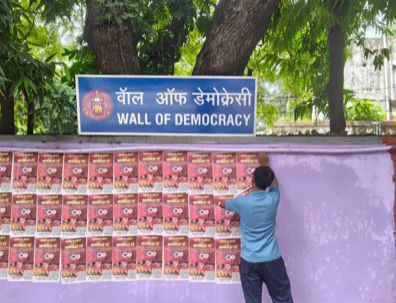
Last week, university officials reaffirmed a zero-tolerance stance on defacement, limiting campaign materials to handmade posters, imposing expenditure limits, and promising to set up “walls of democracy” in colleges as approved spaces for election displays. They also agreed, following student suggestions, that these “walls” would be formally recommended for both college-level and university-wide elections.

Sharma further affirmed, “Following last year’s incidents, the university submitted a set of reform suggestions to the court aimed at preventing defacement this year, which included the ₹1,00,000 bond requirement. However, in view of the opposition from students, we have yet to take a final decision.”

The university has notified the schedule for this year’s elections—the DUSU elections will be held on September 18, with counting scheduled for September 19. The notification also sets September 10 as the deadline for filing nominations along with a ₹500 demand draft, affidavit, and ₹1 lakh bond, followed by scrutiny and the publication of nominated candidates the same day. The withdrawal deadline is September 11, after which the final list will be released. Voting will run from 8:30 a.m. to 1 p.m. for day classes and 3 p.m. to 7:30 p.m. for evening classes.

With the deadline for filing nominations less than a month away, the fate of the ₹1 lakh bond provision remains uncertain. Student bodies await the administration’s final decision, which could determine whether the upcoming polls proceed under the contentious rule or with revised guidelines. For now, preparations for the September 18 elections continue under the shadow of last year’s controversies and the university’s push for cleaner, regulation-bound campaigning.


Image Credits: Deepanshi for DU Beat

Neeraja Unnikrishnan
[email protected] 

Read Also: DUSU And Central Council Elections 2025-2026: Official Timeline Announced