Tag

dusu

Browsing

From its establishment in 1949 to first elections in 1954, the Delhi University Students’ Union has had a long run, one that preceded India’s Independence and saw the rise and fall of multiple governments in its lifetime. 


It has become difficult to discern the notion of student politics at any level in India without mentioning the inception of the country’s biggest Student’s Union, DUSU. Seven lakh students, ninety-one colleges and a run of over seventy years: the Delhi University Students’ Union has had a legacy that continues to define and re-define student elections and politics in India.


Late historian and professor, Aparna Basu, in her book, University of Delhi (1922-1997) details the formation of the body politic of the university at a time when quiet rebellion against British Raj was brewing, alongside a surge of student-led activities. It becomes imperative to note that the opposition to colonial rule worked in tandem with student demands for a space where they could air out concerns in relation to administration, education and other issues in relation to DU on democratic terms. It all began in the same year India got Independence—1947.


Students across colleges under the University had been raising demands for a Union that catered specifically to the needs of DU students, a task into which discussion was initiated by the–then Head of DU’s Economics Department, VKRV Rao. A provisional committee consisting of presidents of all unions across colleges was set, following the undertaking of a general meeting with an advisory board. Two years after, in 1949, the Delhi University Students’ Union was inaugurated by the–then Prime Minister, Pandit Jawaharlal Nehru and was inculcated into the University. 


DUSU’s origin story can be traced back to a few years prior, when in 1942, during the Quit India Movement, students from colleges of North Campus like Hindu, St. Stephen’s and Indraprastha went from college-to-college encouraging students to participate in protests for liberating Congress leaders who had been jailed previously.


The students then went down the road adjacent to Chandni Chowk, shouting slogans and organizing protests the records of which can only be found in resources like Basu’s book. The Union was the product of a multitude of college students across the DU circuit coming together to champion the quest for a platform that was for the students, by the students and of the students. 


As the years passed by, DUSU had made contributions to some of India’s biggest political movements, demonstrating participation in the Jayaprakash Narayan Movement that originated in Bihar in 1974, as well as the imposition of the Emergency under Prime Minister Indira Gandhi in 1975.


The Union has four office bearers officially: President, Vice President, Secretary and Joint-Secretary, all of which can be contested for by student organizations across the college circuit. Positions are elected individually, which means that members that make up the Union need not be from the same political affiliation. It can be said that DUSU exist as a microcosm of majoritarian politics in India, given that some of the biggest names in the game, Akhil Bharatiya Vishwa Parishad (ABVP) and National Students’ Union of India (NSUI) are affiliated with political parties (the Bharatiya Janta Party and the Indian National Congress respectively) that have held office at different times and have defined the political landscape of India we see  today. In all of DUSU’s recorded history, with the exception of one candidate (Manoj Choudhary, who held the seat from 2009-2010 and contested as an independent candidate), all student-elected Presidents belonged to either of the two organizations. ABVP candidates have been elected President nine times more than NSUI candidates, a testament to the party’s legacy as the largest student organization in the world, having over a fifty-five lakh membership count.


This is not to say that student parties are partial to majoritarian politics. Left-leaning parties like All India Students’ Association (AISA), which works in association with the Communist Party of India (Marxist-Leninist) have made waves in the landscape of student activism in India. Though their popularity amongst students of the University has been largely clipped, and cannot rival the widespread acclaim they have gathered in similar institutions like Jawaharlal Nehru University, left parties have played an integral role in taking up issues that have drowned under the flashy displays of money and muscle power.


While student leadership in India did not begin with DUSU alone, it continues to remain one of the most longstanding and successful examples of it. As Delhi University’s official website puts it, “In the past, several of the official bearers of Delhi University Students’ Union have gone on to hold public offices in State and Central Governments.” Some of the biggest names in DUSU have gone on spearheading a similar route in Indian politics, including the late Arun Jaitley, who served as India’s Minister of Finance and Corporate Affairs from 2014 to 2019.


While pursuing his bachelor’s in Commerce at SRCC, Jaitley was elected President of the Delhi University Students’ Union (1974–75) and it was under his informal leadership that DUSU made the shift from indirect to direct elections through an agitation that lasted almost fifty days. Between 1972 and 1973; the University was shut down without a formal day of re-opening, and administration settled on allowing all students from colleges affiliated with DU to participate in voting directly for their leaders. Jaitley, the-then President of his college’s Students’ Union was pivoted into stardom after being one of the few familiar faces who led the crowd, and ABVP made a clean sweep across all contesting positions in the elections held in the following year. Jaitley was elected DUSU President.


The Delhi University Students’ Union has had a legacy that stretches far beyond the divisions of the multi-party system that it took from the country’s election system. It is not merely a topic of discussion for students enrolled in one of DU’s colleges, but a multi-tier apparatus that exists as a larger reflection of the timelessness of student activism, student politics and student leadership in India. 


Image Credit: Hindustan Times

Image Caption: Former DUSU President Arun Jaitley, as seen post-1974 win

Aastha Singh
[email protected]

The 2025 DUSU elections showed a striking paradox: voter turnout increased, while NOTA captured over 23,000 ballots. Together, these trends reveal a student body eager to participate in democracy yet frustrated with the choices offered.

The Delhi University Students’ Union (DUSU) elections this year told two very different stories simultaneously. On one hand, Turnout this year stood at 39.45% , a clear jump from the 30–35 % range of the past few years. On the other, thousands of them also pressed the “None of the Above” (NOTA) button, choosing to reject every candidate on the ballot. Put together, these numbers show us a student body that is more active but also more dissatisfied with the choices in front of it.

Many credit this rise of turnout to the “Clean Elections” effect. After the Delhi High Court pulled up DUSU candidates last year for their excessive defecation, this election was much more regulated. For many first-year students, this made the whole process worth engaging with. 

However, many also used their vote to say no to everyone. NOTA polled over 23,000 votes across the four central panel posts—around ten per cent of all votes cast which is significantly higher than last year’s. 


Post NOTA Votes Percentage of Total Votes Polled (Approx.)
President 3,175 5.3%
Vice President 5,820 9.7%
Secretary 7,365 12.3%
Joint Secretary 7,314 12.2%
Total Across 4 Posts 23,674 ~10% of total votes polled


Why did so many students go this way? For one, the reputation of DUSU elections as contests dominated by money and power still lingers, even if this year looked cleaner. For another, there’s frustration with the limited choice. The ABVP–NSUI rivalry has long dominated the union. 

This leaves us with a paradox. Students are more engaged: they are turning up to vote in bigger numbers—but they are also more critical, and less willing to settle.


Picture Credits: Anjali P for DU Beat

Juhi Bansal

[email protected]

The politics of our country has long been shaped by caste arithmetic. DUSU politics could have been a model of issue-based politics but, even today, its elections are swung by the “caste lobby”.

To me, the most attractive thing about DU’s red brick walls used to be their political spirit. Debates at tapris, protests against administrations, and the feeling that there I could touch and feel politics was what defined DU for me. I once imagined student politics as an accessible space. A space where any student, regardless of background, could speak, contest, and belong.
That imagination was built on the hope that education and democracy could dissolve social hierarchies, and that Delhi University, with its national reputation could be a rare equaliser. That utopian vision perhaps came from DU’s reputation as a cosmopolitan university—a gathering  of bright young minds from across the country. In some sense, it is cosmopolitan. However, its student union is anything but.

The Delhi University Students’ Union (DUSU) has become a mirror of the worst in Indian politics. It is a space where the caste arithmetic dictates tickets, campaigns, and results.DU’s campuses draw their student demographic heavily from Haryana, western Uttar Pradesh and Uttarakhand, and the political fibres of those states replicate themselves on campus. The student wings of the RSS (ABVP) and Congress (NSUI) end up mimicking the caste blocks of their parent parties. The Jat community, for instance—an influential agrarian group forming roughly a quarter of Haryana’s population—has long dominated the state’s politics. The 2016 Jat reservation agitation, which paralysed Haryana for days, showed us just how decisive their mobilisation could be. Since then, both BJP and Congress have carefully calibrated tickets along the “Jats versus others” divide. This same arithmetic plays out in DUSU, where tickets rarely ever go outside Jat and Gujjar groups.

On paper, it may seem that this student election is free for anyone interested. But to fight a DUSU election with any reasonable chance of winning requires resources, and resources have always been controlled by a few groups. Networks of village associations, PG landlords, shopkeepers, and alumni associations directly transform this caste mobilisation straight into votes. As per policy, DU has a 22.5% reservation for students belonging to Scheduled
Castes and Tribes (SC – 15% and ST – 7.5% interchangeably), a policy that frequently comes under fire from supporters of “meritocracy”.

It’s worth asking then why our student politics remains firmly in the grip of dominant castes. Not once in its history has DUSU elected a Dalit or Adivasi president. The post has always gone to Jats, Brahmins, and other dominant communities. In the last two decades especially, Jat dominance has been near- total, perhaps a spillover of their post- 2016 political assertion.

In a student election as important as DUSU, where campus news makes national headlines, representation matters. Almost every DUSU office- bearer goes on to a career in mainstream politics, and the exposure and connections it offers are invaluable. That Dalit and Adivasi students—despite being present in significant numbers—are systematically excluded from leadership is evidence of the glaring social and resource gaps that remain.

The knowledge of the overpowering sway of caste politics on DUSU has become almost banal. During the 2025 campaign, rebel candidate Umanshi Lamba told Dilli Tak that Joslyn Nandita Choudhary “isn’t a Jat, nor…a Gujjar…[and yet] she got the ticket on Jat lobbying, but now is saying she is a Gujjar. I am a Jat.”

The interviewer further continued on this line of questioning asking, “Aryan Maan is a strong Jat candidate, and you are a female and a Jat, how come you did not get the ticket?”The fact that such statements can be made openly, in 2025, inside one of India’s premier universities, says it all. DU is meant to be a representation of the brightest, most intelligent minds of India. What does it say of our character that the brightest kinds of our country are only as powerful as their background allows them to be?

The share won this year by SFI-AISA’s Abhinandana Pratyashi suggests students are not only voting along caste lines. Perhaps it was her strength as a candidate, perhaps a new appetite for issue-based politics. I used to find it inspiring to hear parties talk of menstrual leave, scrapping SEC/VAC, or defending student rights. But the politics of marginalisation, of equality, of an end to the caste system, doesn’t seem to carry much weight.`DUSU should have been a space of cross-state unity and collaboration, a place where the most marginalised voices of our student body could take centre stage. Instead, it has been reduced to a microcosm of India’s ugliest politics. Until caste dominance is broken here, DU cannot claim to represent the future of India.

Perhaps this is the sobering truth we must face: the very students who are supposed to create a more equal tomorrow have become complicit in a tragically unequal system. If our leaders here believe that this exclusion is natural, then we shouldn’t be surprised when the same logic echoes in Parliament.


Image Credits: Manan for DU Beat

Anjali Paruvu
[email protected]

Amidst the festive fervours of the electoral season, laden with processions, celebrations, and dynamism, the critical question persists: does the participatory spirit of DUSU elections still survive?

The month of September adorns the nation with a wide range of festivals, every weekend bringing to the fore another tile of the cultural mosaic that pieces Dilli together. True to its microcosmic nature, the University of Delhi steps into the season of retreating clouds with the festival of election, the jashn-e-satta. Streets dazzling with the chaos of participatory measures, music concerts and bhandara-like freebie stalls floating through the lanes, processions flow not in devotion to gods but allegiance to people, to democracy. The satya-ki-galiyan and kamla lanes turn into epochal grounds of jubilation, marked profoundly with the political propaganda of all the competing factions. In a nation that has borne the curse of giveaways for decades, the students don’t usually get driven away by the gluttony of political theatrics but rather opportunistically immerse themselves into the joy of the ‘free’. What’s left behind is the debris, not just of the material, but also of promises and initiatives that ought to have lived in these streets instead. 

The Delhi University Student Union (DUSU) elections might appear loud, chaotic, or even the prodigal child of Indian politics. However, dismissal on those grounds strips away the political and intellectual imperatives it holds that are almost reflective of the paradoxes and possibilities of Indian democracy. German philosopher Jürgen Habermas situated democracy within the ‘public sphere’, the space where political opinions can be cultivated in the social arena through discussions and deliberations that fuel publicised discourse, which then influence governance and political action. Universities, when functioning optimally, represent a similar sphere where students formulate and refine their political beliefs and opinions. 

At Delhi University, the DUSU elections transform everyday spaces into stages of political practices. The chai-ki-tapris near the colleges, the packed metros en route to academic spaces, and the student accommodation areas, all echo discourse on the political season. Albeit often divergent and contrary to each other, these discussions ensure that at least a certain degree of participation seeps into every stakeholder. Habermas’ construction of the ‘public’ holds profound relevance here: democracy cannot just be reduced to institutions of governance; it lives in the spaces of everyday discussions, the ‘public sphere’. And so, the cacophonous chaos of DUSU is not a distorted version of democracy but plausibly one of its most authentic enactments. 

Carole Pateman’s theory of participatory democracy further strengthens this view, drawing upon earlier proponents of the same, in Rousseau, Mill, Cole and others. The refined theory argues that democracy cannot just be reduced to the act of casting a vote; it needs to sustain an active involvement in the decision-making and pre-electoral processes. Participation itself, she argues, is of educational value; it empowers citizens with the ability to deliberate, claim rights, and hold accountable their chosen representatives. The pre-election canvassing, the student interactions, and the presidential debates; all lead one to appreciate the didactic model of participatory democracy that DUSU elections embody. 

However, the data speaks in a different code. While the voter turnout has witnessed a steady increase every year, it still stands at nearly half the voter turnout of the general elections of the nation, brewing questions for the voters: Does the participation from students restrict itself to the performative phase of the pre-election phases? And by extension, does the practice of deliberation and accountability dissipate once the vote is cast, creating a void where participatory temperament once held ground?

However, to see the elections through the lens of Pateman and Habermas allows for knowledge of only fractional perspectives of the election season. Gramsci’s reflections on hegemony extend into all institutional spaces, and inevitably into Delhi University as well. National and regional parties treat the DUSU elections as training and testing grounds, investing significant capital into shaping the candidates and their public perceptions. While some of them practice it overtly, others do it from behind drawn curtains. Thus elections, even in hyperlocal forms, risk reproducing the dominance of the privileged classes, with the apparently subordinate groups in agreement with it in most cases.

The sub-localised nature of the elections also attempts to ensure that the political arena remains a fluid space, wherein every movement births a counter-movement that finds expression—campaigns led by the diverse groups, independent candidates, and collectives might not always lead to electoral victory, but they do succeed in establishing a narrative alternative to the popular discourse. In essence, the DUSU elections uphold a central paradox of practicing democracy; they become simultaneous mechanisms for reproduction and contestation of prevailing ideologies. 

Despite embodying the features of a participatory democracy, the DUSU elections fall short in most other avenues. The passive disengagement from a larger section of students, reflected in the less than 40 percent voter turnout, reveals the inconsequential temperament attached to the votes. This creates an enigma, wherein participatory measures exist, but their effectiveness lies in the students realising their own agencies. In the noise of campaign slogans and the clutter of posters, then, lies something far more enduring: the rehearsal of democracy itself. To participate in DUSU is to learn, however imperfectly, what it means to be a citizen in the largest democracy of the world.

Image Credits: DU Beat

Shikhar Pathak

[email protected]

DUSU elections saw 39.36 per cent turnout, up from last year but below 2023 levels. Voting was peaceful yet marred by littering, clashes, traffic, and EVM tampering allegations amid tight security and 21 candidates contesting.

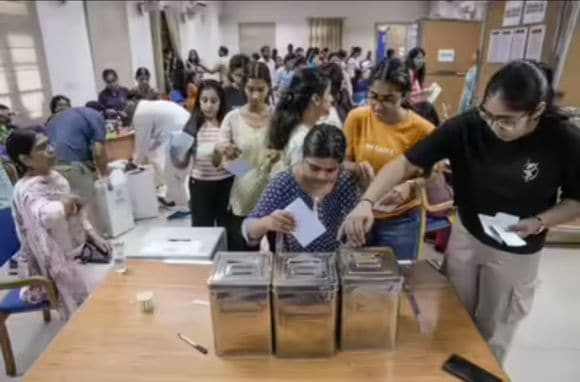
The voter turnout for this year’s Delhi University Student Union (DUSU) election stood at 39.36 per cent, a decent rise from last year’s turnout, which stood at 35.2 per cent, but it still does not meet the rate of 42 per cent, which was recorded in 2023. This was amidst a 3-year halt in the conduction of elections due to the COVID-19 outbreak. Polling was conducted at 52 centres with 195 booths, where 711 Electronic Voting Machines (EVMs) were deployed.

Chief Election Officer Raj Kishore Sharma said polling proceeded smoothly across most colleges.

Out of the 1.53 lakh registered voters, 60,272 students cast their votes. At Kirori Mal College, the turnout was 32 per cent.  Principal Dinesh Khattar said,

The college has successfully conducted polling, and the campus is clean… no defacement or waste lying around.

At Ramjas College, the turnout was slightly higher but still lower than the average at 37.52%. Principal Ajay Arora stated that,

Voting has been successfully held at seven booths.

Miranda House saw an active participation of over 2500 votes in the first phase. Polling in the college was conducted in two phases: from 8:30 am to 1:00 pm for day scholars and from 3:00 pm to 7:30 pm. Delhi Police deployed over 600 personnel, including 160 with body-worn cameras, while drones and CCTV surveillance covered sensitive areas.

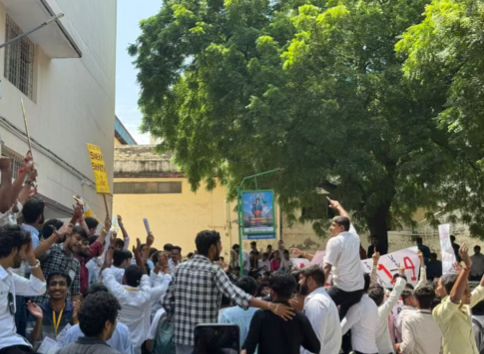
The election was conducted not without its hurdles; the area surrounding the campuses saw littering due to cards of candidates being distributed. Despite tight police control, clashes still occurred between rivals, and supporters of each faction gathered in huge numbers, resulting in road blockages and significant traffic congestion. 

The elections also witnessed controversies due to allegations of malpractice by the National Students’ Union of India (NSUI)’s presidential candidate, Joslyn Nandita Choudhary, alleging that she observed blue ink on the EVMs near the name of Akhil Bhartiya Vidyarthi Parishad (ABVP)’s presidential candidate, Aryan Maan.

Delhi ABVP State Secretary Sarthak Sharma responded by stating,

Just as the Congress blames EVMs after every electoral loss, NSUI is following the same pattern. Their desperation is evident from their fear of defeat and declining popularity among students.

This year, 21 candidates were contesting for the four main student body posts – President, Vice President, Secretary, and Joint Secretary. Of these, nine contestants were competing for the president’s seat, while the remaining were contesting for the other three positions.

Read Also: What Does the Student Body Want? 

Image Credits-: Sameer for DU Beat 

Divyanshi Dusad 

[email protected]

The Delhi High Court prohibited victory processions after the DUSU election results, citing security and order concerns.

On Wednesday, 17th September, the Delhi High Court ruled that no victory processions shall be carried out in the capital by candidates or their supporters post the result declaration of Delhi University Students’ Unions (DUSU) elections on Friday, 19th September. This has come from the bench comprising Chief Justice DK Upadhyaya and Justice Tushar Rao Gedela, in response to Advocate Prashant Manchanda’s plea, concerning widespread violations of Lyngdoh Committee norms and other poll codes. The latter had submitted photographs showing alleged violations being carried out by candidates. As per Law Beat and The Indian Express, it involved large-scale campaigning using money and muscle power,  traffic breaches and damage to public property. According to The Hindustan Times, the High Court has also warned:

We’re not interfering with elections, but if the elections do not happen in a satisfactory, peaceful and orderly manner, if your reports are not positive, counting may take place, but we will stop functioning of the office bearers of the election.

The Court took notice of the fact that once the counting concludes, victory processions taken out by the winning candidates and their supporters become difficult for the police and university authorities to manage. Following this, the Court has not only prohibited these victory processions in and around the university campuses and hostels, but has also directed the Delhi Police, the university administration and the local civil administration to take all necessary measures to ensure that no untoward incidents occur during the polling process or at any time before or after it. It further instructed that no violations of regulatory norms be allowed.

According to The Hindustan Times, around 2.8 lakh students cast their votes today. More than 600 police personnel were deployed to ensure a smooth voting process, including 160 equipped with body cameras. The Supreme Court-appointed Lyngdoh Committee, which delineates mandatory rules to ensure free, fair and orderly DUSU elections, has capped the election expenditure of each candidate at Rs 5,000, and has allowed only handmade posters, that too at specified locations and in limited numbers. However, violations in the form of large convoys of luxury cars, excessive use of graffiti and banners and traffic disruptions necessitating road detours are visible. The HC ruling prohibiting celebratory marches is aimed at maintaining peace and order during elections.

Read Also: From Lecture Halls to Delhi High Court: DU’s Bribery Scandal Ends in Justice


Image Caption: Delhi HC prohibits victory processions after DUSU election results


Image Source: The Hindustan Times


Nasheta Zaidi


zaidinasheta @gmail.com


The Delhi HC has prohibited victory processions after the DUSU election results, citing security and order concerns.

On Wednesday, 17th September, the Delhi High Court ruled that no victory processions shall be carried out in the capital by candidates or their supporters post the result declaration of Delhi University Students’ Unions (DUSU) elections on Friday, 19th September. This has come from the bench comprising Chief Justice DK Upadhyaya and Justice Tushar Rao Gedela, in response to Advocate Prashant Manchanda’s plea, concerning widespread violations of Lyngdoh Committee norms and other poll codes. The latter had submitted photographs showing alleged violations being carried out by candidates. As per Law Beat and The Indian Express, it involved large-scale campaigning using money and muscle power,  traffic breaches and damage to public property. According to The Hindustan Times, the High Court has also warned:

We’re not interfering with elections, but if the elections do not happen in a satisfactory, peaceful and orderly manner, if your reports are not positive, counting may take place, but we will stop functioning of the office bearers of the election.

The Court took notice of the fact that once the counting concludes, victory processions taken out by the winning candidates and their supporters become difficult for the police and university authorities to manage. Following this, the Court has not only prohibited these victory processions in and around the university campuses and hostels, but has also directed the Delhi Police, the university administration and the local civil administration to take all necessary measures to ensure that no untoward incidents occur during the polling process or at any time before or after it. It further instructed that no violations of regulatory norms be allowed.

According to The Hindustan Times, around 2.8 lakh students cast their votes today. More than 600 police personnel were deployed to ensure a smooth voting process, including 160 equipped with body cameras. The Supreme Court-appointed Lyngdoh Committee, which delineates mandatory rules to ensure free, fair and orderly DUSU elections, has capped the election expenditure of each candidate at Rs 5,000, and has allowed only handmade posters, that too at specified locations and in limited numbers. However, violations in the form of large convoys of luxury cars, excessive use of graffiti and banners and traffic disruptions necessitating road detours are visible. The HC ruling prohibiting celebratory marches is aimed at maintaining peace and order during elections.

Read Also: From Lecture Halls to Delhi High Court: DU’s Bribery Scandal Ends in Justice

Image Caption: Delhi HC prohibits victory processions after DUSU election results


Image Source: The Hindustan Times


Nasheta Zaidi


zaidinasheta @gmail.com


Congress leader Sachin Pilot campaigns at Delhi University on behalf of NSUI ahead of DUSU 2025 polls, backing Joslyn Nandita Choudhary and team as students debate for change against the ABVP dominance.


Congress General Secretary Sachin Pilot on Monday visited Delhi University’s North Campus, meeting students and expressing confidence that the National Students’ Union of India, or NSUI will sweep the upcoming Delhi University Students’ Union (DUSU) elections.

During his visit, Pilot, joined by the NSUI National President Varun Choudhary, and Delhi Congress Chief Devender Yadav, interacted with students at Miranda House, Campus Law Centre, and Hindu College. Outside Hindu College, tensions briefly flared when supporters of the NSUI and the Akhil Bharatiya Vidyarthi Parishad (ABVP) came face-to-face, shouting slogans before security personnel intervened to restore order.

Pilot said, 

Delhi University is one of the most important universities of our country. All four NSUI candidates will surely win with the support and trust of students,” 

He asserted that students were eager for change, citing the growing discontent with both the Union and State Governments. “The students believe in our ideology and vision, which will be reflected in the results,” he added.

The visit was part of a larger outreach programme by NSUI to highlight student-centric issues such as campus facilities, hostels, and academic reforms. According to an official statement, the campaign is aimed at mobilising support across colleges and presenting a credible alternative to the ABVP, which has traditionally dominated student politics at DU.

This year’s NSUI panel features Joslyn Nandita Choudhary, a 23-year-old postgraduate student of Buddhist Studies, as the Presidential candidate. Choudhary is the first woman in 17 years to contest for the top post. The panel also includes Rahul Jhansla for vice president, Kabir for secretary, and Lav Kush Badhana for joint secretary. Party leaders described the line-up as a “blend of fresh faces and representative voices.”

The DUSU polls for the 2025–26 academic session are scheduled for September 18, with counting to be held the next day. The elections are seen as a key barometer of student sentiment and often carry symbolic weight in national politics.

In last year’s elections, the NSUI staged a notable comeback after a seven-year gap, winning the President and Joint Secretary posts. The ABVP, affiliated with the Rashtriya Swayamsevak Sangh, managed to secure the vice president’s position and retained the secretary’s post. The contest this year is expected to be closely fought, with both outfits banking on strong mobilisation drives across the campus.

As the campaign heats up, Delhi University once again finds itself at the centre of high-energy student politics, with national parties keenly watching the outcome.

Read Also – Campus Promises: ABVP, NSUI, and SFI–AISA Manifestos 2025


Featured Image Source – Free Press Journal


Richa Choudhary

[email protected]


DU Beat in conversation with Sohan Yadav, contesting for the post of Vice President for Delhi University Students Union (DUSU) 2025, from the Students’ Federation of India (SFI), as a part of the AISA-SFI panel. This interview was originally taken in Hindi and has been translated into English.

S: What, according to you, is the biggest challenge that university students face, and how would you work on improving it?

S: There are three to four very common but major issues. Lack of Hostels and privacy are huge issues. Quality food is not available in most colleges, and colleges where quality food is available offer it at such a high price point that it is not affordable for many. At SFI, we believe that just like we succeeded in curbing the issue of fee hikes at Jawaharlal Nehru University (JNU), as a part of DUSU, we will do the same at Delhi University. We will provide metro passes to students, just as we have done at Hyderabad University. Additionally, we want there to be quality and affordable food at all colleges. Another huge issue is the degrading state of academics in the university. Our demands also include making the SEC and VAC papers completely additional and optional to allow students to focus on their main areas of interest.

S: . What are some key points within your election manifesto?

S: Right. So our first point is the democratisation of the Internal Complaints Committee (ICC) in all colleges, which is not the case in many colleges. The second point is the issue of hostels. Our third pointer is the issue of fee hikes. Our fifth pointer is about ensuring the functioning of a quality and affordable canteen in every college, and our sixth is the demand for concessional metro passes for students. Lastly, our seventh point is to increase student safety in and around campus spaces – we observe students being murdered and committing suicides around us, and we would like to take steps to curb this.  Another demand that is closely tied to this is the creation of quality medical facilities within colleges. In many colleges, while a medical room exists, psychiatrists, nurses, doctors and other professionals are not present in those rooms. Especially in today’s times, where so many students are suffering from mental health issues, it is necessary to ensure the presence of mental health professionals within the medical room of each college.

S: With increasing financial pressure on students, what steps would you advocate for better affordability?

S: See, there is only one solution to this. Firstly, the fee hikes that we face have already separated the oppressed classes and alienated them. When I used to study at Zakir Hussain College, every year, I used to fill the fees for at least six students by sourcing and collecting funds through my organisation. I myself have worked part-time jobs to fill the fees for two semesters after the fee hikes. So I fully understand the ripple effect of issues created after the fee hikes. So our main demand is putting a complete stop to fee hikes while simultaneously creating new policies and systems of support to help students from oppressed backgrounds who may not be able to pay their fees due to multiple reasons.

S: With increasing financial pressure on students, what steps would you advocate for better affordability?

S: Basic needs and amenities need to be targeted first. For instance, if a student is able to get affordable hostels and accommodation, costs will be reduced there; if they get concessional metro passes, travel costs will also be reduced; if they can get affordable food within their canteens, costs will also be reduced for food. So our continuous attempt after coming into DUSU will be the creation of a university where students get affordable travel, affordable food, affordable accommodation and affordable education to decrease financial burdens on students. It is our dream to create such a university space, just as we have done in JNU over the years.

S: What specific, achievable changes can you realistically deliver within your one-year term if elected, and how will you show that progress to students?

S: Right, so firstly, one of our immediate steps is to curb a very common issue, which is the lack of clean and functioning water coolers in colleges. This issue has not been settled until now, since coolers in many colleges stop working after every two months. We will also work towards maintaining quality and affordable food in every college canteen. Lastly, South Campus students have been facing this issue for a long time. The administration does not sit in the South Campus building, and as a result, they have to come to North Campus for many administrative issues. We will ensure that an administrative body also sits in the South Campus building, and lastly, we strongly believe that “keval chunaavi vaasi na chalein” (only vote-based actions should not prevail), so the special U buses should run even after the elections, and I will ensure that that happens.

Read Also: Interview with Anjali | AISA Candidate | DUSU Elections 2025

Image Credits: DU Beat

Interview by Sakshi Singh
[email protected]


DU Beat in conversation with Anjali, contesting for the post of President for Delhi University Students Union (DUSU) 2025, from the All India Students’ Association (AISA), as a part of the AISA-SFI panel. This interview was originally taken in Hindi and has been translated into English.

S: What, according to you, is the biggest challenge that university students face, and how would you work on improving it?

A: The biggest challenge is that there is a lack of trust between the students’ union and the student body as a collective. Students tend to think that student politics is limited to what they see around them, where being a part of the union is merely a launching pad for some and where hooliganism and muscle power dominate the scene. Access to quality facilities is also a huge issue—students spend more time studying VAC/SEC courses like Swach Bharat and Yoga, as opposed to their course of interest; the entire semester is taken up by multiple assessments under the IA/CA model, and with almost 45 marks being solely in the hands of the faculty, the democratic nature of the classroom is slowly eroding. Therefore, there is hooliganism on one hand and the eroding nature of education on the other, while the students suffer in the middle. 

S: What are some key points within your election manifesto?

A: Every student comes here with the aspiration of building a future for themselves, irrespective of their socio-economic background. Our first and foremost demand is access to quality education. Students come to Delhi University with the aim of studying their disciplines of choice, like History, English, Political Science, Economics etc in depth, but under NEP, in the name of “value addition” and “skill enhancement”, they are being made to study courses like The Art of Being Happy, Fit India, Yoga, etc., which are all subjects that they could have easily studied on YouTube, without coming into a “premier institution” like Delhi University. Moreover, issues like the surveillance of teachers within academic spaces and discrimination in the classroom further raise a huge question on the accessibility, affordability and quality of education in the university.

In the same Delhi University that was historically known for its diverse social fabric and witnessed students coming from a variety of backgrounds, the UGC (University Grants Commission) has been replaced by HEFA (Higher Education Financing Agency), which has led to a 20-25 per cent fee hike every semester. These hikes seem to say, “Gareeb ghar ki aulad ho? Tumhare maa-baap rickshaw chalate hai, auto chalate hai? To bhool jaao ki Delhi Vishwavidyalaya mei tumhare liye koi jagah hai.” (You belong to a poor family? Do your parents drive an auto-rickshaw? Then forget that there is any space for you in Delhi University). So, fee hikes are another issue that we are and will continue to fight against.

This is the same University where Dhani Ram, a professor from Ramjas College, harasses a first-year student, enjoys impunity, and further threatens her by saying, “Tumhare sattar number kaat lunga.” (I will cut your 70 marks). I am a graduate from Indraprastha College for Women, and 2.5 years ago, in our college’s fest, 230 written complaints were filed with the Internal Complaints Committee (ICC), despite which no action has been taken after the formation of a proctorial committee to date. We demand that all ICCs across colleges be functioning and democratic, with gender sensitisation workshops being made compulsory for the teaching faculty, non-teaching faculty, and the students.

Q. With increasing financial pressure on students, what steps would you advocate for better affordability?

Anjali: We strongly believe that the meaning of studying at Delhi University also means the ability to afford Delhi as a city, wherein the university itself is as big as a Lok Sabha constituency, consisting of North, South and Off-Campus colleges. Students from every corner of the country come to this university, but less than five per cent of students are able to get a hostel. The larger concerns about affordability and accessibility can only be addressed through the construction of more hostels.

In 2016 and 2017, the All India Students Association (AISA) launched a campaign titled “A Room of One’s Own”, showing higher authorities tracts of empty land which should have been, and can be, used for constructing hostels. In 2019, when a 39-storey building was constructed in front of the Vishwavidyala Metro Station, we protested and said, “McD, Pizza Hut ke bina zindagi chal jaayegi, Yaha hostel ka nirmaan kariye!” (We can live without McDonald’s and Pizza Hut. Make hostels here.)

A concessional metro pass is another demand. Travelling in a city like Delhi means that you have to spend around 100-120 rupees daily, and in this environment, just weeks ago, DMRC launched a notice increasing the token price in a range of Rs 1 to 4, depending on the distance. We are continuously fighting for concessional passes. We are from the student association that fought in 2017 to get concessional bus passes for students. Our model is that of resistance and continued struggle.

S: DU has a diverse student population across campuses, regions, and backgrounds. How will you ensure that voices from all corners of the university are included and represented?

A: If you look at the 2025 AISA-SFI panel and also the nature of politics that AISA represents, we have always fought for diversity and inclusion on the campus.

Even in this panel, Abhinandana hails from the northeast, Sohan worked as a security guard to pay his university fees, and Abhishek, whose parents came to Delhi in 2002, happened to fill out a form for the CRPF by chance and got a job through which he was able to get access to education. I hail from Gaya, Bihar, and in my village, most women have not studied beyond 12th. Even for my family, it is extremely difficult for them to understand why I am doing a master’s degree instead of focusing on marriage prospects. I feel that this resistance, the continued struggle for the education of all students of this university, is representative of its diversity. 

Additionally, we are from the student association that stood against communal hatred when a Northeast shop was attacked in Vijayanagara. We are from the student association that, along with 200 other students, marched into the Principal’s cabin at SBSC, after he slapped a Dalit student, demanding an end to caste-based discrimination, demanding his resignation and demanding the implementation of the SC/ST act. From Dhani Ram to the IPCW protests, AISA has been there, bearing witness to incidents of police brutality and administrative proceedings. I think our collective resistance is living proof of the fact that elections will come and go, but it is forces like us who will continue to struggle and work.

S: What specific, achievable changes can you realistically deliver within your one-year term if elected, and how will you show that progress to students?

A: Definitely, as I said before, the very burning question right now is quality, affordability and inclusivity. We will work towards the reduction of IA weightage, the restoration of quality education, democratisation and proper functioning of ICCs, the conduction of regular elections and gender sensitisation workshops for the ICCs across every college, and the provision of concessional metro passes for each and every student of the university. We will also fight for the creation of more affordable hostels and resist the arbitrary rise in rents of PGs and flats, demanding the implementation of the Rent Control Act.

Read More: Interview with Abhinandana Pratyashi | SFI Candidate | DUSU Elections 2025

Interview by Sakshi Singh

[email protected]

Image Credits: DU Beat