Tag

dusu

Browsing

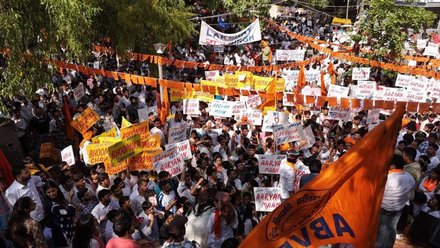
The National Students’ Union of India (NSUI) launched a protest on 13th August at the Arts Faculty of Delhi University’s North Campus calling for 12 days of menstrual leave per semester for female students of DU. Using the slogan, ‘From Pain to Power,’ and imprinting nearby walls with red handprints, the protest gained traction from students across the DU circuit.

The demonstration, carrying out a signature campaign in furtherance of their advocacy, was held under police supervision.

“Every signature is a stand for dignity, equality, and the right of female students to rest without stigma,” NSUI had claimed via a post on their official Instagram account.

Varun Choudhary, the nationwide President of NSUI emphasised on menstrual leave as a basic right for every female student, stating that, We will continue the fight until Delhi University implements this rule, as this provision exists in many universities in India and abroad. NSUI has also fought for this in Panjab University,” he said.

According to the student outfit, menstrual health significantly influences female students’ academic outcomes, mental well-being, and active involvement in campus life. They emphasised that neglecting this concern often leaves students with the difficult choice of missing classes, or they get bound to endure considerable discomfort merely to satisfy attendance criteria, not excluding other curricular commitments that they have.

NSUI urged Delhi University to formulate policies that accommodate female students’ plight in order to make campus more inclusive and gender sensitive. The organisation vowed to continue their efforts to urge educational institutions to implement multi-stakeholder policies. 

Image Credits: NSUI Delhi via Instagram 

Divyanshi Dusad
[email protected]

Also Read: DUSU and Central Council Elections 2025-2026: Official Timeline Announced 

University of Delhi has revealed the official calendar for the election of office bearers of the Delhi University Students’ Union (DUSU) and Central Council members for the academic session 2025-2026. The announcement marks the beginning of one of the most dynamic and politically vibrant seasons of the academic year, with the election process scheduled to take place in September. 

The official notification issued by the Registrar sets 10th September, 2025, as the deadline for the submission of nomination papers, which must be filed by 3:00 p.m. and accompanied by a demand draft of Rs.500, alongside an affidavit, and a bond of Rs. 1 lakh. Scrutiny of nomination papers will take place the same day at 3:15 p.m., with the list of duly nominated candidates to be published at 6:00 p.m. For DUSU positions, nomination papers must be put in a sealed box located at the Office of the Chief Election Officer, Conference Centre, University of Delhi, North Campus. For Central Council elections, nominations must be filed with the respective college or department. Nomination forms can be accessed and downloaded from the official Delhi University Website. 

Candidates who wish to withdraw their nominations must do so by 11th September, 2025, before noon. The final list of candidates running for office will be published later that day at 5:00 p.m. The polling day is set for 18th September, 2025, followed by the counting of votes which will take place the next day on Friday, 19th September, 2025.

The voting process will be conducted in two stages. Students enrolled in day classes will vote during the window of 8:30 a.m. to 1:00 p.m. and those in evening classes must vote from 3:00 p.m until 7:30 p.m.

The notification further aligns itself with the Code of Conduct, DUSU Constitution, and court orders from the Supreme Court of India and the Delhi High Court. It reiterates that the procedure would be carried out in compliance with the Delhi Prevention of Defacement of Property Act (2007) and the National Green Tribunal guidelines. 

With the schedule now in place, the university is set to witness a charged election season, as student organisations and candidates prepare to campaign for leadership positions in one of the country’s most closely watched student political arenas. 

Image Credits: Sushil Kumar Verma

Navya Chandok
[email protected]

Read Also: DU Issues Anti Defacement Measures; Mandates 1 Lakh Bond Rule For DUSU Poll Candidates

With a rebrand, AAP’s ASAP enters the DUSU race promising a new political culture — free from education mafias and rooted in equity and reform.

The Aam Aadmi Party’s rebranded student wing, the Association of Students for Alternative Politics (ASAP), has kicked off its campaign drive a month ahead of the Delhi University Students’ Union elections. Relaunched in May with a new name and mission, AAP National Convenor Arvind Kejriwal promised to turn student activism into a force for national transformation. Previously known as the Chhatra Yuva Sangharsh Samiti (CYSS), the party was established in 2014 to bring AAP’s vision of “alternative politics” to campuses. CYSS made its debut in the 2015 Delhi University Students’ Union (DUSU) elections but failed to secure any seats. Despite winning the president’s post in the Panjab University Campus Students’ Council elections in 2022, CYSS’s presence and influence in campus politics remained largely limited. The party, thus, struggled to gain a foothold.

ASAP’s logo features a torch-shaped fountain pen nib. Kejriwal stated,

The mainstream politics of the past 75 years is the root cause of all problems in India,” describing the launch as a departure from a system where elections are won through the misuse of power. ASAP’s mission, he added, was to “win hearts”.

Although the on-campus presence of ASAP is comparatively smaller than that of its competitors — the BJP’s student wing, Akhil Bharatiya Vidyarthi Parishad (ABVP), and the Congress’s student wing, National Students’ Union of India (NSUI) — there has been a subtle shift in allegiances, with several former ABVP and NSUI members now seen in ASAP. The Lyngdoh Committee recommendations stipulate that no candidate should be allowed to spend more than ₹5,000 or use printed material such as posters and flyers; however, “money and muscle power” continue to be evident through large hoardings, the distribution of printed manifestos, and the use of branded vehicles for campaigning.

As reported by The Indian Express, Deepak Bansal, a former DUSU joint secretary (2011) and ex-ABVP member who joined CYSS in 2023, stated that contesting DUSU elections has traditionally required significant financial backing, with candidates often expected to come from affluent backgrounds even to be considered. Therefore, it closes doors on students hailing from middle-class families, who have ideas and vision but no political godfather. Another issue, highlighted by The Indian Express through Ishwar Chand — who served as ABVP’s Delhi state president from 2009 to 2015 and joined AAP last year — is that tickets are almost always given to Jats and Gurjars, typically those with political clout and money, citing a “regional advantage.” He added that it was not just ABVP, and that NSUI too operated in the same manner. A massive number of DU students from UP and Bihar are left without a voice because candidates are chosen based on wealth and caste.

Moreover, another Delhi University student told The Week that the dominant national parties don’t often pick issues that resonate with students. If they do, however, pick relevant issues, many students may turn towards them. ASAP’s entry into the DUSU race thus represents an attempt to widen the space for participation in campus politics.

In the words of AAP’s Avadh Ojha,

ASAP’s mission is to make the people feel that they are the true rulers of this nation, and that they must demand their rights from the government.”


Read Also: Delhi University Earns an A++ NAAC Grade Upon the Second Round of Evaluation

Image Source: PTI/India Today

Nasheta Zaidi

zaidinasheta @gmail.com


Delhi University’s new DUSU poll guidelines mandate a ₹1 lakh bond to curb defacement, sparking backlash over affordability and fairness from various student organisations.

Delhi University on 8th August issued a new set of guidelines that direct DUSU (Delhi University Student’s Union) poll candidates to endow a bond of Rs. 1 lakh at the time of filing nominations for any defacement or poll code violation. This comes amidst the advent of DUSU elections for the new session, which is expected in September. 

This amount will be liable for forfeiture if the candidate or their supporters are found violating defacement norms,” the advisory issued by DU Registrar Vikas Gupta stated.

This move was met with significant backlash from various student organisations on grounds of being uneconomic for the common folk, especially candidates from relatively underprivileged backgrounds, and being “exclusionist” in nature. 

Someone from a lower-income background may not be able to afford the Rs 1 lakh bond required for nomination, which could prevent them from participating despite their willingness,” Ronak Khatri, the incumbent president of DUSU, told PTI.

 He urged the university authorities to hold candidates individually accountable in case of any violation by lodging direct fines instead of mandating them for all candidates in general. 

We welcome the guidelines, but we oppose the provision that requires students to submit a ₹1 lakh bond. It is not convenient for students to pay such a huge amount. We will soon release our own guideline in response to this,” said ABVP National Secretary Sarthak Sharma.

All India Student’s Union (AISA) President Nitish Kumar supported the motive of curbing electoral malpractices; however, he raised questions about the monetary constraints that the guideline imposed. 

We welcome rules that aim to ensure transparency and reduce malpractice. However, merely depositing a bond of one lakh rupees cannot prevent the misuse of money power. In campuses like JNU, elections are conducted without the use of money,” he said. “The volume of money power used in DUSU can only be curbed by placing stakeholders in a more informed position,” he further added.

 He highlighted that during the Joint Proctor’s meeting, he proposed to democratise the election process through presidential debates, but he was met with no response from the authorities. 

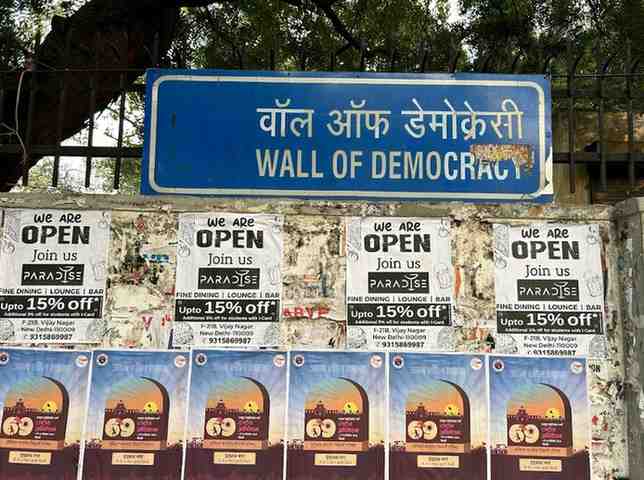
The directive included a range of guidelines with adherence to court orders and the Lyngdoh Committee, such as an anti-defacement affidavit at the time of admission and barring the use of loudspeakers, rallies, and roadshows outside designated “walls of democracy”. Violations may attract a fine of Rs 25,000, suspension, rustication, or even disqualification.

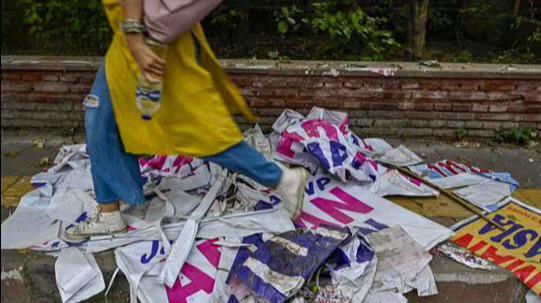
The results of DUSU elections 2024 were delayed by two months due to outrage over rampant vandalism committed during election campaigning by various student outfits and Delhi High Court intervention directing student organisations to restore defaced property.


Read-DUSU 2024: An Election in Waiting

Image Credits – Nabeera for DU Beat

Divyanshi Dusad

[email protected]

DU Arts Faculty Dean stepped down after student protests over exam delays. The incident involved allegations of negligence and chaos following the postponement of a political science general elective exam. 

The dean of Delhi University Faculty of Arts, Mr Amitava Chakravarti, resigned on Monday, January 6, following a heated student protest. He was allegedly heckled by a group of students led by the Delhi University Students’ Union (DUSU) President, Ronak Khatri. The protest erupted after students of the Russian department were unable to receive the question papers for their political science general elective exam on time causing postponement and rescheduling of the exam. Frustrated by the situation, a group of students gathered at the dean’s office, demanding his resignation. The confrontation turned chaotic, with students accusing the dean of negligence. 

In a post shared on X, Ronak Khatri stated

HoD of the Language Department and the Dean of the Arts Faculty were drunk, and their gross negligence caused students to suffer today. Over 60 students were unable to take the General Education (GE) Political Science exam. We have also learned that he abuses both students and administrative staff. We have demanded his immediate removal and disciplinary action against him.” 

Khatri also accused the Dean of abusing students and alleged that he was intoxicated at the time of the incident. The video accompanying the post shared by the DUSU President on Instagram and X shows the dean being surrounded by a group of students.  The video also shows a member of the faculty who accused the dean of creating a hostile environment and claimed,

“Since he (the dean) has come, every student and teacher in the Russian section have been ruined.” 

As the situation grew more tense, the dean reportedly fainted due to low blood sugar and was promptly rushed to the hospital. In a conversation with DU Beat, Mr Chakaravarti revealed that he was taken to Pramanand Hospital, where he was treated in the emergency room. He also stated,

Even in the hospital a few student leaders kept on entering the emergency room and threatening me while I was just regaining my consciousness.” 

Since then, the dean has submitted his resignation to the director of South Campus. Furthermore, he has firmly denied the students’ and the DUSU president’s accusations of intoxication, calling them baseless and defamatory. According to Times Now, he has stated that he might consider filing a defamation case against individuals spreading false allegations. 

In the letter to the Director of South Campus, Chakravarti explains,

“However, on 6 th January, 2025, the examination could not be started on time due to some communication gap between the offices involved. That day itself I had an online meeting of a national level expert group regarding the promotion of Bangla as a Classical Language from 9:30 a.m. Hence, when I could check my mobile for missed call and could call back, I came to know of the delay and the student unrest about this, and rushed to the Department.

He further adds that it was in fact one of his colleagues who took advantage of the situation and instigated the students to go against him,

“The said colleague, knowing very well of the reasons of me being holding that position, or that of my name being included as Ph.D. supervisor with a retired teacher of Russian as the Co-supervisor, instigated the students by accusing me of wrongdoings, and underlining the fact that I am a teacher of Bengali. This led to the student leaders abusing me further, asking me to read from a Russian text, say various types of Russian words, and responding to Russian comments of the students, all in the presence of the said colleague.There were sloganeering in his name as well.

Speaking with DU Beat, NSUI member Namrata Jeph said, 

The students’ grievances about the exam delay were valid although this situation led the dean to decide to resign may have crossed the ethical boundaries. Ultimately, this incident could serve as a catalyst for improving administrative transparency and student- faculty communication within DU.”

According to the dean, the unfortunate incident has now “created a precedent wherein teachers could be physically and verbally harassed and made to submit resignations, that too with the active participation of a colleague from the Department.” 

Read Also: Dalit student allegedly harassed and assaulted by Shaheed Bhagat Singh College’s principal. 

Featured Image Credits: Devesh for DU Beat 

Ashita Kedia

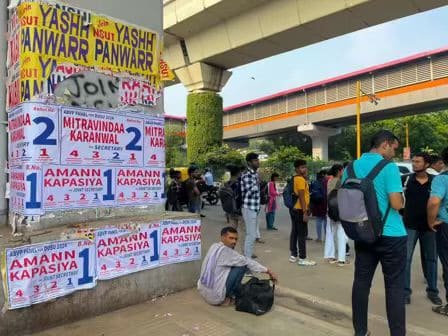
Characteristic of DUSU elections, the DUSU elections for the session 2024–25 were also a display of money and muscle power, tearing up of nomination forms, and a rather irreverent attitude towards the Lyngdoh Committee guidelines for the elections. The emergence of identity-based parties, an SFI-AISA alliance, and the Delhi HC directive to postpone counting of votes augur major changes. Despite this, the voter turnout remained abysmally low at 35.2%, the lowest of the past 4 elections, and from what students claim, this reduction seems to be manufactured by the administration. 


Slated to start its counting post the 21st of this month after the court hearing scheduled on the same date, this year’s DUSU elections were different from all previous elections. From the alliance between the Left and the emergence of identity-based parties like Ambedkar Students’ Association (ASA) and Fraternity Movement in DUSU to the last moment introduction of special buses, the inauguration and removal of a miniature Ambedkar statue by the DUSU, and eleventh hour changes in presidential candidates of major parties, this election saw it all and was, by far, one of the most happening elections of all times. Despite these developments, it seems unlikely to have such a low voter turnout. Though the hostile nature of the campus during elections and the rather short time frame for voting discourage a lot of students, especially female students, and thus, voter turnout appeared unnaturally low. 


According to Hindustan Times, the voter turnout for this year was 35.2%. It is important to remember how the voter turnout is calculated in order to understand the trends for this election, as the figure measures the number of votes cast as a percentage of the eligible voters rather than the number of voters who come to their institutions to cast votes. It is the gap between the number of eligible voters who show up on the day of voting and the number of votes cast, reflecting the number of voters who were unable to cast their vote despite showing up on the day of elections. While this gap has emerged in the previous elections too, it seems to have widened rapidly in this election, making it seem ‘manufactured’ by the administration to decrease the number of votes cast, as per the claims of the students. This gap was exacerbated by issuing last-minute notices in several colleges that set out the eligibility criteria to vote in the elections and made students stand in long queues in administrative offices on the day of voting, to update their ID cards that took hours, leading to situations where the voters were unable to cast their vote past, despite their early arrival in college. Further, in several colleges, only a handful of polling booths were allotted for the entire institution despite the availability of more polling booths, making 1000s of eligible voters poll from a single booth. These booths were also changed at the last moment, creating confusion around the venue for voting.


A third-year student from Ramjas College notes:

I couldn’t vote because I was 2 minutes late. There was a big jam on the campus, and no auto was able to make it through, and as soon as I got to the college gate, they didn’t let us in. I waited there for a while to enter, and as soon as I did, there was so much confusion with the venue of the voting; some said the auditorium, and some said other classes. When I finally found the classroom, they didn’t let me join the line as I was 2 minutes late. The faculty was rude, and they were shouting at us without listening to a word we said. I wasn’t the only one who was left out, and there were a lot of other students as well.


Though several colleges had sent out last-minute notices about verification of fee slips and upgradation of ID cards for all voters, in stark contrast, it turns out that at several institutions, the faculty was not checking whether the ID cards of students had been upgraded. 


Another third-year student from Ramjas notes:

Though the college had notified students to verify their ID cards, several students, including me, were only asked about our courses and year of study and were allowed to vote even regardless of whether our ID cards were updated or not. The faculty members at the polling booths were not following the rules as a lot of students were in the queue to vote. While I was voting, the DUSU presidential candidate of a major political party entered our booth and was openly campaigning, and no faculty members present in the booth stopped him, despite this being a clear violation of the guidelines. They rather allowed him to speak.


Though bureaucratic mismanagement and chaos are natural in such a large election, a lot of the aforementioned incidents seem deliberate and conscious attempts to dissuade students from voting. Even while the students were verifying their ID cards, the candidates were openly campaigning and helping those in queue using their contacts in the college administration to get their ID cards verified faster to garner more votes. This ensures that only a selective and chosen crowd gets to vote in the elections, and a large crowd of students is not allowed to exercise their right to vote despite their attempts to do so.


A student from Miranda House notes the manufactured chaos in the order of voting in the elections:

Students remember the ballot numbers of each candidate, and that’s how polling booths are supposed to work. In Miranda House, in the initial phase when the elections started, the order of positions in the polling booth was informed to us as President, followed by Vice President, Secretary, and the Joint-Secretary but later on, as the elections went forward, they altered the position. The Joint-Secretary’s position was moved to the first, and the President’s position was moved to the last in the polling booth which caused a lot of confusion among students because that is not how you come memorising the numbers.


Though bureaucratic mismanagement led to a further decrease of voter turnout, the developments in this year’s elections will have a long-term impact. With the strict action taken by the Delhi High Court to ensure that counting doesn’t begin until public defacement is removed, it could potentially tamper with the results but might result in lesser defacement and a violation of rules next year. Further, the directive to ensure 50% reservation of women in DUSU would also have a positive impact. In terms of party politics, sudden changes in candidates of major parties post-nominations and the withdrawal of community support following the same might lead to a reflection about the role of caste politics in DUSU. The emergence of identity-based parties and the alliance among the Left would also ensure that the ABVP-NSUI binary is challenged in the upcoming years.


Read Also: Under the Shadow of DUSU Elections: A Stage for Sexual Harassment and Caste-based Politics


Picture Credits: Nehal for DU Beat


Vedant Nagrani

[email protected]

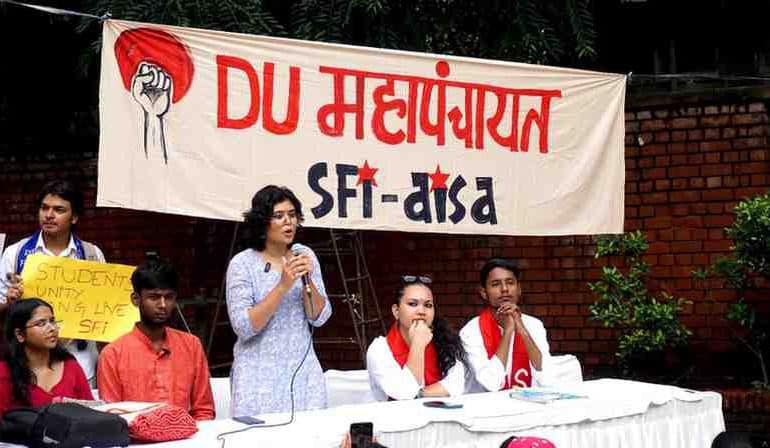
We spoke to Sneha Aggarwal, a recent graduate from Ramjas College, who is currently a student at Law Faculty, DU. Aggarwal is the candidate of the left-wing alliance between AISA and SFI. She is an SFI member. 


Interview took place on September 18, 2024


Question: What motivated you to run for the position, knowing the degree of  money-muscle politics?


Sneha Aggarwal: Everyone has to face this, those who have any ideological bearings. Money and muscle power have always been a part of student politics but as DU deteriorates and students don’t have any alternatives other than ABVP and NSUI – it shows the need for someone to step up. Being a part of SFI has shown me that you need to be present. 


Question: How do you plan on keeping students informed about the union, and taking feedback?


Sneha Aggarwal: SFI has always managed to do so with its mass presence and membership with units across 20 colleges. We also don’t use ideology as a filter for members. Our social media presence, and GBMs or general boarding meetings across colleges is how we communicate. 


Question: What is the biggest challenge students are facing?


Sneha Aggarwal: There are several: fee hike, [lack of] hostel facilities, women’s safety – Union is not representing students’ issues. DU is a central university and a public school, it must continue to  financially alleviate those who cannot afford to do so themselves, DU cannot just be for day-scholar students and the financially privileged 


Question: How will you measure the success of your manifesto’s initiatives, if elected? 


Sneha Aggarwal: If elected, we have a formal platform to put pressure on and communicate with the administration as seen from JNU where we got hostels made and metro paths created


Question: Why did you decide to create an alliance [with AISA] this time?


Sneha Aggarwal: We saw a similar model of left unity being followed in JNU as well, given the need to contest the right-wing influence. The same process is underway in DU – the ABVP has risen because members of the Sangh have entered the administration due to the government’s favour, even the faculty has been affected –  SFI and AISA have lean to the left, we have a shared ideology, shared goals, and more importantly – a need to counter muscle and money. 


Question: NSUI also has a parent national party, the Congress which recently formed the INDIA alliance. Why was the national model of alliance-making not enacted at the  university-level? 


Sneha Aggarwal: NSUI is already in the union so it has already had an opportunity to represent, which has been inadequate. The use of caste politics or muscle power isn’t just limited to the ABVP, NSUI too is becoming similar. We cannot ally with someone simply on the basis of their national party. 


Question: How do you strive to ensure that the students’ demands for hostels are fulfilled without conflict?


Sneha Aggarwal: Being in the Union gives formal channels of communication as well as the ability to put pressure [granted student legitimacy]. We intend on pointing out that there is space for expensive student centres and Nescafe kiosks but not for hostels. There is a need to better utilise space and resources. Like the promise of university special buses is only mentioned during elections, citing that there was an unused COVID fund, misuse of money should not happen, there should be a common student union fund. 


Question: How does SFI plan to make campus more inclusive for all marginalised groups? 


Sneha Aggarwal: There are already many SC/ST cells, WDC, queer cells in DU but the issue is functioning. In my alma mater itself, the SC/ST cells were headed by professors who’d make distinctions according to class. Only Miranda’s [College] queer cell is officially recognised. The Union must get these cells recognised and function effectively. Even with the functioning of CASH committees and ICC, they’re responsible for more than just complaints and cases but also effective sensitisation of the student body towards the issue. 


Question: Why is your stance anti-FYUP and what alternatives do you propose? 


Sneha Aggarwal: There are many issues with the implementation of NEP and the four-year programme – they’re imposing the American which only caters to a few who can afford higher education abroad so why four years? Eventually, they’re trying to make it almost compulsory[B.A. programme requirement to qualify for an Honours degree] yet there are multiple entry and exit –  this is simply education commercialised. UGC scrapped education loans and moved towards privatisation as seen with Hindu’s College, where hostels have been leased out to private contractors. We suggest a survey across the country and especially DU, to see which students are dropping out the most and then implement, in order to encourage these communities to finish their degrees. There is also the  SFI policy of NEP 2.0. 


Question: Parties like ASA and Fraternity all support identity politics yet they do it as a means of representation and criticise left for fielding mostly upper class candidates, how do we make a choice? 


Sneha Aggarwal: Many of our left leaders themselves are from marginalised groups – this time there’s many women on the panel from varying backgrounds. But on the matter of identity, there are many such who do contest. Left believes in overall emancipation, not just that of a singular identity. 


Question: Was there an attempt to ally with these parties like in JNU? 


Sneha Aggarwal: We don’t believe in this, this is not our politics. In JNU,  there was a need for the SFI-BAPSA alliance given the right-wing turn. 


Question: Is the alliance anti-ABVP or ideologically driven? 


Sneha Aggarwal: We are driven by our goals — for the students’ needs to be fulfilled, that is our common ground. Our functioning remains different. 


Question: The Left is criticised for themselves being hypocritical with their stances, particularly when it comes to internal misogyny? How will you fight these forces? 


Sneha Aggarwal: Simply being a communist doesn’t erase patriarchy, given the way society functions and shapes us. This is reality, simply to “de-class” oneself isn’t enough  but must also sensitise oneself. If we make it to the Union, we can only try to self-correct through [constructive] measures but not by boycotting or “cancelling”. The aim is to support growth. 


Read Also: Interview with Dr. Abha Dev Habib


Image credits: DUB Archive


Interviewed by Bhavana and Vedant 

[email protected]

[email protected]


We spoke to Shivam Maurya, a first-year B.Com (Hons.) student at Hindu College, contesting for the post of president from DISHA Students’ Organization, ahead of the DUSU elections scheduled for September 27, 2024. 


Question: What in your individual capacity motivated you to contest for election?

Shivam: We come from very far-off to the nation’s biggest university, it is however not how people say it is. We are not being provided with hostels. Looking at fees, you think it’s low but when you have to pay it. My own fee is  Rs. 26,870; it’s too much for a middle-class student.

Question: What do you see as the biggest challenge that students face today?

Shivam: The biggest challenge is anti-student policies. Policies like NEP, FYUP teach students skill-based knowledge so they can do some fixed work for fixed industries. These are designed in a way that disallows lower-class people from coming forward. Seen this way, the most-backward can never make it to the front.

Question: You talk of “merging the student-youth movement with the struggle of the working masses” in your manifesto. How do you interpret this? 

Shivam: Like we have students and working-class individuals, this statement is not for the elite.

Question: Also, what is a ‘common minimum programme’?

Shivam: Common minimum programme reflects common interests and problems of students like fee hikes, hostel accommodation, and (un)employment.

Question: Your manifesto repeatedly refers to the ‘common student’. What is this common student in your understanding? Is every student in DU a common student?

Shivam: At a basic level, every student is a common student. Several students, however, take admission [in DU] to spread propaganda for selfish purposes. Those are in no way common.

Question: The image of Bhagat Singh is your ideological representative, ABVP uses that too. How is it different?

Shivam: For us, Bhagat Singh’s ideology is that of equal education, opportunity, and [equal] treatment of everyone. But as you say ABVP uses Bhagat Singh’s iconography as well but – in a false manner and they throw their pamphlets over roads and use Bhagat Singh to save themselves[for their own political benefit].

Question: How does not being aligned to any party help you during elections? One can see this as a weak ideological position but, how is it a strength? 

Shivam: We have to understand the difference between a political party and a student organisation. If you are aligned to a political party then you represent the party rather than students, like ABVP and NSUI do. Whereas, DISHA represents only students and you think of it as a weakness but it is not a weakness.

Question: SFI and AISA have come into an alliance for left-unity, DISHA can also be ideologically interpreted as a left party. Did you approach them for an alliance?

Shivam: We do not feel it should be ideologically-run as every student who aligns themselves with our common minimum programme is welcome to join DISHA. If we only take someone from a fixed ideology then students of different ideologies are excluded. 

Question: But the way you claim that ABVP-NSUI have a politics of money and muscle, but even their politics come from ideas that are accepted by the masses who elect them to power. Your manifesto claims DISHA has no ideology. Isn’t it a weakness that you don’t have an ideology? 

Shivam: No, it does not mean that we’ll let anyone join the organisation. If someone promotes casteism or hooliganism, we won’t keep them in the organisation as they are violating our common minimum programme. 

Question: Several members of DISHA have often been seen indulging in online debates using heavy terms that might not be accessible to marginalized students who are not familiar with Marxist discourse. This is contrary to your manifesto that states you don’t have an ideology. How far do you think these debates can be stretched in order for them to not reduce to in-fighting?

Shivam: What members of DISHA do, is their own matter. The organisation is isolated from this. 

Question: So, your members’ actions are separate from the organisation?

Shivam: We are concerned as to what they do at the level of the organisation. We can’t interfere in their personal lives.

Question: How does your organisation plan to include students from gender, religious, and caste minorities, LGBTQIIA+ students, and students from economically weaker sections? 

Shivam: We see them all equally. We oppose their oppression but we do not oppress them. They all can come with us and fight and we are with them too.

Question: Systems of power oppress them. For instance, the recent Delhi HC directive about ensuring 50 per cent representation of women in DUSU counters gender oppression. Is DISHA doing anything to ensure this representation and inclusivity?

Shivam: It’s nothing like that. It’s not necessary that only women can understand women’s issues or only Dalits can understand Dalit students’ issues. From time to time, our organisation protests or engages in struggles whenever necessary. As students see us and recognise our struggles, they’ll try to join us.

Question: The DUSU candidates of DISHA are not as publicly visible as other candidates are. This makes mobilization of students difficult as candidates are the face of any organisation. Why so? 

Shivam: We are trying our best but we are unable to gather such a large outreach. 


Image Credits: Devesh for DU Beat


Read Also: Interview with Dr. Abha Dev Habib


Interviewed by Bhavana and Vedant 

[email protected]

[email protected]

Fraternity Movement, Delhi University released a statement on 19th September 2024, condemning the actions of NSUI members for confiscating and ripping the nomination form of their candidate, Yaseen K. Muhammad, in front of the DSW office gate. Representatives of the NSUI have declined to address the matter or refute the accusations.

On Thursday, 19th September 2024, Fraternity Movement Delhi University released a statement alleging that the National Students’ Union of India (NSUI) “goondas” forcibly confiscated and tore the nomination form of their candidate, Yaseen K. Muhammad, right outside the gate of Dean Students Welfare (DSW), Conference Centre, University of Delhi. This happened in front of the police officers and security guards, who refused to do anything and played mere spectators to the incident. The NSUI members have refused to comment on the issue and ignored the texts and calls asking them to deny or accept the allegations.

Yaseen K. Muhammad, in conversation with DU Beat, spoke about the incident:

“It was very terrifying that day. On the way to submit my nomination, I entered through gate no. 4 of the University of Delhi, Botany Department. As I entered gate no. 4, my documents were checked by the ABVP and NSUI members. They don’t have any right to check my papers, but they still checked my papers in front of the police and other security guards. I got the entry after their verification, and I went straight to the DSW office, where the nominations were to be submitted. At the gate to the DSW office, while I was stating my name and other details to the security guard, a NSUI cadre snatched my nomination form in front of everyone and tore it. To not leave any evidence, the person put the pieces of my nomination form in their pocket. All the high-ranking police officials and security guards surrounding us did not protect me, nor did they stop the NSUI members from snatching and tearing my nomination form.”

Interestingly, Yaseen had contested for the position of Vice President in the 2023 DUSU elections. However, his nomination form was rejected due to some discrepancies related to the documents. In the official statement, released on their Instagram page, Fraternity Movement, Delhi University stated:

“In an attempt to undermine the democratic process and avoid the consequences of a potential defeat in the DUSU elections, NSUI goondas restored to obstructive tactics by forcibly confiscating the nomination papers of Fraternity Movement candidates as they were en route to file them. These actions escalated further as the miscreants unlawfully entered the election commission office, endangering vital election documents. Alarmingly, the election commission showed no intention to intervene, effectively enabling these anti-democratic manoeuvres. This organised disruption by NSUI, driven by fear of losing the ideological contest, seeks to derail the electoral process.”

The DU Beat team tried to approach the NSUI members several times; however, the texts and calls were initially ignored. An NSUI member denied commenting on the issue by stating that he was out of station and refused to get us in contact with any other NSUI member who could speak on the issue. After multiple attempts, we briefly reached another representative. However, the call was cut short with a statement indicating a willingness to speak later. Despite follow-up efforts, no further communication was received by the time of the publication of the report.

A 2nd-year university student who accompanied Yaseen to the DSW office alleged that:

“While our candidate was allowed only one supporter to enter, the place was filled with ABVP and NSUI members and their supporters. If I am not mistaken, Abhi Dahiya (Vice President DUSU) was present there when one of his cadres snatched and tore the nomination form of our candidate. I have only had a year participating in all of this election fiasco, but I am very sure that NSUI members were the ones who ripped off Yaseen’s form.”

As of the latest updates, Yaseen will not be able to stand up for the position of secretary due to not being able to submit his nomination form. The Fraternity Movement movement, in their official statement, has demanded an extension of the nomination deadline and accountability for the perpetrators. However, the Delhi University authorities have not condemned nor released any statements regarding the incident.

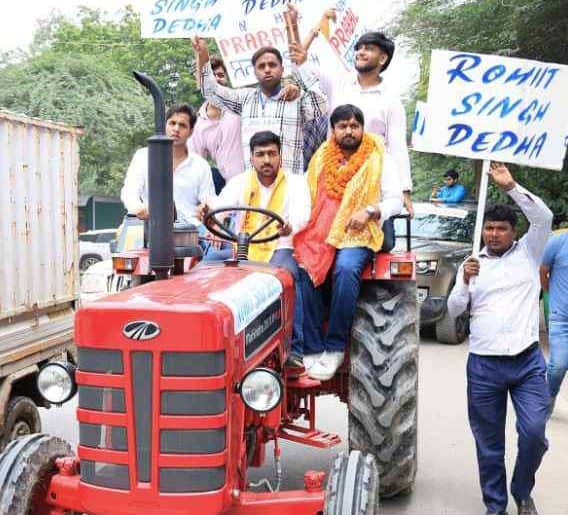
Read Also: Controversy Erupts Over Tushar Dedha’s Presidential Candidature as DUSU VP Files Complaint

Featured Image: Arush for DU Beat

Reeba Khan

[email protected]

DUSU elections 2024 schedule has been released by DU. Elections are to be held on September 27 in two shifts. Results will be announced on September 29. 

Delhi University has notified that the students’ union elections will be held on September 27. Votes will be counted a day later and the results are likely to be announced on September 29. 

Separate slots are allocated for the convenience of morning and evening batch students on the day of the election, notified with a circular released on September 2nd laying out a schedule for the same. The elections will be held between 8.30 a.m. and 1 p.m. for morning batch students and from 3 p.m. to 7.30 p.m. for evening batch students.

The notice also mentions that the last date for the receipt of nominated candidates and their affidavit along with a sum of five hundred rupees is September 17th till 3:00 pm. 

The filed nominations can also be withdrawn by September 18 till 12 noon. After careful examinations, a final list of the nominated candidates will be published on the same day at 6:00 pm. 

The votes will be counted on September 28, at Police Line. The prescribed nomination papers shall be dropped in the sealed box kept outside the office of the Chief Election Officer, DU elections, 2024-25, as stated in the bulletin. 

The Chief Election Officer, Mr Satyapal Singh of the Sanskrit Department, the Chief Returning Officer, Mr Raj Kishore Sharma of the Chemistry Department, and the Returning Officer, Dr Rajesh Singh, the University Librarian, will ensure the smooth conduct of the elections. These appointments were made by Vice Chancellor Yogesh Singh, as detailed in the notification dated August 29.

While the student body awaits the elections to take place this year, last year Akhil Bharatiya Vidyarthi Parishad (ABVP) members Tushar Dedha and Sachin Baisla were elected for the post of the DUSU President and Joint Secretary, and Aparajita as the Secretary. The union was formed with the election of Abhi Dahiya, a member of the National Students Union of India (NSUI) as the Vice President. 

Read also: 10 Days,10 Women,10 DUSU Presidents

Featured image credits: Ananya for DU Beat

Taruni Banerjee 

[email protected]