Tag

dusu

Browsing

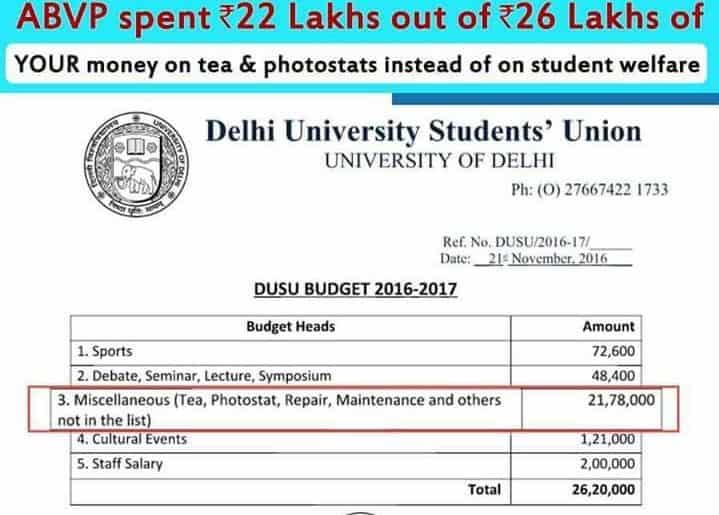
Right before elections, a photo uploaded by the National Students’ Union of India (NSUI) had started making rounds on the internet. The picture alleged the Akhil Bharatiya Vidyarthi Parishad (ABVP) of spending Rs. 22 lakhs out of the assigned 26 lakhs for the Delhi University Students’ Union (DUSU) budget on tea.

Soon, there was an outrage in the student community regarding the blatant misappropriation of expenses. NSUI officials claimed that Mr. Mohit Garid, the Joint Secretary of DUSU, provided the information as he has got access to all DUSU official records.

20914196_110099089717513_600105314418395050_n

But when DU Beat reached out to ABVP, the other side of the story was unfolded. Mr. Amit Tanwar, president of DUSU, explained that the document making rounds is the budget of DUSU and not the expenditure. He further told DU Beat that many other events were conducted which didn’t fall in any of the other categories, hence, were included in miscellaneous sections.

Mr. Saket Bahugana, the national media convenor of ABVP, shared with us the original complete document, which clearly reflects the signature of Mr. Mohit Garid on the document.

img-20170822-wa0013
Image Credits: DUSU office


Mr. Bahugana adds, “Why didn’t the Joint Secretary object to the budget while it was being proposed?” He also alleged that Mr. Garid had taken more than Rs. 5 lakhs from the DUSU fund but failed to utilise the money towards an event with the money.


Feature Image Credits: NSUI Twitter Handle 


Sandeep Samal

[email protected]


The Delhi University Students’ Union elections are just around the corner and the election fever is in full swing. In this context, we analyse the finer nuances of what sways the DUSU election results.

  • The name game

While campaigning, candidates often change how their name is spelt. Posters and hoardings will often bear the names of candidates with one or more letters misspelt. This leads to the following benefit – if there are any pending cases or FIRs against them, it would be harder for the average Joe to look it up. The second benefit allows them to manipulate the ballot number they received by adding “A” at the beginning of their name as a prefix. For example, the 2015 DUSU President Mohit Nagar filed his nomination as “AAA Mohit Nagar” which resulted in him getting ballot number 1. The ballot list is made in alphabetical order which means that the candidates with the maximum number of As at the beginning of their name would get 1 as their ballot number. Since a lot of people in DUSU elections vote just for the sake of it, the probability of them voting for the first candidate on the list is considerably higher. To combat this, in 2015 the Delhi High Court described this practise as “flawed” and finally put an end to it.

  • Money matters

Freebies ranging from movie tickets, chocolates, t-shirts, pens, notebooks, water park tickets, and what not are distributed during the election season. But it does not stop there. Major student political parties also go to large PGs to promote and campaign for their candidates. An anonymous resident of Aparna Girls Hostel, a private PG that houses around 300 girls, says, “Last year both the ABVP and NSUI came to our PG to campaign. They spent around 20-30 minutes there and also sponsored special food for the day”. These freebies are aggressively thrown around as the election day comes closer in order to sway the maximum number of voters until the very end.

  • Graffiti

Without any regard to either public and private property or to aesthetics, candidates spray paint their names over walls, buildings, pavements, hoardings, and any flat surface which catches the eye. The idea is to familiarise the maximum number of people with a certain name before election day. If the rival party has already put up their logo on a particular wall, instances have shown that political candidates are not above throwing black paint all over it. Every year, in the name of elections, these walls are besmirched with black spray paint and posters.

  • Personal touch

Any politician worth the salt knows how important personal touch is. Vox populi vox dei is an ancient Latin phrase which means that the voice of people is the voice of God. Candidates in DUSU elections are more than aware of this philosophy.  Once people want a particular candidate to win because they think he/she deserves it, there is little that can stop them. As soon as the logistics are dealt with, door-to-door campaigning begins. Personally helping people, reaching out to them, acquiring  goodwill, and building up a network of loyal friends are keys to unlocking the puzzle that is DUSU elections. On the day of the elections it is this goodwill acquired across months of rigorous campaigning and a band of loyal supporters and friends that ensures victory.

  • Party lines

Contrary to what most of us would like to believe, student politics does sync with national politics. DUSU elections are a playground for major national political parties. Most DUSU presidents acquire a certain degree of political relevance and end up with successful careers working with their parent organisations or parties. Delhi University is also a recruitment pool for these parties. A considerable number of today’s political leaders started their careers in Delhi University itself.

As far as the DUSU election results are concerned, the stakes are extremely high. It is a matter of immense pride to win the student elections in one of the largest universities in the country. The pivotal driving force in these elections – perhaps the sole factor that makes it so very grand – is the involvement of national parties. When Delhi University becomes the battle ground for the biggest political parties in the country, one can expect a magnificent showdown.


Image Credits: Kinjal Pandey for DU Beat

Kinjal Pandey
[email protected]

Delhi University Students’ Union (DUSU) elections are just around the corner and the anticipation is palpable even from quite a distance. With just a fortnight before its commencement, All India Students’ Association (AISA) has urged Prime Minister, Narendra Modi’s intervention in subsuming the unwarranted and illegitimate practices of Rashtriya Swayamsevak Sangh (RSS) affiliated Right Wing students’ political body Akhil Bharatiya Vidyarthi Parishad (ABVP).

AISA has openly raised arguments about the alleged unethical behavior of ABVP goons and brought to light the ill temperament of right student wing delinquents in the university campus and particularly highlighted their near malevolent attitude towards Kawalpreet Kaur, AISA President, by calling her an “anti-national slut” and allegedly outraging her modesty.

“The ABVP has become the censor board in the campus and reserves the authority on what is allowed and what is not allowed…. The election cannot be free and fair as long as their violence continues,” Kawalpreet Kaur told the press of IANS live.

She has demanded the Delhi University’s administration to refrain from letting ABVP contest in the elections on account of their homicidal behavior during the incident in Ramjas College. She showed pictures of Ankit Basoya and Mahamedha Nagar, ABVP candidates, attacking protesters during the Ramjas incident. She also spoke about the fear that ABVP has entrenched in the campus with their blatant hooliganism.

They have drawn a very subtle parallel between Modi’s “Beti Bachao Beti Padhao” campaign and ABVP’s alleged reputation for shamelessly using force on women and their supposed misogynistic treatment of the ilk. They have also suggested failure of Modi’s “Swachh Bharat Abhiyan” under ABVP’s election campaigning which unabashedly involved soiling the varsity spaces with party pamphlets.

Sanjay Bohidar, a DU professor expressed his agitation towards ABVP in general and the government in particular for letting unscrupulous elements like that of ABVP to prosper. He was of the opinion that an atmosphere where even the police is under dire pressure and ceases to deliver justice, is anti-education, not because of one ideology domineering over the others but because of consensus of a common view under the ambit of that ideology.

He also recalled former DUSU President, Satender Awana’s outright tongue lashing at St. Stephen’s teacher, Nandita Narain and Law Faculty Dean Ved Kumari and how despite the severity of the event, the lack of prosecution by either the police or the university administration.

A video which went viral on social media platforms last year, witnessed Satender Awana verbally tormenting Ved Kumari in the presence of police and general public.

Another teacher from Shri Ram College of Commerce was of the view that the university premises lacked basic freedom and that there was no exhibition of cultural activities by any organisation other than ABVP.

In the light of the Ramjas incident which took place in February this year, AISA members accused ABVP, the alleged conspirers for physical assault and repeated threats. Similar cases have also undergone police intervention and legal trial. A very recent example of the same is Kawalpreet Kaur’s alleged harassment by ABVP activists in Satyawati College, immediately after which she approached the police to file an FIR.

The varsity is no doubt a sight of uneasy and murky politics as the election season unfolds and sets to witness the polls on September 12.

Feature Image Credits: Hindustan Times

Lakshita Arora

[email protected]

The Student’s Federation of India(SFI) organised an event in the Art’s Faculty, North Campus on 23rd August that comprised of a protest march from the Art’s faculty towards Ramjas College, Kirori Mal College and back. This march was joined by many SFI members as well as a number of the general university student populace who wanted to voice their grievances.

The Student’s Federation of India is a student wing of the Communist Party of India (Marxist) working towards making the University space a comfortable for the quotidian student. The march was driven by a general discourse of the various demands of the students. Some of the points raised during the meet were:

  • Scarcity of hostels accommodations and lowering of the fee structure
  • Installations of sanitary napkin vending machines in the various colleges
  • Provision of University buses
  • Abolition of gender discriminatory rules in the university space
  • Ensure hygienic environment in the university
  • Stop vandalization of University walls by electoral parties

An SFI member spoke to us saying Government education par zyada paisa khurch karna nahi chaate. Desh bhar ki chatraye bade sapne lekar DU aate hain lekin yaha unhe ek 6×6 size ki overpriced room main rehkar padai karna pardta hain kyunki college hostel provide nahi kar sakti. Humari maang yeh hain ki education funds ko badaya jaye.” (The Government does not wish to spend much on education. Students from all over India come to DU with dreams but on getting ere they are made to live in a 6×6 overpriced room because the college cannot provide hostel accommodations. We demand that the education funds be increased.) Slogans like “Saste hostel lekar rahenge” also resonated throughout the stretch of the march.

The gathering was addressed by the Venezuelan Counsellor, Juan V. Freer who talked about the education model and the politics of a socialist country. The organisation will soon release its manifesto for the upcoming elections which is one crafted and submitted by students across 20 colleges in the University of Delhi.


Feature Image Credits: DU Beat

Trishala Dutta

[email protected]

As the election season is round the corner, there are a few questions we need to ask ourselves before you cast your precious vote. For the past many years these student unions have been releasing majestic manifestos. Has there been any progress? Has the University witnessed a change?
If you go through the manifestos of different parties, you’ll realise how similar they are in the amenities, provisions and campaigning techniques. The consecutive years have seen no major change in these manifestos; they remain focused on providing a safe environment for women, affordable hostel facilities, proper implementation of the Choice Based Credit System, formation of a North Eastern Cell, encouragement of anti-ragging and anti-discriminatory practices, and so on.
One might argue that change doesn’t happen in a day but the fact that certain parties have backed a seat or two (or more) in DUSU elections year after year and still the agendas they put forth remain the same is a matter of great concern. The students of the University of Delhi need to question their political presence and the allocation of resources that they garner.
Talking of ABVP, since 2014, certain bullet points have maintained their place in the list of agendas even after them coming consecutively to power. They include having a bank account for all the students of the University, hostels, safety from sexual harassment and discrimination, North East progression and preservation of their culture and rights, etc. It is alarming that such issues of grave concern still remain left to be addressed. The same story continues if we look at the manifesto of NSUI or even that of AISA.
Political ideology and inclination is what separates them because the demands and needs of the students are basic and every party knows the importance to assure the basic minimum requirements in their own ways. The problem arises when after capturing the seats, the funds are misused or muscle power becomes the means to address issues, staff and students alike.
One way by which we, being aware citizens of this University, can ensure greater credibility, responsibility and participation from their side is by continuously questioning them through the means of different forums regarding their earlier manifestos and the allocation of funds. The fact that we are the largest democracy of the world gives us an advantage over these parties who live in a constant fear of losing elections if they don’t perform to the best of their abilities. We have to target this weakness of them because this one vote that all of us have is our greatest strength.
Feature Image Credits: PV Purnima for DU Beat
Ananya Bhardwaj
[email protected]


The ruckus of college elections has been a major bone of contention between students and DUSU candidates. Shouting while campaigning and openly flouting rules have further aggravated the issue. Could this be why so many colleges are not affiliated to DUSU?

With the elections season dawning upon Delhi University, freshers have managed to catch a glimpse of the obtrusive manner of the month-long frenzy. Classes being disrupted, loud sloganeering resonating through college walls, and a literal sea of pamphlets to step on – these are just a few pointers that the election season is fast approaching.

Despite being an ostentatious simulation of real life-politics, there are a good number of colleges that do not observe this annual commotion as they aren’t affiliated to the Delhi University Students’ Union (DUSU) body. St. Stephen’s College, Kamala Nehru College, Shaheed Sukhdev College of Business Studies, etc. form the minority of colleges that are not involved in the DUSU election process and have a separate college union in replacement of that.

There is a clause in the Lyngdoh Committee recommendations that explains how colleges should be a part of DUSU. Under section 6.1.7, it is written, “Subject to the autonomy of the universities in respect of the choice of the mode of election, all universities must institute an apex student representative body that represents all students, colleges, and departments coming under the particular university. In the event that the university is geographically widespread, individual colleges may constitute their own representative bodies, which would further elect representatives for the apex university body.” The Lyngdoh Committee guidelines were issued by the Ministry of Human Resource Development in 2006 in accordance with the direction of the Supreme Court to reform students’ union elections. The implementation of these recommendations is largely missing, as rules are continuously flouted and we still observe the use of money and muscle power in politics.

It’s astounding to think of at first – why aren’t so many colleges affiliated to the official students’ union? After further research and pondering, a pattern of sorts can be observed. Most colleges that have distanced themselves from DUSU are girls’ colleges, and a lot of them have been vying for an autonomous status since the past year. St. Stephen’s College and Lady Shri Ram College for Women have their own student unions in place and a remarkable absence of the hullabaloo that is mainstream in North Campus. Bharati College pulled itself out from DUSU’s wing in 2008, as did Jesus and Mary College about 40 years back when students opted against the DUSU system for governance, citing the politicised atmosphere as a top reason. Daulat Ram College, Gargi College and Indraprastha College for Women are also not affiliated to DUSU. While there is no one particular reason why popular colleges are digressing further away from student politics, the hotly debated question pops up frequently: is a college’s student union a better choice over DUSU?

Many colleges like Miranda House and Shri Ram College of Commerce have adopted a unique approach to address this issue; they conduct DUSU elections and have an active students’ union to facilitate the representation of its college students at a university-wide platform and ensure day-to-day governance in the hands of the college union. With upto 14,000 votes clocked for NOTA and a declining voter turnout down by nearly 7% from the previous year, many continue to doubt the relevance of DUSU elections. Apart from a basic exposure to politics at university level and large-scale cultural events, DUSU functions are similar to those of college unions, the ruckus and mess caused by them notwithstanding. Whether colleges continue to stay under the umbrella of DUSU or plan to digress, only time will tell.


Feature Image Credits: The Hindu

Vijeata Balani
[email protected]

The University of Delhi, in a press release on Monday, notified the dates for the election of office bearers of the Delhi University Students’ Union (DUSU) and members of the Central Council, the most awaited students’ election contest in the country. The election are to be held on 12 September 2017 for the 2017-18 academic session.

The last date for the receipt of nomination papers and the security and publication of the list of duly nominated candidates for both DUSU and Central Council members will be 4 September 2017. The DUSU nomination papers are to be submitted to the Chief Election Officer, DUSU and the final list of candidates will be released on 6 September 2017. The date, time, and venue for the counting of votes  will be announced later.

21082017notification-schedule-of-election-of-dusu-2017-18

DUSU is the umbrella council for Delhi University’s various colleges and faculties. Each college will also hold its own students’ union elections within the same period as well. The campus is already buzzing with excitement which is visible through littering of pamphlets and active campaigning and propaganda by the various students’ wings and their members in SUVs and on motorcycles.
Feature Image Credits: University of Delhi

Oorja Tapan
[email protected]

Members of Delhi University Students Union (DUSU) staged a protest at the North Campus of University of Delhi on Wednesday after the announcement of the results of the third year students not clearing the exam took to the news. Slogans demanding “Third-year students be promoted” rang outside gate number four of the university, as many students gathered to demand that they should be promoted, despite failing.

A number of third-year students failed in their practicals and in turn, failed to clear their third year. The students claimed that they were not informed that they had to pass individual components of a course in order to clear a subject, and hence their failing in the course was ‘unfair.’ Members of DUSU claimed that they had received applications asking for help from as many as 2000 students, most of whom had failed the practical component of a subject in their fifth semester: At least 700 applications from B.Com programme students who failed in practicals in Computer Applications, students who have had issues in Music, B.Com (H), and Statistics (H).

“I had scored 36 out of 45 in theory, and seven out of 15 in internals in Computer Applications which are both above the passing grade of 40%. Even my total score of 56% was above the passing grade. However, they said I have failed the subject because I have scored only 13 out of 40 in my practical exams. I was never told by my teachers, or my college, that I would need to pass theory, practical and internals separately to clear the subject,” said a B.Com programme student of Laxmi Bai College.

Meanwhile, DU officials have said that a committee had been formed to look into the issue and will check if the students have been misinformed. Relevant steps will be taken to resolve the issue.

Feature Image credits: www.hindustantimes.com

Radhika Boruah

[email protected]


In a bizarre and never before witnessed move, the Delhi University Students’ Union (DUSU) has issued a letter which reads: “DUSU hereby authorises Nanu Girls PG to promote their respective PG accommodation within the north campus. They are allowed to distribute pamphlets.” Furthermore, its letterhead bears the logo of the University of Delhi (DU). Meanwhile, Priyanka Chhawri, the office-bearer who issued the letter on behalf of DUSU, defended her stance as a well-intended measure to reach out to outstation students. However, the move seems not to have gone down too well with the University officials.

“No one can do such a thing. How can a university recommend a private accommodation? We will look into the matter,” commented a senior official in the proctor’s office, as reported by The Indian Express. The officials seem to have been unaware of the decision. Meanwhile, Chhawri is adamant in denying the allegations that her personal “stakes” are involved in any way, seeing as the letter promotes Nanu PG specifically. “If other PGs approach me, I will look into it,” she says. She maintains that this is her way of “helping” the hapless parents and students sending her repeated queries, asking her for details regarding “good” and “affordable” paying guest accommodations in the vicinity of north campus.  Meanwhile, other DUSU office bearers have denied having any knowledge of the same.

With the admission process already delayed and a row being created over the availability of seats in some colleges, this fiasco comes across as yet another obstruction in the way of the not-so-smooth sailing admission season. For many of the unsure, unfamiliar outstation students, life in DU is still an uncharted territory. It is a race to the finish line involving both parents and students, which does not end merely at getting admission into a college. With few hostel seats available, feasible accommodation remains a major source of worry and hassle for many. In these times, a callous move coming especially from a body of responsibility such as DUSU, comprising of representatives elected by and for the students, reflects poorly on the student organisation’s management of the admission season. If anything, it seems to add to the chaos and has the potential to leave the university officials red-faced.

UPDATE

Delhi University Student Union(DUSU) has come out with an official statement saying that the Union is against the system of private accommodation in the University. It further stated that DUSU is committed to fighting for an increase of University Hostels seats and aims to provide University accommodation to as many students as possible.

Copy of the permission of the letter

With inputs from The Indian Express.


Feature Image Credits: Srivedant Kar for DU Beat


Deepannita Misra

[email protected]

On the last Wednesday of June, tensions rose and confusion ensued as the police was called in to Daulat Ram College to assuage the worried applicants. June 28th marked the last day for applicants to enrol in college under the first cut-off list, and some candidates were denied admission to the college due to a lack of availability of seats.

Admission denied

According to some student testimonials, applicants wishing to pursue B.A. Programme were prohibited from entering the college as the authorities claimed that the seats were full. These candidates had cleared the cut-off and fulfilled all eligibility requirements, and as per the varsity’s rule, were entitled to secure a seat in the college.

While the University has a prescribed number of seats for admission into various courses, there is no bar on the number of students who actually register and confirm admission under a certain list. Moreover, as the undergraduate portal was riddled with technical glitches, several students were unable to obtain the acknowledgment slip of a college on the first day. Students also often wait till the last day of a cut-off list to weigh in the college options available to them, and to clarify the Best of Four requirements. The time frame allocated to a cut-off list allows every student who meets the criteria to secure a seat in a given college, without any counter policy.

Intervention by ABVP and DUSU

The situation scaled when volunteers of the RSS-affiliated student wing, Akhil Bharatiya Vidyarthi Parishad (ABVP), intervened on behalf of the aggrieved students. The Delhi University Students’ Union’s President Amit Tanwar expressed his dismay at the erroneous decision on the college’s part. He said, “According to the University rules, all students who clear the cut-offs are to be admitted. There is no first come, first serve policy. Several applicants had come to seek admission today [on Wednesday] as it was the last day to do so under the first cut-off list. They were, however, told that the seats were full. This caused panic.” As the agitation transferred from the applicants to the student leaders, the police were asked to step in.

The college has lodged a complaint at the Maurice Nagar police station against the ABVP, DUSU, and parents who allegedly manhandled the Principal, along with vandalising her office. The Principal, Ms Savita Roy, claimed that the ABVP and DUSU members entered her office without permission and misbehaved with her. The complaint filed proclaimed that, “They used abusive language, manhandled me, and threatened me with dire consequences if I did not admit the students.” She also added that the crowd refused to send a representation of two people despite her request. An FIR has been filed against six persons who were involved in the scene, and the Principal has requested police protection to continue with the admission process.

However, these allegations have been refuted by the ABVP as an “excuse” by the administration, and are being labelled as an “arbitrary denial.” Tanwar adds, “The parents of students, who were confused after being denied admission even after the verification of documents, approached the ABVP and DUSU members. All of them went to the administration to ask why were they denied admission.” A student from DRC spoke to DU Beat and confirmed the refusal of admission, and also added that the teacher coordinators for the admission process refused to allow a student to opt for B.A. Programme on account of the lack of seats, and continued to “misguide” her by advising her to enrol in other courses. She said that the ABVP proceeded to help the student who had to bear the brunt of the commotion. However, she claimed that members of the ABVP and DUSU barged in the college and misbehaved with the officials.

Authorities’ stance

A senior member of the administration said that the college complied with the admission process of all candidates who met the cut-off requirements after the ABVP volunteers barged in. However, the number of seats would act as a hindrance for them to undertake the subject-combination of their choice.

According to sources, a committee was set up to look into this issue.

Daulat Ram has set the cut-off for B.A. Programme at 91% this year, a lower number as compared to other North Campus colleges. An all girls’ college, it offers 169 seats for the course. The next cut-off list is scheduled to be announced by the midnight of June 30th.


Feature Image Credits: DU Beat

Saumya Kalia
[email protected]