Tag

Delhi University

Browsing

The Tis Hazari court granted bail to DU Associate Professor, Ratan Lal, who had been arrested on Friday by Delhi Police responding to an FIR lodged against him in regards to the ‘shivling’ comment controversy. Read to find out more.


Delhi University Associate Professor, Ratan Lal, who was arrested on Friday night, 20th May 2022, after an FIR was lodged against him for making alleged objectionable remarks through a Facebook post, has been granted bail, on a bond of Rs. 50,000 and a surety of likes, by the Tis Hazari court.

The complaint, which was lodged by a Delhi-based lawyer, Vineet Jindal, alleged that Lal had recently shared a “derogatory, inciting and provocative tweet on the Shivling”.

The DU professor had been arrested by the Cyber Police Station, North under IPC sections 153A (promoting enmity between different groups on grounds of religion, race, place of birth, residence, language, etc., and doing acts prejudicial to maintenance of harmony) and 295A (deliberate act to outrage religious feelings of any class by insulting its religion). The Delhi police had been seeking a 14-day judicial remand of Professor Ratan Lal in order to facilitate a proper investigation in the case, considering that they had received six complaints against him so far.


Appearing on behalf of the police, Additional Public Prosecutor, Atul Shrivastava, told the court that, “prima facie some comments have been passed that have the potential to disturb public tranquility”.

Accordingly the FIR was registered… the most important aspect, not expected from such an educated person, was after making such type of remarks, he has not stopped there, he has been defending himself through different videos uploaded on YouTube,” Shrivastava argued.


On the other hand, Professor Ratan Lal’s lawyers (Advocates Amit Srivastava, Aditya Kumar Chaudhary, Dr Satya Prakash, Sanjay K Chhadha, ND Pancholi, Rahul, Mukesh, Deepak Jakhar and Karish Kumar Mehra) had moved his bail application before the Chief Metropolitan Magistrate, Siddhartha Malik, arguing that his arrest was in violation of the Supreme Court guidelines as mentioned in the Arnesh Kumar judgement.

What circumstances happened that you had to make an arrest? He was not a criminal or a habitual offender. He is a professor in a reputed college… You had proper time, you could have served notice, waited for a reply, and if there was an unsatisfactory reply then you could have arrested. This is contempt of Arnesh Kumar judgment and the officers involved in this arrest should face departmental enquiry,” Lal’s lawyer submitted.


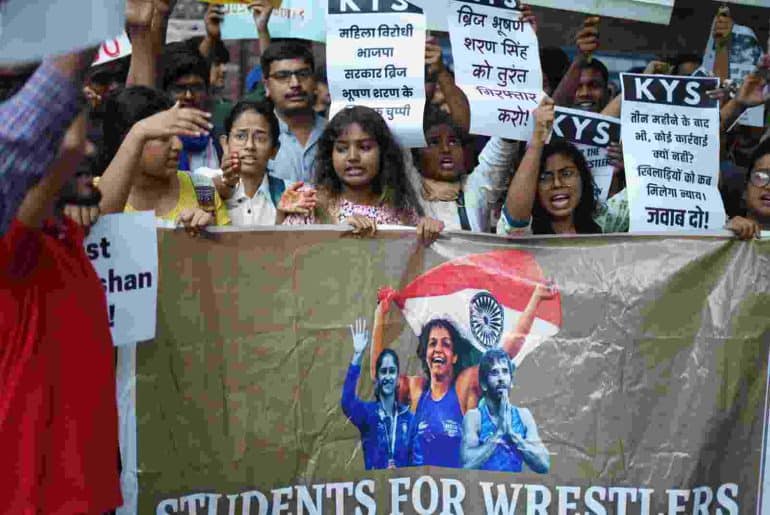
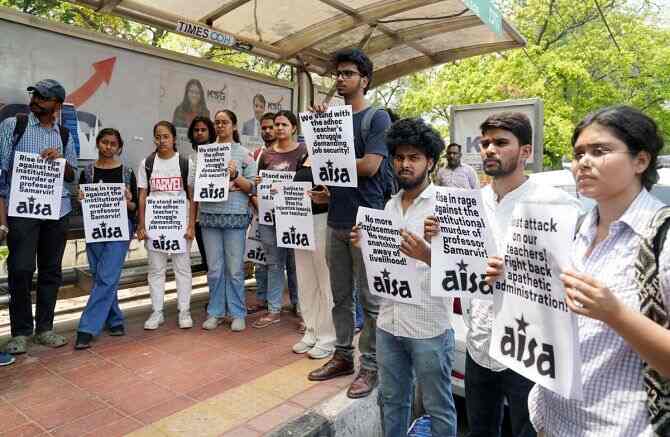
On Saturday, 21st May, 2022, students as well as student organisations had held a protest outside Arts Faculty, DU against the arrest of Professor Ratan Lal. This included organisations cuh as AISA, Krantikari Yuva Sangathan (KYS), and DSU taking a stand in support of the professor. The students participating in the protest held placards saying “Stop attack on our teachers”, “Stop curbing democratic voices”, and “Release professor Ratan Lal”.

The FIR has been lodged against Prof. Lal under the section of blasphemy, an act which has no place in a country such as India which is not a theocratic state. Our constitution recognizes itself as a secular country, promoting all contending schools of thought, including those that are against institutional religions. Therefore, blasphemy must be decriminalized. It is only a tool in the hands of religious fundamentalists to quell voices who stand firmly against religious mongering,” said Noel Benny, SFI Delhi State committee member, while addressing the student gathering.


SFI Delhi also issued a statement in solidarity with the professor, condemning his arrest and the arbitrary action of the state.

This punitive action against Prof. Lal is characteristic of a Brahminical state. Brahminism since its inception as a hegemonic ideology has always violently suppressed its opposers… The current instance of using state machinery and constitutional provisions to penalize critics is only a manifestation of the oppressive ideology, which reaffirms that the state continues to follow the traditions of the Brahmanical order,” read the statement made by SFI Delhi.


Taking its decision, in addition to granting bail, the court directed the DU Professor to refrain from making any new social media posts or from engaging in different means of interaction such as interviews concerning the ‘shivling’ controversy.

In regards to this issue, Professor Ratan Lal had previously argued and made a statement that all he had done was impose a question to the general public as a student of history. 

People can be hurt by anything. Academic discourse cannot be sidelined on account of perceived hurt. I had asked a simple question to enquire if the so-called shivling was broken or cut. Mullahs and Pandits don’t need to comment on it. An art historian should answer this question,” said Professor Ratan Lal.

The court said that considering that the concerned remark by the professor had not been made with the intention of inciting any particular group or promoting tension/ enmity between people and had been made on a structure that was being claimed by different groups as different religious symbols, the court considered that “the post of the accused may be a failed attempt at satire regarding a controversial subject which has backfired, resulting in the present FIR.”

The presence of an absence of intention to create animosity/hatred by words is subjective nature as is the perception of the recipient who reads/hears a statement,” the court order stated.

The court also remarked that the feeling of hurt by one individual cannot be considered representative of an entire community or group of people. Thus, any such complaints should be considered in the larger context of the actual facts and circumstances.


This controversy also launched a lengthy discussion on the concept of tolerance as it exists in the Indian culture and the array of opinions that people might have on this subject.

It is observed that Indian civilisation is one of the oldest in the world and known to be tolerant and accepting to all religions. The presence or absence of intention to create animosity/ hatred by words is subjective in nature as is the perception of the recipient who reads/hears a statement,” the court remarked.

The Chief Metropolitan Magistrate also commented that with India being a country of more than 130 crore people, there can be 130 crore different views and perceptions on any given subject.

The undersigned, in personal life, is a proud follower of Hindu religion and would call the post to be distasteful and an unnecessary comment made on a controversial topic. For another person, the same post can appear to be shameful but may not incite the feeling of hatred towards another community. Similarly, different persons may consider the post differently without being enraged and may in fact feel sorry for the accused to have made an unwarranted comment without considering the repercussions,” said the court, talking about how different people might view the controversial post differently.


https://images.assettype.com/barandbench/2022-05/95080cc7-8d4c-4537-9525-eb04df387e6d/State_v__Ratan_Lal.pdfThe judge noted that the anxieties of the police could be understood and had not been completely ill-placed as they were only trying to accomplish their task of maintaining peace and order amongst the people. However, the court made its decision considering all the facts that were presented before them.

It is true that the accused did an act which was avoidable considering the sensibilities of persons around the accused and the public at large. However, the post, though reprehensible, does not indicate an attempt to promote hatred between communities,” they stated.


Additional Resources:

https://images.assettype.com/barandbench/2022-05/95080cc7-8d4c-4537-9525-eb04df387e6d/State_v__Ratan_Lal.pdf

Read Also: DU Professor Booked for his Remarks on “Gyanvapi”

Featured Image: @profdilipmandal on Instagram


Manasvi Kadian

[email protected]

Have you ever felt so lost that even an episode from Friends turns out to be unfruitful? This is when you find your world in your comfort food. A plain and simple bowl of Dal and rice can sometimes trump the most delectable fares.


On a late winter night, while everyone is snuggled up in their blankets, you are awake to complete those due assignments. You could hear your flatmate’s snoring but there is nothing much you could do about it. That is when your stomach growls. You get up from your chair and head towards the kitchen to make some instant noodles. You pour in water in the saucepan and wait for it to boil. Suddenly you feel an urge to not eat those noodles. You start reminiscing about the time from your younger days. Those days when your mother used to cook your meals while you worked hard for your tests. At that time it felt insignificant only for you to realize its higher place in your life and that is how your everyday food became your comfort food. So, in the dead of the darkness, while you look at your noodles in the making, you are craving your comfort food. The thought about your comfort food makes you crave it even more. Surprisingly, you could smell it even when it was not in front of you. From ‘aaj bhi Dal chawal’ to ‘where is my Dal chawal’ we have all grown up.

Besides this, have you ever dwelled on your long vacation feelings? Some years ago while holidaying in Mumbai, I was hit by a strange feeling. I love to explore different cuisines and a trip to Mumbai is everything when it comes to food. Whilst enjoying the Vada Pao and Bhel Puri, I realized that I can not take another bite of it. At that moment all I wanted was some home-cooked rice, piping hot dal garnished with a dash of lemon, and fried potatoes. A girl, whose sole purpose of life is to eat and explore, was yearning for a home-cooked meal. What an odd thing to see. A few months back a similar feeling aroused when I visited Ooty. Indulging myself into the fine dining experience with chicken Chettinad and finishing it with Mysore Pak on my ‘I don’t remember’ day of the trip, I almost broke down into tears at the sight of that mouth-watering food. I felt extremely overwhelmed and the only thing my soul craved was for my comfort food. I loved the south Indian cuisine but at the moment it seemed as if my dal-rice was winning all the battles. Without a doubt, I could have ditched caviar for my home-cooked meal.

The feeling that you get when you crave your soul food but can only fancy it. That feeling when you close your eyes and imagine yourself sitting on your bed completely relaxed with your favorite novel. You start reading those yellow pages which have a deep story, a thrilling climax, and an unanticipated river of twists hidden in them. You reached the 94th page and that is when the door opens. You can see that perfect bowl of your favorite meal coming towards you. Your gaze is fixated on the bowl when it finally sits before you. You could already taste the zesty flavor that it has and smell the woody scent that your entire body yearned for. The scrumptious bowl of heaven awaits “your highness”. This is when the spell finally breaks and you realize the existence of this tangible realm where your bowl of goodness lives far away from you at the moment. You open your eyes to comprehend the heartbreak to be more hurtful than a breakup. Any affliction is tolerable but not the estrangement from your comfort food. The solace that a bowl of comfort can bring you is unparalleled.

Living far away from your humble abode can be challenging. From doing every mundane task to keeping yourself protected, every responsibility solely lies on your shoulder. However, what makes this sitch more arduous is that home-sick feeling. Especially when you fall sick and all you long for is some comfort through the meals you have. Yet, a disappointing discretion that you address is the distance from the place you once woke up every day. You as a breathing being do not get to choose what settles your mind but what does is that toothsome morsel. It is rightly marked that the way to one’s heart is through their stomach. You can go and explore any part of the world, meet any number of people and try out as many cultures as your heart desires but your affection for your comfort food is simply irreplaceable. I can not comment on who is going to be there for you but ‘for better for worse, for richer for poorer, in sickness and in health, to love and to cherish, till death do us part’ your dal-chawal is going to stick to you till the very end.

Read Also: Must Try Street Food Joints in DU

Featured Image Credits: Dawn Images

Ankita Baidya

[email protected]

The Vice-Chancellor of Delhi University laid down the foundation stone of a new academic block at Kamala Nehru College on Monday, 31st January 2022. Read more to find out about this new building.


The foundation stone of a new academic block was laid down at Kamala Nehru College by the Vice-Chancellor Yogesh Singh at a ceremony on Monday, 31st January 2022. This event was organised in two parts: the foundation stone laying ceremony, held at nature square in Kamala Nehru College, and the felicitation and address which took place in the auditorium hall of the college. The entire event was streamed live on the YouTube channel of the college to maximise the viewing capacity even with the COVID restrictions and guidelines in place.


This new academic block was proposed as part of the Other Backward Class (OBC) Infrastructure Expansion plan, implemented in the college in 2017. This plan can be interpreted as one building upon the past attempts to expand infrastructure after the implementation of the 27% reservation policy of 2009. 


According to the statements by the college, the new block is to be built upon an area of 1250 sq. metres with a basement, a ground floor, a mezzanine floor, and a first floor. The ground floor is set to have a lecture hall with a 180-people seating capacity and a green room, equipment room, storeroom, and washrooms, while the basement would have nine tutorial rooms, a staff room, and lockers. The mezzanine floor is to have a loft and storerooms, and the first floor will have a classroom, a terrace porch, and a bridge connecting the new block with the old one. All the classrooms in the block will be smart classrooms. The college also added that this new building is an environmentally friendly structure, reflecting the college’s commitment to environmental sustainability.

As a student, inculcating smart learning and technology into the physical classroom feels like a great step to me. The addition of this new building and these classrooms will make it easier for the college to accommodate the huge student body, in addition to making learning more interactive.”, says Hridya Madhav, a first-year student of Kamala Nehru College.

The addition of smart classrooms signifies a change in the educational perspective of Indian institutions as well as of individuals who are part of Indian academia. This step towards adopting a more hybrid form of learning, in addition to the proposal and implementation of a policy like NEP, signifies a rising trend of change in the Indian academic sector.


After the laying of the foundation stone, the addressal began with recalling the laying of the foundation stone of the original building of Kamala Nehru College by the then-president V.V. Giri on 21st November 1972. This was followed by a felicitation of the chief guest, Vice Chancellor Yogesh Singh, as well as other senior officials who were present at the event including the Dean of Colleges, Prof. Balram Pai; Director, South Campus, Prof. Shri Prakash Singh; Chairperson, KNC Governing body, Shri Jaydeep Ahuja; and Treasurer, KNC Governing body, Shri Anwar Shahid.

The college’s principal, Dr. Kalpana Bakhuni elaborated upon the various ways the college had moulded itself to function in such unprecedented times of the COVID crisis, such as through the use of online resources, technology, as well as the various aids that were provided to the students through schemes like ‘Recharge the Learning Scheme’.

Vice-Chancellor Yogesh Singh also addressed the audience, appreciating the college’s efforts in adapting to this changed learning environment as well as in the context of the new academic block. He also brought attention to the NEP, emphasising the role played by higher educational institutions and teachers in the implementation of the policy and the need to properly understand the intricacies of the same. He also talked about the guiding principle behind this policy, which is inculcating a more comprehensive, all-encompassing, and value-enriched curriculum rather than one which is solely focused on academic achievements of students. 


Read also “Guiding Lights in ‘Unprecedented Times’: DU Professors” https://dubeat.com/2022/02/guiding-lights-in-unprecedented-times-du-professors/ 


Feature Image Credits: DU Beat Archives


Manasvi Kadian

[email protected]

The Maulana Azad National Fellowship Scheme provided 5 years of financial support to minority scholars.

On 12th January 2022, members of the SFI (Students’ Federation of India) demonstrated against the government’s discontinuation of the Maulana Azad National Fellowship Scheme in front of the Ministry of Education, as well as at the University of Delhi and Jawaharlal Nehru University. Also part of the protest were members of the All India Students’ Association (AISA), Maulana Azad National Urdu University, Students’ Union (MSU), Krantikari Yuva Sangathan (KYS) and JNU Students’ Union, as well as students from institutions across the capital. The Maulana Azad National Fellowship was launched in 2009 and provided financial support for five years to students from six notified minority communities: Buddhists, Christians, Jains, Muslims, Parsis and Sikhs who were pursuing MPhils or PhDs.

While the government has claimed the decision to roll it back was taken because it overlapped with other schemes, opponents have argued that this justification is invalid, as students cannot benefit from more than one educational scheme in any case. They have also pointed out the discontinuation of other government aid such as the pre-matric scholarship for SC, ST, OBC and Minority students. They see this decision as part of a larger attack on minority scholars.

Shakir, a PhD student from DU, and a recipient of the MANF, told edexlive.com that following the decision he will essentially have to stop my research, or rush through it to submit it soon.” 

My academic journey will stop here. There are costs associated with being a research scholar that I cannot bear without this scholarship.” – Shakir, in conversation with edexlive.com

The protestors have alleged that they were manhandled by the police, being dragged across the road and shoved into buses despite demonstrating peacefully. Several students sustained injuries, and over 100 were detained at the Mandir Marg Police Station.

As far as I saw, all of the policemen at the protest were men and they seemed hostile right from the beginning. They soon began to push and shove us around, including the female protestors, and even those who were not seriously injured came out of the experience battered, both physically and otherwise.” – an MA student at the demonstration.


The student is not a member of any student political organisation, but attended the protest as she fears that the discontinuation of the MANF and other schemes like it will prove disastrous for her career as a scholar.

Feature Image credits: DU Beat

Shriya Ganguly

[email protected]

As a semblance of normalcy begins to return to functioning around us, Delhi University performance-based societies choose to go offline with their workings – a decision that risks alienating outstation students who are still hesitant to return to campus. Read on to find more. 

Delhi University sees a diverse crowd in all terms. The play of privilege has come to the forefront in the era of the digital divide. We witnessed students committing suicide, leaving education, and going to all ends to just afford a phone or laptop for studies. In this phase, where do the cultural societies of Delhi University stand?

In the online scenario, all the performing societies were forced to operate in the online space, as a result of which we saw many online productions, audio plays, and virtual open mics. But the transition phase in DU societies has begun even before the colleges are officially reopened. A few months back a lot of performing societies started functioning offline, some with or without permission from the college authorities.

These mainly comprise drama societies, music and dance societies which need offline spaces to carry on with their operations smoothly. But since DU is not a university of Delhi students only, the question that ‘Do DU societies belong only to Delhi people?’ seems pretty valid in a scenario where outstation students are being repeatedly sidelined by the indiscriminate move to go offline with functioning.

Just a few days back Mood Indigo, the fest of IIT Bombay, organized the prelims for its street theatre competition, where some of the prominent societies performed with their productions like Ibitida, Hindu College, Hansraj Dram Soc, Kahkasha JMC, Lakshya, Kamla Nehru College, Anubhuti, Sri Venkateswara College, and many others. DU Beat talked to Simran from Hansraj Dram Soc to understand their take on conducting offline practices and workshops in collaboration with other societies.

We first years came into the society to perform and sadly it was not happening. Offline practices were essential for us to learn how DCTC worked as we will soon become seniors and the onus of training others will be on us.”

An outstation member of Kshitij, the street play society of Gargi College which organised an offline workshop in collaboration with Hansraj Dram Soc, on grounds of anonymity, shared their views with DU Beat,

If we talk about outstation students, someone who has never seen their college, for them, online meets are everything, that screen becomes more than just a screen. Offline meets are not fair to them, and they cannot be expected to travel long distances to attend, it is just not fair. They are missing out on experiences and lessons because of the circumstances. In the end, it comes down to whose perspective you choose to see – that of the helpless first year or the third year who will choose the offline mode due to the sheer rigour and space it allows one to work in.” 

The culture of performing societies is surely a source of pride for the University of Delhi but another thing that the nukkad nataks propagate is the call for equality. In such a situation, when being in Delhi means being able to experience the societies, aren’t these societies becoming elite spaces? Various outstation students, who can afford to be in the city for internships or societies have moved here already, so who is actually being left behind? For these answers, we talked to Jai Mahajan from Shunya, Ramjas who shared his society experience.

Being in an online space has affected theatre but we are trying our best to level the playfield. Shunya is trying to come up with a fusion of both online and offline work. Surely people in the offline mode are learning and adapting quickly, but it’s up to seniors how they balance the collaboration.” – Jai, a member of Shunya, Ramjas

In the month of November, Shunya conducted its first series of month-long offline workshops. Students across departments and years from the college attended the workshops, which were conducted by incumbent and erstwhile members of the society on a wide range of topics relating to theatre. But the attendees also included a large number of outstation students who flew down to the city specifically to attend these workshops. Although safety precautions were adequately taken for the same, the decision to conduct these workshops in the offline mode, which many society members too could not attend, still remains under question.

As the auditions of performing societies were conducted in the online mode in the time of the digital divide, it already pushed out students from backward sections of societies. Several talented students could not audition due to unstable internet, and some had to travel elsewhere just for the sake of giving their auditions. And after that exclusion, the dispersion of outstation and Delhi students brings forth the question of representation. Performances talking about the evils of caste and class while propagating on those same foundations are making a farce of the art form.

We can’t lose out on practice just because the colleges are online now. To get on the stage and win awards and experience that feeling of dancing in front of people cheering for you hoping that you win. To learn things online is really difficult, offline practice is of the utmost necessity if you want to bring the best out of your crew. There is no formal permission as such but socs have never totally depended on college to practice even when it was offline.” – A member of a dance society

DU performing societies have been known for their rigorous working, but the entire working process changed owing to the prevailing conditions. Talking about how his society operates, Tushar, a member of The Dramatics Society of Dyal Singh Evening College, Junoon said,

Most of the members of our society are from Delhi, offline meets are recorded, and activities are discussed in the online meets. The same activities are done in the online mode with some tweaks to make them feasible.”

Meanwhile, Jai from Shunya, Ramjas shared how audio plays helped them bridge the gap to some extent.

Some of our members are from Kashmir and places where there is low connectivity; for them, we practiced and explored auditory drama on phone calls.”

Shruti, the President of Lakshya, KNC, shared her society experience of working in the online mode. For better functioning, they divided the team into two where outstation members worked on the stage production, working with characters, while the Delhi students worked on street play.

At least some of the students would learn and know something; this year we are focusing more on learning and teaching.”

There are also various societies that chose not to function in the offline space. Siddhi from LSR Dramsoc shared her take on the issue,

Even though the offline experience was beautiful, we chose not to practice in offline mode since we have people from other cities as well in our society. We need to adapt to the times, and to pass on the culture, we talk about our past experiences and activities, so our juniors know about the working. DCTC as a group needs to think and engage in dialogue to come to a better and more feasible conclusion.”

While sharing her experience of being an outstation student, a member of a drama society said in a conversation with DU Beat,

It doesn’t feel like a team anymore; the production doesn’t feel ours. If offline working brings back the culture of theatre it also breaks the team apart in two. It’s a sort of slow coercion over outstation students to leave since we don’t play any active part. We feel like outsiders instead of outstation students, where we realize being in Delhi is a privilege that we can’t afford.” 

Despite the brouhaha surrounding the debate around offline and online functioning, there are societies that have accepted the online mode and have gone ahead with annua productions; for example, the Shakespeare Society of St. Stephens College performed their annual production for the year Chateau Manor House on Zoom a few weeks back. The reluctance of many societies to adapt to the same mode is, on one hand preserving the physical essence of these performance societies. At the same time, it risks non-functioning and becomes largely emblematic of the larger hegemony present in these societies to refuse to adapt to changing times and tweak and challenge procedural functionings that have been set in stone for years now.

Image Credits: Sabha, the dramatics society of St. Stephens College 

Read Also: The Rise of OTT: Destruction of The Theatre Culture?
Remembering Safdar Hashmi: Inquilab and Theatre

Kashish Shivani ([email protected]

Anwesh Banerjee ([email protected]

With the rosy season of auditions going on, this is an introduction for freshers to the dark side of DU Societies.  

As the audition season approaches, one could have seen the college areas buzzing with auditions. On the online campus, it’s a bit different; the society’s social media pages, which have been abandoned for long, now become the main agenda of society meetings. All of a sudden, reels are being posted, and you see clips of happy members of societies playing along, some on screens while some on the ground, and a Ritviz song playing in the background. The usual words that will be used in these videos are “family”, “creative community” and every adjective you can imagine for a bunch of happy undergrads. But are societies really this happy, or is it just the poster happiness to lure in freshers?

(Obviously, not all societies fall into this category, the main aim is to introduce freshers to the toxic side of DU societies.) A lot of societies are run by seniors who exercise control over all the functioning. At some colleges, administration or the teacher or convenor intervene, but at some, they don’t pay any heed. Some societies have also faced such extreme obstruction of administration that even their performances have been canceled, whereas the bullying by many societies goes unchecked due to no surveillance. (Societies should ideally lie between this tussle of control, where admin maintains minimum control but a required check, but hey, we are in DU!)

A hierarchy is maintained among all the members to maintain ‘discipline’. But this setup often leads to toxicity as seniors in positions of responsibility take undue advantage of their power. The societies that should act as communities housing creative talent become a powerhouse of trashy politics and toxicity, where bullying and ragging houses.

Recently, such a situation came to light during the auditions of Finance Investment Cell of Hansraj College, about which a first-year student said,

During our Finance Investment Cell interviews, the core team members made us dance against our will, I felt uncomfortable but since I wanted to get into the soc, I had to go with the flow. Later on, they were boasting about the fact that they made us do squats, dance, and sing in the interviews during our induction meeting.” 

First Years who are already ridden with anxiety get pushed underneath the wish of being in the cool circles of college and fail to report such behaviors, and the cycle of toxicity continues. Another student from a dance society shared their experience in a conversation with DU Beat.

This certain level of hierarchy restricts our freedom as an artist and as a person. The role of unions should be to represent the members of the society and to guide us, but it feels like someone has given them authority and they just want to show it off.”

Even in the online mode, several students have suffered terrible things at the hands of societies. With the second batch moving into the online campus, we need to configure our thinking accordingly. If the cultural front of the university keeps on reeking privilege and toxicity, the development of the individual would be a far-gone concept here. It’s high time proper redressal forums (talking about Cultural Secretaries) work in every college to respond to all grievances and dismantle these toxic hierarchies.

[email protected]

Kashish Shivani

A brief outlay of what goes into perceiving film criticism as one of the most misunderstood and least credited forms of entertainment journalism

 Entertainment journalism is probably the least taken seriously category of journalism in most mainstream discourses on the same. People diss it off in terms of it being something that works primarily on exercising unsolicited opinions. Film critics specifically are called people whose failure at being professionals of cinema led to them choosing lives as critics who find it inherently impossible to break upon the scene as real artists. To warrant a ‘positive’ review the film itself needs to emerge from a certain generic space – preferably indie – whereas those belonging to genres more mainstream will always remain sidelined in terms of the adulaton they receive from critics (clearly people don’t read reviews coming out of film festivals).

In a post-paparazzi world, the act of recording itself has been essentially reduced to its barest levels whereby entire film reviews are just sent out through character limited tweets are limited to a string of adjectives which are incoherently strung together to create what could only be possibly labelled as a mood piece gone horribly wrong. There is much less consideration of film criticism as an evolved form of journalism that requires an in-depth understanding of the material at hand – not only on a narrative level but also in terms of technicalities such as editing, cinematography and sound – to name a few. The dilution of entertainment criticism is also largely owing to the social media boom where every person not only has an opinion but also a space to offer that opinion at; and hence opinions – mostly under-researched and unfounded, start masquerading as ‘reviews’ with no credibility.

Over the years a variety of outstanding critics (sadly mostly Western) have made their mark in the field by developing styles unique to themselves such as the balanced, seemingly objective outlook of someone like Roger Ebert, displaying a child-like joy and enjoyment of the medium as opposed to someone like Pauline Kael who took a much personal, feisty and passionate look at every film she reviewed turning her reviews of the films into as deeply personal experiences as the film itself.

Another massive negating point of film criticism is the lack of appreciating subjective standpoints. While on grounds of technicality one can take an objective stance and comment on badly edited sequences of out-of-sync sound sequences – the final response to film as a piece of art is something that is deeply individual and subjective. 2001: A Space Odyssey termed by Ebert as one of the greatest films ever made is undoubtedly two hours of technical brilliance but I am allowed to espouse my opinion with regard to how deeply boring I found the film.

Which brings us to the question of rating films. It is very easy to end an opinion piece on any film we see with a string of stars lying at the end like a discarded appendage without an universal metric system to ensure that star ratings are uniform. While people reduce the reviews to their final star ratings to have an essential understanding of the critic’s viewpoint they fail to realise that the existence of the star rating is perhaps the most subjective derivative of the act of film criticism. As Shah Rukh Khan had famously said in the first edition of the FCCA, why must our film experiences be akin to five star hotels? Can’t we do better than this?

Anwesh Banerjee

[email protected]

A brief outlay of what goes into perceiving film criticism as one of the most misunderstood and least credited forms of entertainment journalism

 Entertainment journalism is probably the least taken seriously category of journalism in most mainstream discourses on the same. People diss it off in terms of it being something that works primarily on exercising unsolicited opinions. Film critics specifically are called people whose failure at being professionals of cinema led to them choosing lives as critics who find it inherently impossible to break upon the scene as real artists. To warrant a ‘positive’ review the film itself needs to emerge from a certain generic space – preferably indie – whereas those belonging to genres more mainstream will always remain sidelined in terms of the adulaton they receive from critics (clearly people don’t read reviews coming out of film festivals).

In a post-paparazzi world, the act of recording itself has been essentially reduced to its barest levels whereby entire film reviews are just sent out through character limited tweets are limited to a string of adjectives which are incoherently strung together to create what could only be possibly labelled as a mood piece gone horribly wrong. There is much less consideration of film criticism as an evolved form of journalism that requires an in-depth understanding of the material at hand – not only on a narrative level but also in terms of technicalities such as editing, cinematography and sound – to name a few. The dilution of entertainment criticism is also largely owing to the social media boom where every person not only has an opinion but also a space to offer that opinion at; and hence opinions – mostly under-researched and unfounded, start masquerading as ‘reviews’ with no credibility.

Over the years a variety of outstanding critics (sadly mostly Western) have made their mark in the field by developing styles unique to themselves such as the balanced, seemingly objective outlook of someone like Roger Ebert, displaying a child-like joy and enjoyment of the medium as opposed to someone like Pauline Kael who took a much personal, feisty and passionate look at every film she reviewed turning her reviews of the films into as deeply personal experiences as the film itself.

Another massive negating point of film criticism is the lack of appreciating subjective standpoints. While on grounds of technicality one can take an objective stance and comment on badly edited sequences of out-of-sync sound sequences – the final response to film as a piece of art is something that is deeply individual and subjective. 2001: A Space Odyssey termed by Ebert as one of the greatest films ever made is undoubtedly two hours of technical brilliance but I am allowed to espouse my opinion with regard to how deeply boring I found the film.

Which brings us to the question of rating films. It is very easy to end an opinion piece on any film we see with a string of stars lying at the end like a discarded appendage without an universal metric system to ensure that star ratings are uniform. While people reduce the reviews to their final star ratings to have an essential understanding of the critic’s viewpoint they fail to realise that the existence of the star rating is perhaps the most subjective derivative of the act of film criticism. As Shah Rukh Khan had famously said in the first edition of the FCCA, why must our film experiences be akin to five star hotels? Can’t we do better than this?

Anwesh Banerjee

[email protected]

Following the recent events, we tried to locate what language our nation speaks—of hate or of Mir?

“I knew that language is the most private and yet most public things.” – Arundhati Roy, In What Language Does Rain Fall Over Tormented Cities?

What language do we speak altogether, collectively as a nation? 780, or the ones actually recognised? Of love or of hate? Do we even speak together, ever?

I learned in my history class about imagined communities. Are we just one true imagination that exists with all its hypocrisies with just one name that binds us together? The peculiar curiosity about your identity starts somewhere around our age only, I think India never got out of that phase, she is still trudging the path of curiosity to know all about it.

Being trilingual, I get how difficult it can be to brainstorm with three words meaning something somewhat similar but never the exact same. How does India manage with so many? We read about diversity since first grade. In the language, I read it, “Anekta mei ekta.” At times, I think her diversity could never get out of this essay. It tried and tried, but it was such a high pedestal that returning was never an option, but we found out her invisibility on the streets at times, for we all read or maybe heard it – India: A Land of Diversities.

But whose language does India actually speak? Of Ghalib or of those who went rallying against Fab India when it named its Diwali Collection Jashn-e-Riwaaz, which loosely translates into a celebration of tradition.

The social media went mad with hails of ‘NO Abrahaminsation of Hindu Festivals’. And amidst this, a Markazi Khayal came to me that what word could we substitute for Khyal in Kabhi Kabhi mere dil mei Khayal aata hai? Or maybe what would we substitute when the people actually discover that the words Hindi, Hindu and Hindostan are from Persian Arabic? Did I miss a class of Language partition when the words of Urdu casually entered the conversations and even a bit of Shudh Hindi found its place with slang from the local dialect?

The Partition happened when, during the British era, the Hindustani language broke up into Hindi and Urdu, and since then, the graph has been up and down with the ‘language’ that we decide to speak publicly, sometimes of hate and sometimes of mir.

According to a research paper about the decline of Urdu sounds,

First, the decline of Urdu sounds began in the 1990s, which marks the rise of the Hindutva politics and the beginning of the mushrooming of cable television networks.”

So, this is the language I have been referring to the language that the current hegemony chooses to speak.

A good thing about Grammarly is that you can set the tone of language that you want to deliver your content in, and it rectifies the words accordingly. What would the tone be when people don’t let Munawwar Faruqui perform in Goa for 500 people would set themselves on fire. The organisers received threats from several Hindutva groups, and shows in Raipur, Surat, Ahmedabad, Vadodara and Mumbai had to be cancelled. Munawwar was also arrested for a joke he did not tell, and the apex court that granted him release said the tone of the FIR was vague and no apparent reason for his arrest.

Clearly, the cancel culture in our country goes a different way, where the dominant group shuns the language that it does not want to hear, be it just the name of the collection, an advertisement that talks of love bonds, or anything that might prick the forces of Hindutva. Who will be the next Kaifi saheb, perhaps Ghalib or the true sense of diversity that we talked about on pages?

Although Hindi’s victory has been a resounding one, it does not seem to have entirely allayed its keepers’ anxieties. Perhaps that’s because their enemies are dead poets who have a habit of refusing to really die.” – Arundhati Roy, In What Language Does Rain Fall Over Tormented Cities? 

There is a linguistic relativity hypothesis that says our language shapes our thought, and Arundhati writes in her essay that a country’s public language is its own public imagination. So, the next time you say ‘ye Ishq nahīñ āsāñ itnā hī samajh liije ik aag kā dariyā hai aur Duub ke jaanā hai’ know that in the current context it literally applies to the word Ishq for someday people might take offence for its existence because of its source.

All this is to say that we in India live and work (and write) in a complicated land, in which nothing is or ever will be settled. Especially not the question of language. Languages.” – Arundhati Roy, In What Language Does Rain Fall Over Tormented Cities? 

Kashish Shivani

[email protected] 

The ongoing talks of Sri Venkateswara College being dismembered from DU and shifting its affiliation to AU have been in the headlines and a cause of concern for some time now. With DUTA officially siding with the SVC staff association in their resolve against the fragmentation of Delhi University and the ongoing protests by the student body, the Democratic Teachers’ Front (DTF) as well, has released an official statement in solidarity with the fraternity of SVC, calling upon teachers and students to unitedly fight against NEP. 

DTF, in solidarity with the teachers of Sri Venkateswara College (SVC), expresses its concerns in synonymy with the latter’s protest against the attempts of the Andhra government to press for the merger of the college with Andhra University. DTF President Nandita Narain and Secretary Abha Dev Habib go on to shed light on how the excellence achieved by the college owing to it being a part of the University of Delhi (DU) must not be undermined. 

The Andhra government has made a plea to the Centre to amend the 2009 UGC order disallowing the jurisdiction of a university beyond the state by which it is established. DTF further goes on to point out how the move is driven by the host of steps taken recently as part of the government policy toolkit to acquire brand value through the ranking framework to be competitive in the market that would be determining for successful business in education. 

DU planning offshore campuses is driven by the same objective of reshaping itself as a business enterprise and has nothing to do with revamping education. The IoE scheme, which granted this freedom, for select universities had too narrow a base. The freedom to do business therefore has been extended to the management of every university and college under NEP 2020.

“This is also a forewarning of the dismemberment of colleges from Delhi University unless DU wants to make some wholly a part of itself and the college managements agree to cede powers to the BoG of Delhi University. The freedom granted to BoGs is unlikely to disallow takeovers, mergers and acquisitions.”

-Statement in Solidarity with the fraternity of SVC, DTF

Further outlining the existing laws to prevent such happenings and the effect NEP will have on them, DTF expresses its concerns on how the protections that we enjoy today from the UGC Act and DU Act from such takeovers will become a thing of the past as NEP gets rolled out. In particular, with the introduction of the provision under clause 19.2, “There shall be overarching legislation that will supersede any contravening provisions of other earlier legislation”.

In conclusion, DTF states that the Andhra Government need not plead any longer over any regulation for NEP’s “Light but Tight” regulatory framework will only require persuading the college management. The high ranking of the college will ensure such a possibility sooner than later.

“We fear that this move may be driven by and find support from the NEP recommendations to universities to have offshore campuses. The host of steps taken in the recent past as part of the Central Government policy is pushing institutions to acquire brand value through a specious ranking framework in order to be competitive in the market for edu-business.”

-Abha Dev Habib, Treasurer, DUTA

DU Beat reached out to the SVC Student Union in the same matter. The entire students and staff fraternity of SVC has been disheartened ever since the initiation of the move. The seriousness of the issue is what has brought the entire staff and students under a consensus who have been unitedly protesting against the move.

“Some prominent teachers of our college have offered to resign in case any of such development takes place. The Telugu students of our college are also not willing to get the college affiliated with AU, hence the issue of catering to the needs of Andhra students is not justified. The students, especially the first years are quite a bit disappointed with the move, and it is due to the ongoing COVID-19 protocols that we are unable to assemble inside the college campus to show our disregard. However, the students union on its part, started the protest on online platforms yesterday, and I was quite overwhelmed by the response that our struggle was addressed with.”

-Anand Devendran, Acting President, Students Union, SVC

The online Twitter storm, dated 25th February 2021 has been quite a success with students from other colleges joining in as well in large numbers. #Venky_belongs_to_DU and #VenkyIsDU have been trending ever since, thus bringing the required attention to the issue. “The level of support that we got yesterday has proved that the entire DU stands behind Venky and if the future developments are not in our favour, we will resort to physical dharna and protests. I want to reiterate that all the students and staff bodies are united against this move and we will ensure that SVC stays in DU only,” added Anand. 


Also read: 

https://dubeat.com/2021/02/duta-opposes-andhras-move-and-sides-with-svc-staff-association/

https://dubeat.com/2021/02/sri-venkasteswara-college-to-leave-du/

Featured Image Credits: Siksha

Annanya Chaturvedi

[email protected]