Tag

infrastructure

Browsing

The University of Delhi is the place to be for most non-pcm students in India. Why is it, then, that the varsity is not able to compete with higher education institutions abroad?

If I told you, dear reader, that I knew where to start when I first took on this topic, I would be blatantly lying. Should I start with the insane cutoffs that plagued the varsity until this year? Perhaps the lack of teachers for advanced subjects in various colleges? Maybe the Sisyphus level pointlessness of trying to cooperate with DU’s admins?

Or maybe where it all starts and ends: the education system. It is no secret that India’s education system has lagged behind for a long, long time. Ask the first student you see about what they think of the education system they are a part of and answers range from a frustrated and tired admission of defeat to a colourful and impressive string of swears (the latter is a lot more common in Delhi though).

It might just be that universities in India are seen as the natural extension of the schooling system instead of a place for learning and growth – quite unlike their high ranking counterparts in other parts of the world. The schooling system is geared towards gaining marks, memorising book knowledge to then ace exams and DU seems to be a very similar system but without the influences of a schedule or teachers. For example, students in higher education institutions abroad choose electives and minors in fields that support their major, are their interest or are beneficial to their overall development. However, you will find most students in the University of Delhi picking their electives and by extension, their minors, based on what’s scoring and what gets marks with the minimum amount of effort. Despite learning how to score in exams instead of true learning for the 15 years of school life, it seems that students will not or cannot make the choice to expand their knowledge in an environment with experts that can offer that knowledge to them.

However, can you really fault them? After all, it’s hard to gain knowledge and gain insightful learning from experts when your college doesn’t have any of them for your subject. Delhi University struggles with having enough professors for undergraduate subjects across different colleges. According to the data shared by the education ministry, as of April 1 2022, DU has 900 teaching positions vacant. As Hindustan Times found out in its piece, as of 2019, there were 4500 ad-hoc teachers – about 50% of the teaching posts available at the varsity.

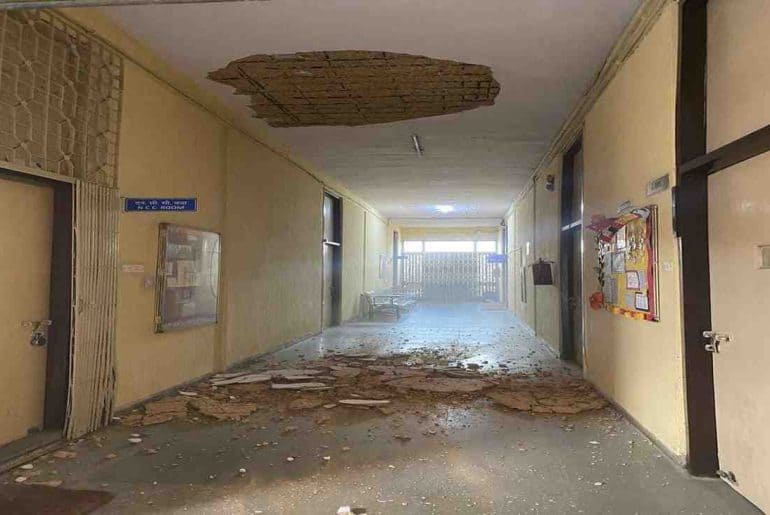
Then there’s the issue of infrastructure. Colleges across the university seem to only remember to invest in infrastructure and facilities during inspections. The University of Delhi has a long history – most of its colleges were established in the 20th century. As its reputation as being one of the most sought after universities in the country has grown immensely, its infrastructure has barely followed at all in the decades that have followed. To give you perhaps the quickest summation of this issue that I can: in April of this year, a ceiling fan fell on a student in Lakshmibai College. Only colleges like SRCC and Shaheed Sukhdev College of Business Studies have centralised air conditioning, with most other colleges having only a few classrooms that have this amenity. Some colleges, on the other hand, barely have working fans let alone air conditioning. The lack of air conditioning in most colleges, thus, made the lack of summer holidays for the batch of 2024 an especially hellish condition during the Delhi summers this year.

Which brings us to the next issue: the University of Delhi’s admin. The university and its college’s administration is notoriously caught up in bureaucratic chains. Its almost impressive inability to address issues in an efficient manner led to the delay in admissions and the subsequent start of the first semester for the 2021 season. This delay in sorting out the admission process then led to a first and second year with barely any breaks in between semesters and thus the aforementioned lack of summer holidays. In fact, the batch of 2024 have been given the long, relaxing and peaceful vacation of exactly one night after their third semester exams. The Lakshmibai incident we mentioned earlier, needed the filing of an RTI to gain any sort of transparency on the state of infrastructure within the college due to the college’s repeated refusal and avoidance to answering any questions.

Delhi University ranks 521-530 in the QS Global University Rankings. The reasons behind such a low rank for a university that lakhs of students clamour to gain admission in are varied. There is the emphasis on studying for marks, an education system that teaches you how to work hard and worry about placements that net you a decent amount of annual packages instead of growing and developing a knowledge base that goes beyond the books. There is the lack of infrastructure except for when you’re getting graded on it (ironically, just like most students including yours truly’s tendency to study the night before exams). Quite infuriatingly as a student of this university, it’s also the typical bureaucratic government administration style.

Perhaps, these are all signs of an institution that knows there are lakhs of students fighting for a seat here anyway. Perhaps, Delhi University is simply an institution that prefers to rest on the laurels it won in days gone by instead of actively competing with the Harvards and Oxfords of the world. After all, when all is said and done – DU toh DU hai!

Read also: DU and its All-Pervading Issue of Inadequate Infrastructure

Siddharth Kumar

[email protected]

The infrastructural issues of many Colleges continue to deteriorate and no action has been taken for its improvement. Just because students study in a government college, are they supposed to accept the conditions or is there any hope for correction?  Read to find out more.


For many of us it has been a ‘dream come true’ experience as we entered University of Delhi (DU). From living ‘the’ college life to savouring moments that only a student of DU would know, it has been one of the most anticipated journeys that we always wanted to embark on. Words fall short while describing the feeling of finally getting into the college for which you had worked so hard. However, it all comes crashing down because of a few shortcomings and this makes you question your decision of whether you made the right choice. DU is one of the most prestigious institutions of the country but is it really capable enough as it is deemed to be? From a very young age, we have been taught that if we study hard, we will score a government college but is it worth it when even the basic necessities for a decent academic experience are not to be found here.

DU is an institution set up in the times we call history. It becomes quite important to make the necessary adjustments and carry out renovations in regards to the infrastructure. Nevertheless, DU has somewhat failed us in that domain. A number of colleges under DU have reported a lack of basic infrastructure in terms of classrooms and washroom facilities. The buildings may look poised and aesthetic from outside but from the inside a different story has been spinning from a very long time.

The lack of infrastructural care is quite evident in Kalindi College, DU. On talking with a number of students from the college on the pretext of anonymity informed us that none of the washrooms present in the college have proper latches, working flushes, soaps or even a basic standard of hygiene. The loos stink almost all the time. Apart from the washrooms, the buildings of the college are in need of an “immediate renovation”. Walls have not been repaired since years and the paint has cracked and deepened into dry flakes. Further, the condition of the classrooms are in a battered state. The benches and chairs are broken and the doors do not have latches due to which they swing freely. Even in Delhi’s harsh weather, fans of many classrooms fail to work which makes the teaching and learning process a tedious task. There is absolutely no maintenance whatsoever of the college infrastructure. According to various students, the Principal, Dr. Naina Hasija, has been notified about these issues on several occasions including the general body meeting of the students and faculty. However, no steps have been taken to improve the conditions, which continue to deteriorate.

In conversation with a student from Gargi college, DU, told DU Beat about the hygiene issues that persist in their college washrooms. According to the student, the washrooms are very dirty and they are in quite a horrible condition. To add onto this, the student stated that the loos stink almost all the time and they even get flooded with water sometimes. Further, the student brought to light that the first year class representatives brought this matter to the attention of their previous  students’ union and followed the developments. However, they were told that this happens every year and nothing is done about it.

There are Indian loos but the western ones usually have dirty seats which increases the risk of an infection, especially during the menstrual period.

-Student, Gargi College, DU

Amidst the reports of a fan falling over a student in Lakshmibai College, DU, another similar issue has been reported from Shaheed Bhagat Singh College. A student of the college told DU Beat that a fan in their class was shaking hard and during the exams the fan fell down but no one was hurt. However, we await for an official confirmation about the same. Additionally, such infrastructural issues were also reported from Satyawati College, DU. In conversation with a student from the same college, told DU Beat that since the inception of the new building, there has been no maintenance work done for the old building of the college. Besides this, the worrisome conditions of the washrooms are also deteriorating.

The washroom beside our auditorium does not have mirrors while the washroom located above the canteen has mirrors but no water. Urinals do not function and they always stink. Also, the walls of our college are covered with slogans like ‘Join ABVP’ and names of students who are a part of the political parties. The outer beauty of the college has also been compromised because of this.

-Student, Satyawati College, DU

Besides this, there is an infrastructural issue present in Kamla Nehru College as well. In conversation with Taneesha, a student of Kamla Nehru College told DU Beat about the conditions of the classrooms. She informed us about the lack of seating and even classrooms to accommodate the students of any course. She claimed that during the winters, the teachers used to take classes in the shed activity area present in the college or in the ‘choppal’ area. However, in summers too, they are taking classes in that open area under the scorching heat of Delhi, according to her.

Half of the students in ‘choppal’ are eating, some of them are taking a lecture, and some are taking some other lecture. It is a complete mess.

-Taneesha, Kamla Nehru College, DU

Further, she asserted that there are no proper benches to sit on and this is quite evident during the examinations. She claimed that as she entered the class to give her exam, she found no seats left. However, at the end, there was a chair and no table where her roll number was mentioned. According to her, she was asked to sit on the chair and give her paper but at this, she questioned the authorities and asked for a table since without it she would not be able to give her exam. After about ten minutes of searching, Taneesha was given a table as she stated.

Very poor conditions of the classrooms and seating arrangement. The college has a small infrastructure to the extent that the batch of political science has 180 students but it can not even offer the basic infrastructure to 100 students.

-Taneesha, Kamla Nehru College, DU

This does not end here. Another college under DU, perhaps already in a tussle of disaffiliation, College of Arts (COA), has a very dilapidated infrastructure issue. In conversation with Deepika, a student of COA, told DU Beat about the deteriorated conditions present in their college. She stated that the washroom issues continue to remain the same. The restrooms in the college lack door latches and water, have broken windows, and non-functional flushes, as she stated. She asserted that the college has re-painted the walls of the buildings to maintain the “outer beauty” of the college. However, this was done over the wall paintings created by the seniors. According to her, the students are again painting the empty walls to maintain the environment of the college. Another student of COA told DU Beat about the poor conditions of the classroom. Additionally, he claimed that there is no proper drinking water present in the college.

They installed a college flag and painted the entire campus but they are not working to provide the basic needs to the students which should be sorted first.

-Student, College of Arts

The conditions in regards to the infrastructure and hygiene is quite perturbing and troublesome for the students. The authorities must take cognition of the situation and act on it at the earliest.

Read Also: DU and its All-Pervading Issue of Inadequate Infrastructure

Featured Image Credits: swirlgirlspeaks.com

Ankita Baidya

[email protected]

Students of the prestigious University of Delhi institution, Miranda House, feel like there are a lot of differences in the so-called Arts and Science blocks of the college.

Miranda House is an Arts and Science college in North Campus. It offers eleven B.A. (Honours) courses, a B.A. Programme course, five  B.Sc. (Honours) courses and two B.Sc. Programme courses. The college building is broadly divided in such a way that the right blocks have labs and classes for students pursuing Science courses are conducted there, while classes for students pursuing Arts courses are conducted in the left block. 

Recently, a new building was constructed, which is also termed as the “Science Block” by the students. The building is equipped with better infrastructure and more facilities, as compared to the Arts block. Elevators are installed, as are sensor-driven taps which speak of better infrastructure. Science students are more than those pursuing Arts, and that their events are given more priority. 

Another fact pointed out by many students is ‘the Science canteen’. A comparatively small canteen near the front-gate of the college called the science canteen is located close to the Science block. There is another main canteen and other cafes in the college, but there is no such place called the Arts canteen in the college. However, the so-called Science canteen can be accessed by all the students, but the name given to it by the students is enough to raise a question.

A student of B.A. (Honours) Political Science said, “The Arts and Sciences divide becomes very visible by things like infrastructure and facilities in the buildings. While there is a lack of basic facilities like properly functioning fans in classes for Arts students which aren’t looked at even after repeated complaints, there are several rooms in the science block which are equipped with air conditioners also.”

The Wi-Fi network is another issue. It is the strongest in the science block while there is negligible to none network in other areas of the college. Wi-Fi works in almost all the rooms where science classes are conducted, and near the Physics Department where the network is the strongest. A recent survey conducted on the college campus for testing the quality of drinking water revealed that the Science block had the most suitable water for drinking, as compared to other places. 

Mani, a third-year student of B.Sc. (Honours) Physical Sciences said, “There are many instances which show this bias. The theme of ‘Tempest 2018’ was based on the technology where robots and gadgets adorned the campus. Many big scale events and competitions of the Physics Department are organized by D.S. Kothari Centre, which witnesses high footfalls and requires more space. Science Conclave, which is a three-day event with various competitions and international speakers sees mass participation. While there are no such events for the Arts department.”

Another student of B.A. (Hons) History who wished to remain anonymous said, “A general bias can be seen in the facilities for Arts and Science students. However, according to me the reason for this bias is the academic background and inclination of our ex-principal, Dr. Jolly. As she was a Science faculty, more preference was given to events conducted by science departments, and this could also be the reason for better infrastructural facilities in their department. However, with the appointment of Dr. Bijayalaxmi Nanda as the acting Principal, there are chances of change in the situation.”

All these instances make the differences between Arts and Sciences in Miranda House evidently foregrounded. A number of these issues were also put forward during the manifesto reading, but the Student’s Union hasn’t addressed any of them yet. The President of Miranda House Students’ Union (MHSU) has also denied speaking on the issue.


Image Credits: shiksha.com

Priya Chauhan

[email protected] 


India is confronting a mental health crisis, with one out of every three individual dealing with depression. The Mental Health societies in University of Delhi (DU) aim at improving this condition at student level, in the wake of Sri Venkateswara college’s new mental health club, “Empathise”.

Mental health is an indispensable part of character, and is more than the absence of mental disorders. It refers to a broad array of activities directly or indirectly related to the mental well-being, prevention of mental illnesses, treatment and rehabilitation of people affected by mental disorders.

According to the National Mental Health Survey of India 2015-16 (quoted by a 2017 World Health Organisation report), one in 20 people in India over the age of 18 have suffered from depression, and more than 80% of sufferers have not received any treatment. The National Crime Records Bureau reports that students made up almost 7% of recorded suicides in 2015.

The viewpoint of Indian people towards mental illness isn’t very comforting. There prevails a pervasive stigma that responds to it by maintaining a safe distance from those who are mentally ill or categorise people striving for mental help, as attention seekers. But over the past few years, Indian society has witnessed some changes and the number of people who deeply care for this cause has increased.

College societies play a very substantial role in developing students. They prove to be a good forum to generate changes, create acceptance and develop a healthier environment that is more than just attending classes and scoring well.

Bhavika Mehta, founder of “Empathise”, The Mental Health Club, Sri Venkateswara College said, “College can be a wonderful experience for many, but it could be miserable to a lot as well, given the fact that people from all backgrounds and pluralities come to one place. The objective of the club that will turn into a society would be to establish a safe and comfortable space for anyone who wishes to talk, our team would be there for them with open arms and listening ears.”

A society solely concerned with Mental Health is beneficial for the college and would eventually normalise the notion of needing mental help and stimulate people to not see depression, anxiety or any other discomfort as a call for attention, rather something really sensitive and severe.

There are several other colleges of DU amassing Mental Health societies that are working even on a larger scale. Friends’ corner, Hindu College is an active society that endeavours to make the college more empathetic. They also have a page called “Humans of Hindu” that encourages the students to share their stories. The White Rose Club, Gargi College, is another society that aims at spreading awareness, curtailing hate, and encouraging students to rise above their phobias. Apart from this, the colleges that are yet to have a Mental Health Cell, have shown their support to this cause on a secondary level. The NSS unit of Kamala Nehru College organised a peer mentoring session that encouraged freshers to reach out for any mental, emotional help, the society would provide them with assistance.

Students strongly believe that the fact that there is a need for such societies is an indication of how our educational institutions lack counsellors and therapists. A student instigated organisation cannot be a substitute for proper counsellors and psychological assistance. The Indian education system needs to realise the importance of this aspect and act on it on a wider scale.

Feature Image Credits: Mentalhealth

Avni Dhawan

[email protected]


Apart from being well known for the intellectual environment and shaping students into future leaders, IP College for Women, St. Stephens, Ramjas and Hindu College have a lot more in common than one might imagine. The colleges have played key roles in the freedom struggle and the independence movement of India and its high time we realise and remember our histories and pasts all the more.

As a part of the four-piece series covering each college and bringing out their insights and contributions in the shaping of the Independent India, the first article is about the role of IP College- the first women’s college of the University and how it had shaped India’s past.

The University of Delhi has countless laurels to itself be it right from national and international contributions in various fields, to its impressions in the student as well as the national level politics. With Independence Day upcoming, here is the first part of the four-part series on how four colleges of the University played key roles in the freedom struggle and the Independence movement of the nation.

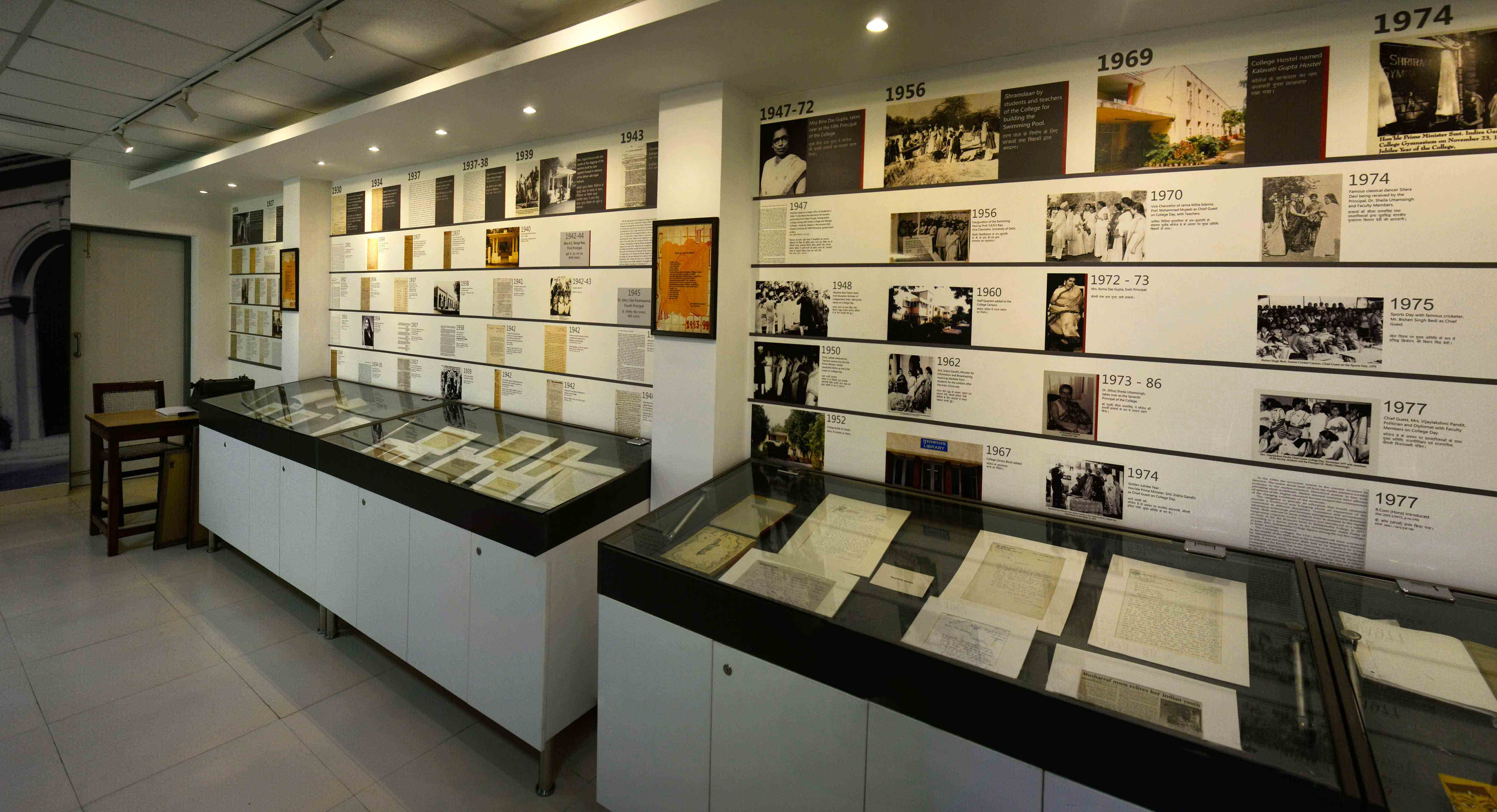
IP College for Women is the first women’s college of Delhi as well as the University of Delhi. “I see IP college as a movement. I still see IP college as a movement in the sense of activism”, quotes the Principal of Indraprastha College for Women in the interview to Sahapedia about IP as an institution which has stood the test of times and holds onto its legacy as it celebrates its centenary decade. The college has its own Museum and Archives Centre which serves to tell the students as well as the people around of the college’s glorious past.

An insider view of the Museum and Archives Centre of IP College for Women

One simply cannot overlook the college’s contribution in the freedom struggle. The college played pivotal role in bringing women into the mainstream culture of protest against the British.

Amidst the stigma and stereotypes which had restrained women’s movements in general, Dr. Annie Besant, who is famous for her contributions in women’s rights and education was one of the leading people behind establishing the institution. The girls of IP taking the lead during the Quit India movement was truly a model for the country to behold.

But standing up against the British was not an easy task. With the students participating in the Quit India Movement, hoisting and saluting the national flag amongst other actions of defiance against the British, the wheat rations to the college were stopped and the teachers penalised.

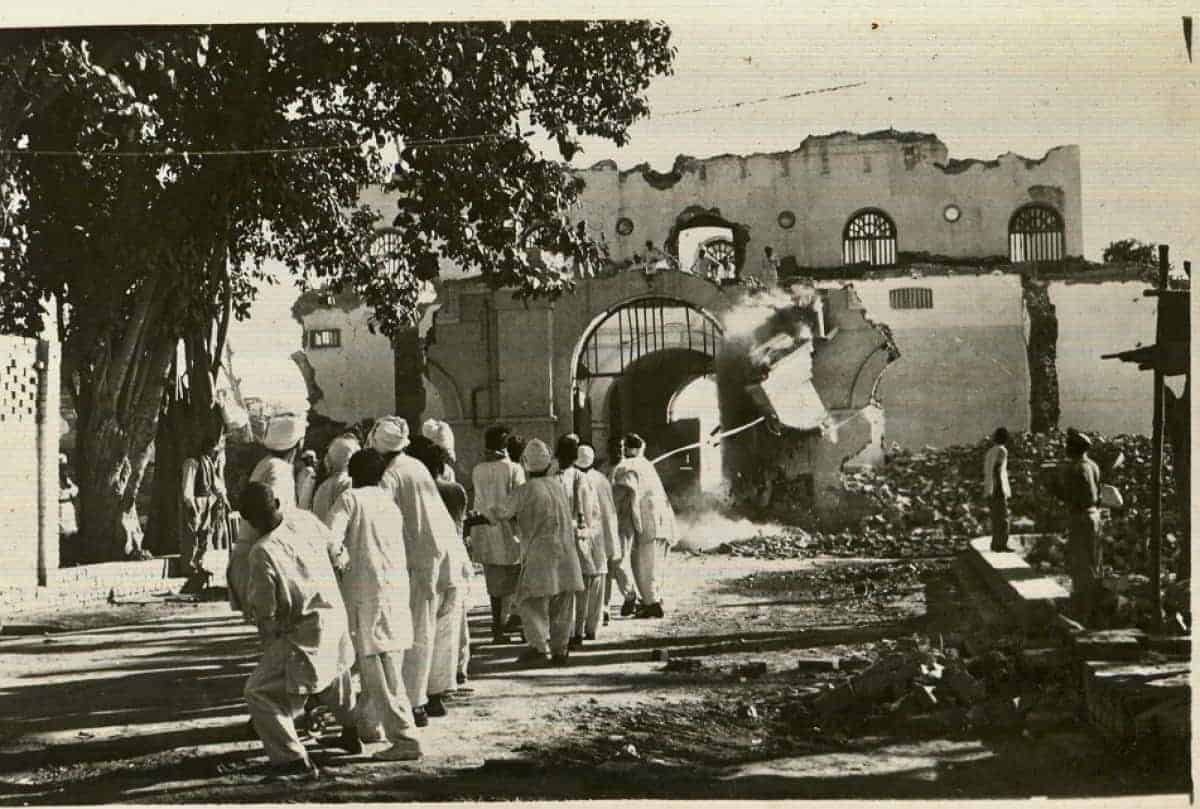
The sound of IP’s actions in Independence struggle had even forced the British to imprison one of college’s student at the Lahore Jail (now in present day Pakistan) who had participated in the national movement.

Central Jail Lahore where one of the students of IP College was imprisoned

But none of the efforts on the part of the British faltered the courage in the hearts of the brave, young women who later on even joined with the students of St. Stephens, Hindu and Ramjas to protest at various places against the government’s decisions.

Even after the Partition, IP College spearheaded in various spheres, including running the college in evening shift so as to accommodate the huge number of women from Punjab states so that they could complete their education, even if it meant that the degrees would be affiliated to the Punjab University or collecting donations for the soldiers during the India- China war of 1962.

Till this date, the college has been a host people who have played key role in moulding India into the land our forefathers dreamt of, right from first President of India Shri Rajendra Prasad, Independent India’s first Education Minister Maulana Abul Kalam Azad, Smt. Indira Gandhi to the Late Former President Shri. A.P.J. Abdul Kalam.

Maulana Abul Kalam Azad takes the Guard of Honour on College Day, 1948

The college continues to thrive and bloom, as it inches towards its hundred glorious years.

Stay tuned to read up the next article another college of DU which played a key role in India’s struggle for Independence.

Feature Image Credits: Sahapedia

Amrashree Mishra

[email protected]

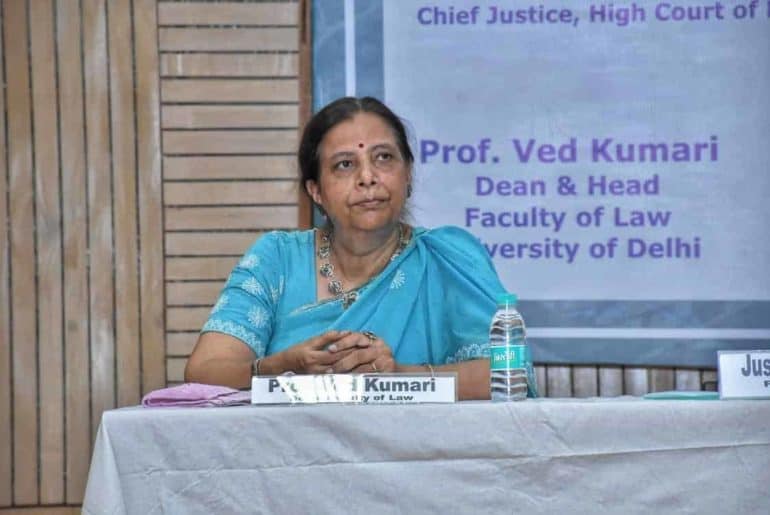
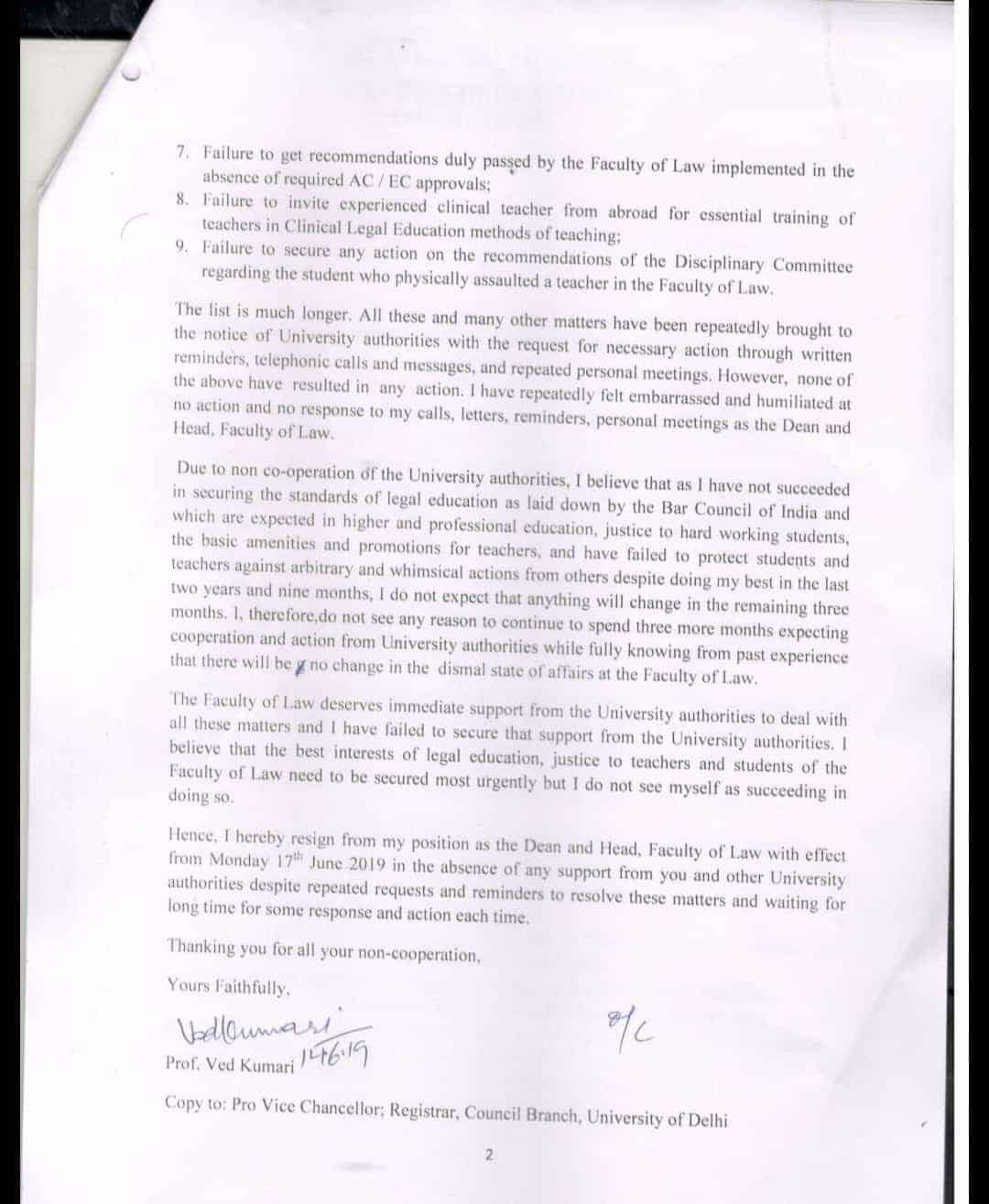
Citing non-cooperation by the authorities as the reason, Dean and Head of Faculty of Law, Professor Ved Kumari resigns.

In a shocking turn of events, Dean and Head of Faculty of Law, Professor Ved Kumari has resigned from her position on Tuesday, 18th June. 

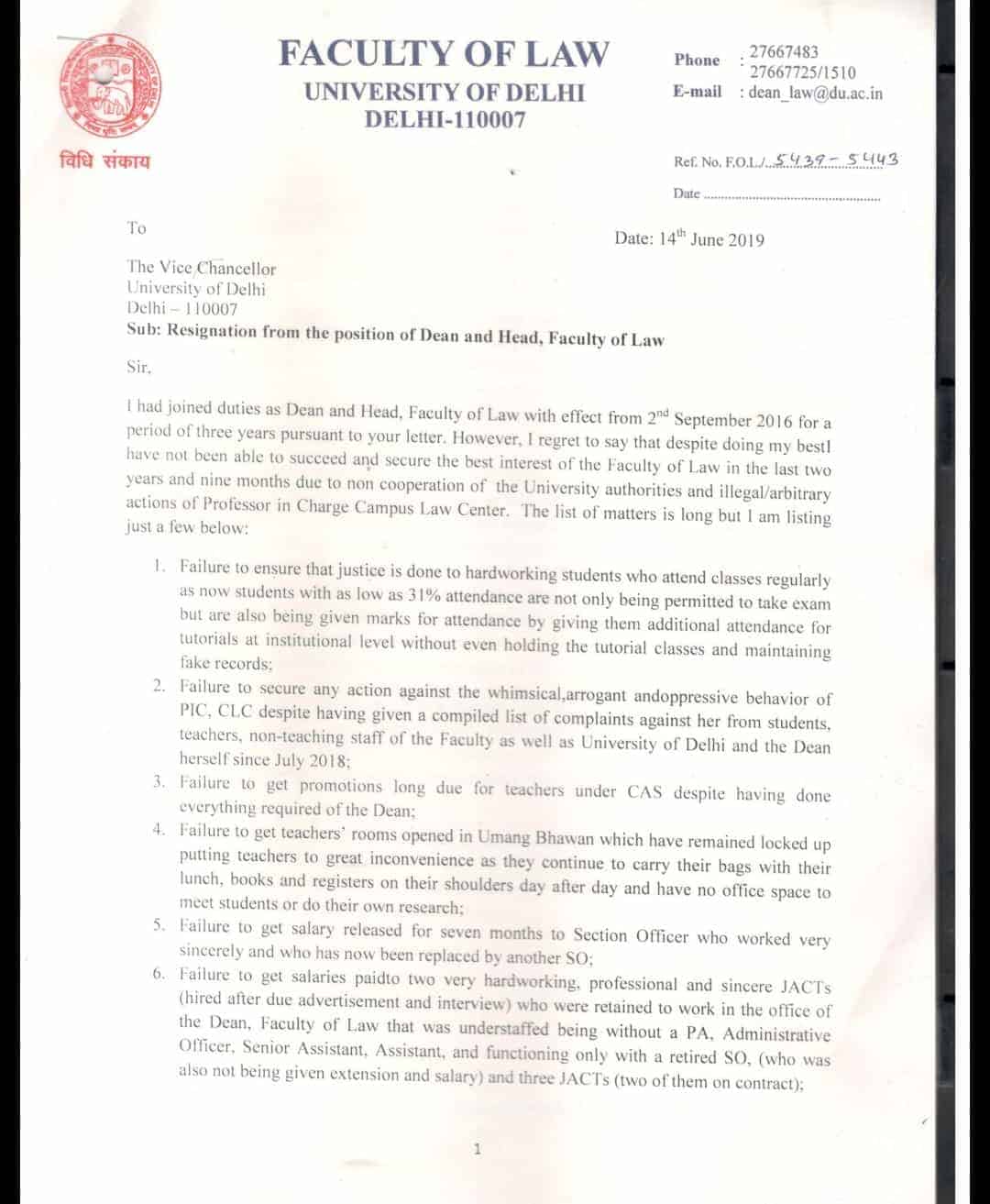
Professor Kumari, who assumed the post on September 2nd, 2016, resigned three months prior to her term-end, citing “non- cooperation of the University authorities and illegal/ arbitrary actions of Professor-in-charge, Campus Law Center.”

In her letter addressed to the Vice Chancellor of the University, she writes, “I regret to say that despite doing my best, I have not been able to succeed and secure the best interest of the Faculty of Law in the last two years and nine months.”

In her letter, she made some shocking revelations which lead to her resignation.IMG_20190618_213555

She accused the institute and the authorities for allowing students with even 31 per cent attendance to take exams, and in this allowance, serving injustice to the hardworking students who attend the class regularly.

She also revealed that fake records of tutorial classes were maintained in the institute.

According to Professor Kumari, she has “repeatedly felt embarrassed and humiliated at no action and no response,” to her calls, letters, personal meetings as the Dean and Head by the University authorities, when asked for necessary action to be taken.IMG_20190618_213604

She believes that nothing will change in the coming three months and thus, she has decided to resign before her tenure ends.

Speaking to the dismal state of affairs at the Faculty of Law, she says that the institute deserves immediate support from the authorities to deal with the numerous issues hovering over it.

This is not the first time that one of the most prestigious law institutes of the country, Faculty of Law, has been embroiled in a controversy.

Last year, the institute came into the media’s scanner after LLB entrance exam and LLM semester exam papers were leaked.

Feature Image Credits: DU Beat archives

Shreya Agrawal

[email protected] 


The construction work in front of Ramjas college, which started a month ago to install sewage lines has been creating problems for the daily commuters. The roads were demolished in order to build proper sewage lines, and were hastily and temporarily repaired recently.  

This temporary and haphazard work done by the authorities is creating problems for the students and teachers alike. All the people suffering from breathing problems such as asthma find it difficult to breathe in the air, which is rife with dust particles. It not only aggravates their breathing, but also adversely affects their health.
Archit Singh, a student from the college suffering from asthma said, “I live in the hostel and I fear to go out of the college because the air is full of dust particles.”
Both asthmatic students and professors faced problems as they were unable to attend lectures resulting in huge loss to academics.

The road is not well-developed and is causing problems for the daily commuters. Veethi Khare, first year student of the college says, “I come to college on foot and the damaged footpath is run all over by the vehicles. This makes it quite difficult for the pedestrians to walk as they have no space left.”

It is also a major concern for the disabled people who face problems in crossing the road.
A PwD student Sumer Ram said, “The authorities are not making the road due to which so many PwD students refrain from coming to college. Blind students face problems in crossing the road.”

A student of Ramjas College, Udbhav Sharma wrote an application to the North Delhi Municipal Corporation (NDMC) and highlighted the major concerns pertaining to this issue. He said, “Ramjas is a big college of Delhi University and such broken condition of road does not reflect good on the ambience of the college itself.” He also laid emphasis on the problems that the freshers will face, if the road is not constructed well within time.


Priya Sharma, a first year history student said, “It’s a shame that the administration has not shown any concern towards this. Even around this time, I didn’t come across any signs of improvement. The road is still in the same old condition. Moreover everybody is supposed to go from the main gate, I mean it’d be nice if they can allow people to enter from the other gates.”

Faculty members of the college appealed to the concerned authorities to take the requisite action. Talking to DU Beat, Principal Manoj Khanna questioned the Delhi Jalboard’s inefficiencies in completing the task on time.

Feature Image Credits: Ramjas College on Instagram (@ramjascollege)

Antriksha Pathania
[email protected]

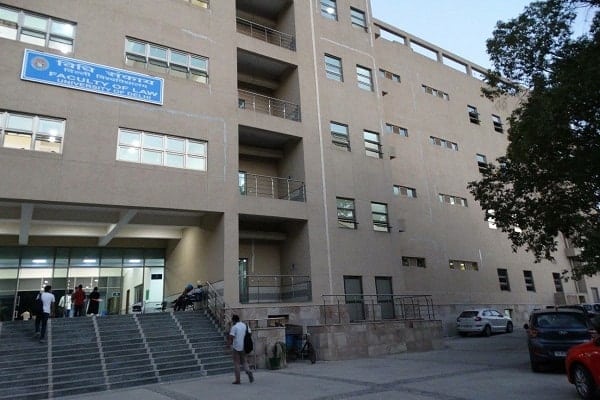
Infrastructural and administrative issues find way in the University once again, this time, at the Faculty of Law.
For years, students have complained over the poor infrastructure, dysfunctional air conditioners, not up-to-date technology, and less library space. It was also noted that the administration has not sanctioned the required expenditure of INR 76,00,000.
As reported by The New Indian Express, Rajesh Singh, Deputy librarian informed that a proposal of INR 76,00,000 was submitted by library committee. “Students have been raising these issues for a long time. We have written to the University three to four times since 2016, when the issues came to our knowledge,” he said. The latest request made to the varsity, he said, was in March this year. Singh, later ensured that the Dean had submitted the request to the University Grants Commission and the once the University generates funds, changes will be made.
In a number of letters written to the administration, there are repeated complaints of space shortage in the library, library systems not being updated, and the computer systems being out of order.

Shivansh,  a student at Faculty of Law said, “A requisition has been made by the students to get the required infrastructure. While we are nowhere close when it comes to National Law Universities as far as facilities are concerned, access to online law databases like SCC Online and Manupatra are a must for a law student to exist in this profession. Library is mostly overcrowded and there is a scuffle to get a seat, at times. We are not allowed issue, expensive publishers like Halsbury and Mulla. These are some issues we all face day in and day out. I understand how the Faculty of Law is the best place to learn if we were to take in regard return on investment.  However, that can’t be the benchmark when it comes to government universities.”

Kartik Saini, another student addressed the problems Hindi medium students face. He said, “There are not enough books and reading material especially for Hindi medium students. Students from south India sometimes face problem in understanding when teacher uses Hindi as a medium of communication in class. Apart from that, fans seem to be useless. The library lacks chairs and the ones present right now aren’t comfortable enough.”

The Faculty of Law has also failed the teachers. Many classrooms lack microphones and teachers have to bring their own required teaching material to the classes.

One can hope that these matters are addressed immediately and the University administration takes prompt action.


(With inputs from The New Indian Express)

Feature Image Credits: DU Beat Archives

Jaishree Kumar

[email protected]


A proposal was put forward by the Delhi University Administration in order to ask for funds for the construction of new infrastructure but it has been struck down by the Ministry of Human Resource Development.

The Delhi University administration asked the Ministry of Human Resource Development for Rs 5000 crore for the construction of a few buildings for the use by the University, but this proposal has been struck down by the MHRD. The MHRD termed the proposal as ‘unjustifiable’ and ‘over-hyped’.

According to sources, the DU administration submitted a quotation for the construction of buildings and had sought Rs 7,000 per square meter on an average, which was objected by the finance committee members who termed the quotation “unjustifiable”.

However, the issue of funds crunch has been raised by the Delhi University administration at various platforms, but the money that it had already hasn’t been spent by it and was returned to the University Grants Commission.

An elected member of DU’s finance committee said, “The DU administration has failed to spend Rs 300 crore it had received for the construction of buildings and other development work. The unspent money has already been returned to the University Grants Commission. Due to the short-sightedness and lethargic approach of the DU administration, the funds had lapsed”, as quoted in Sunday Guardian.

A proposal for a fund to the tune of Rs 5000 crore for the construction of buildings in DU was submitted by the DU administration in March during the finance committee meeting where MHRD officials were present. But the quotation that it had put up was considered to be too high. The DU proposal had sought Rs 7,000 per square meter as construction charges, which, compared to current market rates available for the construction of any building in Delhi, is more than thrice. Thus, MHRD officials openly criticized the DU administration and struck down the proposal, terming it unjustifiable and overhyped.

According to sources, the DU administration also sought for clearance of old bills of contractors but the validity of this demand was questioned by the finance committee on the basis that some of these bills are pending for over three decades. A similar demand was raised by DU to sought Rs 40 crore to clear a bill, but the original tender was of Rs 6 crore.

Abha Dev Habib, former member, Executive Council, DU told DU Beat, “While the UGC/MHRD has the right to scrutinize any proposal seeking a grant, increasingly the fear is that refusal to give grants will become a way to push universities to take loans for infrastructural requirements through Higher Education Funding Agency. These loans will have to be repaid primarily through student’s fees. We also want to add that right now the focus of the Government and universities should be infrastructure and manpower expansion required to cater to the EWS expansion. Unless this is done on a priority basis, universities will fail to cater to the increased number of students to intake on the count of EWS quota starting from this academic session.”

Thus it can be said that if the grants aren’t approved by the MHRD, then a hike in the fees of the students can be expected.

Image credits: DU Beat archives.

Priya Chauhan

[email protected]

Jesus and Mary College (JMC),  faces an immense water shortage everyday in terms of drinking water and water in washrooms. DU Beat brings to the extent of the problem and the reasons why.  

The students of Jesus and Mary College (JMC), Chanakyapuri have been facing major problems due to the lack of availability of drinking water and water in washrooms. The college, undergoing continuous constructions since the past many years, has two washrooms for girls located on each floor and a water dispenser for drinking water outside those washrooms. However, the washrooms run out of water in a couple of hours in the morning everyday and so do the drinking water dispensers.

“Jesus and Mary college does not have pipelines installed in the college which is why there’s always a water shortage in the college. The entire college has just one tank installed which gets exhausted within very less time,” says a second year student of Jesus and Mary College who wishes to remain anonymous.

“Our college has plenty of water available, except it’s not in the taps but on the floors,” says Ananya Chopra, a second year student of Jesus and Mary College. The washrooms reek of an unbearably strong odour and a dozen sanitary infections caused by the lack of hygiene. The flush installed barely ever works, there is no provision for soaps and the floors are always wet.

The inadequate washroom facilities are matched by the lack of availability of free drinking water. “Since drinking water is not available in our college, we have to go buy a bottle of water every day. Only half the washrooms are generally open and by the afternoon, there is no water available,” says Shiyona Biju, a second year student of B.Com. (Hons.) at Jesus and Mary College.

“Everyday, I am faced with water-less toilet facilities. Juxtapositional to dysfunctional flush, spray and basin systems are the perennial tap-leakages, wet floors and oh-so-wet wash basins; water at unusual spaces, basically. It’s needless to say yet I’ll say that our toilets are unhygienic, smelly, and highly dysfunctional. I’d really like to find out what degree of cash-crunch the college is facing to not be able to employ effective maintenance resources,” says Devanshi Jindal, a second year student of B.Com.(Hons.) at Jesus and Mary College.

DU Beat tried to reach out to the administration for a comment but was unable to get a response. The students of Jesus and Mary College wait with bated breath for some form of structural or tangible change and wonder why the college exposes them to such an inadequacy of basic necessities such as drinking water and hygienic washrooms.

Feature Image Credits: Ranjit John Architects

Muskan Sethi

[email protected]