Tag

DU Beat

Browsing

Dyal Singh College faces a big administrative crisis as the Principal’s office gets sealed over ongoing probe on financial and administrative irregularities.


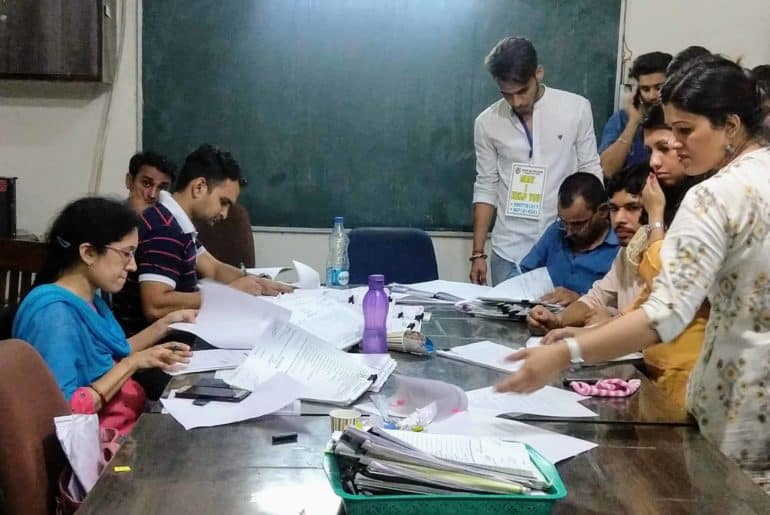
Dyal Singh College, faces a big crisis as a part of the ongoing tussle between the Principal and the Chairman. It all started when, on September 24, 2018, Governing Body [GB] chairman Mr. Amitabh Sinha issued an order, sending the Principal on a ‘long leave’. The reason stated was alleged him of being guilty for the financial and administrative irregularities. The Principal, I.S. Bakshi was charged with serious allegations regarding the state of financial and administrative irregularities and was asked to avoid visiting campus during the inquiry against him. Despite the notice, Bakshi has been continued coming to college, chiding the allegations as “illegal” with mala fide intentions.

The tussle grew stronger when the Chairman overturned the decision of the college’s Election Committee to cancel the election of Rohan Awana, an ABVP member, as president.

Things escalated as Mr. Sinha sealed his office on Friday, claiming it had been occupied ‘without authority’. The Principal also received a letter from the college’s bank stating that no transactions will be processed with his signature, as they have been mandated by the GB to conduct all official transactions through the officiating or the acting principal.

In a letter addressed to the chairman dated October 10th 2018, the branch manager of State Bank of India, Lodhi Road stated that the appointment of the acting principal should be done in accordance with the prescribed guidelines of the Ordinance XVIII which states that in absence of the Principal, the vice-principal will act as the principal, and in the vice-principal’s absence, the most-senior teacher will take over the administration and financial duties. This stands for colleges other than those that are maintained by the Government Of India.

According to a report in Jagran Josh, the tussle between the Principal and Chairman is reportedly causing financial losses to employees. DSC teachers’ Association’s president PK Parihar stated that the money is not being transferred into their PF account because of which they are losing interest and the medical reimbursement of all, especially the pensioners, is under threat.

Following the sealing of the office, Bakshi will be allowed inside the college campus only after the convener of the inquiry committee, Mr. OP Malik, retired IPS officer and DGP, provides written information, according to recent sources on the issue.

Sources: The Indian Express, Jagran Josh

Feature Image Credits:  The Hindu, image of the notice from the college’s official website


Avnika Chhikara

[email protected]


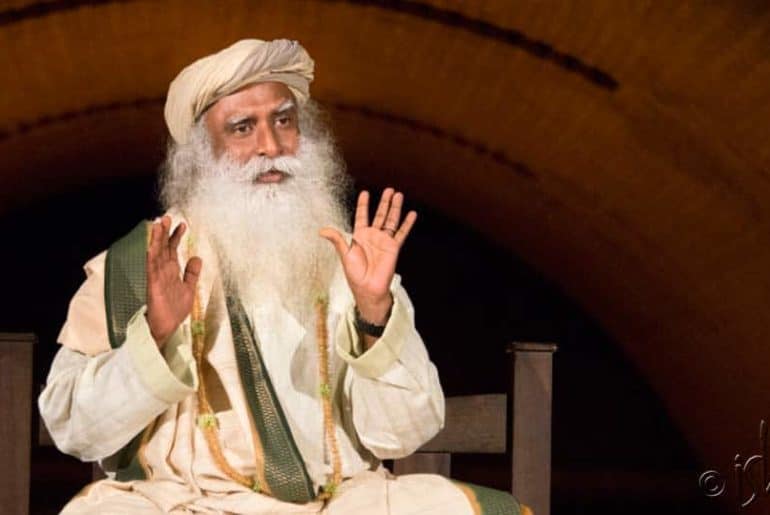
Yogi Sadhguru paid a visit to SRCC recently, as a part of his campaign titles ‘Youth and Truth’. An analysis of the advice given by innumerable motivational speakers in The University of Delhi reaped interesting outcomes.

Sadhguru, a renowned yogi, mystic, and founder of the NGO Isha Foundation, was at Shri Ram College of Commerce on 4th September 2018. The biker and English-speaking guru was accompanied by his entourage, following a suspension of lectures and extensive police barricading, extending from SRCC till Patel Chest Institute (bit much for a yogi, perhaps?). Contrary to popular belief, he wasn’t there to preach, and true to the essence of his campaign, ‘Youth and Truth’, his session included but wasn’t limited to, genuine advice about goal setting, relationships, confidence building and parenting. Once the initial aura of celebrity had subdued, and snapchat stories had been uploaded, people started to really listen. This was probably succeeded by the realization that the speaker hardly partook in original preachings, instead, like most motivational speakers, he simply validated already existing feelings and knowledge. This is a common occurrence, and it is this validation and connection that students seek from motivational talks/speakers, in the University of Delhi.

Celebrities, leaders, motivational speakers, members of the elite academia, and those who made it big by pure chance; the students of Delhi University have stood firsthand witness to it all, via panels, seminars, conferences, conclaves and other events similar in nature.

Students flock to these events in large numbers, seeking motivation, inspiration, enlightenment, or to simply catch a glimpse of a famous entity. However, when reconsidered, it seems as if all of these speakers, regardless of their field of expertise, are making the same point. You seldom come across anything radically enlightening, rather receive recycled gyaan.  If you’ve heard the terms ‘hardwork’, ‘leadership’, ‘innovative thinking’, ‘bringing something new to the table’ and ‘being humble’ one too many times; congratulations! you have unwittingly become a victim of nebulous direction.

Everything makes sense and nothing makes sense. Vague and nebular advice is the new preaching. Nothing anybody says adds any intrinsic value to the lives of students, their leaders themselves often presenting recycled ideas while simultaneously urging students to be ‘innovative’. One reason for the same is that there is no set path to success, and students are often too delusional to realize that. Students are burdened with the desire and/or pressure to overachieve, and often this desire arises not from within, but as a result of environmentally generated competition.

Leaders and speakers are an important part of college culture, but often, making examples of the small fraction of people who ‘made it’ advertises a lifestyle that is probably already out of stock. There is no market equilibrium; the demand and supply are poles apart, and in the end, students are suffering.

Nikita Bhatia

[email protected]

Vineeta Rana, Editor 2017-18 writes her farewell note, bidding goodbye to DU Beat. 

I first came across DU Beat during my college research post my Grade 12 examinations and recognised instantly that it was a platform like none other. It had the perfect blend of credible University of Delhi (DU) news that I required and light-hearted college-oriented content that I couldn’t wait to consume as a student studying in the varsity. In one of my first weeks in college, I watched with awe as one of my seniors who worked at DUB distributed a print issue. I wanted so desperately to be involved with the organisation, but when she told me I should apply at the end of my first year, I was doubtful. I wasn’t sure I was good enough for such an esteemed platform and I didn’t want to face the possible rejection. But I went ahead and applied anyway, and I can confidently say that it was the best decision of my college life.

I was recruited as a correspondent but started copyediting only a few months into my tenure, and had the opportunity to realise my passion for print publications by working with DUB’s print core. From getting to cover BITS Pilani’s Oasis with no senior member in the team in my third semester to heading LSR’s Tarang in my fourth, fest season became my favourite time of the year. I couldn’t get over the media privileges and interviews that a press ID card granted me, but more importantly, I couldn’t get over how much fun I had during it all with some of my best friends by my side. Before I knew it, my passion for writing had seamlessly expanded into my passion for the organisation and its members.

By virtue of its dynamism, DUB offers a steep learning curve that is rarely seen in other establishments. My tenure as Editor has been the single greatest learning experience and has taught me through practice what I would not have had the opportunity to learn anywhere else.       The 2017-18 team accomplished certain unprecedented feats for the platform – daily videos, regular graphic series, and our first-ever on-ground event, Mushaira, to name a few. All of these projects allowed me to drastically hone my journalistic, interpersonal, and leadership skills. But the extraordinary feature of DUB lies beyond these professional accomplishments.

To an outsider (and even to me when I first joined), DUB is a credible platform for university-related news and a media publication that churns out impressive content on a daily basis. However, being part of this team, and having the privilege of leading it for the past year, has opened my eyes to what this organisation actually is – a team in the truest sense of the word. DUB is made up of the most talented and hardworking individuals in the University of Delhi who come together to fulfil a shared vision of responsible journalism and student-based issues. We pitch in for each other when it is required and take on responsibilities we technically have no obligations to fulfil. I have been lucky enough to work with a team of department heads who have now become my closest confidantes, and even more fortunate to work with an immeasurably skilled team of copyeditors who have played a crucial role in the growth of our newspaper. Moving ahead, I am immensely proud to pass the baton to Kinjal Pandey as Editor and Vijeata Balani and Bhavya Banerjee as Associate Editors for web and print. I am confident that with their leadership, the next year holds great things in store for the platform.

Being a part of DU Beat for the last two years has been the experience of a lifetime and I am beyond grateful to everyone who made the journey as fruitful as it has been. To DUB and all the DUBsters I have ever had the honour of working with, thank you for everything.

Vineeta Rana
[email protected]

There is a lot of misconception about how DU Beat functions. To commemorate our 10th year, here is a look at all that goes into being the University of Delhi’s (DU) most loved newspaper. 

DU Beat (DUB) was founded in the month of October in 2007. The year 2018 commemorates the celebration of the 10 years DU Beat has served the students and faculty of University of Delhi by addressing student’s issues, reporting legitimate news, and expressing views regarding the University. DUB can be referred to as the first rough draft of the history of Delhi University, as journalism is often called the first rough draft of history. For the past ten years, DU Beat has provided an effective and ever-growing platform to over 250,000 individuals via our online platforms spread across Facebook, Instagram, Twitter, and Snapchat. We have also marked our presence in 17 DU colleges offline through our weekly printed newspaper.

Even though DU Beat is the first independent student newspaper of Delhi University, the progression of how it functions is quite ambiguous. Here is a look at all the departments of DUB that work day and night to be deserving of the most loved and largest student media platform in India.

The most common conception of the average student is that DUB comprises of a team of Editors, Correspondents, and Photographers. While these three are the most highlighted and represented departments through our work, the Marketing, Human Resources (HR) fuel DU Beat’s engine.

Marketing Department

The Marketing Department functions mostly out of editorial bounds, which is why they are the most unnoticed departments of DU Beat, despite being the most central to the functioning of DU Beat. It is because of them that printing of our weekly newspaper is possible, which reaches an audience of 30,000 yearly. The team represents DU Beat to the market. With their help, our first on-ground event, Mushaira, which was held at Hindu college and hosted a plethora of notable personalities, like Shashi Tharoor was made possible.

Human Resources Department (HR)

The Human Resources Department of DU Beat ensures the sustainability of the organisation as they are responsible for the recruitment process. The department ensures that the organization’s morale remains boosted. In addition to this, they ensure the smooth functioning of DUB, in terms of coordinating with fests and making sure all the internal departments of DUB are coordinating with each other and working as efficiently as they can.

Design Department

The design team of DU Beat is full of talented and creative individuals that help create the visual layout of both our social media platforms as well as the printed newspaper. The team works tirelessly to ensure that the layout of the newspaper is appealing. They improve the quality of the work that is put upon our platforms in terms pictorial representation. DUB owes its aesthetics to its design team.


Feature Image Credits: Sayanee Mandal for DU Beat

Bhavya Banerjee

[email protected]

DU Beat began as a dream. In a pre-Facebook world, there was no way for students to come together and talk about the issues that affected them, the issues that mattered. DU Beat aimed to bridge that gap. And with that small dream in mind, I founded DU Beat.

It was not easy. We faced resistance from everyone – teachers, students, political parties, the administration. No one knew who this new entity was, where it came from, and what it was trying to do. But we were the ones who wanted to talk about what mattered – education, fests, clean bathrooms, well-stocked libraries, healthy canteen food, healthcare in colleges, and many more issues without the pressure of political rhetoric.

We started from scratch, from nothing. The first publication was a Big Bang of sorts. The universe of DU Beat was infinite molecules coming together to form student groups that would focus only on the real issues. We thought college students must learn from the best and so we elicited writings from the best we knew – from William Dalrymple to publishing the last ever interview of Sabina Sehgal Saikia to Shashi Tharoor – we worked hard to get these diverse perspectives.

We engaged with principals, teachers, karamcharis, and students alike. All with a singular purpose – to evolve the student experience to the best it could be. We thought about the biggest problems facing students and brought about campaigns like ‘Dirty Loos’ to hold DU colleges accountable for the conditions of restrooms to writing stories about lack of healthcare to providing systematic knowledge about intercourse through the wildly popular Sex Amma column.

For me, the most inspiring idea behind DU Beat has been how it enabled students who had been involved to find their calling. From our first ever Head of Content and Head of Design running their own start-ups to subsequent alumni becoming investigative journalists, being featured in the Forbes ‘30 Under 30’, winning national awards, and attending Ivy League schools, DU Beat alumni conquer the world. We learnt at an early age what it meant to break the mould.

Education is important to attain abilities. It also teaches obedience, which often is not a helpful skill for innovation. The best innovators break the mould, look at life from a micro lens, understand problems, find solutions, and change the world. This has always been the main focus of DU Beat. To find passion, inculcate it, and excel.

Marx said, “Question everything”. This is the philosophy that propels DU Beat to constantly strive for brilliance, find cutting-edge stories, and bring news that is important and relevant to students week after week. Journalism is the fourth estate. Its role is to question the authorities and set notions and norms, and to bring to light new and better ways of life for students at every level. Over the last 10 years, DU Beat has committed itself to this standard of excellence. It will continue to do so for another 10 years. And 20. And 30. And 40. And on and on and on.

Happy 10 years! We have loved being a part of your lives. We hope you bring us the same love, care, and commitment, always.


Kriti Gupta
Founder, DU Beat

Feature Illustration by Sayanee Mandal for DU Beat


With 3 May 2017 being declared as World Press Freedom Day by the United Nations Educational, Scientific, and Cultural Organization (UNESCO), the American Center, New Delhi celebrated the month of May to raise awareness about freedom of speech. On the last day of the month, an event was conducted jointly by DU Beat and the American Center – Debate on Free Speech and Social Media – How much is too much? The event brought together debaters from the University of Delhi and the National Law University to speak in support of and against absolute freedom of speech on social media. The debate took place at the American Center, with an interactive audience and listeners who even stood at the back, surpassing seating capacity.

The debate was moderated and judged by Karnika Kohli, Social Media Editor of The Wire, Craig L. Dicker, Cultural Affairs Officer at the Embassy of the United States of America, and Richard E. Pinkham, Director of Programs, North India Office at the Embassy of the United States of America.

The speakers covered a wide range of ideas and topics to support their stance, from allusions to Reliance JIO to details of legal cases. They were asked challenging questions by Ms. Kohli in response to their statements. Additionally, the engaged audience members also gave their inputs and asked the debaters to flesh out their arguments. The passionate speeches left the audience, as well as the judges, in a dilemma with regard to which side to support. As Mr. Dicker stated, he felt “like a ping pong ball” which bounced from side to side with each speech.

At the end of all the speeches, the judges deliberated to announce Abhinav Hansa Raman and Bhishm Khanna of the National Law University as the winners, who argued for and against the motion respectively. The conclusion of the event was followed by a high tea. The entire debate was live-streamed on Facebook and garnered thousands of views.

“It was immensely gratifying to welcome such intelligent students to the American Center so they might contest the appropriate limits of free expression in the realm of social media. I will not be surprised if sometime before long our participants are ?debating the same issue as part of a policy-making exercise. For now, our audience was very fortunate to be able to hear such bright minds argue both sides of this most topical issue. Our thanks to partner DU Beat for organising this excellent session.”
– Richard E. Pinkham

As DU Beat is a platform that has fiercely supported freedom of expression for a decade, it was a privilege to be able to conduct this debate, especially in the current political environment. With mainstream Indian thought becoming increasingly homogenised and peripheral voices being silenced, the debate offered a broader look into the idea of freedom of speech and expression as a whole. A similar scenario is visible in the US, where occurrences of hate speech have become more numerous since the Trump administration came into power. Therefore, this debate could not have been held at a more apt time about such a pertinent subject. We are certain that the event offered food for thought to everyone present and forced them to re-evaluate their presence on social media.


Feature Image Credits: Alex Arthur for DU Beat

Vineeta Rana
[email protected]

A year back, I was asked to be the Web Editor at DU Beat. Not having edited a single article in my life, I was unsure where that came from. Having been a student of Journalism, I knew a bit about the profession. But would I make a good editor? That was a question I didn’t have the answer to.

Today, after 10 months, of allotting, editing, filtering and a bit of bossing around, that tenure has come to an end. As I head out of the door and join the Ex-DUB editors’ club, here’s my goodbye note.

Starting with a bit of boasting – last year has been one of the key years for DU Beat as an organisation. We witnessed record growth in our readership and social media community and simultaneously explored new approaches to storytelling. The year saw us join Instagram and cross 500 followers in 15 days (the number crossed 1500 recently). We closed June 2013 with 11,000 Facebook followers; today the number has crossed 60,000. The fest season saw live updates. We experimented with different forms such as live blogging and video as well as interactive tools such as timelines and info graphics. It is not as much about numbers, as it is about the fact that we were doing something right. We know that there is still ample amount of potential that we hold as a news organisation, but we are constantly working towards getting better each day.

An outgoing DUBster (the cool name our team members associate with) recently said that the best thing about DU Beat is the creative space that you get here. This is a factor that is truly defined by the tagline our founders came up with – ‘Freedom of Expression’. It is also a right that we have been struggling with, during the past few years in the University. While there are strong voices from the student and teacher community against the administration, there is often an attempt to curb those. The University’s education structure has changed dramatically in the past three years, and from what is forthcoming, there are going to be even more changes. Last year we saw over 20 protests from DUTA members, most of which were against what they term as the VC’s ‘authoritative regime’ and the (un)popular FYUP. AISA’s referendum stated that 91% of the people who participated in the same were against the FYUP. Another feedback conducted by DUTA had 43 college faculty associations out of the 47 that participated, condemning the FYUP. Despite these voices, not much has changed. Yet this means that there are voices that need to be given space and amplified. As the current leadership of DU Beat steps back, and a new set takes over, we hope to be platform for the diverse voices this University is proud to have.

For all that we have been able to achieve as an organisation, I want to thank the team and our readers. Adding a bit of gratitude to my note, thank you Cheshtha for working in way where we could integrate the web and print operations. Another shout out to Priyanka Banerjee, the Associate Web Editor who always supported me when I came up with crazy ideas that most people thought were a lot of work.  Thank you to each correspondent who often missed a lecture to cover a ‘boring’ event and photographers who spent the day constantly up on their feet, slogging in the sun. Whatever our readers saw happen to this space, is hugely because of them.

For times when we failed, I apologise and hope that the forthcoming leadership will learn from our mistakes. Speaking of which, it is a pleasure tell you that Niharika Singh will take over my position as the Web Editor. Further, Mridul Sharma and Vani Vivek will be stepping up as Associate Web Editors and Raghav Chopra as the Copy Editor.

Keep reading and keep voicing your opinion through your comments and feedback, for it is one way to keep track of when we go right, and when we are wrong.

It is indeed a ‘good’ bye. For today as I leave, DU Beat is in a good place (and in good hands).

Over to Niharika!

Signing off,
Gurman Bhatia
Web Editor (2013-14)

P.S.: I need to mention that serving this community has been the most fulfilling experience of my college life. If at any point you feel that you fit into this crazy place full of crazy people and have a keen inclination to learn and take bashing positively, drop us a mail at [email protected]. This organisation needs people like you.

Read the farewell note of Editor Cheshtha Gupta here.

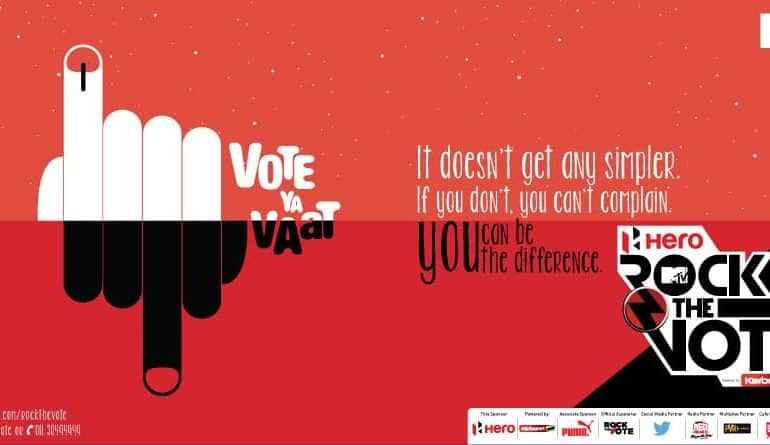
With the general elections just around the corner (April 2014), the involvement of youth in Indian politics, or lack thereof, is an issue that needs immediate attention. Being aware of politics is one thing and being politically conscious is another. To address this question among the youth, MTV India has come up with a campaign ‘MTV India Rock The Vote’ to understand the political mindset of India’s future and proactively encourage them to be a part of the system, at least fulfill their obligation and exercise their right to choose the next head of the country. The Campaign, which started with MTV promoting the cause on its various media platforms, both with celebrities and the youth, has now spread its wings. DU Beat has joined MTV’s endeavor to make the youth understand the urgency of the hour and the need for them to be a part of the most important aspect of the country- its Government.

Rock-the-Vote_Banner-1-X-2_Ice-Cream-New

The Campaign kicked off in December 2013. Through its inceptive weeks, MTV took the campaign to various youth- centered platforms including college fests, events etc. They have also used their brand power to bring together various personalities through web and TV episodes, who pledge to ‘Rock the Vote’ this year and have their voices heard.

With a tongue in cheek tagline ‘Dabao na… Button’, Rock The Vote emphasizes on the idea that if you don’t vote to affect the system, you can’t complain when the system wrongs you. The campaign also guides you as to how to go about the entire electoral process, including getting a voter ID made. Visit their website for more information!

Through our association, DU Beat plans to take the campaign to its core- The youth. We plan to reach out to the empowered DU student and promote awareness and political participation this April along with understanding and attempting to develop the mindsets that they have with regards to the Indian political system.