
With gallons of expectations and raging curiosity, prospective students are soon to set into the new academic environment of Delhi University that has swept amass every single person of this country with its mystified character. While dreamy eyed school pass-outs gallop their way into a luscious arena of modified milieu, here is a keynote to the economics four year undergraduate program at a glance.
The four year undergraduate program has adopted an application based analytical setting, that aims to provide students with skill based knowledge of the economic scenario along with striving to form a firm rooting conceptually of the subject.
The Course:
The first year accommodates two subjects, principles of economics and mathematical methods for economics-I. The former subject is structured to explore the subject matter of economics, the basics of demand and supply and an introduction to macroeconomics. The second semester shall continue to hone mathematical skills through knowledge of the second part of mathematical methods for economics along with introduction to statistics. The third semester shall introduce the first applied course being game theory, along with strengthening statistical roots and exploring subjects like microeconomics and introductory economics. Likewise in the fourth and fifth semester, students shall acquire knowledge of applied courses such as financial economics and public finance alongside study of the discipline courses that aim to develop practical and application skills of students. The sixth semester shall introduce in perspective the economic scenario that has prevailed in India and an applied course of environmental economics. The last two semesters are intended to refine the research skills of students. The students are envisioned to submit a dissertation in the final year which will carry 75 per cent of the weightage of marks.
Co Curricular Activities:
The spread of the courses in the four years is a harmonious mix of aligned subjects that render scope for students to pursue co-curricular activities as well. In depth knowledge and scope for absorptive study is in fact an advantage of the change.
“I personally feel that the four year undergraduate program is a great opportunity for us as it enables us to explore other areas of interests through the system of applied courses and minor subjects while adding to our future prospects. Apart from that it provides us with 4 years of education which is an essential requirement to apply for higher studies in many countries” says Aakash Sahai, a contented prospective applicant for the course.
Employability:
The program essentially claims to improve employability through imparting skill based knowledge and an option to leave the course after two years with a diploma and after three years with a bachelor’s degree, but whether these can be competent enough compared to an honours degree when it comes to employability, is still a matter in disputed territory.
Nevertheless, the holistic approach adopted by the program is certainly a step in the right direction.
(For analysis of other courses click here)
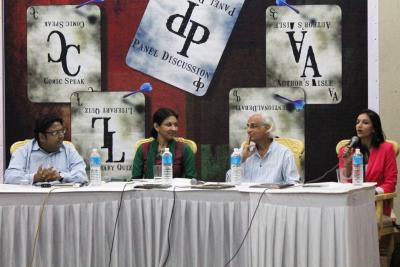
 While reckoning the grandeur displayed by lustrous posters donning the NSIT campus, I seldom pondered upon the impact that a debating fest might have on me. Colloquium, the first ever debating festival organized by NSIT College, kick started its first day with a stimulating panel discussion with eminent guests who had the faith to write the scripts of their own lives. The luminaries included renowned authors, Ashwin Sanghi and Ira Trivedi, the versatile dancer and activist Mallika Sarabhai and the erudite social scientist and political ecologist, Dunu Roy.
The event was host to immense motivation that stirred through the air, as each panelist unraveled the story of their dreams and destiny. As rightly worded by the host college, the life stories of these luminaries fit the saying, “square pegs in round holes” as copiously as it could. Each one of the panelists inspired the audience to carve out the best in themselves and have the fortitude and courage to pursue their passion. The panel discussion addressed many questions in the students’ best interest, like whether the Indian education system cripples or enables the youth to follow their dreams, what the role of a mentor is in every individual’s life, why reasoning is essentially important, and how one needs to balance the weights of societal pressure and one’s true passion. It evoked statements like, “Even the greatest equations have unknown variables”, by Ashwin Sanghi, which inspired each in his audience.
The next event was a conventional debate on the motion ‘This house is a frozen fire’, exposed to interpretation by the participants. There were in all twelve participating teams which included colleges like Hansraj, LSR, SSTB Khalsa and more. Worthy arguments sprung up during the course of this debate, battling to justify their interpretation of the topic. Some of them drew analogy of this motion to patriarchy and critiqued polarisation of sorts, others drew parallel to human emotions. The best team was awarded to LSR represented by Vanshika and Mayanka. The Best speakers were Parash from Hansraj and Isha from DTU. The best interjector was awarded to Divya from Venkateshwar International School.
Poornima Kharbanda
While reckoning the grandeur displayed by lustrous posters donning the NSIT campus, I seldom pondered upon the impact that a debating fest might have on me. Colloquium, the first ever debating festival organized by NSIT College, kick started its first day with a stimulating panel discussion with eminent guests who had the faith to write the scripts of their own lives. The luminaries included renowned authors, Ashwin Sanghi and Ira Trivedi, the versatile dancer and activist Mallika Sarabhai and the erudite social scientist and political ecologist, Dunu Roy.
The event was host to immense motivation that stirred through the air, as each panelist unraveled the story of their dreams and destiny. As rightly worded by the host college, the life stories of these luminaries fit the saying, “square pegs in round holes” as copiously as it could. Each one of the panelists inspired the audience to carve out the best in themselves and have the fortitude and courage to pursue their passion. The panel discussion addressed many questions in the students’ best interest, like whether the Indian education system cripples or enables the youth to follow their dreams, what the role of a mentor is in every individual’s life, why reasoning is essentially important, and how one needs to balance the weights of societal pressure and one’s true passion. It evoked statements like, “Even the greatest equations have unknown variables”, by Ashwin Sanghi, which inspired each in his audience.
The next event was a conventional debate on the motion ‘This house is a frozen fire’, exposed to interpretation by the participants. There were in all twelve participating teams which included colleges like Hansraj, LSR, SSTB Khalsa and more. Worthy arguments sprung up during the course of this debate, battling to justify their interpretation of the topic. Some of them drew analogy of this motion to patriarchy and critiqued polarisation of sorts, others drew parallel to human emotions. The best team was awarded to LSR represented by Vanshika and Mayanka. The Best speakers were Parash from Hansraj and Isha from DTU. The best interjector was awarded to Divya from Venkateshwar International School.
Poornima Kharbanda