Tag

DRC

Browsing

The DRCSU Election 2018-19 presented itself all enveloped in controversies. A new face of politics revealed itself to the students as they fought, protested, won, and lost.

The Daulat Ram College Students’ Union (DRCSU) Election was held on 10th September 2018 and the voting hours were between 9:30 a.m. to 2:30 p.m. Here are some major and vital highlights of the same:

  • The Absence of NOTA

“I entered the hall to cast my vote with the above-mentioned prospects of a ‘democracy’ clear in my mind, only to realise that a violation of these prospects was waiting for me in the form of an Electronic Voting Machine (EVM) where there was no option of ‘None of the Above’ (NOTA).  I voted only for candidates whom I believed were worthy of voting. As I made my way out of the little space reserved for voting, a teacher told me to cast my vote for all the posts. I told her that I wanted to vote only for two posts. But then, I was informed that voting for each post was a compulsion.  Apparently, the vote wouldn’t be recognised if one person from each post was not voted for.”

In a survey conducted by DU Beat, among Daulat Ram College (DRC) students which asked ‘Do you think the option of “None of the Above” (NOTA) should have been there while voting?’ 80.1% marked their opinion as a ‘Yes’, out of the 500 people who participated in the survey. The whole purpose of having NOTA as an option is to provide the voters with a space to express that they do not find any of the candidates contesting the election deserving. NOTA gives us an explicit insight into a picture of the elections. It creates scope for future candidates to improve their ways. 

  • Mismanagement

In the DRCSU Elections, students had to wait for more than 2 hours to cast their vote, in a humid and crowded corridor.  A few voters standing in the queue were seen backing out too. “The entire scenario could have been avoided if voting happened in slots. Subject wise, we could all be made into groups and asked to vote. It would have created much less havoc”, a second-year student who chose to stay anonymous suggested when asked how the situation could be improved.

  • Ill-working of the EVMs

As mentioned before, it was mandatory for the voters to select one person each for every post. The vote would be invalid if not cast for each post. According to this, the number of votes for each post should be equal. However, it was not so. A recent count of the votes says that there is a difference of about 200 votes between the post of General Secretary (GS) and others. Meaning, there are 200 more votes for the post of GS as compared to others. How and why such a discrepancy occurred is unknown but it sure questions the spirit of the voters.

When asked about the working of the EVMs, a few voters were reported saying that some of the buttons on the machine weren’t working when they pressed them. A little here and there is still something that can be understood. But a difference of 200 votes may turn all the tables.

  • The Controversy: Where it started

The candidates contesting for the prestigious post of college President were in a tussle long before the elections even began. Neha Beniwal, a presidential candidate allegedly claimed that unlike her, none of her opponents (Sonia Sehrawat and Diksha Verma) had the minimum percentage of attendance required to contest for the post. The shortage of attendance was a problem for several other candidates contesting for the posts of Vice-President as well. All the candidates were, just before the declaration of the nominations for DRCSU, made to sign undertakings promising the completion of 75% attendance in the ongoing semester, to be able to be eligible to contest in the elections. The college was, as a result, witness to a lot of protests and counter-protests. 

The rivalry soon took an ugly turn. On the evening of 10th September, the results of the elections were declared and, Diksha Verma was elected as the President of the 2018-19 Students’ Union of Daulat Ram College. Out of the total votes cast (1439), she got 40% votes and won with the margin of 71 votes. The victory was celebrated by her supporters but was short-lived. She was questioned by the opponents from the panel, which won a significant majority in the DRCSU, but their presidential candidate, Sonia Sehrawat, had lost.

The most contentious matter however, was the result of the General Secretary post, wherein the total votes did not tally with the other posts, and an increment of 200 votes was seen.

The panel, along with their supporters, alleged that the EVMs were not working properly and demanded the recounting of votes, despite having tested the EVMs on their functionality on morning of the elections themselves.  All electoral candidates were invited by the Election Commission to affirm the correct working of the EVMs, post which they signed a document, confirming the same.

They staged aggressive protests outside the Principal’s office on the evening of the elections, wherein things got violent as students banged the doors and the windows of the admin block, demanding an answer from the administration. 

The 11th of September was a new day for everyone but it brought with it the putridity of protests. The other two candidates, along with their followers assembled outside the staff room of the college, sat there and shouted slogans. Interestingly, the protests questioned Diksha Verma’s win, rather than questioning the working of EVMs. “Diksha Verma nahi chahiye” (We don’t want Diksha Verma) “Goondaraj nahi chahiye” (We don’t want hooliganism), were some slogans that the students were heard shouting. Most of them, it is believed, belonged to the college hostel. 

This protest witnessed around 100 students blocking the corridor of the college, as they were sitting outside Lab 5, the room in which the Students’ Advisory Board (SAB) was deliberating the fate of the elections. The protesters were joined by Debangana Baruah, who was the DRCSU President from 2014-15, and Nandita Nain, who was a presidential candidate in 2017. Both ex-students of the college were seen enticing the students and motivating them to raise such slogans. This practice raised several concerns as it is a clear violation of the Lyngdoh Committee Recommendations Clause 6.3.1.

Nandita Nain (ex-student, in white, with a black bag), seen with Sonia Sehrawat, the opposing Presidential candidate (standing next to Nandita) during the protest.
Debangana Baruah (in a green kurta), the Ex-President of DRC in the college during the protest.

Later, a demand for re-elections was also raised by the protesters. The Election Committee agreed to it and informally announced the scheduling of the re-elections to be held on the 13th of September, 2018. However, no such notice was delivered officially to the students from the administration or the Principal. The protesters rejoiced and dispersed, and the news of the re-elections, which was still not confirmed officially, spread like wild fire. 

The evening of 12th September, brought about a message from the convenor of the SAB, calling all electoral candidates to the committee room of the college on 13th of September, at 10 a.m. The SAB along with the Principal of the college addressed all the queries and concerns of the candidates, they were re-assured that the elections have been carried out in a fair manner, with discrepancies in the post of General Secretary, which were caused due to a fault in the buttons of that specific post. The meeting resulted in the official declaration of Diksha Verma as the President of DRCSU 2018-19. The solution for the matter of General Secretary was not that of a re-election, but the inculcation of all three electoral candidates in DRCSU as the General Secretary.

The official notice was uploaded on the DRC website after the meeting.

The Oath Taking Ceremony was held on 14th September, wherein only the President, General Secretary, and ICC member participated. Meanwhile, the opposition continued their protest outside the college building demanding “justice.”

Diksha Verma, during the official oath taking ceremony held today.


Feature Image Credits – Students of Daulat Ram College

Akshada Shrotryia
[email protected]


For applicants applying under the ECA category, the best place to be informed is the University Website, College websites, and college notice boards which will notify the number of seats available, the list of students selected from the ECA trials. However, admission into a college only depends upon the availability of seats in that particular college and is not subject to clearing the final trials.

General Guidelines

Here are the general guidelines for the students applying under the ECA category:

  1. The applicants are required to apply separately under the ECA category under the UG admissions portal for an additional fee of Rs. 100/ (per event).
  2. The applicants are required to upload only one certificate (preferably the one with the highest achievement) issued after 1st May 2015 to 30th April 2018 in each activity they wish to apply for as a proof of their involvement in the relevant activity.
  3. Trials will be held at two levels:
  • Preliminary trials
  • Final trials.

The dates for the same will be notified on the University and college websites as well as the college notice boards.

  1. The applicant shall be allowed to appear in the preliminary trials only once in an event.
  2. Not more than 15% concession/relaxation in academic merit vis-à-vis UR category applicants (for the last relevant cut-off) may be given for admission to specific programmes (subject to the minimum eligibility of the programme).
  3. Weightage in the final trials will be given to the trials and certificates in the following ratio: Trials: 75%, Certificates: 25%. The certificates are verified by the ECA committee of the college.
  4. The applicant must secure at least 50% marks in the final trials (38 out of 75) to be eligible for the final list of selected candidates
  5. All students should carry a copy of their application registration form as well as their certificates which they would have to submit in the venue of the trials.
  6. The trials for admission under the ECA category shall be the conducted by an ECA committee (Admissions) appointed by the University Admission Committee.

Colleges offering this course

51 colleges are offering ECA quota under Indian classical and Indian folk including Daulat Ram College, Deshbandhu College, Miranda House, Hansraj College, Lady Shri Ram College for Women, and Kamala Nehru College. There are 47 colleges offering ECA quota under Western Dance including Maitreyi College, Miranda House, Kamala Nehru College, Sri Venkateshwara College, and Lakshmibai College. In Choreography, 22 colleges are offering ECA quota including Deen Daya Upadhyaya College, LSR College, Ramjas College, Miranda House, Hansraj College, and Zakir Hussain Delhi College.

The Trials

Four categories are providing ECA quota under dance i.e. Indian Classical, Indian Folk, Western dance and Choreography.

According to Kaira Rakheja, a first year ECA quota student studying B.A. Political Science honours in Miranda House, “There were two rounds of trials and there were three to four judges at a time. Dancers were evaluated on the basis of technique and expression. It was quiet a speedy and efficient process. Each dancer introduced themselves, performed and was asked a few questions about their dance style and choreography.”

Students are often asked to be prepared by the teaching faculty for a large degree of competition in such a category. “I consider myself lucky to have gotten the rank that I did. It was really heartening to see the attention to technique as well as the high energy in each and every performer,” Ms. Rakheja says.

Feature Image Credits: Akarsh Mathur for DU Beat.
Sara Sohail
[email protected]

A professor at Daulat Ram College (DRC) has been booked under relevant sections of the Indian Penal Code for allegedly molesting and harassing a student of the same college. The alleged incident came to light when the woman approached the police on 31st January and lodged a complaint against the ad-hoc professor at Maurice Nagar police station.

The woman, in her complaint, avowed that the professor would stare at her and often wink during classes. She further stated that on 21st January, he met her near the college canteen and passed crude comments. “He told me I am looking hot and sexy. Then he touched me inappropriately and tried to come closer to me,” the woman cited in her complaint.

The complainant further said the accused offered to join her for a cup of tea or coffee and insisted on meeting her alone. His texts to her read, “Can we have tea/coffee tomorrow at 10?” and “Just chit chat over coffee.” When she refused, he threatened to fail her in the internal examination.

It is noteworthy that this is not the first time that complaints against the professor have surfaced. A few months back, a student from the Philosophy Department of DRC had complained to the authorities regarding inappropriate advances made by him. With respect to this, the Head of Department of Political Science said, “We were definitely concerned and held a departmental meeting because he is from our department. The girl, the professor, and members of the Students’ Union were also present at this meeting.” The matter was put to rest after he had apologised, and the Principal had served him a warning.

On being asked about this incident, a third-year student of the Political Science Department observed, “Ever since he joined college a few months back, he has been overly friendly with the students. He would make sordid remarks like “Aap Baal Kholke Aaya Karo” (keep your locks free). A strict action should have been taken against him, to stem his guts right at the beginning.”
On talking to a few students of the same college, the correspondent unearthed text messages from the same professor sent to different students, some of which read, “I need you more than anybody else” and “You are beautiful smart n.. Very HOT n SEXY (sic)”.

Diksha Verma, Vice President of the Political Science Department of DRC, commented, “Since this is not the first time we have received complaints about him, the Principal should take a bold step and suspend him. If no action is taken, then it can encourage other people to behave in the same way.”

However, in a phone conversation with the DU Beat correspondent, the Principal of the college seemed reluctant to provide answers and said, “The matter is so sensitive, the police also haven’t told me anything. I haven’t talked to the teacher also. Unless I know who is the girl involved and what is the Professor’s take on it, I just can’t keep talking to people.”

On being asked about the future course of action, Principal Savita Roy, remarked, “Generally, if a complaint like this is filed in the college, it is routed to the Internal Complaints Committee, but since the matter is already in the domain of the police, we’ll see what kind of action the police takes. I’ll assure you, it will be the strictest possible action. It’s a women’s college.” Meanwhile, the police have ensured, “We have questioned the teacher. We are verifying the allegations”.

It is well known that the fear of harassment in the National Capital can help explain a women’s college choices in Delhi. A college is supposed to be that sphere in a woman’s life where she can grow, live, laugh, and learn unrestricted. It becomes a matter of public concern if even that space becomes soiled with the fear of harassment and coercion.


Feature Image Credits: The Indian Express

Vaibhavi Sharma Pathak
[email protected]

On the last Wednesday of June, tensions rose and confusion ensued as the police was called in to Daulat Ram College to assuage the worried applicants. June 28th marked the last day for applicants to enrol in college under the first cut-off list, and some candidates were denied admission to the college due to a lack of availability of seats.

Admission denied

According to some student testimonials, applicants wishing to pursue B.A. Programme were prohibited from entering the college as the authorities claimed that the seats were full. These candidates had cleared the cut-off and fulfilled all eligibility requirements, and as per the varsity’s rule, were entitled to secure a seat in the college.

While the University has a prescribed number of seats for admission into various courses, there is no bar on the number of students who actually register and confirm admission under a certain list. Moreover, as the undergraduate portal was riddled with technical glitches, several students were unable to obtain the acknowledgment slip of a college on the first day. Students also often wait till the last day of a cut-off list to weigh in the college options available to them, and to clarify the Best of Four requirements. The time frame allocated to a cut-off list allows every student who meets the criteria to secure a seat in a given college, without any counter policy.

Intervention by ABVP and DUSU

The situation scaled when volunteers of the RSS-affiliated student wing, Akhil Bharatiya Vidyarthi Parishad (ABVP), intervened on behalf of the aggrieved students. The Delhi University Students’ Union’s President Amit Tanwar expressed his dismay at the erroneous decision on the college’s part. He said, “According to the University rules, all students who clear the cut-offs are to be admitted. There is no first come, first serve policy. Several applicants had come to seek admission today [on Wednesday] as it was the last day to do so under the first cut-off list. They were, however, told that the seats were full. This caused panic.” As the agitation transferred from the applicants to the student leaders, the police were asked to step in.

The college has lodged a complaint at the Maurice Nagar police station against the ABVP, DUSU, and parents who allegedly manhandled the Principal, along with vandalising her office. The Principal, Ms Savita Roy, claimed that the ABVP and DUSU members entered her office without permission and misbehaved with her. The complaint filed proclaimed that, “They used abusive language, manhandled me, and threatened me with dire consequences if I did not admit the students.” She also added that the crowd refused to send a representation of two people despite her request. An FIR has been filed against six persons who were involved in the scene, and the Principal has requested police protection to continue with the admission process.

However, these allegations have been refuted by the ABVP as an “excuse” by the administration, and are being labelled as an “arbitrary denial.” Tanwar adds, “The parents of students, who were confused after being denied admission even after the verification of documents, approached the ABVP and DUSU members. All of them went to the administration to ask why were they denied admission.” A student from DRC spoke to DU Beat and confirmed the refusal of admission, and also added that the teacher coordinators for the admission process refused to allow a student to opt for B.A. Programme on account of the lack of seats, and continued to “misguide” her by advising her to enrol in other courses. She said that the ABVP proceeded to help the student who had to bear the brunt of the commotion. However, she claimed that members of the ABVP and DUSU barged in the college and misbehaved with the officials.

Authorities’ stance

A senior member of the administration said that the college complied with the admission process of all candidates who met the cut-off requirements after the ABVP volunteers barged in. However, the number of seats would act as a hindrance for them to undertake the subject-combination of their choice.

According to sources, a committee was set up to look into this issue.

Daulat Ram has set the cut-off for B.A. Programme at 91% this year, a lower number as compared to other North Campus colleges. An all girls’ college, it offers 169 seats for the course. The next cut-off list is scheduled to be announced by the midnight of June 30th.


Feature Image Credits: DU Beat

Saumya Kalia
[email protected]


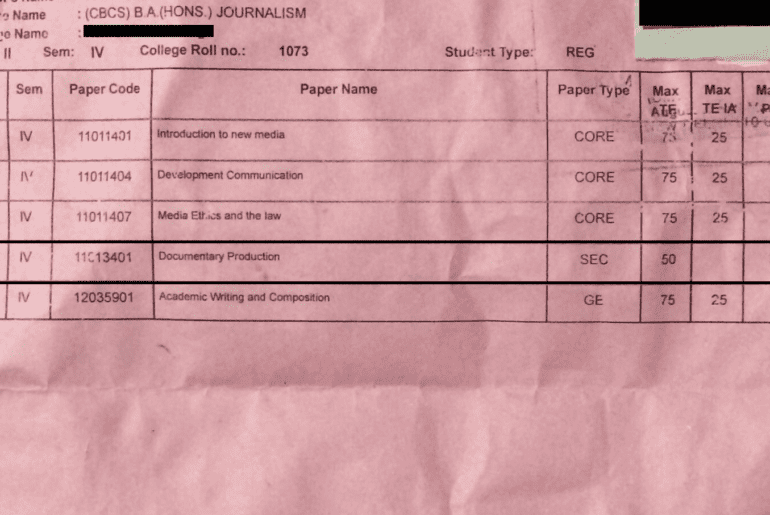
Many students studying Journalism Honours and Psychology Honours under CBCS guidelines received information about the Skill Enhancement Course’s external and internal assessments’ final marks distribution from their college’s faculty members close to the date of their final examination. With the dates of receiving this information varying in different colleges, students from Journalism Honours in Kamala Nehru College (KNC) learnt about the same from their teachers hours before their examination. Interestingly, the confusion of the Psychology Honours’ batch of Daulat Ram College (DRC) was clarified only upon receiving the question paper.

The discrepancy was found out in various colleges upon receiving the admit card. Students of Journalism Honours in KNC and Lady Shri Ram College (LSR) found a 50-50 marks distribution for external and practical assessment for SEC in their admit cards. While KNC students had been studying the course keeping the 50-50 distribution in mind, LSR students were uncertain as they had been following the 75-25 marks distribution, with 25 being allotted for internal assessment. Students from other colleges also underwent similar confusion. “Our admit cards said that the SEC paper that was documentary production would be of 50 marks. But the paper actually was for 75 marks.”, said Aditya, a Journalism Honours student from DCAC.

The situation varied across different colleges and different departments. In certain colleges, the final distribution came to the students’ knowledge quite late, while in certain colleges like Indraprastha College for Women (IPCW), there had been no discrepancy about the same neither in the admit cards, nor with the faculty.

The entire situation around the distribution of marks created confusion and hustle among students. “We were pretty confused since we didn’t know how the marks would be divided and how we are supposed to answer had it been for 50 marks.”, said Utkarsha, a Psychology Honours student from Daulat Ram College, where no clarification from the faculty had been received regarding the SEC Emotional Intelligence paper.

DU Beat reached out to faculty members, but received no comments from their end. There is still uncertainty whether the discrepancy had been for the Journalism Honours and Psychology Honours courses only.

Such action by the college administration as well as the faculty members makes us question whether the students’ best interests are really at heart. After all the formalities and unnecessary steps the students are forced to go through to receive their admit cards, such a massive error with regards to the marks distribution is a careless mistake by the authorities. Students who prepared accordingly, having faith in the college administration and the teachers, were shocked on the day of the examination. With all the buzz around exams and the pressure on students, why was this matter handled so inadequately by the authorities?


Priyal Mahtta
[email protected]

The much celebrated fest season of Delhi University has almost come to an end. Most of the colleges have had their annual cultural fests with spectacular performances in the competitive events, and to the amazing EDM and Star Nights. With the tribal theme on point, Daulat Ram College successfully organised its two-day fest Manjari’17 on the 22nd and 23rd of March. The pots painted with warli paintings and tribal masks: everything was splendidly placed, decorating the entire college premises beautifully.

The audience relished the amazing performances of different colleges in the western dance competition Laasya, folk dance competition Ulhaas, classical dance competiton Yogya, and semi classical face-off Darpan organised by Zenith, the western dance society of DRC and Annhad, the Indian dance society of DRC respectively. Alahyaa, the Indian Music Society of DRC held its annual music fest Aaroh’17 where the leading music societies competed in the different events like Sur Sangam, Jugalbandi and Annhad. Memesis, the theatre society of DRC organised Adakari’17- the theatre festival of DRC which saw a vast multitude of spectators pulled towards the amazing annual productions of the different theatre societies. Annual exhibition Taabeer’17 was organised by Sepia, the film and photography society of DRC. ‘Shades’ was organised by Spectra– the fine arts society of DRC. Tajagna, the quizzing society of DRC hosted Big Fact Hunt- a general quiz. All India Mushairah was also organised. A talent hunt competition was held for the visually challenged students. Events like Promenade by Debonair, the fashion society of DRC and Zaahir-e-Hunar, the open talent hunt, had immense spectation.

Superstar singer Guru Randhawa of Suit, Patola, Yaar Mod Do fame ignited the evening with his peppy numbers, making the crowd dance on their toes. The two-day celebration was drawn to a close with Bollywood hits like Pee Loon, Tere Sang which are credited to the name of the soulful singer Tulsi Kumar.


Feature Image Credits: Pinterest

Radhika Boruah
[email protected]

The day before Manjari, the annual cultural fest of Daulat Ram College, saw a Sports Day be conducted. It started off with the entry of the chief guest, Dr. Kuljeet Kaur, who is an athletics champion and alumni of the college, and the Principal, Ms Savita Roy. A round of felicitations then took place, with the chief guest, the Principal, and the organising teachers being recognised. This was followed by recognition and appreciation of the students who excelled in the previous Sports Day. Their hard work was applauded while they were received by a warm welcome from the crowd.

The actual event was an exciting affair, with wide participation from not only the students, but also the teachers. Most surprisingly, even the Principal took part in a couple informal events, which truly lent an element of fun to the occasion. Some of the races included classic favourites such as frog race, spoon race, and three-legged race. Such events brought everyone back to their elementary school days, when these races were the highlight of the school year. Apart from this, there were the usual formal sports events. These included distance races such as the 100m race, long jump, and so on.

Once the competitive events were concluded, there was an awards ceremony where all the winners were presented with their prizes. All in all, the day concluded on a note of laughter and excitement, and got both the students and teachers all hyped up for Manjari in the consequent days. It was a successful event that left everyone with a high.

Feature Image: Daulat Ram College Cricket Team

Vineeta Rana
[email protected]

On 27 October 2016, the film and photography society of Daulat Ram College, Sepia, held a photography exhibition in the gazebo in the front lawns. The exhibition displayed photos taken by the current team, as well as some ex-Sepia members. It included a variety of shots, such as those of nature, animals, and portraits. The event was open to all, and students from other colleges also came to admire the efforts of the team. Sepia also constructed a photo booth with a funky background and quirky props that everyone could use. They also had a feedback book, in which it was apparent that the viewers of the exhibition truly appreciated the hard work put in by the society members.

The event was a success overall and is only an indicator of the events to come this year.

Myraid themes came together in one exhibit.


Image Credits: Team Sepia

Vineeta Rana

[email protected]

Electric rickshaws have garnered huge popularity ever since their inception as cheap, accessible and affordable modes of transport. Though a lot of discussion and debate has been taking place regarding the legality and benefits of this recent innovation, research in this segment is still scant.

University of Delhi facilitates innovation projects where the students from different colleges take up potential topics and conduct extensive research upon them under the guidance of a mentor and teachers. One of the projects undertaken this time is by the students of Daulat Ram College on the topic ‘A Comprehensive Analysis of Electric Rickshaws in Comparison to Conventional Fuel Vehicles’.This Project is brought together by Ms. Ritu Khanna, Ms. Shikha Singh and Ms. Raman Arora and 10 students under the mentorship of Mr. V. Packirisamy. The team of students comprises of Harshiel Chahal, Aleena Khan, Arushi Gupta, Aishna Sharma, Gajal Jain, Aswitha Visvesvaran, Astha Goyal, Garima Goel, Talat Khanam and Muskan Gupta.

DRC innovation project
Primary surveys of e-rickshaw drivers were undertaken

The main objectives of the project were to study the socio-economic impact and environmental effects of e-rickshaws and to make policy recommendations for future action. A primary survey of 220 passenger electric rickshaws was conducted across Delhi with the comprehensive questionnaire designed to include social and economic profile of drivers and the vehicular profile of e-rickshaws. It has also questioned the regulatory and legal ambiguities in the e-rickshaw industry and suggested key improvements in the urban public transit governance for the same. Based on the findings of the survey and methods of calculating carbon emissions accepted globally, electric rickshaws have been found more environmentally sound than other conventional fuel vehicles.


The most significant contribution of the project has been the quantification of socio-economic impact to e-rickshaws, which had been an ignored area of study till now. The project could make several conclusions encompassing many socio economic indicators like income, working schedule, education, and living standards among others. These results play a pivotal role in putting together an inclusive report to the grass-root realities and make it possible for policy makers to look beyond a veil of fabricated understanding.


DRC innovation project
A comprehensive understanding of the on-ground situation along with the socio-economic conditions of drivers was attempted at.

The project also facilitated a comprehensive understanding of the on-ground situation of e-rickshaw drivers, which pointed towards several loopholes and administrative failures. Along with a pragmatic study of evolution of the regulatory framework, this helped us make necessary policy recommendations, which account for problems faced by the drivers that is often overlooked in the face of need  for rapid development. Thus, it will prove to be an indispensable piece of literature and act as guiding study for future researchers and policy makers                                                                                     .


This project has provided the students a first-hand experience of working with the target group along with the academic curriculum.The team has presented papers at prominent conferences including the International Conference on Corporate Finance, Governance and Sustainability, the National Conference on Social Science and Economics (NCSSE) and the National Conference on Emerging Issues of Climate Change: Sustainability and Economic implications, receiving immense appreciation for the research and innovation undertaken. It will also be presenting a paper at the International Conference titled ‘Socio-Economic Justice after Seventy Years of India’s Independence: Domestic and Global Challenges’ organized by Faculty on Law in November, 2016 and International Conference on “Green Chemistry in Environmental Sustainability & Chemical Education” (ICGC-2016).

The student union elections were finally held in Daulat Ram College (DRC) after being delayed by a month due to protests and renovations. On 26th October, 2016, thousands of DRC students went on to cast their votes to elect the Student Union for the year 2016-17. Most posts saw close competition between the contenders, especially for the posts of general secretary and cultural secretary. The option of NOTA (none of the above) was also a popular choice, with a count of 103 for the post of treasurer.

The results were announced around three hours after the voting ended. The newly elected union celebrated their victory with music and dancing in the college premises. The Student Union for the year 2016-17 is:

President – Nishita Narwal

Vice President – Rajni Upadhyay

Treasurer – Tamanna Chaudhary

Proctor – Prachi Goswami

General Secretary – Surbhi Hooda

Cultural Secretary – Rakshanda Bhat

Joint Secretary – Sanchita Jain

Image Credits: Bhavesh Bellani

Vineeta Rana

[email protected]