
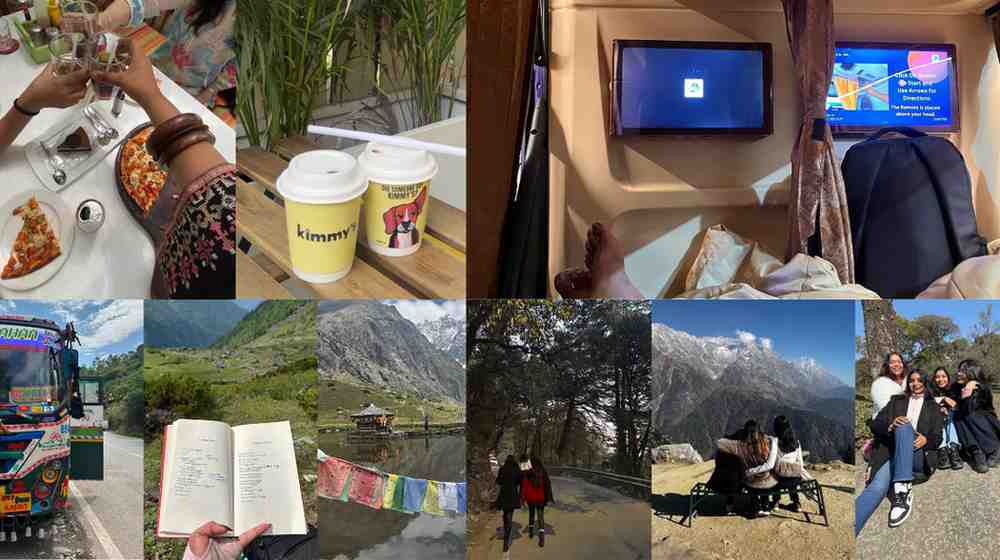
The single-most important factor when it came to travel opportunities used to be money. Now, a growing number of Gen Z travellers are proving that meaningful journeys are shaped less by how much they spend and more by the choices they make along the way.
Budget travelling is no longer just about spending less. For Gen Z, it is about spending smartly. Instead of choosing luxury at every step, young travellers are becoming selective about where they want to indulge. What travel looked like a few years ago has changed. Today, luxury is less about a five-star hotel and more about having an experience that feels worth the money.
This shift is often called à la carte travelling. Simply put, it means building your own trip. Instead of buying a pre-planned holiday or café dining package, you decide where to save and where to spend.
You do not have to look very far to see this. It starts right here in college. Café hopping is almost a part of student life. A day before the plan, the research begins. Which café should we go to? Is the food worth it? Does the place have a nice ambience? How far is it? Then comes the budget. Instead of booking a cab, everyone squeezes into an auto, splits the fare, reaches the café, splits the bill again, clicks pictures for Instagram and spends the evening there. They save on the commute so they can spend on the experience.
The same approach follows them when they travel. Instead of spending on every part of a trip, they spend only on the parts that make the journey memorable. They might stay in a hostel instead of a hotel, take an affordable bus instead of a flight, or use public transport or rent a scooty to explore a city, so that they can spend more on experiences that actually matter to them.
Vrushank Kupsad, a student at Sri Venkateswara College, University of Delhi, prefers staying in hostels because they bring people together. “Hotels have no life in them. In hostels, you meet people, share stories and make connections with strangers,” he said.
He also recalled taking an ₹800 bus from Bengaluru to Hubballi. “I ended up sharing life stories with a fellow passenger. It became one of my best travel memories,” he added.
Aaratrika Ghosh, a student at Lady Shri Ram College for Women, University of Delhi, said,
“I feel inherently as a student who funds her trips with her own money through freelance and internships, budget travelling becomes a plus point to optimise travel and actually travel and not just vacation. Recently, I went on a trip to Yulla Kanda in Kinnaur, Himachal Pradesh, and I completed it under ₹4,500 (Delhi to Delhi) while travel agencies were charging a minimum of ₹7,999. I saved money by travelling local, eating local, and supporting local homestays and hostels.”
Ananya Maurya, a student at Kamala Nehru College, University of Delhi, said travelling to McLeod Ganj, Himachal Pradesh by bus and staying in a hostel made the trip both affordable and memorable.
“I still remember lying on our bunk beds in the hostel after the bus journey, talking about the reels we would make. It felt surreal that a trip which had only existed in our group chat had finally become a reality. In between, I felt like I was living in the fantasy world of Yeh Jawaani Hai Deewani,” she said.
Harshit Singh, a student at Deen Dayal Upadhyaya College, University of Delhi, said renting a scooty allowed him and his friends to explore Dharamshala freely.
“It cost us ₹600 for two days, was budget-friendly, was less expensive than a cab, and gave us the freedom to explore the city on our own,” he said.
This is equally evident at international student conferences as well. Every year, the Harvard Project for Asian and International Relations (HPAIR) brings together around 700–800 student delegates from across the world in an Asian city to discuss global issues, leadership and policy. Yet, the conference is only one part of the journey. The planning around it shows how Gen-Z travels and manages the budget today.
Once delegates are added to their cohort and city groups, conversations quickly shift to budgets. Students coordinate with one another to book the same hostel or hotel, share rooms to reduce accommodation costs, compare flight fares before prices increase, and plan extra days in the host city to explore it beyond the conference. H-PAIR also shares local recommendations and places to visit, encouraging delegates to experience the city outside the conference venue.
Taken together, these choices are changing the travel economy. Instead of relying on travel agencies and fixed itineraries, many Gen Z travellers prefer planning their own journeys. Recommendations often come from fellow travellers in a hostel, a local restaurant owner, an elderly co-passenger on a bus explaining the history of a town, or even a chance conversation with a resident, rather than from a tour operator. These interactions give travellers the flexibility to change plans, stay longer at places they enjoy and discover cafés, neighbourhoods, local markets and hidden spots that are often left out of packaged tours.
As a result, money that was once spent on hefty, all-inclusive holiday packages is now finding its way to hostels, cafés, local transport providers, scooter rentals, walking tours and other local businesses, many of which are MSMEs (Micro, Small and Medium Enterprises). Rather than making one large travel purchase, Gen Z is distributing its budget across different parts of the journey.
À la carte travelling is doing more than changing where young people spend their money. It is also encouraging community building. Hostels have become more than just affordable accommodation; they are spaces where travellers connect, exchange recommendations, share stories and build friendships with people from different backgrounds. These interactions often continue beyond the trip, turning chance encounters into lasting connections.
For Gen Z, the value of a journey is no longer measured by how much they spend, but by the memories they create, the people they meet and the stories they bring back. As more young people travel this way, they are not only re-framing the travel economy but also creating a travel culture where experiences, human connections and shared stories matter as much as the destination itself.
Photo Credits: Mahi Mishra, Vrushank Kupsad, Ananya Maurya and Aaratrika Ghosh
Read also:- The Housewife Who Answered for the Government
Mahi Mishra



Comments are closed.