
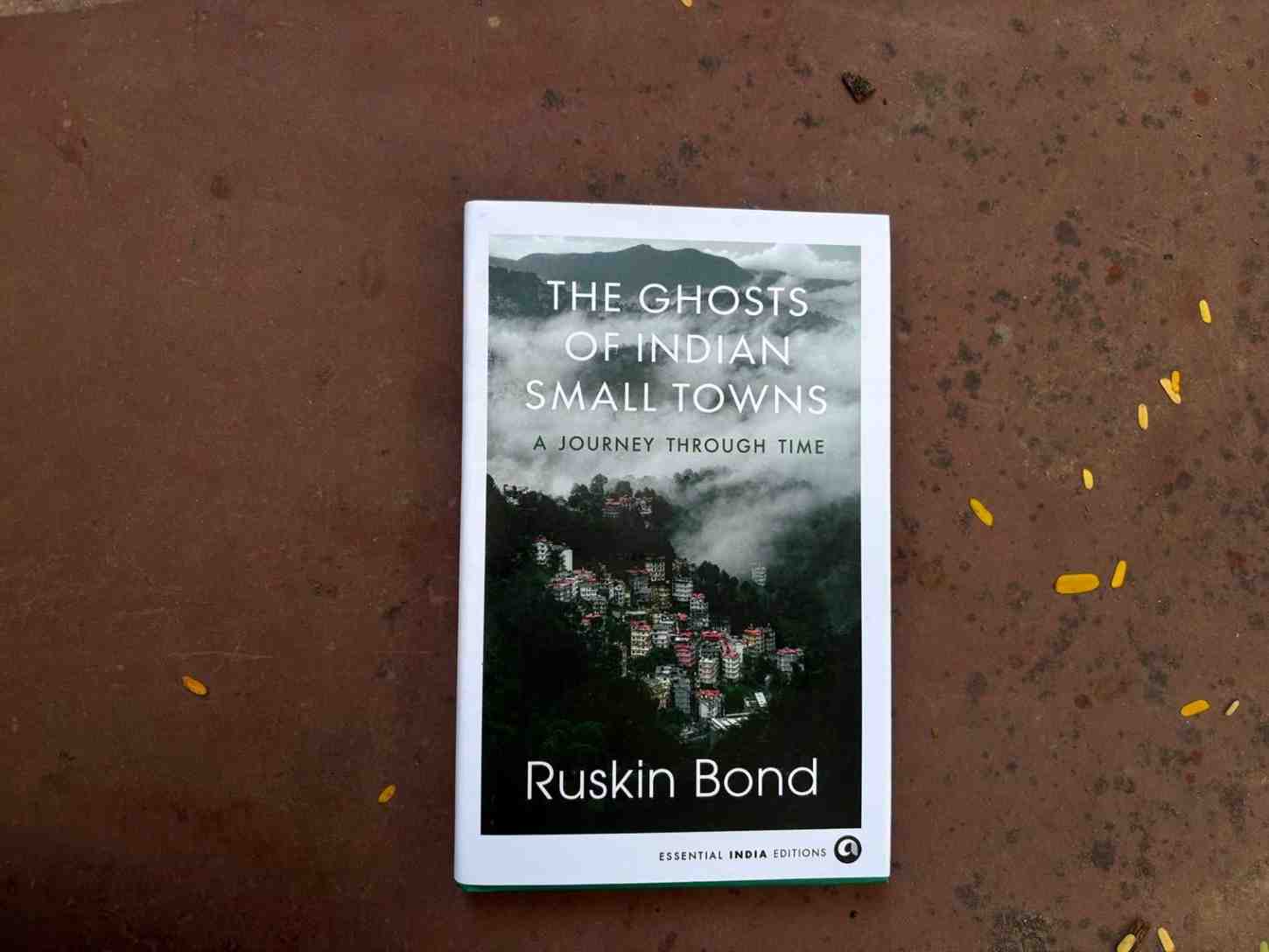
From Dehradun to Varanasi, DU students revisit the small towns they grew up in, reflecting on urbanisation, memory, and the people who continue to define home.
“Villages become small towns, small towns become big towns or even cities, and cities become megacities.” With these words, Ruskin Bond opens The Ghosts of Indian Small Towns: A Journey Through Time, looking back at nearly ninety years of watching India transform. From Dehradun, Meerut and Landour to Bangalore, Bond revisits the towns that have lived on in his memory, drawing a picture of their transformation.
Recalling his first visit to Bangalore in 1960, Bond writes of himself as a young man, “published but unknown”, selling the occasional article to The Deccan Herald. It was a time when rural and urban India still coexisted, when towns could be crossed on foot and life unfolded at its own pace. Looking at the city today, he writes, “Once there was a town called Bangalore. Now we have a city called Bengaluru.“
Yet Bond does not mourn change. Instead, he leaves the question to his readers. “One day, the nation will become one big city! Complete unification. So perhaps it’s for the best. Who knows? Only you, my youngest reader, will be around to tell the story.”
That story continues across the University of Delhi, where students who have left India’s small towns behind have watched their hometowns change while holding on to the things that still make them feel like home.
For Prakriti Chauhan, a BA Programme student at Kamala Nehru College from Dehradun, the changes have been impossible to ignore.
“I keep seeing reels saying, ‘Delhi cafés would be jealous of this café in Dehradun,'” she says. She believes the city is increasingly being seen as an extension of Delhi.
She worries about the loss of greenery as development leaves less space for wildlife. She also feels the city’s lifestyle has changed, with the rise of clubs and what she describes as a ‘wannabe-Delhi’ culture. “People wanted clubs, and Dehradun got a nightlife, but it came with its own problems,” she says. She recalls that gun violence and stabbings in marketplaces were unheard of during the ten years she lived there but have become more visible in recent years.
Despite these changes, one thing remains constant for her. “I’ve moved out, met new people and made new friends, but my family is there. Dehradun is the place that saw me grow up.”
For Anushka Saha, a student at Gargi College from Siliguri, the difference between home and Delhi usually begins with making plans.
“Whenever we plan to go somewhere, it’s almost always by Metro,” she says. Back home, friends simply picked each other up on a scooty or bike, and most places were only two or three kilometres away. Even a five-kilometre journey from her PG in Saket to college can take nearly forty minutes because of traffic. “That’s why small towns feel less noisy and less polluted. Life isn’t always spent waiting in traffic.”
While Prakriti and Anushka speak of changing cities through everyday experiences, Maanik Verma, a student at the College of Vocational Studies, remembers home through the familiarity of small-town life.
“Food is what brings people together in small towns,” he says. If something special was cooked at home, it was common to share it with neighbours, and the same happened when neighbours prepared something special. Birthdays and family gatherings meant people coming together over meals while children played. “You always have people around to celebrate your happy moments and support you through difficult ones. At the same time, people also tend to know a little too much about each other’s lives.”
Urbanisation has changed the way parts of Varanasi look and feel. For Abhishek Pradyot, a student at the Faculty of Arts from Varanasi, Nadesar is one example of this change, where landmarks such as the Taj Hotel and Nadesar Palace have transformed the locality.
But for him, what has endured matters more. Referring to Kachori Gali, a song by Coke Studio Bharat inspired by colonial-era migration and the longing for home, he says its beauty lies in the fact that it is still sung in the very lanes of Kachori Gali in Varanasi.
“No matter how much urbanisation reaches there, I feel Banaras will always remain a small town at heart. Its heartbeat is still the Ganga.”
Bond wondered whether the nation would one day become “one big city.” Listening to these students, that future no longer feels far away. Their hometowns have welcomed wider roads, new cafés, expanding skylines and global brands, but growth has not erased the memories and connections that define them.
Bond writes that it is people who give character to a town. Perhaps that is why, no matter how much these places grow, they continue to hold on to something familiar: the streets, the people and the moments that make them feel like home.
Read Also: A Global Tapestry: Goals, Heritage, and Halftime Shows at the 2026 FIFA World Cup
Image Credits: Mahi Mishra for DU Beat
Mahi Mishra



Comments are closed.