Tag

Home

Browsing

From Dehradun to Varanasi, DU students revisit the small towns they grew up in, reflecting on urbanisation, memory, and the people who continue to define home.

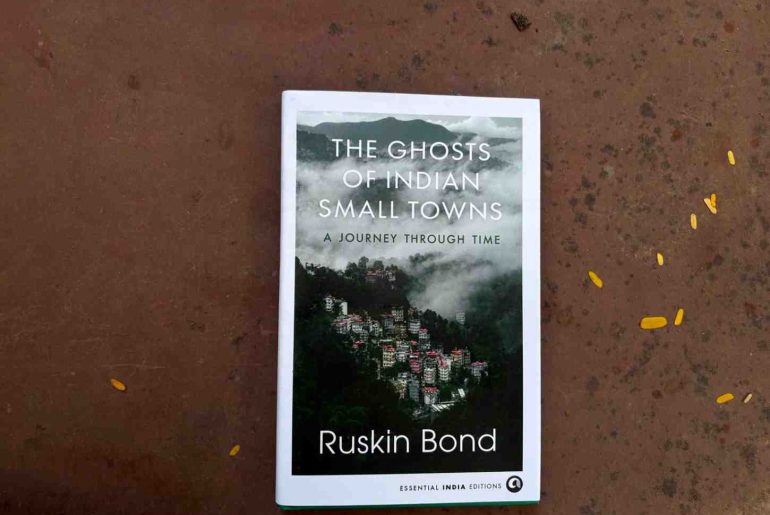
“Villages become small towns, small towns become big towns or even cities, and cities become megacities.” With these words, Ruskin Bond opens The Ghosts of Indian Small Towns: A Journey Through Time, looking back at nearly ninety years of watching India transform. From Dehradun, Meerut and Landour to Bangalore, Bond revisits the towns that have lived on in his memory, drawing a picture of their transformation.

Recalling his first visit to Bangalore in 1960, Bond writes of himself as a young man, “published but unknown”, selling the occasional article to The Deccan Herald. It was a time when rural and urban India still coexisted, when towns could be crossed on foot and life unfolded at its own pace. Looking at the city today, he writes, “Once there was a town called Bangalore. Now we have a city called Bengaluru.

Yet Bond does not mourn change. Instead, he leaves the question to his readers. “One day, the nation will become one big city! Complete unification. So perhaps it’s for the best. Who knows? Only you, my youngest reader, will be around to tell the story.”

That story continues across the University of Delhi, where students who have left India’s small towns behind have watched their hometowns change while holding on to the things that still make them feel like home.

For Prakriti Chauhan, a BA Programme student at Kamala Nehru College from Dehradun, the changes have been impossible to ignore.

“I keep seeing reels saying, ‘Delhi cafés would be jealous of this café in Dehradun,'” she says. She believes the city is increasingly being seen as an extension of Delhi.

She worries about the loss of greenery as development leaves less space for wildlife. She also feels the city’s lifestyle has changed, with the rise of clubs and what she describes as a ‘wannabe-Delhi’ culture. “People wanted clubs, and Dehradun got a nightlife, but it came with its own problems,” she says. She recalls that gun violence and stabbings in marketplaces were unheard of during the ten years she lived there but have become more visible in recent years.

Despite these changes, one thing remains constant for her. “I’ve moved out, met new people and made new friends, but my family is there. Dehradun is the place that saw me grow up.”

For Anushka Saha, a student at Gargi College from Siliguri, the difference between home and Delhi usually begins with making plans.

“Whenever we plan to go somewhere, it’s almost always by Metro,” she says. Back home, friends simply picked each other up on a scooty or bike, and most places were only two or three kilometres away. Even a five-kilometre journey from her PG in Saket to college can take nearly forty minutes because of traffic. “That’s why small towns feel less noisy and less polluted. Life isn’t always spent waiting in traffic.”

While Prakriti and Anushka speak of changing cities through everyday experiences, Maanik Verma, a student at the College of Vocational Studies, remembers home through the familiarity of small-town life.

“Food is what brings people together in small towns,” he says. If something special was cooked at home, it was common to share it with neighbours, and the same happened when neighbours prepared something special. Birthdays and family gatherings meant people coming together over meals while children played. “You always have people around to celebrate your happy moments and support you through difficult ones. At the same time, people also tend to know a little too much about each other’s lives.”

Urbanisation has changed the way parts of Varanasi look and feel. For Abhishek Pradyot, a student at the Faculty of Arts from Varanasi, Nadesar is one example of this change, where landmarks such as the Taj Hotel and Nadesar Palace have transformed the locality.

But for him, what has endured matters more. Referring to Kachori Gali, a song by Coke Studio Bharat inspired by colonial-era migration and the longing for home, he says its beauty lies in the fact that it is still sung in the very lanes of Kachori Gali in Varanasi.

“No matter how much urbanisation reaches there, I feel Banaras will always remain a small town at heart. Its heartbeat is still the Ganga.”

Bond wondered whether the nation would one day become “one big city.” Listening to these students, that future no longer feels far away. Their hometowns have welcomed wider roads, new cafés, expanding skylines and global brands, but growth has not erased the memories and connections that define them.

Bond writes that it is people who give character to a town. Perhaps that is why, no matter how much these places grow, they continue to hold on to something familiar: the streets, the people and the moments that make them feel like home.


Read Also: A Global Tapestry: Goals, Heritage, and Halftime Shows at the 2026 FIFA World Cup

Image Credits: Mahi Mishra for DU Beat


Mahi Mishra

[email protected]

What’s more difficult than having to say goodbye to your friends, professors, college lawns, your college canteen, and the city you called “home”? It’s figuring out what to do next. What’s the next stop in this journey for which you neither have an itinerary nor a guide to help you schedule your breakdowns? 

It’s 7 pm on a Saturday, you’ve completed all your work and the city lights are more beautiful than ever. You get a text from your friend about a party happening merely two blocks away. You have a faint smile on your face, but somehow your eyes don’t glimmer at the text the way they would have 2 weeks ago. It’s not that you don’t want to go, it’s your heart’s faint protest that is almost 3 days too early. Why, you ask? It’s your graduation ceremony on Monday. Three years of crying for this degree (and with it) have finally ended. But what’s this queasy feeling inside of you? Instead of being happy, you wrestle with this scintilla of bitterness in your chest.

Delhi University, home to thousands of young students, some who grew up here, and others who chose to be here. The ones who did choose also made the choice of leaving their homes behind. The life they’d grown to love, and the life that they now cherish only in memories. Nonetheless, once the city of Delhi – the “Dilwalon ki Dilli” – casts its spell on you, your definition of home begins to expand. You begin to grow a life here, and perhaps, start loving it a bit too. Your friends become your family, your professors become parents.

And yes, soon enough, the career dilemma, the imposter syndrome, and a pile of assignments creep in, and you also finally learn what it means to be truly overwhelmed. The friends that have now become your family also sometimes become a shoulder to cry on when you can’t bear the concept of college any longer. Between the fun, frolic, and a lil bit of crying, acceptance becomes your natural response. And the moment you finally, completely, truly come to terms with this acceptance…snap! Three years are over. 

What follows is the same bitterness, the same anxiety that smuggled its way into your head three years ago when you chose to leave your first home. Except now, you also need to find a job, earn money, and figure out what to do next, all on your own. Acceptance gets replaced with denial (or finally finds its way back to it), and the only “acceptance” you can tolerate are university, internship, and offer letters. No one said it was going to be easy, but between watching yourself stress over college assignments to now stressing over month-end because the paycheck isn’t in yet? Adulting becomes the cold hard reality. 

More than anxiety it’s the pressure of trying to know which city I’m going to go to next. Even if you miss home, you tend to familiarize yourself with the new idea of home and what you’ve found, i.e pretty much wherever you stay has to become your home for a particular amount of time. The home conundrum for me is missing my home, the one I grew up in, constantly and always wanting to go back, but also the feeling of sadness that comes when I realize I will have to leave my current residence in a few days, and then also wanting to stay back a few more days here.” – Debarati Mitra, a 3rd-year student at Maitreyi College and a beloved ex-DUB correspondent

So yeah, the nostalgia learns to balance itself out with the anticipation of tomorrow. Adulting is no longer a Gen-Z slang but something real you get to deal with. As the class of 2023 graduates, and combs into the tousled mess of being an adult, there is, but one takeaway: patience. Be patient, work hard, take care, be madly in love with yourself, and let life piece itself together as you find its various jumbled pieces along the way.

Featured Image Credits: DU Beat Archives/ Sukriti

Read Also: Jab DU Met Bollywood

Vidushi Sinha

[email protected]

Be it the accommodation of a traditional tribal necklace in the outfit of a North-Eastern student, fasting before Eid, or bringing with us the post-holiday ghar-ka-khaana, we all have managed to keep a bit of home alive in us.

The University of Delhi (DU) invites students from all over the subcontinent, and therefore, becomes a microcosm of what the spirit of diversity is all about. In any given college, there would be students from not just every single state of India, but from various neighbouring countries, enrolled. As such, you are able to differentiate one from the other, but certainly not in a divisive way. These different students all come together, bring with them their specific points-of-view, and works towards a common, shared goal.

Be it the classroom, or a society – the amalgamation of various ethnicities is what sets DU apart from the rest of its counterparts.

While it is essential to become one with our peers, we must also not forget that we all have our unique stories, and that is what keeps us interesting, and in some cases, even relevant. In the bid to fit in, we must not let go of where we come from, and maintain our culture – be it art, food, music – people want to hear about it.

In DU, the inquiring of the other cultures is an enormous part of the everyday conversation. On asking Bengalis about Durga Pujo, South Indians about their food, Marathis about Ganesh Chaturthi, we unknowingly, yet enjoyably, become more aware of other cultures, and become truly cultured.

It often does away with the stigma that we might have harboured about a given community, and they always seem less intimidating that they must have appeared.

Besides the educational aspect of it, maintaining the identity of your home(town) lends an aesthetic, almost artistic look to the ambience because the campus has that much more multiplicity.

All said and done, if there is a certain piece of jewellery, a certain harmony, a certain way of greeting people that is characteristic of the place you come from, make it a part of you. Embrace it and embody it, because trust me, identity is more than what it is given credit for.


Feature Image Credits: DU Beat Archives


Maumil Mehraj

[email protected]

What is it like to be half at home, hoping to hault time in the comfort of your town? Vacationing in the hometown is a bittersweet journey of learning and appreciating. Read on to find out why.

Gaius Plinius Secundus was a Roman philosopher who said, over two thousand years ago, “Home is where the heart is.” The twenty-first century is a time of wanderlust, throwbacks to holiday destinations, Kierkegaard’s much feared aesthetic sphere of existence over social media, and a home strewn everywhere but where the heart remains.

The outstation students- smoking in the allies near Symbiosis (Pune), or sitting in protests in the campuses at DU (University of Delhi), or shooting pictures for assignments at NIFT- share this longing for the hometown. So, when the semester ends, December arrives with chilled breezes and cocoa cups in the comfort of home. To go back home is no longer an end to the party, but it is the calm of returning to familiarity after a long day out in the streets of the world.

As a child, one awaited the two months of frolicking away from the hometown, maybe in the garden of grandparents’ place. One felt the joy in climbing up bunkers in trains for journeys that lasted the night to seek a place out of the home, for a vacation. As teenagers in school, Dil Chahta Hai and Zindagi Na Milegi Dobaara were the dream-worlds to aspire for. Sharing the hopes of road trips to Ladakh, making jokes about unfulfilled Goa plans, the time to finally leave hometowns knocked quietly. Vacations at home now become a luxury.

When living with a fixed set of people during the time of peculiar growth and evolution in your desires, friction is bound to exist. Generation gaps, value clashes, adolescent mood-swings, and a sense of distance while living in the same place, day in and day out, are the gist of the drama in an average Indian family. But vacationing in the home thaws the hardened egos on all sides, because it is not a given that one would be around forever to resolve the long-drawn differences. Presence, for a fortunate change, are not taken for granted anymore. Living out of a half-unpacked suitcase, though, remains an unfettered reminder of the vacation that is now home.

Image Courtesy: The New York Times

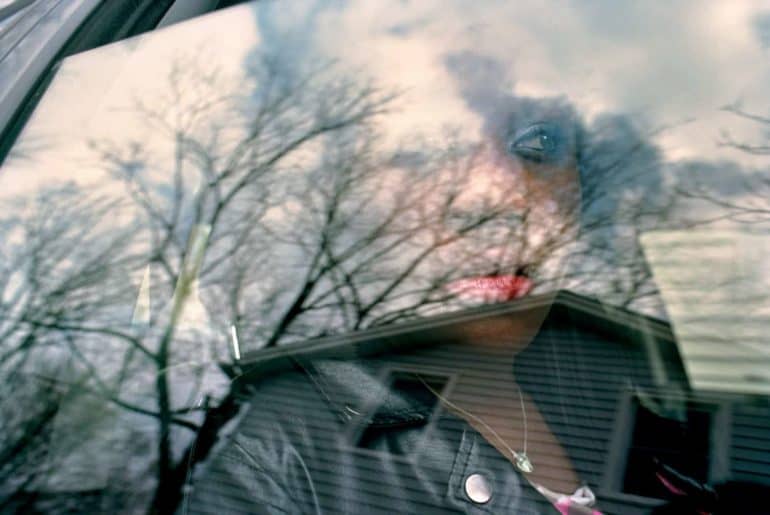
Image Caption: One looks at the familiar places with a softer lens, mostly grateful for having somewhere to always feel familiar at.

Anushree Joshi

[email protected]