
Tag

Delhi University

Browsing

Delhi University officially secures its position in the prestigious list of Higher Education Institutes of India by receiving the highest NAAC grade, ‘A++’, on 9th August, 2025.

The National Assessment and Accreditation Council (NAAC) recently bestowed upon Delhi University (DU) and Lucknow’s King George’s Medical University (KGMU) its highest accreditation grade of A++. 

In the latest assessment, which was also the second cycle of evaluation, Delhi University was honoured with a CGPA of 3.55, reaffirming its position as one of the prominent institutions of the country. KGMU became the second medical institution in Uttar Pradesh to receive this excellence, earning a CGPA of 3.67. 

In a public statement Delhi University proudly said,

This achievement reflects the collective dedication of our faculty, students, staff, alumni, and stakeholders.”

Before having received this certification, DU has had many of its individual institutions honoured with the same long before. 

Shri Ram College of Commerce, the leading institution of DU was awarded with an A+ grade in the year 2016, with a CGPA of 3.65. In the second round of evaluation, it moved up to A++ accreditation with a CGPA rating of 3.75 now.

Two of Delhi University’s women colleges, namely Lady Shri Ram College and Miranda House have been awarded A++ in their second round of evaluation, with LSR bagging a CGPA of 3.75 in 2023. Similarly, Miranda House received the accreditation with a CGPA of 3.61. Joining the other acclaimed colleges, St. Stephens too received an accreditation of A++ in the year 2023 with a CGPA of 3.76 alongside Hansraj that bagged a grade of 3.71 CGPA. Other colleges like Ramjas, Kirori Mal, and Hindu also have an A+ grade conferred upon them. 

The National Assessment and Accreditation Council (NAAC) was established in 1994 by the University Grants Commission of India (UGC). It is an autonomous body that assesses and evaluates the quality status of a higher education institution and inspects the performance of the said educational body related to education, faculty, research, infrastructure, curriculum coverage, governance and much more. The council uses a seven-point grading system to evaluate colleges ranging from A++ to D. The accreditations are valid for a period of five years. 

Although established in the year 1922, Delhi University received its first NAAC grade of A+ in the year 2018 with a CGPA of 3.28. The University worked its way up to the 6th position in the NIRF ranking amongst Universities in India and 15th position overall. 


Read Also: Delhi University Relaxes Criteria for Minor Subject Selection Under UGCF


Image Source: DU Squad


Ananya Agarwal

[email protected]

A swarm of wide-eyed youth – breaking into “ethnic-chic” from their everyday, boring school uniforms – filled up the streets on the very first August morning of 2025. 

As chaos made its way to the corridors of Delhi University Colleges, a sense of new beginnings was once again reignited in the minds of experience-laden seniors. Most colleges welcomed freshers with fourth-year undergraduates for their first day. All classes remained suspended except for Kirori Mal College, whose orientation was held on Wednesday. The decorated campuses came alive with the chatter of students wanting to have the full college-life experience, from making new friends to joining new societies and following their DU dreams. 

“I could not sleep last night. I kept thinking about the friends I am going to make, the societies I am going to join, the food I am going to explore,” Rashmi Taneja told HT as she stepped into the college for the first time – in a light pink chikankari salwar suit and heavy jhumkas. 

Many colleges followed a different scheme – breaking up the orientation programmes into slots or days to accommodate the huge cohort of students joining in. Like CVS will be holding its full-body orientation on Monday, following the departmental orientations held on Friday.  On the other hand, Hansraj College held a havan ceremony to mark the start of a new academic year. Several early morning sports activities, performances by the college music society and an anti-ragging rally led by the NCC and anti-ragging committee were arranged by the college.

The vibrant helpdesks and over-enthusiastic club leaders made the whole experience feel even more fulfilling. “I was honestly terrified of ragging,” admitted Diksha to the Newsdrum. “But the moment I stepped in, all that fear vanished. Everyone has been so kind. Seniors are like older siblings – funny and helpful,” she commented. 

Shri Ram College of Commerce, the most sought-after DU college, held its orientation ceremony on Thursday. Principal Professor Smriti Kaur told PTI that preparations are in order, as this entire year will be celebrated as the ‘centenary year’. Meanwhile, students from ABVP, AISA, and SFI set up colorful stalls outside colleges, distributing pamphlets, bookmarks, and bags to woo freshers. Some welcomed newcomers with tilak and flowers. 

As reported by Times of India, for Prachi, the first day at DU was not just stepping into college – but stepping into her power. “Disability does not define me,” she said with quiet strength, standing outside Miranda House, where she secured admission under the PwD category. It was her dream college, and she got in. Born with a short limb, Prachi never let her condition set the limits of her ambition. “Some people see it as a barrier, but I have always chosen to see it as just one part of my story,” she said. 

That said, the day concluded with solemn satisfaction. As the red brick walls felt the new set of gaze set upon them, the coveted halls were filled with pride. “All programmes ran smoothly” said Vice Chancellor Yogesh Singh. 

Read Also: DU Announces Schedule for Third Round of CSAS UG

Image Credits: Hindu College

Shreya Bhushan 

[email protected]

Delhi University’s push for a fourth year under FYUP has left chaos in its wake with missing infrastructure, mounting workload, and no exit in sight. Has the university confused rhetoric with reform in its rollout?

With a notification dated July 31, 2025, Delhi University formally enforced the fourth year of the Four-Year Undergraduate Programme starting August 1. What should have been a thoughtful academic transition has arrived as a poorly managed surprise, marred by missing infrastructure, insufficient faculty, and an undefined syllabus. For over a year, Vice Chancellor Yogesh Singh has endorsed FYUP as a transformative, student-centric reform aligned with the National Education Policy (NEP) 2020. But students and teachers alike reveal a rushed, unclear rollout, exposing the lack of structure and support that has left students in the crossfire.

According to the notification, the Executive Council met on July 12, 2025, to deliberate on the implementation of the fourth year, recommending that colleges operate from 8 AM to 8 PM to optimise resource usage. While students may choose from a basket of courses, actual availability depends on faculty norms. Faculty deployment will follow existing rules, with guest faculty hired if needed. Though extra staff workload is acknowledged, no clear compensation is outlined. The Council stressed that only experienced, regular faculty should teach the fourth year. Citing UGC Clause 15, the notification reiterates that full-time teachers must work 40 hours a week over 30 weeks annually, including five hours daily on campus and two hours for mentoring, with 16 teaching hours weekly for Assistant Professors and 14 for senior ranks.

Dr. Mithuraaj Dhusiya, an elected member of the Executive Council, highlights the serious concerns raised by DU’s latest notification:

“Directing colleges to adopt 8 AM to 8 PM daily classes is extremely dangerous from the safety perspective of students and teachers. Further, it just shows that DU is not prepared for the 4th year on both counts: infrastructure and manpower. It also insults newly appointed teachers by implying that only senior teachers can teach the 4th year. Teaching is based on areas of specialisation, not age.”

The last-minute advisory, released a day before the Fourth Year began, raises concerns about the university’s planning process. Abha Dev Habib, Secretary of the Democratic Teachers’ Front and Associate Professor at Miranda House, points to glaring gaps and questions the impossible timelines handed to colleges: 

“Does the University know that teaching distribution and timetables have to be made during vacation itself if classes have to start from day one? New courses have been introduced at the undergraduate level without any workshops or preparatory training for teachers. While some colleges may be able to manage depending on their faculty’s specialisations, the University has made no systematic effort to ensure a smooth rollout.”

Beyond academics, the policy has drawn sharp criticism from faculty for its regressive undertones. Rudrashish Chakraborty, Associate Professor at Kirori Mal College and DUTA Executive member, cautions about serious institutional risks:

“The 8 AM–8 PM schedule now has official sanction, pushing a draconian, anti-teacher, and anti-student timetable, especially in colleges lacking basic space. There is also no clarity on how this will affect evening colleges; will they function from 8 PM to 8 AM, or will they be dismantled entirely? The advisory also formalises the exclusion of research supervision from regular workload, paving the way for the overburdening Draft Regulation 2025. The requirement of two hours daily for mentoring 15 students per teacher attempts to quantify meaningful engagement and defeats its purpose. Reserving 4th-year teaching for senior faculty creates a divisive hierarchy. And with many Delhi government-funded colleges still awaiting appointments, ad hoc teachers are now cut out entirely. This not only adds insult to injury but also makes the actual conduct of the fourth year logistically difficult.”

In the end, the most pressing concern remains the lack of choice. With Delhi University’s August 1 deadline behind us, the Four-Year Undergraduate Programme has effectively become a one-way tunnel. Students who may have legitimate academic, financial, or personal reasons to opt out are now left with no transparent pathway to do so. This move erodes student autonomy but also betrays the very spirit of flexibility and choice that the National Education Policy claimed to uphold. What was promised as reform has curdled into rigidity, trapping students in a system that denies their agency. It begs the question, can a system that suppresses dissent and eliminates choice truly claim to educate, let alone empower?

Featured Image Credits: Siva For DU Beat

Neeraja Unnikrishnan
[email protected]

Read Also: Delhi University Relaxes Criteria for Minor Subject Selection Under UGCF

Delhi University to release CSAS-UG 2025 second seat allotment today at 5 PM. Major reshuffling expected as thousands seek upgrades.

The University of Delhi (DU) will release the second round of undergraduate seat allotments today, July 28, at 5 PM, as part of its ongoing centralised admission process for the 2025-26 academic session under the Common Seat Allocation System (CSAS-UG). Candidates who applied in the second round can check the allotment list on the official website once it is published.

Ahead of this round, the university had published a list of vacant seats, allowing candidates to re-arrange their preferences between 5 PM on July 24 and 4:59 PM on July 25.

This round of allocations is expected to reflect significant internal reshuffling. While 16,126 candidates chose to freeze their seats after the first round, a majority of 43,741 students opted for upgrades. These students are now awaiting the second list, hoping to move to their preferred colleges or programmes. The updated allotment will reflect these changes, offering candidates another opportunity to secure a seat based on merit and availability of seats.

According to the official schedule, once the second allotment list is released, candidates must accept their seats online between 5 PM on July 28 and 4:59 PM on July 30. Colleges will then verify and approve the online applications by July 31.

To confirm admission, students must pay the requisite fee through the online portal by 4:59 PM on August 1. Failure to do so may result in the cancellation of the allotted seat. 

Additional rounds of seat allotment may be conducted by the university if vacant seats remain. 


Image Credits: Devesh for DU Beat

Neeraja Unnikrishnan
[email protected] 

Also Read: Few Days to Reopen, Still No Syllabi: What’s Happening at DU?

With just days before reopening, students and teachers remain in the dark, syllabi remain unnotified, decision-making bypasses experts, and institutional autonomy is under threat.

With less than two weeks to go before Delhi University reopens, teachers and council members are raising concerns over the rushed, unclear rollout of the NEP. The University is set to introduce over 82 postgraduate courses under the new PGCF and begin the fourth year of the UGCF for the first time. But shockingly, the syllabi for these new courses haven’t even been notified yet.

Associate Professor of  Physics at Miranda House Abha Dev Habib, and also Secretary of the Democratic Teachers’ Front, posted a detailed statement on Facebook titled “Killing a University!.” She wrote,

Courseworks and syllabi for the UGCF courses for semester VII and VIII, which concern over 60,000 students have not been notified even as these were passed by the EC of 23 May and 12 July 2025. Without information on time, how labs will be prepared or students informed of Elective papers or teachers will prepare for new courses, nothing concerns the University anymore,”

Dr. Mithuraaj Dhusiya, elected member of DU’s Executive Council, shares the same alarm.

DU is still not prepared for the 4th year NEP-UGCF in terms of infrastructure, manpower and academic syllabus. It is extremely shocking that both students and teachers don’t know yet what they would be studying or teaching in the 4th year,”

And such problems go beyond syllabus interference as Rudrashish Chakraborty, an Associate Professor at Kirori Mal College and an elected member of the DUTA Executive says,

The colleges are looking at a situation where theoretically there is a potential increase of 33% students in the institutions with no promise of extra funds. This is a very well-planned effort to dismantle the largest public-funded University in the country”

What’s most alarming is that recent syllabus changes aren’t coming from within departments, but are being imposed by people with no expertise in the subjects, highlighted by Professor Rudrashish Chakraborty:

These outsiders are neither experts nor even belong to the subjects concerned, they act as paratroopers in Standing Committee meetings at the behest of the University administration.” He points out that academic decisions are being overridden, and “no self-respecting academic is allowed to survive in the University of Delhi without compromising on his/her academic integrity.” Referring to the resignation of the Head of the History department,

Abha Dev Habib warns,

Committees have been set up to dictate terms on syllabi already passed by AC-EC. This is unconstitutional and is the result of excessive interference by BJP-RSS.”

Media coverage in recent months has highlighted growing concern among faculty over DU’s readiness to implement NEP-based curriculum. According to India Today, faculty members have also raised alarm about rising teaching loads. Faculty members are expected to engage in 40 hours of work weekly, yet there has been no new staff recruitment. Abha Dev Habib told India Today Education, “The UGC regulations, 2018, clearly specify 14–16 teaching hours. Forcing teachers beyond that violates norms,”

With only days remaining before the university reopens, the situation remains uncertain for thousands of students and their professors alike.

Read Also: Uncertainty Shadows The Fourth Year of Delhi University’s NEP Rollout.

Image credit:  Arush for DU Beat


Juhi Bansal

[email protected]

Seven youth activists were allegedly detained without due process, tortured in custody, and later released, raising serious concerns over legality and institutional silence.

Over a span of 11 days in July, seven students and youth activists were detained by the Delhi Police Special Cell in a manner that civil liberties groups allege have amounted to enforced disappearance. The arrests, which began on July 9, have drawn criticism over alleged procedural violations, custodial torture and intimidation, including threats of sexual violence. 

The detained individuals were affiliated with student-led platforms such as the Bhagat Singh Chhatra Ekta Manch and the Forum Against Corporatization and Militarisation.  

On July 9, Delhi Police detained Gurkirat, Gaurav, and Gauraang, members of the Bhagat Singh Chhatra Ekta Manch, without issuing any formal arrest warrants or prior notifications, an action that appears to violate procedural safeguards outlined under Sections 35 and 36 of the BNSS. Two days later, activists Ehtmam-ul Haque and Baadal were also taken into custody under similar circumstances in Delhi.
Samrat Singh, a psychologist and social worker based in Yamunanagar, Haryana, was reportedly picked up from his residence without any involvement from the local police, raising concerns over the legality of cross-jurisdictional action by Delhi authorities. 

While all seven activists were released by July 21, rights groups have said that the circumstances of their detention and treatment in custody merit closer scrutiny. The use of coercion, threats of sexual violence, and blatant disregard for due process remain matters of serious concern. 

Legal groups and those detained allege that the arrests were made without warrants, and that standard procedures—including informing the accused and producing them before a magistrate within 24 hours—were not followed. Family members and legal representatives claim that for several days, they were unaware of the whereabouts of the detainees, effectively making the situation one of enforced disappearance under international human rights norms.  

The Campaign Against State Repression (CASR) said the detentions violated Article 22 of the Constitution, which guarantees the right to be informed of the grounds of arrest and to consult legal counsel. The group also said there was no adherence to the Supreme Court’s D.K. Basu v. State of West Bengal (1997) guidelines, which mandate the preparation of arrest memos and timely communication with families. 

A report by Maktoob Media, based on interviews with the released individuals and legal advocates, stated that several of the detained activists alleged they were subjected to custodial violence, including beatings, electric shocks, and verbal abuse.  

The Bhagat Singh Chhatra Ekta Manch (BSCEM) stated to DU Beat:  

This level of repression with abduction, week-long illegal detention, and custodial torture including electrocution, being forced to strip naked, sexual harassment, heads being dunked into unflushed toilet bowls is not an isolated incident.” 

The statement continued, “These actions reflect the broader crackdown on democratic voices under the Surajkund Scheme, which aims to criminalise and silence all forms of dissent.” 

Among the most serious allegations were threats of sexual violence directed at female detainees, who were allegedly warned they would be raped with rods if they did not comply with police demands. In some cases, activists claimed they were coerced into signing declarations renouncing political involvement or agreeing not to return to Delhi. 

The Campaign Against State Repression (CASR), in its statement, alleged that the treatment meted out to the detainees amounted to sexualised violence and custodial abuse in breach of both Indian legal provisions and international human rights obligations. The group urged the courts to initiate an independent judicial probe into what they described as unlawful detentions, disappearances without disclosure, custodial torture, and gender-based threats made against the activists during their confinement. 

Among the seven detainees, the case of Rudra, a 20-year-old student of Philosophy (Honours) from Zakir Hussain College, Delhi University, has received particular attention. Rudra disappeared shortly after boarding a train to Delhi on July 18. His phone was switched off within hours, and no information about his location surfaced until he was released on July 21. Activist groups say Rudra’s temporary disappearance typifies an emerging tactic of off-the-record detention meant to silence political speech while evading legal scrutiny.  

Twenty-nine civil society and human rights organisations issued a joint statement demanding an independent judicial inquiry into the detentions. The signatories included the People’s Union for Civil Liberties (PUCL), the Association for Protection of Civil Rights (APCR), Women Against Sexual Violence and State Repression (WSS), and student organisations such as AISA, SFI, and BSF. According to a report by Maktoob Media, the statement described the detentions as part of a broader attempt to criminalise student and youth dissent, particularly among those opposing state policy in conflict-affected regions. 

The joint statement urges the need for judicial oversight, accountability for police actions, and an end to the use of preventive detention in such cases. 

The All India Students’ Association (AISA), which led demonstrations in Delhi following the arrests, framed the incident as an alarming expansion of authoritarian practices under the guise of national security. In a statement to DU Beat, spokesperson Anjali said: 

The rapid erosion of civil and democratic rights has only accelerated in recent times as the ‘war against Naxalism’ spreads into cities. Any and all dissenting voices are being hunted and persecuted… This pattern must end immediately and a judicial inquiry must be constituted into the abductions, enforced disappearances, custodial torture, and threats of sexual violence faced by the detained activists.” 

Other campus groups have called on university administrations and the University Grants Commission to take a stand in defence of student rights and institutional autonomy. 

Despite the severity of the allegations, the case has received minimal coverage in major national dailies and television media. Only a handful of independent outlets have documented the timeline of events, first-hand accounts from the activists, and statements from rights organisations. This limited media scrutiny, observers argue, reflects a broader pattern of silence when allegations involve state agencies. 

Lawyers representing the activists have announced plans to seek legal redress, including filing compensation claims and writ petitions questioning the legality of the arrests. These legal proceedings, if admitted, could require the Delhi Police to account for their conduct during the 11-day detention period and explain the apparent procedural lapses.

Simultaneously, rights organisations are exploring formal complaints to the National Human Rights Commission and relevant State Human Rights Commissions.  

According to Maktoob Media,  

“Legal support networks are also preparing to escalate the matter internationally, citing the custodial torture and enforced disappearances as violations of India’s obligations under international human rights law.” 

The detention and alleged torture of Delhi-based youth activists has raised serious questions about the state’s adherence to democratic norms and constitutional protections. While all seven individuals have been released, rights groups argue that the manner of their detention and treatment warrants urgent institutional scrutiny. 

Failure to address these concerns, they warn, could deepen distrust in law enforcement and weaken public confidence in democratic institutions. With civil society seeking accountability, the onus is now on the judiciary and human rights commissions to ensure due process is upheld. 

Also Read: DU Student Activist Missing Amidst Alleged Police Detention, Speculations Spark Concern


Image Credits – Himanshu for DU Beat

Eram Asrar

[email protected]


DU student activist Rudra has been reported missing; fears of illegal detention rise amid reports of custodial torture and police crackdowns on activists.

Concerns are mounting over the disappearance of Rudra, a 20-year-old student of Philosophy (Honours) from Zakir Hussain College, Delhi University, who has been untraceable since the morning of July 18, shortly after arriving in the capital. His disappearance follows a disturbing pattern of alleged illegal detentions and custodial torture by the Special Branch of the Delhi Police, involving seven other student activists earlier this month.

According to friends and fellow activists, Rudra boarded the Howrah-New Delhi Duronto Express from Kolkata on July 18. He contacted a friend around 7:40 AM, confirming that he had arrived at the New Delhi Railway Station. That call was his last known communication. Since then, there has been no word from him, and his whereabouts remain unknown.

In an interview with Maktoob Media, Rudra’s friends stated, 

Rudra is a very bright student and a diligent activist who has the best interests of people at heart….. What has been happening is an unprecedented attack on resisting voices, and a direct fascistic attack on democracy.

With no information from the police or authorities, Rudra’s family and comrades fear that he has been detained incommunicado—similar to the six previously missing student activists, who were eventually found to be in police custody days later. These detentions, unacknowledged at the time, have since been linked to allegations of severe custodial torture.

The Campaign Against State Repression (CASR) issued a statement,

While in custody, the activists were subjected to torture that directly violates the right to life and dignity under Article 21 of the Constitution. They were stripped naked, beaten, electrocuted, and subjected to degrading treatment including having their heads submerged in toilet bowls.

The six previously detained individuals include Gurkirat, Gaurav, and Gaurang from bsCEM; Baadal and Ehtemam from Forum Against Corporatization and Militarization; and Samrat, a psychologist from Haryana.

Rudra’s Class Representative issued a statement to DU Beat:

Although he was not very regular to the class, he read a lot. He posted about the articles he read on social media. It seemed like he was affiliated to the communist student activist groups. As CR, I’ve talked to him regarding assignments and tests. He was particularly quiet.

Human rights organisations and student groups have condemned what they describe as an orchestrated crackdown on student activists, involving arbitrary detentions, lack of due process, and third-degree custodial torture. According to multiple reports, the seven released activists were held in undisclosed locations and subjected to degrading and violent treatment.

Currently, any details regarding Rudra’s whereabouts are still awaited. 


Read Also: bsCEM Student Activist Gurkirat Detained by Delhi Police on 16th July: Released Later Same Day 

Image Source: Maktoob Media 


Madhav Choudhary 

[email protected]

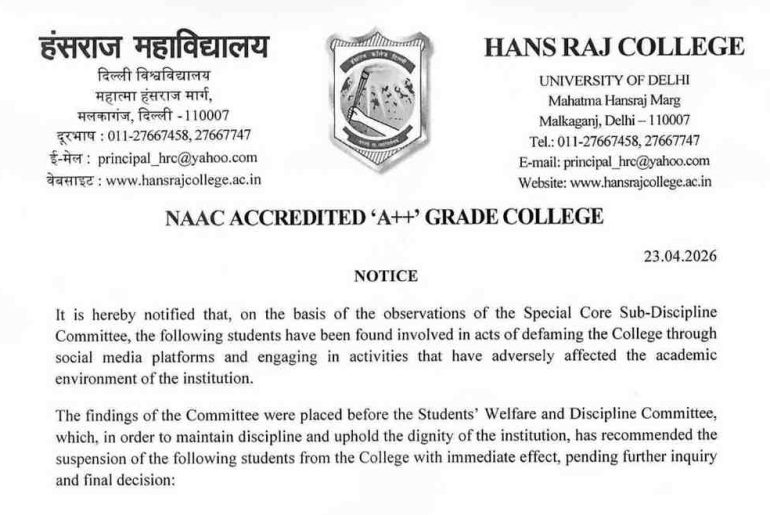
Once an institution known for prolific discourse, intellectually developing excellence, and an exclusive institution of Delhi University, is facing turmoil, the issue is non-compliance with filling out a feedback form.


St. Stephen’s is facing fresh allegations of ‘forms or freedom’ by a bunch of Stephanites. It comes in the face of challenges faced by students from the administration, by withholding their documents and processing any certification, if they do not fill out an IQAC form.  The IQAC student survey form is a part of a routine survey from the Internal Quality Assurance Cell, which is chaired by Professor John Varghese. When asked about the motive behind this survey, a student tells- 

This is the student satisfaction survey that every student is required to fill out. While there is no pressure to fill in good data, the pressure is to fill in the form. Last year as well, students were hounded several times with a reminder to fill in the data. This is because they want to assess each student’s perception of college, and data is the key to control.”


The cell works out in a structured way, as every society consists of these DCS(Data Collection Specialists) who later assess and report the quality of the operations of society and faculty in general, though the data regarding society activities is very minutely accumulated and is followed up by a very anonymous procedure. In terms of faculty, students are asked whether the course is completed timely or not, and how many classes were held for each paper. According to a few students, it is claimed by the authorities that the data helps to augment the academic quality.  The movement hence walks a tightrope that if this survey is going at a cost of depriving students of their official documents, then there is some course correction that needs to be followed.

However, it is said that the same tactic was followed in earlier academic sessions too, to fill the feedback form, students never really came through it. But a persistent insistence on filling the feedback form, which should be a voluntary-based approach, is now being used to threaten the students to do the same for processing any academic-related requests. Though students assure that the academic quality is not compromised, the college remains a safe space for them. This matter holds a vital issue to assess the current situation, especially at an institution that is known to dissent and provide a healthy space for discussion. This is still a developing story. 


Image Credits: St. Stephen’s Instagram page.

Kinjal Sharma

[email protected]

The Delhi University CSAS UG portal is now open, and the first allocation list of colleges has been released. Students can check their allotted college and course on the official website.

The CSAS portal for undergraduate programs released the 1st list for seat allocation at 5 P.M. on 19th July. Students can check their allotted college and course based on their preference list through the official website.

To view their allocation, students must enter their CUET UG application number and password. Thereafter, they must enter the login information to see the allocated college after carefully verifying the information. The candidates can further download information regarding their allotted college and course.

Along with the option of accepting the assigned college and course, students can also avail the option of upgrading. The second round of allocation with upgraded and fresh lists is expected to be out by 28th July. 

The schedule for the upcoming admission process is as follows,  

Event  Date
Declaration of FIRST CSAS Allocation List  5:00 pm Saturday, July 19, 2025
Candidates to ACCEPT the Allocated Seat 5:00 pm Saturday, July 19
till 4:59 pm Tuesday, July 22, 2025
College to VERIFY and APPROVE the online applications 5:00 pm Saturday, July 19
till 4:59 pm Tuesday, July 22, 2025
Last date of ONLINE PAYMENT of FEES by Candidates 5:00 pm Saturday, July 19
till 4:59 pm Tuesday, July 22, 2025
Display of vacant Seats on the dashboard of the candidates 5:00 pm Thursday, July 24, 2025
Window to Re-order Higher Preferences 5:00 pm Thursday, July 24
till 4:59 pm Friday, July 25, 2025
Declaration of SECOND CSAS Allocation 5:00 pm Monday, July 28, 2025
Candidates to ACCEPT the Allocated seat 5:00 pm Monday, July 28
till 4:59 pm Wednesday, July 30, 2025
College to VERIFY and APPROVE the online applications 5:00 pm Monday, July 28
till 4:59 pm Wednesday, July 31, 2025
Last date of ONLINE PAYMENT of FEES by Candidates 5:00 pm Monday, July 28
till 4:59 pm Friday, August 1, 2025

For more information you can refer to Delhi University’s official notice: https://admission.uod.ac.in/userfiles/downloads/18062025_CSAS-UG_compressed.pdf

Students are requested to stay updated and read the Bulletin of Information on the official website of the admission portal. Stay tuned for more information regarding Colleges and Courses.


Read Also: Jesus and Mary College Discontinues NCWEB Teaching Centre; Current Students Shifted to Deshbandhu College Centre

Image Source: India Today

Arya Chaudhary
[email protected]


Bomb threats targeting three DU colleges and 45+ schools have triggered mass evacuations and deepening fear. As students, parents, and teachers grapple with repeated hoaxes, a pressing question emerges: what does safety mean in a city where panic arrives before the school bell even rings?

Amid a string of unsettling events, fresh panic gripped Delhi University as three more colleges, Indraprastha College for Women, Hindu College, and Shri Ram College of Commerce received bomb threats via email earlier today. North Delhi Police confirmed the threats and stated that security protocols were immediately activated, with police teams conducting thorough campus searches. This marks the fourth such incident this week, escalating anxiety across students, parents, and staff. Notably, these threats are not limited to higher education institutions. Over the past few days, more than 45 schools across Delhi have also been targeted with similar alarming emails.

Authorities have launched a full-scale investigation, with cybercrime units working to trace the origin of these messages. While all previous threats have turned out to be hoaxes, they have nonetheless triggered widespread panic, repeated evacuations, and intense law enforcement activity. The surge began on July 14, when three Delhi schools received bomb threats that led to bomb squad inspections; none of which revealed any explosive devices. On July 15, St. Stephen’s College and St. Thomas School were forced into lockdowns after receiving emails about IEDs and RDX being planted on their premises. The case was later traced to a 12-year-old student, who was detained briefly and released following counseling. The threats continued on July 16, when seven private schools received similar emails, prompting early morning evacuations and city-wide searches. No explosives were found in any of these cases, but the wave of threats has deeply unsettled educational communities across the capital.

Reacting to the developments, former Delhi Chief Minister and current Leader of Opposition in the Delhi Assembly, Atishi, took to social media to voice her concern. She condemned the government’s failure to ensure the safety of children, writing: 

More than 20 schools have received bomb threats today! Think of the trauma that children, parents, and teachers would be going through. BJP controls all 4-engines of governance in Delhi, and is yet not able to provide any safety or security to our children! Shocking.”

Cyber experts and senior officers of the Delhi Police investigating the threats add that the senders are using Virtual Private Networks (VPNs) and the dark web. According to police, all the emails received were similar, containing vague but threatening information, sent before school timings and often through international servers. The entire matter is under probe, they added. They warn that the use of VPNs and routing through the web proxies is hindering traceability like “chasing a shadow in a room full of mirrors” and as they “find a clue, it disappears behind another layer of anonymity.”

Meanwhile, in Bengaluru, a similar pattern emerged today as around 40 private schools across the city received hoax bomb threats. Chilling emails claimed TNT devices had been planted, prompting immediate evacuations and bomb squad deployments. However, no explosives were found.  While none of these incidents yielded actual devices, the recurring pattern of early-morning emails, mass panic, and the rapid dismantling by anti-sabotage teams creates a troubling continuity that heightens anxiety across these two cities and places growing strain on emergency response systems. Until those responsible are held accountable and preventive systems strengthened, Delhi’s educational spaces, in particular, remain vulnerable; not just to physical danger, but to the looming cloud of fear.

Image Source: Deccan Herald

Neeraja Unnikrishnan

[email protected]