Tag

Delhi University

Browsing

With officials asking colleges to issue advertisements in order to invite applicants, the University of Delhi (DU) is soon going to begin the process of filling up its vacant teaching posts. On 5th April, 2017, a letter has been issued to the colleges to begin the application process by 19th April. A link has also been sent to a website for generating a centralised application form. Since the procedure has been shifted online, no offline forms from the applicants will be accepted.

“This time, the form is so designed that a candidate needs to only change the college name and apply to all colleges where his/her subjects are taught. Earlier, the API score of a particular candidate used to differ from college to college, creating a huge amount of grievances and complaints. Now a candidate has to fill the same form and it will automatically calculate the API score of candidates,” DeveshSinha, the Dean of the colleges, told Indian Express.

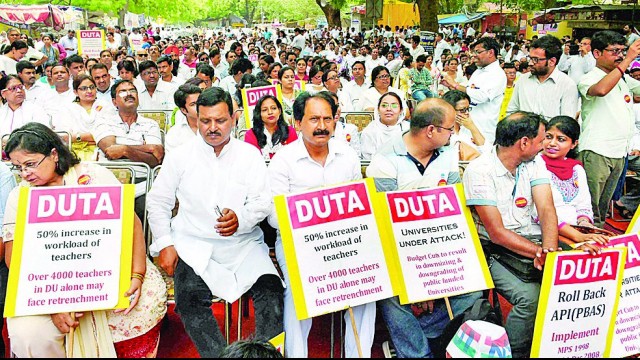
Furthermore, the University has also asked the 28 colleges which do not have a Principal to advertise for the position. DU has a total of 4,000 vacant posts for teachers, which shall be allotted to ad-hoc teachers, each appointed for a period of four months at a time. The governing bodies of the colleges will be sending the details of their vacant positions and reservation rosters, and following their approval, take appropriate steps to screen applications and fix interviews. A few colleges have already begun the application process.

With inputs from the Indian Express
Deepannita Misra
[email protected]
Image credits:sarkarijobnews.com

The University of Delhi (DU), which sees students from all across the world enrol into various courses, has decided to extend the deadline for the admission of foreign applicants. Every year, hundreds of aspirants from countries such as Afghanistan, Mauritius, and Sri Lanka apply to DU for courses such as Economics (Hons.), B.Com (Hons.) etc. in the undergraduate programme. This year, the University saw their number rise to a record 3,300. Thus, a conscious measure taken to extend the application deadline was required, in order to ease up the document submission and screening process.

Ashutosh Bhardwaj, a senior official of the admission committee, verified the news to MAIL TODAY. He said that while the deadline for admission to undergraduate courses for non-Indian students has been shifted to 4th May, the deadline for Ph.D. applications has also been extended to 31st May 2017. Earlier, the deadline for online applications for the upcoming academic session was 20th April 2017 for the undergraduate students. The new deadlines, as Bhardwaj confirmed, give students more time to submit their documents for verification. This step does, indeed, create an opportunity for both the students and the University to participate in the admission process and to make it a smooth and hassle-free affair.


Feature Image Credits: CryBytes

Deepannita Misra
[email protected]

The second instalment of Percipience, the eminent alumni lecture series under the aegis of University of Delhi, North Campus, was held on the 21st of this month at the Convention Hall, Vice-Regal Lodge. The topic for the seminar was “Fundamental Duties under the Indian Constitution: Forgotten Virtues?” The guest speaker for the event was Honourable Justice Arjan K. Sikri, Judge, Supreme Court of India. The moderator for the event was Professor M.P. Singh, Honourable Chancellor, Central University of Haryana, with the august podium presence of Yogesh K. Tyagi, Vice Chancellor, University Of Delhi and Professor Sydney R. Rebeiro, Dean, Alumni Affairs.

The event began with the inaugural speech by Justice Sikri. He spoke of the modern context of the Buddhist idea of enlightenment and the role of good citizenship towards the fulfilment of the purposes behind the constitutional fundamental duties. Talking of the role of the citizen in the rule of law, he referred to the trinity of ‘reminder, warning, and inspiration’ for the materialisation of an envisaged society. In the same breath, he also stressed upon the requisite sense of respect for the national flag and anthem.

Second on the podium was Professor M.P. Singh. In his moderation speech, he spoke on the idea of ‘dharma’ in relevance to the modern perception of fundamental duties. He stressed upon the fact that religion is a secular concept as it is nothing but a way of life. He also cited Mahatma Gandhi when he said that if the fundamental duties are performed well, fundamental rights would be of little concern.

This followed the question hour as the house was opened to the audience which comprised of the alumni, professors, and students of the University. The two guests clarified the various nuances of Part IVA and Article 51 of the Indian constitution.

The all-awaited presidential address was conducted by Dr. Yogesh Tyagi. He subjectively summarised in a nutshell the essence of the two lectures prior to him. Talking of Part IVA which caters to the clause of fundamental duties, he said that this was the shortest, youngest, and arguably the least legitimate of the laws referring to the need of subtle revisions in the wake of modern times.

The event ended with the national anthem led by the choir of the University of Delhi.


Image Credits: Nikhil Kumar for DU Beat

Nikhil Kumar

[email protected]

As third years, are we saying goodbye to our years as undergraduate students in Delhi University or are we saying goodbye to the University as we knew it? 

Shubham Kaushik ([email protected])

It’s that time of the year when another batch of undergraduate students from the University of Delhi are getting ready to bid their colleges goodbye. Farewell gatherings are being prepared for with as much gusto as various entrance exams. While it’s natural for third year students to worry about their future and be nostalgic about their time in the University, it is also important in the current scenario to worry about the university we’re leaving behind.

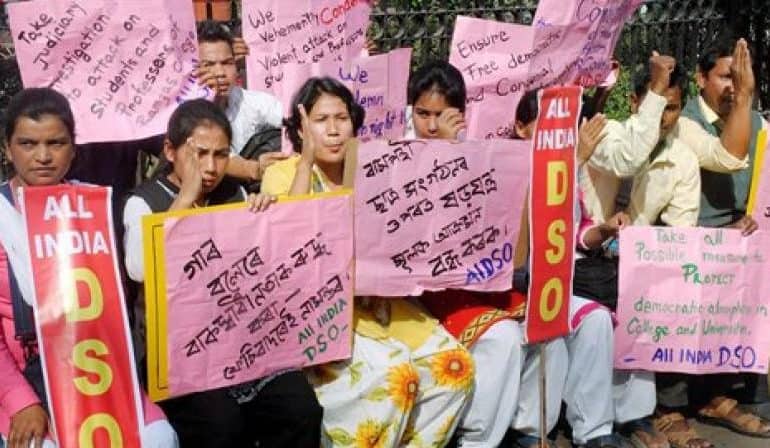
Recent events suggest that Delhi University is no longer the space it used to be a few years ago. Whether this change was in the making for a while or was caused by a few specific events is debatable but it has manifested itself in events occurring around us for the past few months. The subtle nationwide suppression of dissent and revolt against the authoritarian regimes in educational spaces reached the University in its most recognisable form with what transpired in Ramjas College a month ago. The University, which was known for the freedom it gave to students to explore their beliefs and critically analyse the dominant rhetoric, turned into a violent space where students and teachers were targeted and assaulted for doing what shouldn’t just be acceptable but also encouraged in a university space – standing up for freedom, demanding their right to dissent and challenging what years of social conditioning made them believe. When safe spaces meant for exploration and exchanges of ideas are ravaged by forces that aim to homogenise them, it doesn’t bode well for the society at large. This world wasn’t meant for the establishment of one system followed by the majority population with the others coerced to follow suit, and past attempts to do so have always resulted in bloodshed and eventual revolutions that did what had to be done anyway – put the system in motion again and allowed conflicting stances to clash and coexist.

As we’re getting ready to say goodbye to our days as undergraduate students in Delhi University, we must make sure we aren’t also saying goodbye to the university space as we knew it. Spare a thought for seminars being disrupted even as other seminars ‘nationalising’ teaching are organised. Spare a thought for the thousands of students who still look towards DU to mould their future and their beliefs, and who will then go on to mould our society. Spare a thought for the future of Delhi University.


Image Credits: The Wire

A student spends most of his/her day in the campus, but is it really a safe place? With recent incidents of sexual harassment at college fests, the dilemma has become even more prominent in the eyes of the youth.

Meghna Singh, a student from Miranda House, got masturbated on at SRCC’s annual fest, Crossroads. But she isn’t the only one who has gone through an assault like this – many students have recounted their horrific accounts where they have been sexually harassed on campus. When Meghna told the details of what happened with her at SRCC on social media, thousands of people didn’t believe her. Soon enough, she became the topic for jokes, memes and internet trolls where people labelled her as a liar.

Meghna’s story might be the first one to surface online, but it isn’t the first time a girl on campus has been assaulted like this. Sukhwinder Singh’s gig at Hindu College’s fest Mecca also saw a molestation incident where a girl got groped twice in public. One would think that being a student friendly area, the campus would be a safe place where one could walk freely, but is that really so?

Public gatherings like fests and concerts have witnessed many incidents like this take place and most of the time the victims don’t talk about it. And not just public gatherings; horrific incidents involving middle aged men on bikes stopping in front of girls’ PGs and masturbating to the ones standing in the balcony occur on campus on a daily basis.

Roads around colleges become almost abandoned after college gets over, because of the hostel/PG deadlines, and the empty streets have become a nightmare for anyone who is walking on them post 8 pm. Theft and assaults happen regularly and the police is doing the least about it.

As a resident of the campus and a student of the University, me and my friends have faced similar situations where the length of our skirts got men on bikes to slow down next to our rickshaws and call us out. Where simply walking on the roads of Kamla Nagar have gotten old men to masturbate to us. Where being part of protests got us groped and threatened with rape.

On a campus that is clearly not safe, it is appalling that people had problems believing Meghna’s story.


Image credits: DU Express


Anagha Rakta

[email protected]

Professor G.N. Saibaba, former English professor at Ram Lal Anand College, Delhi University, has been sentenced to life imprisonment by sessions court in Gadchiroli district of Maharashtra on 7th March, 2017. The court has found him of “hatching criminal conspiracy to wage war against the Government of India and collecting people with the intention of waging war against the Government of India”.

Professor G.N. Saibaba’s activism.

Before his arrest in 2014, wheelchair-bound and 90% disabled Professor Saibaba use to be an outspoken critic of the human rights abuses by the Salwa Judum and Operation Greenhunt, launched by the government against Maoists. He also played an active role in mobilizing public intellectuals under a group named Forum Against War on People. Owing to his open activism several academics, teachers and students have described his arrest as a deliberate attempt to stifle dissent.

Abduction or arrest?

On the afternoon of May 9, 2014, he was heading back home from the university when a group of policemen in plainclothes arrested him. The next morning after his arrest from Delhi, Professor Saibaba was immediately flown to Nagpur, where the District Magistrate heard his case and sent him to prison. His family was not informed about his arrest and this prompted his wife to file a missing person’s report. The question of this abrupt, almost haphazard arrest raised questions that- why did the Maharashtra police abduct Professor Saibaba in this way when they could have arrested him formally?

The charges against him.

He has been charged under the notorious and dangerously vague Unlawful Activities (Prevention) Act for advocating unlawful activities, conspiring to commit a terrorist act and inviting support for a terrorist organization. Simply put, Prof. Saibaba was arrested for his alleged Maoist links and being a ‘Naxal ideologue’.

Another offence listed against him is that he is the joint secretary of the Revolutionary Democratic Front (RDF), an organization that is banned in Orissa and Andhra Pradesh. However, it is not banned in Delhi. So how does his association with Revolutionary Democratic Front (RDF) matter?


The validity of evidence.

The charges against him rest on of letters, pamphlets, books and videos seized during raids that were conducted in his house. During the raids, his laptop, hardisks and pendrives were taken from which the evidence was gathered. Talking to The Hindu in a 2015 interview Prof. G.N Saibaba claimed that “Police claims to have recovered a letter that I had written to some top Maoist leader. To this day, the police never showed me that letter.”

Even if Prof. G.N Saibaba is found to be a member of a banned organization, it won’t be sufficient enough to prosecute him as according to the previous judgments by the Supreme Court ( the Kedar Nath Vs State of Bihar 1962) “mere membership of a banned organization would not make a person criminally liable unless he resorts to violence or incites people to violence or creates public disorder by violence or incitement to violence”. 

Not an isolated case.

The case against Prof. Saibaba should not be seen in isolation, since the use of the Unlawful Activities (Prevention) Act id not unprecedented. Earlier cartoonist Arun Ferreira, public health specialist Binayak Sen  and many members of Kabir Kala Manch were imprisoned on similar charges. The apparent similarity in all these cases is that they all have been accused of being Naxalites since they talked about issues of lesser known state oppression. Arun Ferreira was eventually released as innocent after spending five years in prison, and Binayak Sen is out on bail since 2011 while the case against him is still pending since 2007. The acquittal rate in the Unlawful Activities (Prevention) Act is 72%, despite this the law is used very frequently.

What can we do?

With corporate driven media, there is hardly any news from remote conflict ridden territories. Those few individuals and organizations that attempt to highlight these problems are harassed in with help of laws such as Unlawful Activities (Prevention) Act. In this situation it is up to us to either live in complicity or listen carefully to what the state machinery does not want us to hear. To not ignore, but to acknowledge what the dissenters are trying to say is the least and often most what one can do.

Image Credits- Shalendra Panday/Tehelka


Niharika Dabral

[email protected]


In a new development and a major change of guard in an institution of Delhi University after the new vice chancellor took over, Prof. Harinder P. Singh has been appointed the new director of Cluster Innovation Centre (CIC). A professor at department of Physics and Astrophysics, Prof. Singh is also the dean of International Relations of the university. An eminent researcher in the field of astronomy, he has been the vice president of Astronomical society of India. He is also a member of the International Astronomical Union as well as a fellow at Royal Astronomical society, London.

Speaking to DU beat, Prof. Singh outlined various things of importance that would be taken up for development of the institute. CIC was set up as a centre to promote interdisciplinary framework as well as promote innovation in the University. “We would look towards increasing projects which can promote science along with a human face, which would in turn promote interdisciplinarity” said Prof. Singh.

Speaking about his plans for various programmes, he pointed out that the students of B.A (Hons.) Humanities and Social Sciences get a lot of freedom in choosing their course which they should use to engage themselves in various activities that could help create a social impact. He also noted, that projects also need to be more socially engaging and should include students from across programmes. “In order to promote the academic environment more seminars, lectures and discussions will be organised. We should be able to give an education that is above the marks and grades system” said Prof. Singh. He also emphasised on increasing attention towards various extracurricular activities which would help in personality development of students in the institute.

Amongst his various new initiatives planned, he wanted the institute to have its own newspaper. “We do so many things the whole year, but don’t showcase it anywhere. We must have our own newspaper.” CIC which has Design Innovation Centre, Startup Incubation Centre and Centre for Scientific Communication as various organs other than its academic programmes had organised an exhibition of various products designed by its students which drew major attention last year. This initiative if successful, would improve the impact factor the institute’s research profile.
“Every student comes with lots of hopes and dreams when he come to an institute. How much of that he is able to fulfill within his time as a student is what determines the success of the institute as whole. We should try our best to help students achieve their dreams” said Prof. Singh.


Srivedant Kar
[email protected]

“I no more need cash in my college. We pay through our ID cards everywhere within the campus” exclaimed Akankshya, a student pursuing B.Com in Lakshmibai College, as she flashed her new identity card which bears a bar code. In a step towards promoting digital transactions and encouraging Information and Communication Technology(ICT) based learning, Lakshmibai College has introduced new identity cards, through which students can make payments at all places within the campus. The identity cards that earlier used to be a gate pass for the college students, are now their food pass too!Provided they have money in their cards,of course.

Akanshya, student of Lakshmibai College
Kriti Thakur, a student of Lakshmibai College

The new cards can be used to make payments at the college library, canteen, photocopy shop and office. Students can load money in their ID cards through the website or the college’s android application. Then, they can use this money within the campus according to their own requirements. At all the points of payments, Radio Frequency Identification (RFID) is used which scans the bar code present in the card and deducts the amount from the card. This initiative was launched as a joint venture between the college and Bank of India, which also operates a branch within the college campus.

According to many teachers and students, this initiative is the brainchild of Dr. Pratyush Vatsala, the principal of the college, who has taken several initiatives towards improving the digital infrastructure of the college. She says, “We wanted to increase the utility of the card, and thought why not make it usable for payments within the campus, so we added the cashless payment option to it. We’re the first college in all of DU to have introduced such a move.”

The cards have been colour coded to signify the students’ year. The first year students have purple-and-white cards, the second year students have blue-and-white cards, and the third year students have maroon-and-white cards. Those who hold positions in college societies have tri-colour bands on the cards.

“Our college began this initiative much before the demonetization was announced by our Prime Minister,” said Dr. Sucheta Gauba, a faculty member from the college. Speaking about the new initiative she insisted that this could be an example for other colleges of Delhi University to go cashless. She also said about various other initiatives that the college has undertaken for increasing digitalization of the facilities. The college has developed an app through which teachers can post crucial updates regarding classes, distribute assignments and students can even order food from the college canteen.

As our country is trying to come to terms with the sudden push of GoI towards a digital economy, this unique initiative by Lakshmibai College authorities is an example for other colleges of Delhi University, which are figuring out ways to create cashless campus by 12th of January, 2017 to fulfill the new order issued by the Human Resource Development (HRD) ministry and promote a digital economy.

Srivedant Kar
[email protected]

Image Credits (both): hindustantimes.com

Delhi Legal Service Authority (DLSA) in collaboration with Delhi University Community Radio (DUCR) initiated an 11 part legal rights awareness programme. While talking to DU Beat, Gayathri Mani, media coordinator of the campaign explained that the objective, in its short term-pilot project basis, is to direct and route people to nearest Legal Aid/ Services Clinics set up by the Delhi state Legal Services Authority and managed under the supervision of concerned District Legal Services Authority. She added that the thrust area of the campaign is ‘Students’ and their involvement in areas of ‘Legal Literacy’. Besides, 65% of the population in India comprises of Youth and thus the youth needs to be aware and able regarding the issues of justice. This campaign was wholly executed by the student volunteers.

The radio series, which ran 30-40 minutes per session, entailed question-answer format type interaction with the Judges and DUCR and Para Legal Volunteers on the enlisted topics ranging from sexual harassment of women at workplace, juvenile justice, consumer protection to rights of senior citizens. The recordings lasted from 15th March, 2016 to 6th April 2016 and the first episode was broadcasted on 5th November. “The timings of the show are not fixed, but will run multiple times between 1:00-4:30 pm”, Mr. Isaac John, Assistant Consultant, DUCR said. You can hear the radio show on DUCR at 90.4 MHz or you can also download the app “DURadio”.

After the successful completion of the project, DLSA and DUCR have proposed phase two of the project, in which they will connect a loop with the community radio in the country, to the Ministry of Broadcasting.

Feature Image: Bloomberg

Niharika Dabral

[email protected]

Being one of the most sought after courses in Delhi University, English Honours crests up the expectations of every literati who seeks admission in this course. The idea of meeting Shakespeare, Jane Austen or George Eliot everyday makes it nothing short of exciting. But how is the journey actually like, well, let’s find out here!

After braving the cut off crisis, entering college on the first day as an English Honours student is bound to elate any literature enthusiast who is looking forward to an expedition of the literary world! The initial days of study in this course certainly blurs the boundaries of literature exploration. Meeting great authors, playwrights and critics through their work takes some time to be familiarized with, yet, makes one feel like delving deeper into the sea of literature. How can we forget the joy of purchasing those new books that never fail to bring a wave of happiness with the smell of their new pages!

Seeing all that happiness, our dear friend – the syllabus, starts pouring us some more love with endless discussions, chapters which seem to never finish and, motley range of timeless drama and poetry. This is when we feel like telling this friend of ours to calm down! With the ever increasing number of texts and background readings, at times it starts getting difficult to manage academic reading and leisure reading at the same time. Adding on to it, friends from different courses keep envying us for reading mere “stories” in the syllabus and having an easy course structure. This is the moment when we feel like enlightening those friends about the difference between reading Blake and Swift for leisure and reading them as part of one’s syllabi. Thus, we join the brigade that breaks baseless myths about the course being a mere cake walk!

Just after the crest phase comes the road to the trough. The teachers expecting students to read their respective texts completely and “critically analyze” everything that comes our way starts getting a little too tricky! This is when we start shifting from mere readers to critical readers of literature. But the road doesn’t seem all that easy in the first semester of the course. With loads of narratives and analysis to remember, one definitely gets overwhelmed with the amount of reading to be done, while being unaware of the questions that can be asked for such study. After putting in much effort, we’re forced to rely on help books to help us sail through the semester. However, the ultimate test of literature love for a first semester student is the semester examination. A study loaded with truckloads of texts, the first semester exams of the course resurface the general emotion for studies in no time.

Nonetheless, English Honours sure makes every seeker a thinker beyond the average one. Despite the initial hiccups, this course is not a mere study, but a leap ahead in the understanding of the world.


Feature Image Credits: www.flavorwire.com

Priyal Mahtta

[email protected]