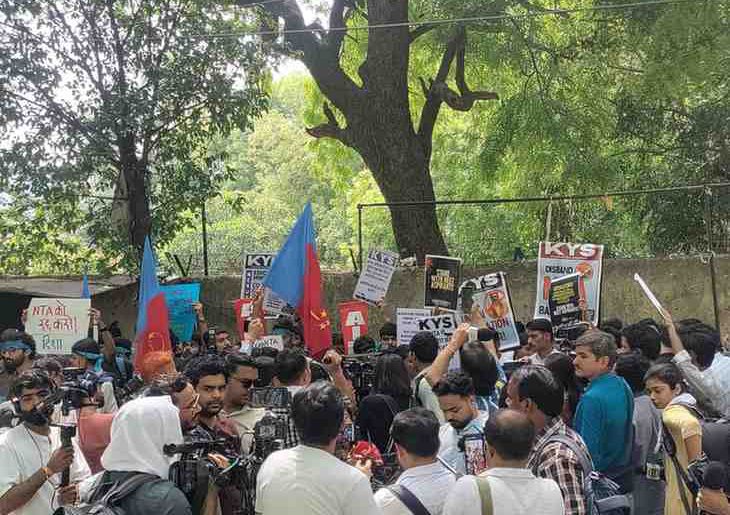
All India Students’ Organisation (AISA) members held a protest at Jantar Mantar on Thursday against the NTA following the cancellation of NEET 2026. The National Testing Agency(NTA) has announced a re-examination in light of the paper leak.
Students of the All India Students’ Association (AISA) came together in protest against the National Testing Agency (NTA) at Jantar Mantar, Delhi today. This comes two days after the NTA officially cancelled NEET 2026 due to the paper leak, announcing a re-examination in the coming days.
Over 50 students gathered at the monument this Thursday, with many Central Reserve Police Force (CRPF) officers present on site. Speaking on the paper leak, AISA-DU Secretary Anjali said that the “series of paper leaks over the years” were “manufactured and systemic”.
“NTA is an incompetent body. It outsources all its functions making it bound to corruption.” In conversation with DU Beat, she reasserted AISA’s demands for Education Minister Dharmendra Pradhan to resign and for the NTA to be scrapped.
Students across the country have slammed the NTA’s decision on May 12 to cancel the exam following the paper leak.
“The current system starts and concludes with profit, resulting in the systematic collapse of this education system—be it slashing public funding of educational institutions, or the coaching-NTA nexus. We demand the decentralisation of exams to respective states and educational institutions.”
shared AISA member Abhishek Kumar with DU Beat.
The agency has urged students to wait for a revised schedule for re-examination, along with hall tickets, which will be released on official platforms. The NEET exam, an entrance examination for medical aspirants, was written by over 22 lakh students this year on May 3.
Other student organisations have also taken to the streets. Members of the Akhil Bharatiya Vidyarthi Parishad (ABVP) staged a protest outside the NTA office in Delhi on Wednesday. They demanded action against the alleged irregularities within the system, with some students attempting to breach the security gates.
The student outfit of the Congress, the National Students’ Union of India (NSUI) similarly organised a protest outside Union Minister Dharmendra Pradhan’s residence. The protestors demanded his immediate resignation and carried placards deeming him ‘paper chor’.
AISA’s Ranchi outfit also held a protest against the agency on Wednesday, with placards asserting that ‘Re-examination is not the solution’. NSUI president Vijay Jakhar asserted that the NTA had “shattered the dreams of millions” in conversation with The Hindu.
The government-ordered CBI enquiry into the matter has led to the arrest of seven accused of involvement in the leak so far. Following the registration of the case with the CBI on May 12th, several locations have been searched as part of investigations.
Initial investigations revealed an elaborate conspiracy, involving scanning and distribution beginning in Nashik and spreading across the country. The medical entrance test’s question papers were leaked using sophisticated technology, including portable scanners, a complex Telegram network and a shadow server. A PDF containing large parts of the paper was circulated as reported by NDTV.
Union Minister Dharmendra Pradhan has not responded to questions about the leak thus far. His silence has been met with frustration from students online and on ground. The NTA’s responses have also been discredited by student activists as ‘vague’ and unclear. Student agitation has only increased with many aspirants and their families expressing deep dissatisfaction with the cancellation of the exam.
A similar situation had taken place in 2024, where the NTA faced allegations of paper leaks owing to the unusual 720/720 score attained by multiple students. CBI inquiries then led to the arrest of 36 persons. However, the exam was not cancelled due to lack of evidence of a “systemic breach”, as stated by the Supreme Court. A repetition of paper leaks two years apart has been felt as lack of any improvement by many aspirants.
Image Source: Anjali (DU Secretary AISA)
Read More: NEET Cancelled: The Fate of Students amidst Institutional Chaos
Anjali Paruvu




Trending