
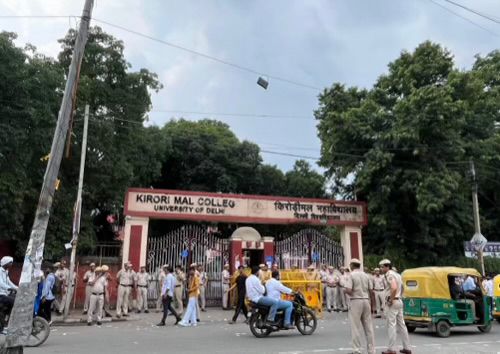
Every year DUSU elections are greeted by much pomp and circumstance. From the beginning of the new academic year to the day of results, it is impossible to escape the crowds, the white paper slips, and the sounds of the world’s largest student body electing its representatives. However, in India’s major state universities, this exercise in democracy is nowhere to be seen.
In 2006, Lucknow University – one of the oldest state universities of Uttar Pradesh – suspended student elections citing incidents of violence, and the recommendations of the Lyngdoh Committee, which was created to ensure transparent and systematic student elections. Since then, no elections to the students’ union have taken place, despite demands and demonstrations by students.
This is not a unique case as students of colleges and universities, both at the state and central level, report fresh cases of suspensions and delays of student union elections coming in every day.
Earlier this year in West Bengal’s Jadavpur and Presidency University campuses, student groups staged protests demanding elections to the students’ union, which have not been conducted since 2017. Similar problems of student representation persist in Tamil Nadu politics.
Without official status as representatives, student groups still stage protests and raise student demands but the effectiveness of such efforts remains questionable. Without elected representatives, it becomes easier for Universities to dismiss even the valid and justifiable grievances and concerns of students as acts of provocation or aggression. Any dialogue between students and the administration becomes challenging. The lack of accountability has left students feeling disempowered.
In many cases, the elected student union has been replaced by an appointed or indirectly elected council, in a process alleged to be full of biases and corrupt practices.
Not just University authorities, but state governments have not been very supportive of students’ unions. In 2023, Ashok Gehlot-led Congress government of Rajasthan was criticised for not holding student union elections in that academic session, due to concerns of ‘money and muscle power’, in a move which was protested by student groups including the Congress student wing NSUI.
The Gujarat government has also been criticised for the ‘Gujarat Common Universities Act’, which allegedly seeks to end student politics on campus by concentrating the powers of administration of universities in the hands of the state government.
In the face of the diminishing state of student politics in India, the emphasis on DUSU elections is very significant, yet the prevalent freebie culture, funneling of resources by respective political parties and lack of productive political discourse on campus paints a distressing picture for the future of student politics.
For better or for worse, the union elections at Delhi University are more about visibility; the competition between the four major student organisations and by extension, their parent organisations. From the colourful banners, to the sloganeering, to the displays of financial and political power and influence in the form of pizza parties and Lamborghinis parked outside colleges, student elections have been reduced to a spectacle. Students today often vote along ideological lines, but in the noise of student elections, campaign manifestos and promises are buried beneath mountains of ballot slips. Voting becomes less about what candidates represent and more about simply remembering who they are.
Universities often tend to express worries over student protests being taken over by ‘outside elements’ and have cited that as a reason to dismiss student unions, but the issues of policies which are purely decorative and leaders nowhere to be seen post-elections already inundate the most prominent unions. Others are still fighting for their share of democracy.
Image Credits: Divyanshi for DU Beat
Mangalya Singh


Comments are closed.