Author

Sakshi Singh

Browsing

Concerns around electoral rolls are neither new nor partisan. Since the first general elections, India has relied on periodic revisions of voter lists, a bureaucratic exercise that is massive in scale and inherently prone to error. Special Intensive Revisions (SIRs), in particular, are designed to clean rolls by removing duplicates, deceased voters, migrants, and erroneous entries. Even election officials privately acknowledge that in a country with high internal migration, uneven documentation, and digitisation layered over legacy paper records, inaccuracies are inevitable. What has changed in recent years, however, is not the existence of these errors but the political rhetoric ascribed to them.


After the 2024 general election, opposition parties, led most vocally by Rahul Gandhi, began arguing that voter roll anomalies were no longer random or benign. The claim was not simply that names were missing or duplicated, but that these patterns appeared disproportionately in constituencies where the opposition was strong or where margins of victory were narrow. The framing of this allegation moved the discussion from administrative competence to intent, from error to fraud. 


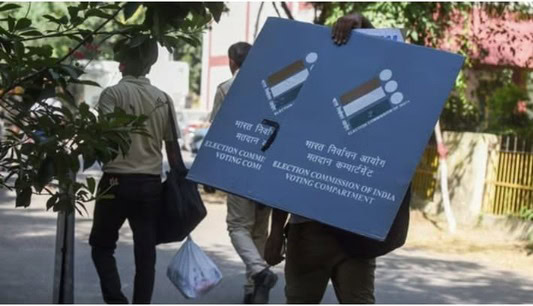
The Election Commission of India insisted that allegations of fraud must be substantiated through formal complaints, affidavits, and verifiable evidence, not press conferences or marches—a legally sound position since the Indian election law does not recognise “vote theft” as a category, it recognises specific violations that must be proven constituency by constituency. Yet the Commission’s repeated admonishment of the “language” used by opposition leaders seems to indicate that it is more invested in protecting its image than in publicly demonstrating transparency.


The opposition’s evidence has not helped its own case. Some of the most widely circulated examples, including duplicated photographs in Haryana voter lists, collapsed under scrutiny when it emerged that stock images or unrelated photographs had been misused. At the same time, dismissing the entire argument on the basis of flawed exhibits risks overlooking legitimate concerns alongside exaggerated ones. To demonstrate systematic manipulation across states would require access to raw electoral databases, audit trails, and internal decision-making processes that are controlled by the Commission itself. Demanding courtroom-grade evidence from political parties while offering limited public transparency creates a circular stalemate: allegations cannot be proven without data, and data is not released because allegations are deemed unproven. In this vacuum, rhetoric fills the gap. “Vote chori” becomes a substitute for disclosure, and denial becomes a substitute for explanation.


India’s context is distinct because the Election Commission has historically enjoyed near-sacred status. Public challenges to its neutrality feel destabilising in a way that similar claims might not in other democracies. The risk, however, cuts both ways. If institutions respond to criticism by retreating into procedural formalism and moral scolding, they risk appearing unaccountable. If opposition leaders escalate allegations without meeting judicial standards, they risk normalising distrust without offering a path to reform. The casualty in both cases is public confidence. 


Ultimately, the “vote chori” controversy erodes an old consensus: the integrity of elections was beyond everyday political dispute. Restoring it requires institutions to be visibly accountable and political actors to distinguish between mobilising distrust and demanding reform. In the absence of these circumstances, India risks entering an era where elections are held on schedule, but legitimacy is always litigated in the court of public opinion.


Read Also: Active Voices, Absent Votes: Unpacking Voting Trends Among Students


Image Credits: Hindustan Times


Sakshi Singh 
[email protected]

In Dalit literary aesthetics, the assertion of authenticity, grounded in lived experience (anubhava), collective memory, and a radical historical consciousness, was an act of political reclamation. However, as these texts have transitioned into global publishing markets, academic syllabi, and translation circuits, the concept of authenticity has undergone a transformation. What began as a tool of liberation is increasingly becoming a commodity of legibility, where the “Dalit voice” is often trapped within a rigid aesthetic demand for a specific kind of trauma, narrowing the scope of literary possibility and inadvertently reinscribing caste hierarchies.


Sharan Kumar Limbale, in his book Towards an Aesthetic of Dalit Literature, argues that Dalit writing is inseparable from anubhava, yet he sharply distinguishes this from a mere documentation of pain. For Limbale, Dalit literature is a historically situated literary practice shaped by protest, negation, and ethical urgency. Authenticity does not reside in the graphic accumulation of atrocities, but in the political clarity with which caste structures are exposed.

Mainstream reception, however, often traps the Dalit writer in what Gopal Guru identifies as the role of the “supplier of experience.” In this paradigm, the Dalit subject provides the raw data of suffering, while the labour of theory and interpretation remains the domain of the privileged reader or academic. This division of intellectual labour reduces Dalit texts to ethnographic artefacts. When autobiography is canonised as the only authentic mode of Dalit expression, formal experimentation comes to be viewed as “lesser” or “diluted”. The reader’s social location further exacerbates the “sensationalisation of authenticity”. For many upper-caste and global audiences, reading Dalit literature becomes a form of pity cleansing, an empathetic engagement that allows the reader to witness trauma without necessarily surrendering their own caste capital. 

Critics further complicate the issue by questioning the notion of an objective experiential reality. He suggests that memory is not a neutral retrieval system but a creative, mediating process. When critics overemphasise authenticity as a transparent record, they ignore the fact that perception always mediates reality. By demanding an unmediated truth, the institutional gaze denies Dalit writers the right to the subjective interiority and psychological abstraction that define the human condition. Authenticity, then, becomes a political project to assert a palatable legitimacy. It becomes a voyeuristic exercise where the “heaviness” of a text is equated with its “authentic” value or capacity to reproduce objective reality. This demand for a unified narrative of injury flattens the internal complexities of Dalit life, ignoring the heterogeneity of sub-caste identities, gendered internalities, and the mundane joys or ironies that exist alongside systemic oppression.

Sivakami’s The Grip of Change represents a radical departure from these rigid expectations. Sivakami’s significance lies in her investment in the power of imagination to resolve the ambiguous nature of the real. She refuses the role of the humble witness, instead using fiction to navigate internal community hierarchies and the “incivil” intersections of Dalit patriarchy.

By moving into the realm of the “unreal” or the speculative, she breaks the “sensationalisation of the real” that characterises the trauma-memoir. Her writing exposes a crucial tension: while earlier critics sought to ground the text in the fact of caste, contemporary writers of the genre use style and artifice to show that the “fact” of caste is also a complex, psychological haunting that cannot be captured by data alone.

This obsession with authenticity leads to the neglect of formal experimentation. When a Dalit writer experiments with satire, surrealism, or non-linear narratives, they are often accused of distancing themselves from the “authentic” Dalit condition. This leads to a flattened literature where the medium is treated as secondary to the message. This flattening is exacerbated by the limits of translation. As texts move into English, the linguistic aggression and incivility that Limbale advocates for are often polished into a standardised, mournful prose. They enter a global literary economy that values exotic specificity. This is often signalled through the italicisation of the vernacular: caste names, kinship terms, and slurs are visually marked as “other”. While publishers argue this preserves cultural nuance, it often functions as a spectacle of difference, signalling to the reader that they are entering a foreign world of deprivation rather than a structural reality that involves them.

To move forward, the critical gaze must shift from the consumption of trauma to an ethical literary engagement. This requires acknowledging that the “fact” of caste is not merely a data point of suffering to be extracted by the privileged, but a complex psychological and structural haunting that demands a diverse range of formal responses from the visceral testimonial to the radical imaginary. By moving beyond the liminalities of authenticity, we allow it to exist as a sovereign knowledge system—one where style, artifice, and silence are recognised not as compromises of truth, but as sophisticated tools of resistance.

Read Also: Understanding Ambedkar: lessons from an elective course

Image Credits: The Lakshmi Mittal and Family, South Asia Institute Harvard Universit

Sakshi Singh

[email protected]

The trajectory of the Indian university, from its inception under colonial rule to its contemporary manifestation in the National Education Policy 2020, is characterised by a fundamental reliance on borrowed institutional models and an ongoing negotiation with entrenched systems of social exclusion. The very concept of the ‘Indian university’ was labelled as an “unnatural desire” contaminated by an “unfortunate weakness for imitation” by early critics like Rabindranath Tagore, who observed that grafting the institutional infrastructure, its buildings, its furniture, its regulations, and its syllabus onto an alien culture and history denied the historical forces required for the idea to achieve “organic sustenance”.

The colonial administration established India’s first universities in 1857, modelled after the University of London, to create a class of lower functionaries and offer instruction in European literature and science. This marked the rise of what academics call the “secular feudal complex of interests”. In Bengal, which saw the first universities in India, they existed to serve the bhadralok, where profits derived from land contracts funded urban bureaucratic careers, and caste privilege was masked as secular intellect. The system actively secured the dominance of Hindu upper castes and neglected existing indigenous, vernacular schooling systems, which historical reports showed had surprisingly diverse student demographics, sometimes enrolling children from marginalised castes like Chandal and Sunri. By tailoring education to win the confidence of the educated and influential classes of the people, the colonial framework institutionalised deep-seated caste and class apartheid in the name of merit.

This borrowed and deeply selective institutional structure provided the foundation for post-independence university planning, which, during the period of 1947–86, operated under the ideology of ‘welfare’. Policy documents, such as the Radhakrishnan Commission Report (1948–49), defined educational opportunity using abstract concepts of “talent” or “ability”, thereby legitimising historical privilege as “merit” and sidestepping structural caste and religious exclusions. The Commission even rooted its curriculum for citizenship in the varnashrama ideal, invoking the dvitiyam janma, traditionally reserved for the dvij (twice-born) upper castes, thus validating caste hierarchies through the metaphor of intellectual attainment. 

A prime example of how the welfare model perpetuated caste exclusion, as Debaditya Bhattacharya argues, lies in the formation of the Indian Institutes of Technology (IITs), modelled after the Massachusetts Institute of Technology (MIT). These institutions were explicitly designed to distinguish intellectual expertise from the productive labour traditionally reserved for lower castes. This structure cemented the aura of “castelessness” around meritocracy, exempting IITs from constitutional reservation mandates until 1973. The selection process, rooted in competitive mass entrance examinations, ensured that scientific and technological expertise was set apart from the “manpower mandate” through selective entry. This institutionalised upper-caste dominance, leading to the unfortunate, documented rise in suicides among marginalised students in these elite technical institutes, confirms the hostility of the meritocratic ecosystem.

This period of focusing on “welfare” failed to dismantle the colonial framework, leading policy to shift to the neoliberal ‘market’ (1986–2012), redefining education around “human resource development”. When the market model failed to provide reliable employment, the policy shifted again toward financial logic and risk management under the NEP 2020, signalling the age of the “Platform University”, which focuses on securing market legitimacy and placements, rather than producing critically thinking educated individuals. 

 The NEP argues that specialised knowledge is unreliable in a world risk society and that education must prepare workers of the future for jobs that may change or disappear. The implementation of multidisciplinary education at universities like Delhi University exemplifies this shift toward non-knowledge and propaganda serving as investable securities. The introduction of mandatory VAC in Delhi University’s curriculum demonstrates the fracturing of knowledge into ideologically charged and tradeable curricular derivatives that have little relation to established disciplinary traditions. The objective is to produce innovative skill combinations that might survive price fluctuations.

The definitive structural mechanism for this platformisation is the Academic Bank of Credit (ABC). The ABC transforms educational institutions into “banks for academic purposes”, mirroring commercial banks for financial purposes, offering services like credit verification, accumulation, and transfer. The platform enables ubiquitous access (any-time, anywhere, and any-level learning) and promotes mass digitisation, ensuring a network effect where the student is reduced to a “credit variable, unique but infinitely circulable”. 

The NEP legitimises this financial restructuring by invoking the myth of ancient Indian universities (Takshashila, Nalanda, Vallabhi, and Vikramshila), claiming that these “world-class institutions of ancient India” demonstrated the success of “vibrant multidisciplinary environments” and that India needs to “bring back this great Indian tradition”. However, a critical history of these ancient sites reveals that they were not true universities in the modern sense. For instance, Takshashila was primarily centred on brahminical education, where knowledge acquisition was confined to the upper dvija (twice-born) castes, with an explicit ban on shudra populations, and instruction was conducted individually within the acharya’s household, lacking the corporate character and worldly openness required of a university. Similarly, Nalanda functioned primarily as a sangharama (rain retreat) for the Buddhist sangha, not an autonomous centre for secular intellectual curiosity, focusing intensely on religious proselytism and monastic doctrine. The transformation of Nalanda into a learning center was accidental, and the mission of foreign visitors there was primarily religious evangelism to procure and translate sacred Buddhist texts, not to engage in disinterested research. The policy’s appeal to this mythological past serves as a political cover to justify the financialisation of the present, ensuring the university’s total surrender to the logic of the derivative asset. The pursuit of happiness studies for students further exemplifies this totalitarian ideological goal: the systematic destruction of the university’s critical “publicness” and the faculty’s capacity for critical private intellectuality, replacing genuine thought with an ideological “science of happiness”.

The platformised university, therefore, is the final stage of the original colonial borrowing, where the foundation is based on structural exclusions. The NEP 2020’s insistence on graded autonomy and the subsequent ranking of institutions (Type 1 Research Universities down to Type 3 colleges) further establishes a hierarchical system, where the great icons at the top receive the bulk of promised funding, ensuring that structural inequalities are perpetuated under the guise of pursuing excellence in an economy of scarcity. The ABC, acting as the university’s super-app or surveillant assemblage, ensures that the student remains a lonely, calculable asset in a system obsessed with rating and credit accumulation over intellectual engagement.

Read Also: NEP: Changing Norms for Teachers and Students

Image Credits: Daily Bruin

Sakshi Singh
[email protected]


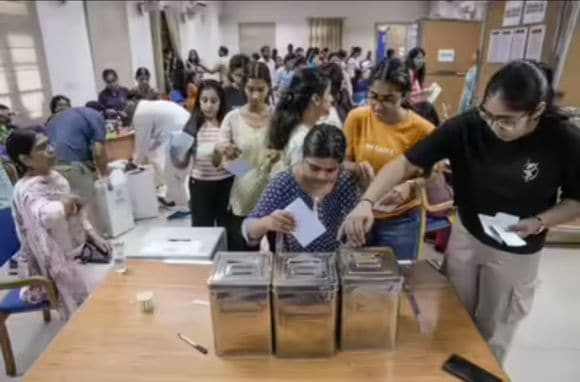
The Delhi University Students’ Union (DUSU) elections in September 2025 saw turnout climb to around 39–39.5 per cent, a notable increase from last year’s 29.7 per cent. While this rise suggests some renewed engagement, it also means that more than 60% of students either could not or did not vote. The paradox raises a deeper question: why does a union with such visibility fail to attract the majority of its student body?

Part of the answer is structural. Many colleges, such as St Stephen’s, Lady Irwin and DCAC are not affiliated with DUSU, excluding large sections of the university. Students in these institutions do not see the elections as relevant to their daily academic lives. Even within affiliated colleges, however, participation is often shaped by what political scientists would call a cost–benefit calculation: the perceived risks and burdens of voting outweigh the likely impact of a single ballot.

For many, the costs are immediate and physical. One undergraduate recalled, “There was a huge turnout this year, and our colleges do not have the infrastructure to support the same. Many of my friends stood there for three to four hours to cast one vote. Another described the atmosphere starkly, “For the lack of a better word, I would say the main reason why I personally don’t go to vote is the sense of gundagardi that surrounds the campus.” Another student who skipped voting admitted, “There was so much stress and fear around the campus that I thought there is no point in risking my safety for one vote.”

Even when students did turn up, the presence of candidates near polling areas created unease. “A friend said that at times so many candidates were around the polling booths that it created a sense of fear amongst the students,” one student reported. Several students also mocked the dramatics of campaign appeals. Students allege that Aryan Maan was near the Miranda House campus and kept approaching students by saying, “aap sabhi behene ho meri isliye bol raha hu votes ke liye.” These accounts suggest that what is framed as democratic engagement often feels like pressure, even surveillance.

Credibility further erodes incentives to participate. “It’s a waste of time for me to put my safety and security at risk, travel for two hours, and wait for another three hours, to cast one vote when I know no tangible change will come out of it,” one student complained. Another added: “Har saal wohi posters, promises, rallies; result toh pehle se decided lagta hai.” Ongoing legal challenges to the election process, including petitions around EVM integrity, reinforce these doubts.

If students perceive the institution as structurally exclusionary, procedurally unsafe, and substantively captured by dominant parties, their withdrawal is not apathy but a rational response. Turnout rose this year, likely due to mobilisation by major political outfits rather than restored trust.

Until questions of safety, accessibility, and credibility are addressed, DUSU’s symbolic prominence will remain unmatched by genuine representativeness.


Image Credits: Times of India 

Image Caption: Who does the DUSU really represent?

Sakshi Singh 

[email protected]

The electoral landscape of Delhi University continues to be marked by a paradox that has persisted for more than a decade. Left organisations such as SFI, AISA, and more recently DISHA, gain marginal votes. The results of the 2025 elections reinforce this trend: the ABVP secured three of the four principal offices, the NSUI captured the remaining post, and Left candidates trailed far behind the dominant blocs.


“On paper, the manifestos of all parties appear strikingly similar,” says a student. “Whether from SFI, AISA, ABVP, or NSUI, promises of affordable hostels, grievance redressal mechanisms, campus Wi-Fi, and improved gender-safety structures recur with regularity,” adds another. The difference, thus, lies in framing and perception: Left organisations articulate these demands through the idiom of democratisation and anti-privatisation, whereas ABVP and NSUI frame them as pragmatic matters of service delivery. The convergence of manifestos places the burden on credibility and trust. In this respect, students, based on our conversations, often regard the Left as effective in critique but deficient in demonstrating administrative efficacy.


The numerical results from 2025 starkly illustrate the challenge. The ABVP presidential candidate, Aryan Maan, won with approximately 59,882 votes; the NSUI contender followed with 15,500, while Anjali, the joint SFI-AISA candidate, polled a mere 5,385. In the vice-presidential race, NSUI prevailed with 29,339 votes, ABVP followed at 20,547, and the joint SFI-AISA alliance again remained in the low thousands. Similar patterns held in the contests for Secretary and Joint Secretary. Turnout, hovering around 39–40 per cent, suggests that disengagement remains a significant feature of DU’s electoral culture, with NOTA itself garnering several thousand votes in some contests. “This not only underscores the marginality of the Left but also highlights a pool of disaffected voters whose dissatisfaction, if organised, could alter the electoral balance,” adds a student from Lady Shri Ram College. 


The deeper problem, however, lies less in raw numbers and more in institutional culture. Over the past 10–15 years, DU has been characterised by what many students themselves describe as a “career-first” ethos, an emphasis on examinations, placements, and credential-building. In this environment, the Left’s reliance on protest, sit-ins, marches, and symbolic agitation generates moral capital but also fatigue. A master’s student remarked that “these protests often felt alienating, repetitive, and disruptive.” The protest per se is not rejected; rather, its frequency and abstraction, particularly when extended to global or national issues, like the Gazan genocide, for instance, are perceived as less directly relevant to the everyday student experience. In this sense, DU contrasts sharply with JNU, where protest is understood as integral to intellectual life and is woven into the rhythm of hostel meetings and general body debates. 


The perception of elitism compounds these structural disadvantages. Several college sub-groups of left-leaning parties belong to debating clubs and circles where English-speaking and politically articulate students dominate. While these networks provide rhetorical sophistication, they alienate a larger, more diverse student body. As one student put it, “it always feels like the debating society kids tell the rest of us what to think.” 


The paradox is thus reinforced. At DU, the Left embodies critique, but critique does not convert into electoral capital. Unless the Left in DU can transform its style, demonstrating delivery, it will remain what it has been for over a decade: an articulate counterpublic, but not a governing force.


Image Credits: Sharanya for DU Beat

Sakshi Singh
[email protected]