
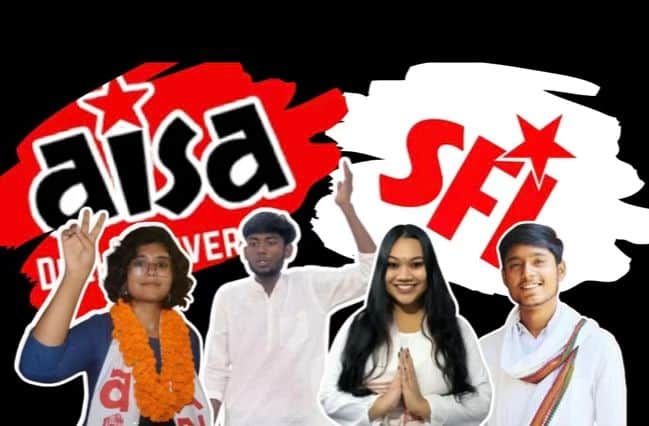
The electoral landscape of Delhi University continues to be marked by a paradox that has persisted for more than a decade. Left organisations such as SFI, AISA, and more recently DISHA, gain marginal votes. The results of the 2025 elections reinforce this trend: the ABVP secured three of the four principal offices, the NSUI captured the remaining post, and Left candidates trailed far behind the dominant blocs.
“On paper, the manifestos of all parties appear strikingly similar,” says a student. “Whether from SFI, AISA, ABVP, or NSUI, promises of affordable hostels, grievance redressal mechanisms, campus Wi-Fi, and improved gender-safety structures recur with regularity,” adds another. The difference, thus, lies in framing and perception: Left organisations articulate these demands through the idiom of democratisation and anti-privatisation, whereas ABVP and NSUI frame them as pragmatic matters of service delivery. The convergence of manifestos places the burden on credibility and trust. In this respect, students, based on our conversations, often regard the Left as effective in critique but deficient in demonstrating administrative efficacy.
The numerical results from 2025 starkly illustrate the challenge. The ABVP presidential candidate, Aryan Maan, won with approximately 59,882 votes; the NSUI contender followed with 15,500, while Anjali, the joint SFI-AISA candidate, polled a mere 5,385. In the vice-presidential race, NSUI prevailed with 29,339 votes, ABVP followed at 20,547, and the joint SFI-AISA alliance again remained in the low thousands. Similar patterns held in the contests for Secretary and Joint Secretary. Turnout, hovering around 39–40 per cent, suggests that disengagement remains a significant feature of DU’s electoral culture, with NOTA itself garnering several thousand votes in some contests. “This not only underscores the marginality of the Left but also highlights a pool of disaffected voters whose dissatisfaction, if organised, could alter the electoral balance,” adds a student from Lady Shri Ram College.
The deeper problem, however, lies less in raw numbers and more in institutional culture. Over the past 10–15 years, DU has been characterised by what many students themselves describe as a “career-first” ethos, an emphasis on examinations, placements, and credential-building. In this environment, the Left’s reliance on protest, sit-ins, marches, and symbolic agitation generates moral capital but also fatigue. A master’s student remarked that “these protests often felt alienating, repetitive, and disruptive.” The protest per se is not rejected; rather, its frequency and abstraction, particularly when extended to global or national issues, like the Gazan genocide, for instance, are perceived as less directly relevant to the everyday student experience. In this sense, DU contrasts sharply with JNU, where protest is understood as integral to intellectual life and is woven into the rhythm of hostel meetings and general body debates.
The perception of elitism compounds these structural disadvantages. Several college sub-groups of left-leaning parties belong to debating clubs and circles where English-speaking and politically articulate students dominate. While these networks provide rhetorical sophistication, they alienate a larger, more diverse student body. As one student put it, “it always feels like the debating society kids tell the rest of us what to think.”
The paradox is thus reinforced. At DU, the Left embodies critique, but critique does not convert into electoral capital. Unless the Left in DU can transform its style, demonstrating delivery, it will remain what it has been for over a decade: an articulate counterpublic, but not a governing force.
Image Credits: Sharanya for DU Beat
Sakshi Singh
[email protected]



Comments are closed.