Author

DU Beat

Browsing

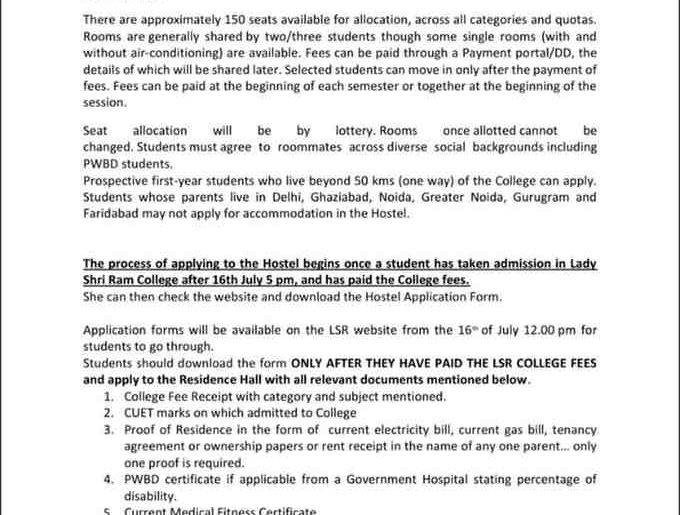
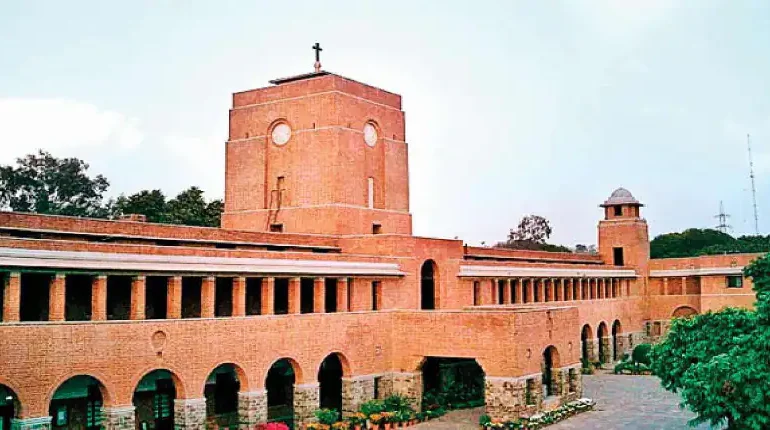
Lady Shri Ram College has reopened its Residence Hall for first-year students after remaining closed since 2023 for structural repairs. The renovated hostel will accommodate around 150 students this academic session. 

The Lady Shri Ram College (LSR) Residence Hall has reopened for first-year students for the 2026-27 academic session after remaining closed for nearly three years due to extensive repair and renovation work.

According to a notice issued by the college, the renovated residence hall will accommodate about 150 students across all categories and social groups in 109 rooms. Most rooms will be shared, while a limited number of single rooms, both air-conditioned and non-air-conditioned, will also be available. The college has stated that single-room allotments will be decided through a lottery system, and once allotted, rooms cannot be changed.

The reopening marks the end of a prolonged closure that began in 2023 following concerns over the building’s structural safety. The hostel was vacated after a resident sustained injuries when the roof of a bathroom cubicle collapsed. Subsequent inspections by a structural engineer identified deficiencies in the building, including deteriorating infrastructure, water leakage from blocked drains and pipes, and rusting, prompting the college to shut the residence hall for major repairs.

At the time, hostel residents were asked to vacate the premises, with the college refunding the remaining hostel fee and security deposit. Students were informed that the repairs could take a considerable period owing to the extent of the structural work required.

With renovation now complete, LSR has resumed hostel admissions for incoming first-year students. The application process for the 2026-27 academic session is currently open through the college website. Students have been advised to carefully read the hostel admission notice before submitting their applications.

The reopening comes as welcome news for outstation students seeking on-campus accommodation, particularly as hostel availability remains limited across several Delhi University colleges. The move restores an important residential facility that had remained unavailable for multiple admission cycles while repair work was underway.


Read Also: CM Rekha Gupta Pledges Infrastructure Push for Delhi University at Shaheed Bhagat Singh College’s Diamond Jubilee

Image Source: Lady Shri Ram College website


Aarushi Chaubey

[email protected]

Speaking at Shaheed Bhagat Singh College’s Diamond Jubilee curtain raiser, Chief Minister Rekha Gupta laid out plans for hostels, a subsidised canteen and expanded bus connectivity for Delhi University, alongside a college proposal for a dedicated girls’ hostel.

Delhi Chief Minister Rekha Gupta spoke at the curtain raiser for Shaheed Bhagat Singh College’s Diamond Jubilee celebrations on Thursday, where she outlined infrastructure commitments for Delhi University, asserting that a nation’s progress rests on how well it invests in its youth and the quality of its education system.

According to Gupta, the state government has prioritised upgrading academic infrastructure and student housing to position Delhi as a hub for higher education. A hostel for Delhi University students on the upcoming Indira Gandhi University campus is reportedly among the measures being considered, though the proposal is yet to be finalised.

Gupta further confirmed that the university will get an Atal Canteen from August 16, offering meals at Rs 5, alongside 50 additional U-Special bus routes for the university’s students.

The Chief Minister urged students to play an active part in nation-building and encouraged colleges to partner with surrounding communities to support local children in pursuing their ambitions. She described the creativity and drive of India’s younger generation as key to realising the goals of a ‘Viksit Bharat’ and a ‘Viksit Delhi’.

Separately, the college’s administration used the occasion to press for a girls’ hostel of its own, proposing that Shaheed Bhagat Singh Evening College be shifted to an alternative site to free up its current premises for the new facility. College representatives said many of its female students commute from outside Delhi, and that the lack of on-campus housing continues to affect their safety and continuity of studies.

The event also featured a virtual walkthrough of the college’s history, along with Gupta’s unveiling of a year-long Diamond Jubilee events calendar and a QR code granting access to the institution’s digital archives. Delhi University Vice-Chancellor Yogesh Singh and college Principal Arun Kumar Attree were reportedly among those in attendance.

Image Credits: Usha Parewa, Haribhoomi.com 

Read Also: CIC Directs DU to Consider Maintaining OCI Admission Records

Vidhi Ramchandani

[email protected]

The Central Information Commission (CIC) has recommended that the University of Delhi maintain records of foreign students admitted through Overseas Citizen of India (OCI) cards, following concerns over the absence of such data despite its relevance to the university’s admission process.

Delhi University has long attracted students from across the world, offering opportunities to international applicants through its foreign admissions process. However, concerns have been raised over the university’s failure to maintain separate records of students admitted under the OCI category, affecting transparency and public access to information.

Information Commissioner Sudha Rani Relangi, in her order, observed that the non-maintenance of records relating to foreign students admitted through OCI cards, despite such information forming part of the university’s admission process, was a “matter of concern”.

The matter arose after Advocate Sanjukta Basu filed a Right to Information (RTI) application in May 2025 seeking details from Delhi University’s Central Public Information Officer (CPIO) regarding the number of foreign students who applied for admission between 2020 and 2024. The application also sought information on applicants who had applied as Indian citizens while availing the benefits of an OCI card rather than through the foreign student category.

In response, the CPIO stated that the request had been forwarded to the Dean, who was the deemed Public Information Officer under the RTI Act. However, as the required information had not yet been received from the Dean’s office, the appellant was advised to pursue the matter with the concerned authority.

Dissatisfied with the response, the appellant filed a first appeal. The First Appellate Authority directed the Dean (Foreign Students’ Registry) to provide the necessary information to the CPIO within two weeks. As the direction was not complied with, the appellant subsequently approached the CIC.

During the proceedings, it was argued that Delhi University’s admission application form provides an option for foreign applicants to seek admission under the OCI category by submitting either a foreign passport or an OCI card. The appellant contended that the existence of this option indicated that the university ought to possess the relevant data, despite the CPIO’s inability to provide it.

During the hearing, Delhi University informed the Commission that while it maintains overall statistics on foreign student admissions, it does not keep separate records of students admitted using OCI or Person of Indian Origin (PIO) cards. The university submitted that foreign applicants had generally been admitted based on their foreign passports and, consequently, no distinct database existed for OCI or PIO card holders.

Taking note of the matter, the Commission recommended that Delhi University maintain a public record of foreign students admitted through OCI cards in the interest of transparency and proactive disclosure under the RTI Act. The Commission further directed that its order be placed before the Vice-Chancellor of Delhi University for consideration and instructed the university to submit a compliance report on the recommendations within six weeks.

The recommendation is expected to strengthen transparency in Delhi University’s foreign admissions process by ensuring better record-keeping and improving public access to information, thereby promoting greater institutional accountability in line with the objectives of the RTI Act.

An Overseas Citizenship of India (OCI) card is issued to eligible foreign nationals of Indian origin, granting them lifelong visa-free travel to India and several benefits similar to those available to Non-Resident Indians (NRIs). However, an OCI card does not confer Indian citizenship, voting rights, or eligibility to hold constitutional or certain government offices. In university admissions, OCI card holders may be eligible to apply under specific admission categories, subject to the institution’s regulations.


RAJARSHI GHOSH

[email protected]

Image Source: Indian OCI – Gateway Visa 


Read Also – Delhi High Court seeks clarity on UNHCR status; Impleads Centre, MHA, MEA in Myanmar refugee’s DU admission plea.

Delhi HC impleads the Union of India, MHA, and MEA in a Myanmar student’s plea against DU’s rule requiring foreign applicants to hold a non-Indian passport.

The Delhi High Court has widened a legal battle over Delhi University’s admission rules, bringing the central government into a case filed by a Myanmar national challenging DU’s insistence on holding a non-Indian passport for foreign student admissions.

Upon hearing the matter on Monday, the court added the Union of India, the Ministry of Home Affairs, and the Ministry of External Affairs as parties. Justice Jasmeet Singh asked the ministries to help clarify whether the petitioner qualifies as a UNHCR-recognised refugee or asylum seeker, and if so, whether he could still be admitted without a passport. The case returns to court on July 20.

The petition, moved by Henry Htoo Aung Lin through advocates Ashok Aggarwal and Kumar Utkarsh, challenges a clause in DU’s Foreign Students’ Registry Admission Bulletin making a valid non-Indian passport mandatory for undergraduate admission. It argues no recognised refugee can realistically meet this condition, since fleeing persecution rules out safely approaching one’s home government for travel documents.

Henry and his family left Myanmar in 2022 amid political unrest and fear of persecution, and have since lived in India under UNHCR protection, the plea states. After finishing school here, he applied to DU for the 2026-27 session through the foreign students’ quota in May, but was told his application was incomplete for lack of a passport; requests to submit UNHCR documentation instead were turned down.

The petition notes that DU’s own admissions bulletin lists a UNHCR Refugee Certificate as valid documentation, rendering the added passport requirement contradictory. It also cites Tibetan students, who may use alternative documents when passports are unavailable, arguing that denying similar flexibility to Myanmar refugees is discriminatory. The plea alleges a violation of Articles 14 and 21 of the Constitution and seeks either the striking down or relaxation of the clause.

The bench has questioned DU’s stance before. At an earlier hearing, the court reportedly asked how the university could expect a passport from someone with refugee status, before directing DU to seek instructions and adjourning the matter.

Henry completed Class X from the Mizoram Board of School Education and Class XII from the Meghalaya Board of School Education, and says his identity and academic record are verifiable through these boards and his UNHCR documentation.

Kaustubh Dwivedi

[email protected]

Read Also: Myanmar Refugee Challenges DU Passport Requirement in Delhi High Court

Delhi University’s FYUP fourth year may not continue across all colleges after low student participation prompted principals to propose alternative implementation models for the research-based programme.

Delhi University’s optional fourth year under the Four-Year Undergraduate Programme (FYUP) may no longer be offered across all affiliated colleges after low student participation raised concerns over the programme’s practical implementation.

According to reports, the Delhi University Principals’ Association (DUPA) has proposed that the fourth year be conducted only at designated colleges instead of every institution. The recommendation comes after only around 30% of eligible undergraduate students opted to continue into the fourth year during the previous academic session, leaving several colleges with very small batches that are difficult to accommodate academically and administratively.

In conversation with Times Of India, Delhi University Registrar Vikas Gupta commented that the University is positively considering the recommendation, adding that resources must be deployed judiciously where student strength is low. According to him, the final decision will be taken after the University receives complete enrolment data from colleges.

Introduced under the National Education Policy (NEP) 2020, the fourth year forms part of Delhi University’s Undergraduate Curriculum Framework (UGCF) 2022. Students who complete the additional year with a research dissertation are awarded an Honours with Research degree, intended to strengthen research opportunities and provide a pathway to doctoral studies. More information on the UGCF can be accessed on Delhi University’s official website. 

College administrations have cited multiple challenges in implementing the programme with limited enrolment. Running specialised research courses for small groups requires adequate infrastructure, faculty members qualified to supervise dissertations, and sufficient academic resources. In many cases, these requirements become difficult to meet when only a handful of students remain in a department.

Gupta also clarified that if the proposal is implemented, students whose colleges are not designated to offer the fourth year would not have to formally migrate. Instead, they would attend classes at the identified cluster college offering the programme.

Student preferences have also contributed to the low participation. Many choose to graduate after three years to prepare for competitive examinations or pursue postgraduate studies elsewhere. 

To address these concerns, principals have suggested a cluster-based model in which selected colleges would host fourth-year classes for students from multiple institutions. They have also proposed introducing minimum eligibility criteria to ensure that the research component remains academically rigorous. The proposal is yet to receive formal approval from the University. If implemented, it could significantly change how the fourth year of FYUP is offered across Delhi University’s affiliated colleges. 

Read Also: NCWEB applications open for B.A. (Prog) and B.Com; last date to register: July 24

Image Source: Parveen Negi, The New India Express

Vidhi Ramchandani
[email protected]

DU and I4C have signed an MoU to tackle cyberbullying and cybercrime against young women, promoting cyber awareness and safer digital spaces. 

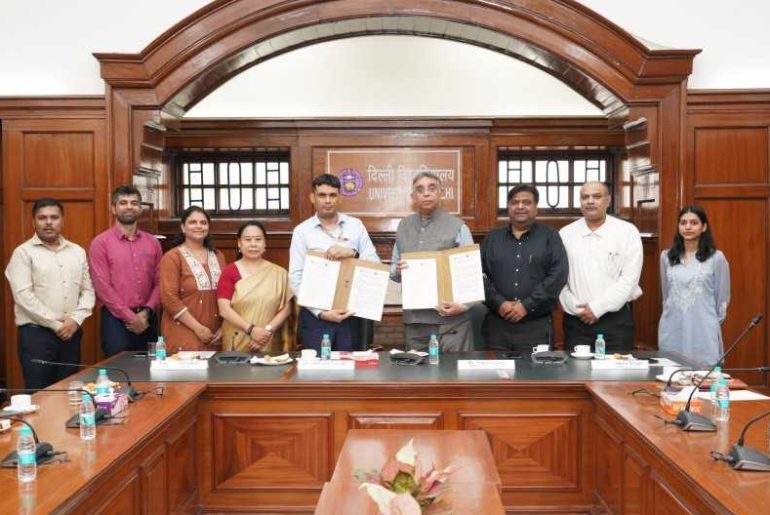
The University of Delhi has signed a Memorandum of Understanding (MoU) with the Indian Cyber Crime Coordination Centre (I4C) to strengthen cyber awareness and safety across its colleges, with a special focus on protecting women students from digital harassment and online fraud.

The MoU was signed on Monday, 13 July, by DU Registrar Dr Vikas Gupta and I4C Director Nishant Kumar, formalising a partnership between the university and the country’s nodal agency for combating cybercrime.

The collaboration comes amid growing concerns over cyberbullying, online fraud, and digital exploitation among students, with women students from economically weaker backgrounds often facing greater vulnerability. University and I4C officials said the partnership aims to build a cyber-aware campus ecosystem by combining institutional support with practical learning.

Under the MoU, DU and I4C will jointly organise awareness programmes, seminars, and hackathons to help students identify, prevent, and report cyber threats. The partnership will also promote knowledge sharing between academia and government to make cybersecurity awareness and digital resilience integral parts of campus life.

Established by the Ministry of Home Affairs, I4C serves as India’s central agency for coordinating efforts against cybercrime, working with state and city police forces to prevent, investigate, and respond to online offences. Alongside enforcement, it also leads public awareness initiatives, including the national cybercrime helpline (1930) and the CyberDost campaign, which promotes safe digital practices.

By Aamna Rehman 

[email protected]

Image Source: www.du.ac.in

Read Also: DU’s One-Year PG Promise Hits a Seat Ceiling 

A resignation changes who holds office – but who answers for the damage already done? Exploring the gap between political resignation and genuine accountability, the limits of symbolic responsibility, and why democracies owe citizens transparency, justice, and institutional reform after a leader steps down. 

News breaks of a devastating train crash. Hundreds have lost their lives. Television screens are filled with horrifying scenes from the accident, social media is boiling with anger against the system, and the opposition is demanding accountability.

“The minister must step down. The minister must resign.”

The calls begin echoing almost immediately. This is what we often hear after every major tragedy in the country. Whenever institutions fail, public attention turns to the person at the top. The minister, the official, the leader – the one responsible must leave the chair.

Yet beneath those familiar demands lies a more important question. Is resignation truly justice? Why do we instinctively believe that once someone vacates office, accountability has been served?

Justice, in public life, is more than replacing one person with another. It is about discovering what went wrong, assigning responsibility, repairing institutional failures wherever possible, and ensuring that similar tragedies do not happen again. Resignation may form part of justice, but it can never be justice in itself.

Resignation, in simple terms, is the act of leaving office. It signals political responsibility and accepts the scrutiny that follows public failure. Accountability, however, demands much more. It requires those in power to explain the decisions they made, cooperate with investigations, face legal consequences where laws have been broken, and implement reforms that prevent history from repeating itself. A resignation changes who occupies the chair; accountability demands answers for what happened while they occupied it.

Perhaps this is precisely why resignation often becomes the more favourable outcome for those under scrutiny. It is easier to leave office than to remain under continuous public, legal, and institutional scrutiny. Stepping down may satisfy the immediate political moment, but it rarely satisfies the larger public interest. Unfortunately, the debate often ends there.

Once a resignation is announced, public attention shifts elsewhere. Rarely do we continue to ask whether an independent inquiry was conducted, whether Parliament examined the failures, whether regulatory bodies were held responsible, whether administrative reforms followed, or whether anyone was prosecuted if laws were violated. A resignation answers only one question: who will no longer lead? It does not answer who will account for what went wrong, who allowed it to happen, or how it will be prevented from happening again.

 

The Grenfell Tower still burning at 04:43 on 14 June, four hours after it started. 

Wikipedia.com

What genuine accountability looks like can be seen beyond our nation. Following the Grenfell Tower fire in London in 2017, which claimed 72 lives, public attention did not end with political fallout. A years-long public inquiry examined not only the actions of individuals but also the failures of government departments, local authorities, regulators, manufacturers, and private contractors. Its findings exposed systemic negligence, gave recommendations for sweeping reforms, and paved the way for further legal and regulatory action. The focus was not simply on who should leave office, but on understanding why the disaster occurred and how such a tragedy could never be repeated. That is the difference between symbolic responsibility and substantive accountability. One satisfies the immediate political moment; the other seeks truth, reform, and justice.

The distinction becomes even more significant because accountability is never the same for everyone.

A cashier’s mistake may affect one customer. A doctor’s error may transform the life of a patient and their family. A CEO’s failure can affect an entire company and hundreds of employees. But when a public institution fails, the consequences extend to millions. A minister shapes an entire sector. A head of government shapes an entire nation. The greater the office, the greater its power, and therefore, the greater its responsibility to answer for its failures.

Yet public life often works in reverse: as power increases, accountability appears to diminish.

The consequences of these failures are also fundamentally different because many of them cannot simply be reversed. Lives lost in disasters cannot be restored. Students continue to suffer because of systemic failures in education. Policy mistakes continue affecting citizens long after the governments that introduced them have changed. Financial scandals still drain public money that belongs to taxpayers.
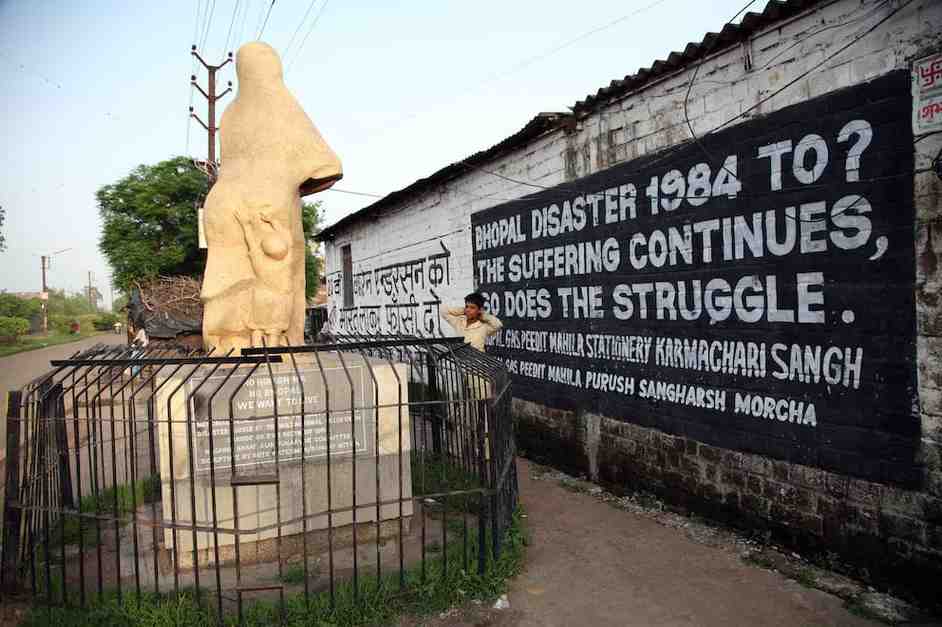
Memorial and murals in memory of the victims (Grosby)

www.infobae.com

The survivors of the Bhopal Gas Tragedy continue to live with the consequences of the night of 2 and 3 December 1984. No resignation could erase those losses. No change in leadership could restore the lives that were taken or undo decades of suffering. The damage had already been done. What people sought – and continue to seek – was not merely symbolic responsibility, but justice through accountability.

Behind every major institutional failure lies a chain of negligence: bureaucrats who overlooked warning signs, regulatory bodies that failed to enforce guidelines, departments that ignored repeated complaints, officials who never acted when action was required, and political leaders who failed to intervene despite possessing the authority to do so.

Reducing such failures to the resignation of a single individual oversimplifies what are fundamentally systemic problems. One person may become the face of the crisis, but they are rarely its only cause.

None of this suggests that resignations are unimportant. They remain important in any healthy democracy. They preserve constitutional morality, acknowledge political responsibility, prevent conflicts of interest during investigations, and help restore a measure of public confidence. A public official who has lost the confidence of the people cannot simply continue as though nothing happened. But resignation cannot replace accountability; it must accompany it.

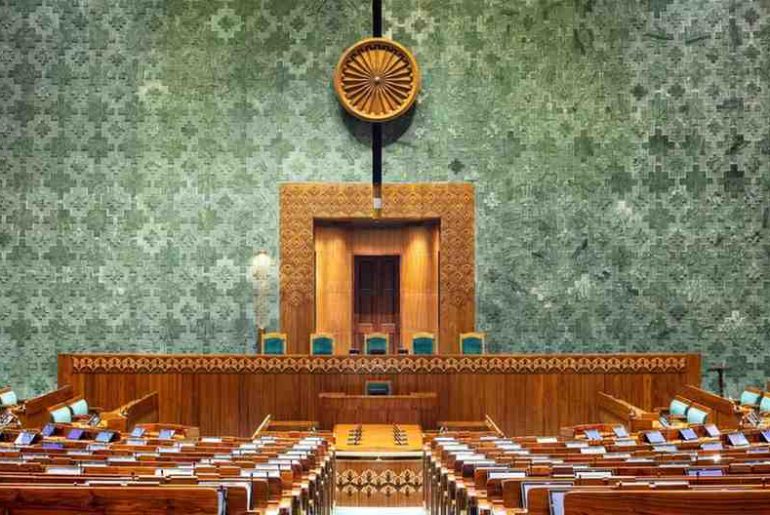
The Speaker’s chair is seen before the House of Commons session begins on Parliament Hill in Ottawa, Monday, Sept. 15, 2025. THE CANADIAN PRESS

Democracies cannot afford to mistake resignation for justice. A resignation may satisfy the politics of the moment, but accountability protects the future. Justice begins when those in power accept responsibility – but it is fulfilled only when institutions answer for their failures, reforms are implemented, and the public is assured that the same tragedy will not happen again.

Rahul Kumar

[email protected]

Image Credits: thearchitectsdiary.com

Read Also: The rise of à la carte travelling: A look into the travel practices of Gen Z. 

DU released simulated UG ranks for 2.06 lakh CSAS candidates on July 12. The preference list editing closes July 13, with first allocation list due July 16.

The University of Delhi published simulated rankings for undergraduate admissions 2026–2027 on the Common Seat Allocation System (CSAS) portal at 5 PM on July 12.

According to the university officials, 2,73,751 candidates registered on the CSAS portal this year, the highest number since 2022. During the second phase of the admissions process, which took place from July 3 to July 11, 2,06,835 candidates submitted their course and college preferences, while 2,18,284 candidates finished their registrations. Additionally, the female applicants outnumbered the male applicants among those who completed their registrations, with 1,20,509 women and 97,775 men, as stated by the officials.

During Phase 2, the candidates were required to map their CUET-UG 2026 subjects against those studied in Class 12 and submit ranked programme-college combinations. The simulated ranks were then calculated using the candidate’s normalised CUET-UG score, Class 12 subject mapping, and the preference order submitted in Phase 2. These ranks indicate a candidate’s likely position for each chosen programme-college combination relative to other applicants competing for the same seats. 

The university officials clarified that the simulated ranks do not mean a final seat allocation or an admission offer. Candidates can revise or reorder their programme and college preferences until 4:59 PM on July 13, after which the preference list will be frozen ahead of the first round of seat allocation.

The first CSAS allocation list is scheduled to be released on July 16. Candidates who receive seat offers will be required to accept allotments and complete document verification between July 16 and July 20, with fee payment due by July 21. A second allocation round, allowing candidates to freeze seats or seek upgrades, is scheduled to begin on July 25.

Admissions to 73 undergraduate programmes and over 100 BA programme combinations across 67 colleges are being conducted on the basis of CUET-UG 2026 scores. According to the seat matrix published on the admission portal, DU is offering more than 71,000 undergraduate seats this year. Some of the most sought-after courses include BCom (Hons), BA (Hons) English, BA (Hons) Political Science, and BSc (Hons) Zoology and Mathematics.


Read Also: Over 41,473 register for DU UG admissions on the first day of CSAS Phase 1

Image Credits: Careers 360

Mayank Scripts
[email protected]

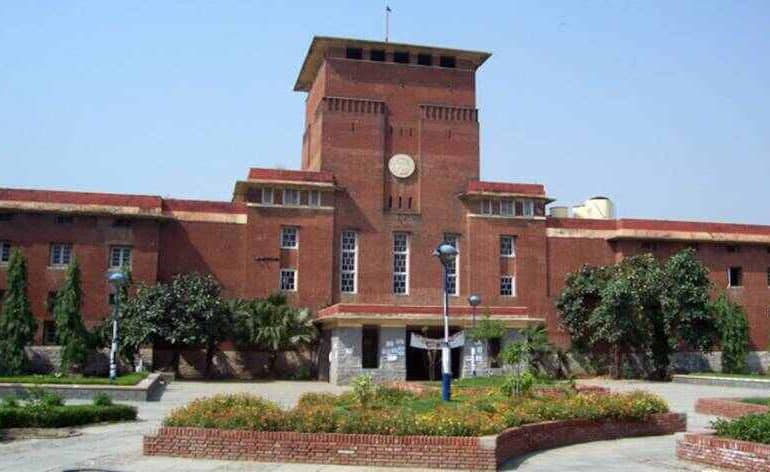
Delhi University’s first One-Year PG Programme offers just around 1,068 seats across 45 programmes, despite thousands of students completing the fourth year under the NEP. An examination of the seat matrix, admission policy, and student experiences reveals a widening gap between institutional promises and reality.

For Delhi University’s first NEP batch, students were persuaded to stay for an additional year on a straightforward promise: complete the fourth year, earn an Honours with Research degree, and fast-track into a one-year master’s instead of the conventional two. The seat matrix, released just a week before this year’s application deadline, tells a very different story: roughly 1,068 seats across 45 programmes for tens of thousands of students who completed the fourth year.

The Bulletin of Information (BOI) for the One-Year Postgraduate Programme 2026–27, published on July 4, 2026, lists 45 programmes across seven faculties. Adding the category-wise seats (UR, SC, ST, OBC-NCL and EWS) gives an approximate university-wide intake of 1,068 seats. M.A. Urdu tops the list with 50 seats, while M.A. English, Hindi, Sanskrit, Philosophy, History, Political Science, M.Sc. Chemistry, Physics, Mathematics and M.Com. appear capped at 45 seats each. At the other end, M.Sc. Biochemistry and Microbiology offer just three seats each.

Another important point is that the one-year PG programme is not spread across multiple colleges, unlike the conventional two-year route. M.A. English alone offers more than 500 seats through the two-year programme when the allocations across colleges are combined. The one-year route compresses that entire intake into a single university department for each subject, explaining much of the apparent seat shortage.

The University also released its official guidelines in December 2025, stating that each department’s one-year PG intake would be a minimum of 20% of its existing pre-NEP-sanctioned two-year intake, capped at 45 seats. Smaller humanities departments could increase intake to 40%, while laboratory-based science departments remained capped at 20%. Crucially, the intake formula is based on a department’s pre-existing sanctioned strength – not on the number of students who actually completed the fourth year.

On August 1, 2025, Delhi University’s Vice-Chancellor told PTI that roughly 55% of the 71,000 eligible students – around 40,000 – had opted for the fourth year. DU’s own figures have since varied, with a later report citing a 30% retention rate for the same cohort. Humanities and language departments nevertheless reported the highest participation, with colleges such as Lady Shri Ram College recording 70–80% fourth-year retention in subjects including English and Psychology. Ironically, many of these are the very subjects capped at 45 seats, suggesting that the seat ceiling and the size of the applicant pool move in opposite directions.

The one-year PG intake formula was finalised only in December 2025, months after most students had already committed to the fourth year. The actual seat matrix was published on July 4, 2026, after students had already completed that additional year.

This is what Aanchal, a fourth-year B.A. (Hons.) English student at Hansraj College had this to say about the programme’s implementation:

I enrolled in the fourth year because DU promised it would lead to a smooth one-year M.A. pathway. Instead, the entire year was poorly planned. We weren’t even properly introduced to our syllabus; professors themselves were often confused, and we were buried under assignments, dissertations, presentations and exams. Despite all this, DU never officially informed us about the one-year M.A. admission process; we had to learn about it through a podcast. The biggest betrayal came after we’d already finished the year. The Bulletin came out on July 4 with shockingly few seats. We invested an extra year, our hard work and our trust, only to discover that a two-year master’s will now effectively take us four.

Another student from Kirori Mal College described fourth-year students as experimental props, pointing to delayed syllabi, faculty shortages and assessment rules that changed midway through the academic year. Teachers’ associations have also separately objected that the one-year PG resolution was passed without adequate consultation with faculty.

The bottom line is this: as of July 11, 2026, when registrations closed, Delhi University had still not released the number of applications received for the one-year PG programme – either overall or subject-wise. Without those figures, it is difficult to calculate the applicants-to-seats ratio for any programme.

Whether this amounts to negligence or simply the turbulence of launching a new programme is open to debate. What is harder to dispute is the mismatch between student numbers and available seats, and the University’s failure to communicate that reality in time to students who based an entire year’s academic decision on a promise that Delhi University could not fulfil.


Name-: Arshia Sharma

Email- [email protected] 

Image credits: DuBeat

Read Also: The Search for a Third Place

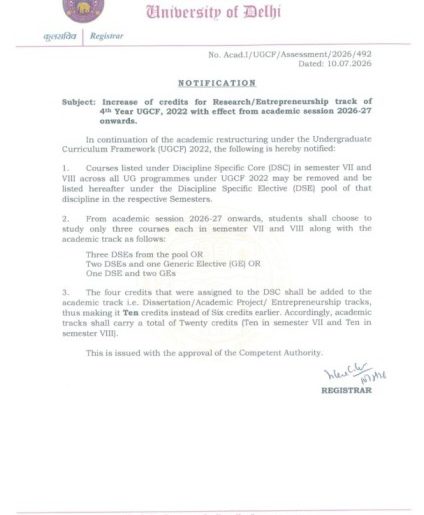
The University of Delhi has revised the credit structure for fourth-year undergraduate students under UGCF 2022, increasing the weight of academic tracks from six to ten credits per semester with effect from 2026-27.

The University of Delhi released a notification, dated 10th July 2026, restructuring the distribution of credits in Semesters VII and VIII for students enrolled under the Undergraduate Curriculum Framework (UGCF) 2022. The changes will come into effect from the academic session 2026-27. 

The most significant change concerns the credit weight assigned to academic tracks. Previously, tracks such as the Dissertation, Academic Project and Entrepreneurship carried six credits per semester. Under the revised structure, four credits previously assigned to Discipline Specific Core (DSC) courses in Semesters VII and VIII will be transferred to these tracks, raising each track’s credit value from six to ten. Academic tracks will now carry a total of twenty credits: ten in Semester VII and ten in Semester VIII.

Alongside this, DSC courses in the two final semesters will no longer be listed as core requirements. They will instead be moved to the Discipline Specific Elective (DSE) pool for the respective semesters. Students will be required to choose three courses from this broader pool each semester, with the following combinations permitted: three DSEs, two DSEs and one Generic Elective (GE), or one DSE and two GEs.

This is not the first revision to the fourth-year credit structure under UGCF 2022. In January 2026, the university had permitted students in Semester VIII to take up to eight additional credits, thus raising the per-semester cap from 22 to 30 to enable students who had not yet completed core discipline requirements to qualify for a major. That change applied to students enrolled in the 2025-26 session. The July notification, by contrast, applies from 2026-27 onwards and addresses the internal distribution of credits rather than the overall cap.

Rishika Jain

[email protected]

Read Also: NCWEB applications open for B.A. (Prog) and B.Com

Image Caption: Official Notification, dated 10th July 2026 

Image Source: University of Delhi