Author

DU Beat

Browsing

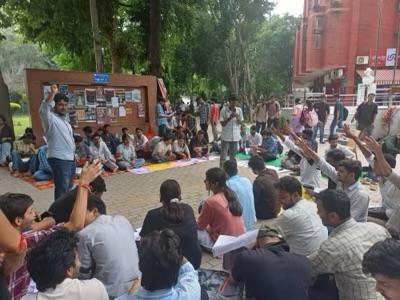
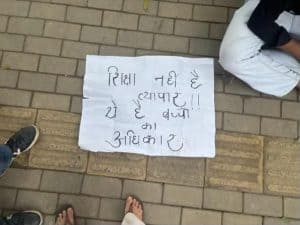
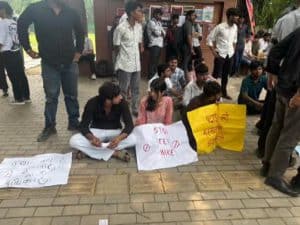
Students at Shaheed Bhagat Singh College protest a controversial fee hike, citing poor infrastructure and a lack of transparency. Tensions rise as the Delhi Police monitors the scene while the administration remains silent. The demonstration highlights growing unrest over educational costs and unmet promises. Urgent changes are demanded.

At 1 a.m. on 28 August 2025 Shaheed Bhagat Singh College’s gates encountered unfamiliar knocks. A group of students dissatisfied with the fee hike citing infrastructure development and quality reassurance showed up ready—per aspera ad astra—to protest their way to change. In a statement to DU Beat, one student mentioned the collapsing ceilings of the newly built reading room at the onset of the first monsoon rain and the poor quality of the reconstructed walls. He said, “in the past two years, we have experienced an annual fee hike. Yet, the quality of development is not maintained. What we demand today is a reduction in these continual hikes and an infrastructural development through the Delhi University’s official grants.” 

With chants of ‘the fate of education in Bhagat Singh’s country’, the SBSC’s entrance was swarming with Delhi Police cars, who kept a close eye on the protesters even inside the campus. The entrance was blocked several times today, and two guards, one male and one female, were the only ones handling the crowd. With no words from the Principal, Prof. Arun Kumar Atree, the protest is foreseen to continue until tomorrow. This leads to ambiguity in the formal fee payment process and does not provide any relief. 

Read Also: Students Stage Mega Protest at Deshbandhu College Against Fee Hike and Poor Facilities

Image Credits: Shreya Bhushan

Shreya Bhushan 

[email protected] 

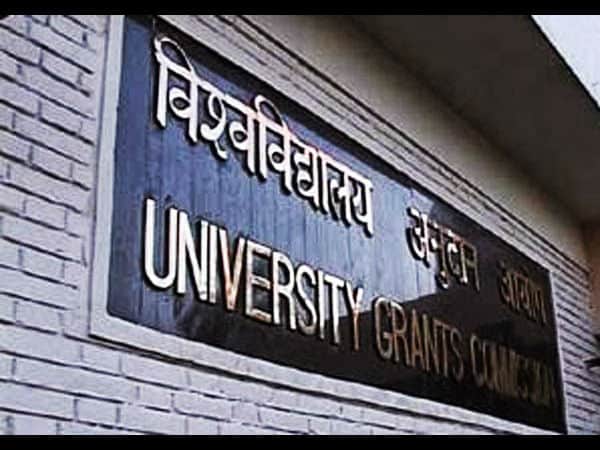
The University Grants Commission (UGC) has released a draft model curriculum for nine undergraduate and postgraduate subjects, emphasising Indian knowledge traditions. The move has sparked criticism from academics, student groups, and opposition-led states over concerns of academic rigour, ideological bias and “saffronisation”.

The United Grants Commission (UGC) on Tuesday unveiled a draft learning outcome-based curriculum framework (LOCF) for nine undergraduate and postgraduate courses, including anthropology, chemistry, commerce, economics, geography, home science, mathematics, physical education, and political science.  This draft LocF, according to UGC, will serve as a “model curriculum to promote flexibility and innovation in programme design and syllabi”.  While released to the public for feedback, the framework came under fire for its focus on “Indian-knowledge based systems”. 

Each LoCF prioritises the inclusion of Indian thinkers in their objective with the rationale that the Indian higher education system has “long been influenced by colonial structures, which have

often disconnected students from the country’s rich indigenous knowledge.” Commerce has additions of ‘Bhartiya philosophy’ with concepts like ‘Ram Rajya’ and ‘Shubh-labh’ philosophy, along with a focus on “India’s commercial history” that “fosters pride and continuity”. Economics similarly has a whole paper on “Kautilya’s Arthashastra” and a course  that aims to “explore the principles of public finance and systems of local governance in India, drawing from classical texts. “

The draft curriculum for mathematics proposes to teach sutra-based algebra (ancient Indian method using mathematical formulas) as a minor or additional course under the undergraduate programmes. Mandala geometry and yantras, rangoli and kolam as algorithmic art forms, temple architecture and āyādi ratios will also be included. The UGC also proposed another course on the philosophy of Indian mathematics. It introduces Bhāratīya philosophical systems, explores the role of mathematics in personality development, and offers a brief study of the Vedas, Vedāṅgas, Purāṇas, and Darśanas. Anthropology witnessed the addition of works of ancient scholars like Charaka and Sushruta, while chemistry added elements such as Saraswati Vandana and modules on Ayurvedic drinks. Critics, however, warn that the framework could undermine academic rigour.

Professor Amber Habib, Department of Mathematics at Shiv Nadar University, told ThePrint that,

A graduate of this curriculum is in no way prepared for modern research and will find it difficult to cope even with the Master’s programmes of national institutions like IITs and IISERs (Indian Institutes of Science Education and Research).

The most controversial of all was the addition of V.D. Savarkar’s The Indian War of Independence as recommended reading for modules on India’s freedom struggle. This move was met with protest from student organisations, particularly the Students’ Federation of India (SFI). They have strongly objected, accusing the UGC of pushing the RSS agenda through education. On August 27, SFI organised protests across UGC regional centres, arguing that “students and youth of this country do not need to study the history of the freedom struggle from books written by those who betrayed the freedom struggle.”

Opposition-led state governments like Kerala have come out to criticise the draft proposal, warning against what they term as “saffronisation” of Indian higher education. Kerala’s Higher Education Minister R. Bindu, in remarks to The Hindu, described the draft as “regressive, unscientific, and aligned with the ideological interests of the Sangh Parivar”. The Kerala State Higher Education Council will review the draft and submit a report to the state government, which will form Kerala’s official response. 

With public comments invited until September 20, it remains to be seen whether the UGC will revise its proposals or hold firm on a framework that has sharply divided opinion.

Read Also: Delhi High Court Directs Blocking of Sci-Hub and Libgen Amid Copyright Infringement Dispute

Featured Image Credits: DU Beat

Yashika Jain

[email protected]

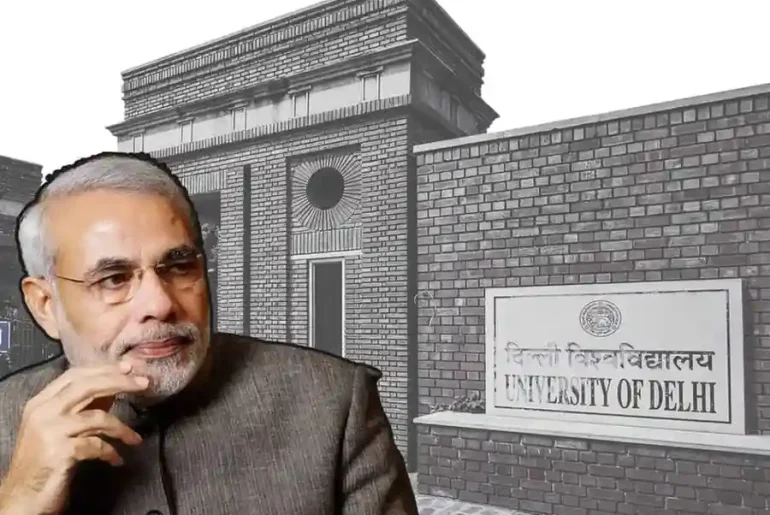
The Delhi High Court, in its hearing on Monday, quashed a 2016 order by the Central Information Commission (CIC) that had ordered the Delhi University to release details of Prime Minister Narendra Modi’s bachelor’s degree in response to an application under the Right to Information (RTI) Act. 

The order highlighted that there is a ‘special relationship of trust and confidence’ between a student and a university. The court held that information pertaining to an individual’s educational qualifications—including degrees and marks—falls within the ambit of “personal information” under provisions of the RTI Act.

Delhi University further challenged the CIC order, which had directed inspection of records for his BA program degree, which he pursued through the School of Open Learning, which he allegedly passed in 1978. 

Justice Sachin Datta, recording that the framework of the university’s statutes “does not permit the disclosure of marks/grades to any third party,” said, “There is a legitimate expectation on the part of the students that confidentiality shall be maintained” with regard to their information.

Justice Datta noted in his 175-page order that,

It is unambiguously clear that the ‘marks obtained,’ grades, answer sheets, etc., are in the nature of personal information and protected under Section 8(1)(j) of the RTI Act, subject to an assessment of overriding public interest… This court cannot be oblivious to the reality that what may superficially appear to be an innocuous or isolated disclosure could open the floodgates of indiscriminate demands, motivated by idle curiosity or sensationalism, rather than any objective ‘public interest’ consideration. Disregarding the mandate of Section 8(1)(j) in such a context would inexorably lead to demands for personal information concerning official functionaries spanning the entire gamut of public services, without any real ‘public interest’ being involved. The RTI Act was enacted to promote transparency in government functioning and not to provide fodder for sensationalism.

The court cited the 2023 judgment of the Gujarat High Court, where it had similarly quashed a direction by the CIC to furnish details regarding the Prime Minister’s degree in 1983 from Gujarat University. 

The Delhi High Court heard six petitions, including four by Delhi University, against a 2016 CIC order. DU had challenged directions issued against it and its CPIO, including a ₹25,000 penalty to be recovered from the officer’s salary for rejecting an RTI plea. The court set aside the penalty, holding that such recovery requires specific findings of deliberate misconduct, which the CIC had not recorded.

Read Also: https://dubeat.com/2025/08/24/discontinuation-of-ncc-safety-units-in-dus-lakshmibai-college/

Image Credits: Siasat

Divyanshi Dusad 

[email protected]

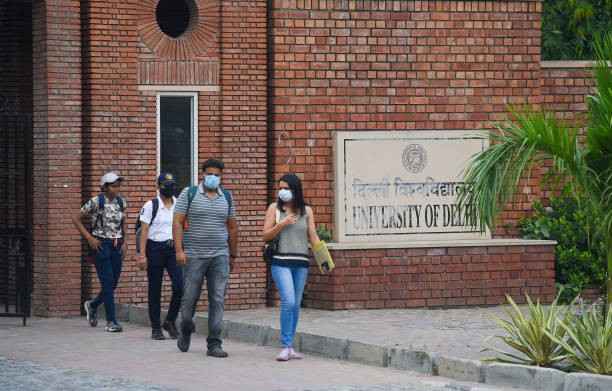
Delhi University has confirmed 68,116 undergraduate admissions after the second round of upgradation under CSAS-UG 2025–26. Students can apply for the Spot Round until August 27, with the announcement of vacant seats expected on August 28. 

Delhi University (DU) on Friday announced that a total of 68,116 students have secured admission to its undergraduate programmes after the completion of the second round of upgradation under the Common Seat Allocation System (CSAS-UG) for the academic year 2025–26.

According to official figures, 17,595 applicants had applied for an upgrade in this round. Out of them, 7,685 candidates successfully received an upgrade in their choice of course or college, while 46,257 applicants chose to freeze their allotted seats. In addition to this, 2,808 allocations were made under the performance-based and supernumerary categories. These include quotas for sports, extracurricular activities (ECA), Persons with Disabilities (PwD), Children/Widows of Armed Forces Personnel (CW), and international students. A DU official confirmed the figures to The Hindustan Times, noting that the second upgrade round marked a significant step towards completing this year’s undergraduate admission process.

As per the admission schedule released by the university, students allotted seats were required to accept them by 4:59 pm on August 23, while colleges were directed to verify and approve applications by 11:59 pm on the same day. The deadline for online fee payment is 4:59 pm today, August 24. Following the completion of these processes, DU will publish the list of vacant seats at 5 pm on August 25. Students who are not admitted to any college by today will be eligible to apply for the Spot Round until August 27, and allocations for the Spot Round will be declared at 5 pm on August 28.

The Spot Round is intended to fill seats that remain vacant after the initial rounds of allocation and upgradation. Students who wish to participate will only be able to apply to courses and colleges where vacancies exist, based on their category. The University has also notified students that admission in the Spot Round will be binding. Candidates must accept the seat offered, as failure to do so will forfeit their eligibility for any further admissions in this cycle.

With over 68,000 admissions already confirmed, the university is nearing the completion of its undergraduate admission process for 2025. The upcoming Spot Round is expected to provide the final chance for many aspiring students to secure a place in one of the country’s most sought-after universities.

Read Also: Google to Equip Students of Delhi University for the Tech Age

Image Credits: Hindustan Times


Neeraja Unnikrishnan

[email protected] 


Delhi High Court ordered the immediate blocking of Sci-Hub and Libgen for copyright violations after publishers’ suit; the move faces backlash from researchers citing high subscription costs and restricted access to essential scholarly work.

The Delhi High Court, in its bench led by Justice Manmeet Pritam Singh Arora, instructed the Ministry of Electronics and Information Technology and the Department of Telecommunications to block access to shadow libraries Sci-Hub and Libgen within 24 hours. The order mandates a ban on these apps with immediate effect. 

This comes as an outcome of a case in 2020 filed against these platforms by renowned publishing houses like Elsevier, Wiley Periodicals, and the American Chemical Society, which filed a suit alleging copyright infringement. They argued that the platforms gave access to copyrighted research papers without any prior approval.

After its initial proceedings, the Court prohibited the websites from uploading or sharing newly published works of the petitioners until further orders. Upon further investigation, it was observed that the articles published in 2022 were also later uploaded on Sci-Hub and another platform called Sci-Net, which violated the previous order. 

The founder of Sci-Hub, Alexandra Elbakyan, based in Kazakhstan, responded to the alleged violation by stating that it was a ‘technical error’ and that Sci-Net was a separate entity from Sci-Hub, which means the nonapplicability of the order to it. 

In February 2021, the Delhi Science Forum and the Society for Knowledge Commons intervened in the case, affirming that Section 52 of the Indian Copyright Act allows “fair dealing” of copyrighted works for research, which they argue protects platforms like Sci-Hub from liability.

Read Also: https://dubeat.com/2025/08/23/kmcs-project-samaavesh-rewrites-campus-life-for-visually-impaired-students/

Image Credits: Live Law

Divyanshi Dusad

[email protected]

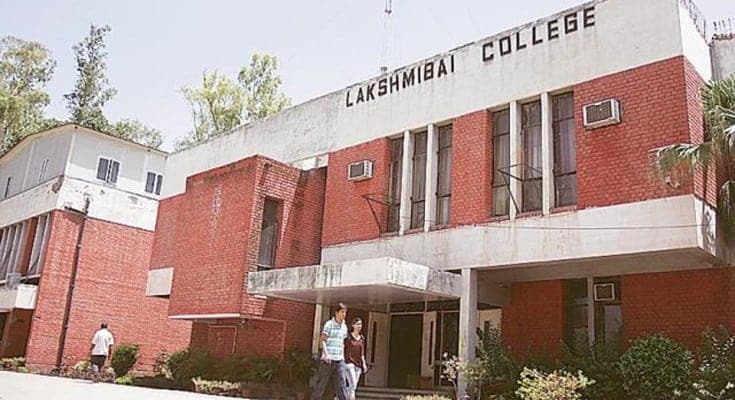
Delhi University’s Lakshmibai College introduced NCC units last year to act upon the harassment complaints made by the students around the campus of the women’s college. The units, named after Hindu Goddesses Durga, Kali and Chandi may be discontinued after a year of their implementation due to changes in the authority and differing views on the subject. 

No new enrolments in the units have been observed in this academic year, and the initiative is being planned to be discreetly peeled away from the college guidelines. 

The regiments, introduced by the then principal, Pratyush Vatsala, were an attempt to  empower young women, teachers and students and convert the campus into a safe space for every individual. 

The selection for these units was made out of the college’s NCC wing, and the students had to go through a rigorous interview process. The chosen applicants were assigned one of the units along with their own uniforms consisting of the coloured themes of red, white and black. The college ensured weekly self-defence training of the members for their own safety and equipped them with bicycles to certify timely appearance in case of any such events reported.

The initiative was met with mixed responses throughout the campus upon its launch. Similar emotions are being stirred up again with the circulation of news of its termination.

A third-year student, who was a participant of the regiment, told The Times of India,Now that the principal has changed, the system seems to be fading away. There have been no interviews or enrolments this year. We are not happy about it because such incidents of harassment are still a daily reality for us around the college.” She added, “Though a police cab is always stationed outside, the units gave us confidence to act when needed. It was an encouraging move and had a positive impact.” 

During its initiation, the move was described by the college administration as a proactive step in making the campus safer, but the action drew criticism along the lines of accountability. Few believed that this would lead to the students taking the law into their own hands rather than relying on the authorities or the institute. 

A faculty member expressed their concerns about the potential risks and said that the idea might unintentionally put students in harm’s way. 

Image Credits: Collegedunia

Ananya Agarwal
[email protected]

Read Also: Sensitization Programme for NSS Volunteers and NCC Cadets Under Swachhta Hi Seva – 2025

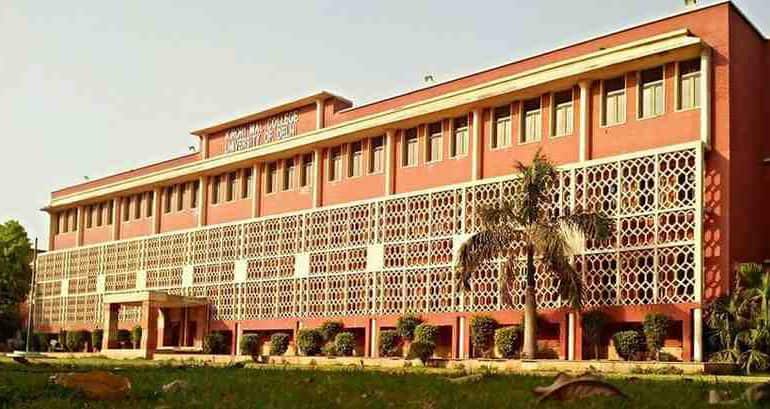
Kirori Mal College (KMC) launches Project Samaavesh, a pioneering initiative supporting visually impaired students with training, resources, and awareness programs to build an inclusive and empowering campus environment.

A quiet revolution is underway at Kirori Mal College (KMC), as a new initiative titled ‘Project Samaavesh – Towards Inclusion and Empowerment’ is actively reshaping campus life for its visually impaired students. More than just a support system, the project is a lifeline, offering tailored guidance, skills training, and, crucially, a sense of belonging to a community often grappling with isolation and limited resources.

“Inclusion is not a favour; it is a right,” states KMC Principal Dinesh Khattar. “There may be limits on sight, but there are no limits on vision.” This powerful sentiment underpins Project Samaavesh, a joint effort by the Centre for Disability Research and Training (CDRT) at KMC and the Score Foundation. The initiative’s core mission is to promote true inclusion through a dedicated on-campus help desk, where visually impaired students can receive support tailored to their individual needs and aspirations.

The project begins with a comprehensive assessment of each student, followed by the development of a customised support plan. This personalised approach directly addresses the systemic gaps prevalent in many academic institutions, where “enabling units lie dormant,” as described by Ankita Verma, a student from Miranda House. Verma highlights a critical issue, stating, “Technology is important, but our basic needs are still unmet,” a reality that Samaavesh seeks to change. The project provides training in essential skills like computer literacy, STEM, AI, and the use of assistive tools, equipping students with the tools they need to thrive in a competitive world.

Beyond resources, Project Samaavesh is fundamentally about changing perspectives. Someshwar Sati, CDRT coordinator, challenges the very definition of disability, asking, “If I give the audience a book in Braille and they can’t read it, are they disabled? Why can’t we embrace different ways of being as part of human diversity?” This philosophical approach is translated into action through sensitisation programmes and awareness campaigns aimed at students, faculty, and staff, fostering empathy and dismantling unconscious biases.

The transformative impact of the project is already evident in the lives of its participants. Sachin Kumar, a KMC political science graduate now pursuing his master’s at JNU, credits the initiative for his personal and academic growth. “When I joined CDRT, we focused on creating initiatives for inclusion,” he says. “We worked to spread awareness and make an impact. Society still doesn’t recognise the full potential of the disabled community. These programmes help bridge that gap.”

For Narendra Kumar Kashyap, a third-year Sanskrit student from Amethi, the project has eased a personal struggle. “Reading content is the biggest challenge. Interacting with peers is also difficult,” he shares. Since joining the program, however, his sense of isolation has diminished. “The gap is bridging,” he says, with a renewed sense of hope for his dream of becoming a teacher. As Sati poignantly puts it, “Nazariya badal denge toh nazar bhi badal jaayegi“—if we change the lens, our view will change too. At KMC, that change is already taking hold, creating a more inclusive and equitable campus for all.


Read Also – 32 Students Move Delhi HC Against DU’s LL.M. Practice Prohibition


Image Source – careers360


Richa Choudhary

[email protected]

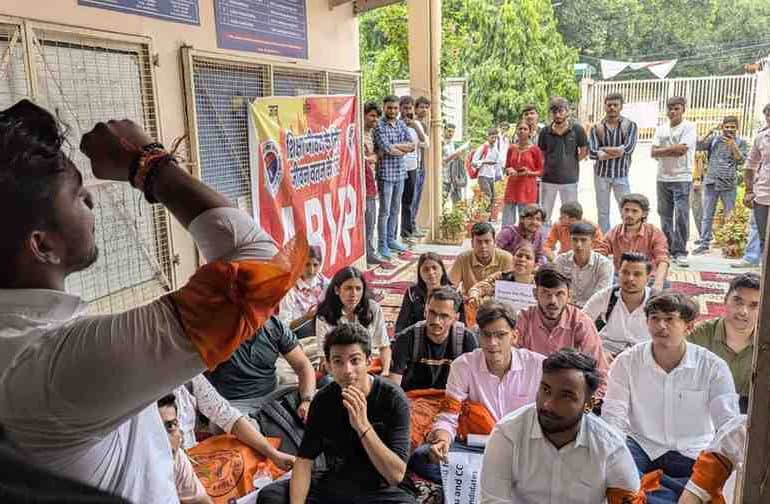
Students of Deshbandhu College, DU, staged a massive protest against fee hikes and poor facilities, highlighting issues in labs, sports infrastructure, Wi-Fi, medical room, and basic amenities.

Deshbandhu College, University of Delhi, witnessed a massive student protest today as several students gathered outside the Admin Office to demand better facilities and to oppose what they termed as “unjustified fee hikes.” The protest was organised under the leadership of Sarthak Singh, President of ABVP, Deshbandhu College, who spearheaded the campaign with the slogan: “No More Excuses, No More Lies – Students’ Voices Will Rise!”

The protest began at 11:00 AM on 22nd August, drawing students from various departments who expressed anger over infrastructural gaps and rising costs of education. Holding placards and shouting slogans, students demanded immediate redressal of their grievances.

At the heart of the protest was the demand for reliable Wi-Fi connectivity, which students argued is indispensable for academic work, research, and digital submissions. Many students complained that repeated assurances by the administration had yielded little progress, leaving them at a disadvantage compared to other colleges. Equally pressing was the issue of the college medical room, which, according to students, lacks both equipment and personnel to handle emergencies. Calls for a functional and well-equipped facility echoed throughout the demonstration.

Speaking at the demonstration, Sarthak Singh, ABVP leader, said:

Education is a right, not a privilege. We will not tolerate exploitation in the name of infrastructure when students lack access to even the most basic facilities. The administration must listen to us.

Another female ABVP leader of Deshbandhu College raised some important concerns: 

There are some very common problems, such as girls’ washrooms, Wi-Fi connectivity, and drinking water. The college holds zero accountability towards these basic responsibilities, and we must raise our voice in unison to demand answers from the administration. 

A major concern among students has been the inadequate state of the science laboratories, where a persistent shortage of essential chemicals and basic apparatus has disrupted regular academic work. Many practical sessions remain incomplete, leaving students unable to meet required coursework standards. Alongside this, the college’s sports infrastructure has also drawn criticism. Facilities are limited, equipment is outdated, and the available space fails to cater to the needs of a growing student population. Together, these shortcomings reflect what students describe as a broader neglect of academic and extracurricular resources.


Read also: NSUI Launches Protest Demanding DU to Implement 12 Days of Menstrual Leave Per Semester Policy

Featured Image Credits: DU Beat 

Madhav Choudhary 

[email protected]


The Delhi High Court in its hearing on19th August has issued notice on a plea challenging a condition enforced by the Delhi University stating that the two-year LL.M. programme is available only to students who are not engaged in any employment, trade, profession, business, or occupation. Justice Vikas Mahajan sought response of the University and Bar Council of India (BCI) and listed the matter for hearing on September 25. The plea has been filed by 32 students who are pursuing LL.M at the faculty of law for the session 2024–2026. Their case alleges that the condition is ‘ arbitrary, ultra vires and unconstitutional’. The plea stated:

 On the strength of this aforementioned Notification, the Faculty of Law, University of Delhi by way of rules, imposed an affidavit condition which requires LL.M. (2-year course) students to declare that they will not practise law during the course of their studies. The Petitioners who are already enrolled as advocates submit that this condition is arbitrary, unconstitutional, and directly violates their fundamental rights under Articles 14, 19(1)(g), and 21 of the Constitution.”

They further add that other universities, including the ones that offer more rigorous one-year LL.M. programmes, do not impose such restrictions, allowing students to simultaneously practise law and gain practical experience. This, they argue, places DU’s students at a disadvantage compared to their competing institutions when applying for judicial services or other professional opportunities.

Image Credits: Bar and Bench 

Divyanshi Dusad
[email protected]

Also Read: Students of Campus Law Centre Protest Against Unjust ICC Elections

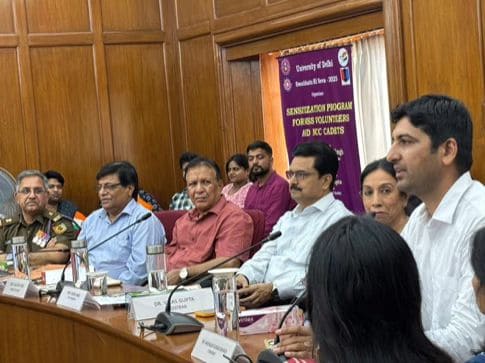
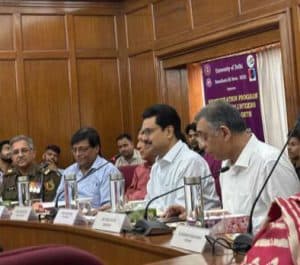
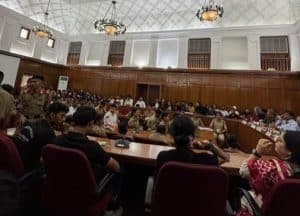
On 13 August 2025, the University of Delhi organised a Sensitisation Programme for NSS Volunteers and NCC Cadets under Swachhta Hi Seva – 2025 at the Council Hall, Vice Regal Lodge. The program aimed to inspire young volunteers to take an active role in promoting cleanliness, sustainability, and civic responsibility.

The session was hosted by Maj. (Prof.) Sanjay Kumar, NCC Coordinator, University of Delhi. He emphasised that eradicating substance abuse is essential for building a healthy and responsible generation, and called on students to take ownership of positive changes in their communities.

The Chief Guest, Prof. Yogesh Singh (Vice Chancellor, University of Delhi), delivered a keynote speech linking Swachhta Hi Seva to both individual commitment and systemic action. He expressed confidence that with collective effort, substantial improvements could be achieved within two years. Prof. Singh reflected on the sacred role of rivers in Indian history, contrasting their revered past with current environmental challenges. He urged students to focus on uplifting India before looking to foreign examples, stating, “Bharat ka rehne wala hu, Bharat ki baat sunata hun.” He also announced plans for university-level cleanliness and sanitation drives, including improved toilet facilities and waste management with swift follow-up after official communication.

The Vice Chancellor also announced his vision to launch a series of new cleanliness and sanitation projects across the University, with a special focus on ensuring the regular upkeep and maintenance of toilets in all campuses and hostels. He said that these initiatives would not remain on paper but would be implemented with urgency, with immediate follow-up actions taken as soon as official communications were sent to the concerned authorities. In a strong message to the student community, Prof. Singh advised against voting for candidates in student elections who had damaged university property with graffiti or littered pamphlets.

Highlighting the University’s A++ accreditation and international ranking of 328, he reminded students of their responsibility to maintain the institution’s prestige. Today’s students are tomorrow’s policymakers and change-makers, he emphasised , urging active participation in creating lasting change.

Speakers from NSS and NCC offered their perspectives on how volunteers can bring about transformation within their units and society. They stressed practical steps like waste segregation, awareness campaigns, and leading by example in cleanliness initiatives. The programme concluded with the Kul Geet of the University of Delhi, followed by the National Anthem, fostering a sense of unity and shared purpose.

This sensitization programme successfully blended inspiration, education, and practical guidance, leaving the volunteers motivated to not only adopt cleanliness as a personal habit but to champion it as an essential civic duty across society.

Read Also: Vandalism Erupts at DUSU Office Bringing Student Politics to a Dark Turn

Image Credits: Krishna Gurjar for DU Beat

Krishna Gurjar