Author

DU Beat

Browsing

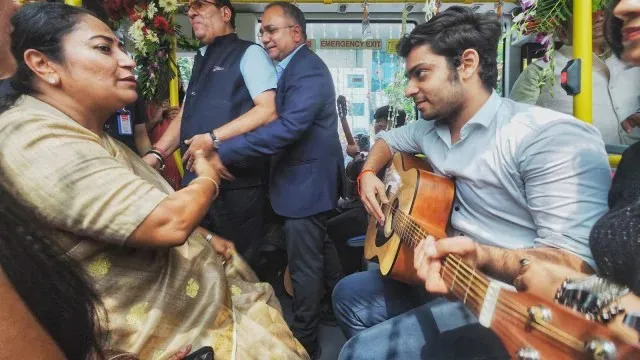
What is a palace on wheels for DU students? Probably some indie songs; add some Bohemian Rhapsody, Jagjeet Singh, and poetry, and you have a DU student in the snap of a finger. As much as this sounds too good to be true, you will be able to experience the beats of DU every Friday.

The launch of the universal specialist buses by DTCs and DU has sparked a renewed sense of excitement and enthusiasm among aspiring artists, as well as artistic zeal among those chosen to display their skills while touring the upscale historic buildings on the North Campus

The Managing Director of DTC, Prince Dhawan, was quoted as saying, “This initiative by DTC will not only promote the use of electric buses, but it will also help curb pollution.” 

This project contributes to DU’s cultural fervour and helps bring its beats to life. DU is not only renowned for its tote bags, contentious ideas, and well-known tea stalls, but it is now a magical place where DU culture is genuinely celebrated on wheels. 

As a student, you can squeeze this juice from the remnants of the DU every Friday. Every artist will be given one route every Friday, according to some estimates; it has been said that about 1000 artists are on the roll to perform.

Read Also: U-Special Buses to Return to DU, Students Ask if they’re Still Needed

Featured Image Credits: The Indian Express

Kinjal Sharma

[email protected]


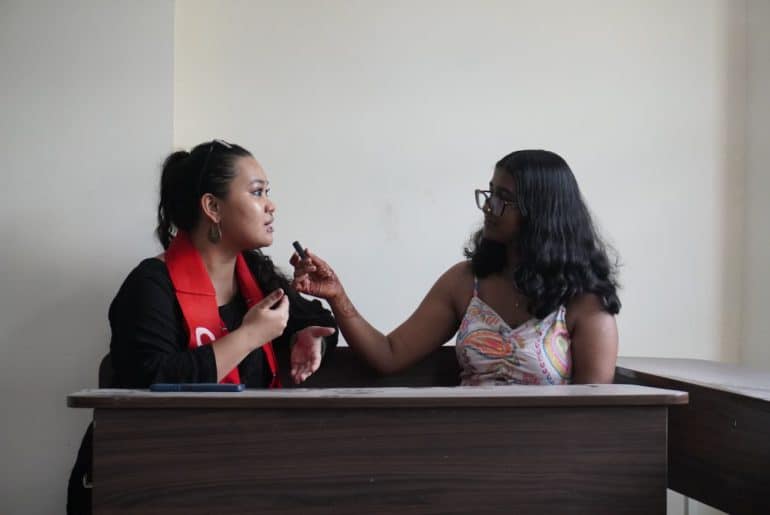
DU Beat in Conversation with Abhinandana Pratyashi

Abhinandana: So, hello everyone! My name is Abhinandana, and I am from North East, Assam. Assam is very popular for its floods, right? You must know Assam like that, but it is much more than that, because today I have become the first ever North Eastern Tribal person to contest for DUSU. I did my schooling in Assam, and I was the state topper both years. Now, I’m in Hindu College, pursuing Sociology Honours. I’m from SFI (Student Federation of India). 

Neeraja: Thank you for the introduction! I would like to start with, what do you think is the biggest challenge that DU students face right now? And how do you think you could improve on it?

A: See, the biggest challenge that Delhi University is facing right now is the hegemony of muscle and money politics that we see everywhere, right? We understand how the status quo prevails. People who are part of the hierarchy never want anybody else from below or outside the hierarchy to come and take space. And this is what that is personally, and that’s why socially and organizationally happening to me as well. Being a queer and being a Northeastern person, right? So, all these muscle and money politics and organizations that we see around ourselves, they are so visible. They have the money to visibilize themselves, right? So, they always take power over issues that are much more grounded. Those issues that need to be addressed, right? Like, for example, any of these issues that SFI is picking up. We can talk about fee hikes, we are talking about metro passes, and we are talking about women’s safety. But all of these issues, most of the time they are either co-opted by people who are not really affected by them or like just overpowered by muscle and money politics. So, this is like the biggest issue that we have right now. And the only way to challenge this or to combat this is with ground-level work. Unless there is proper education, there won’t be agitation.  And unless there is agitation, there won’t be an organization. And only when we have an organized mobilization of people, and only then, can we have some real change. And which is visible right now. So, right in front of me in my team, that’s Sneha, right? Sneha is standing right there. So, Sneha, without muscle and money politics, without the visibility of muscle and money politics, she was contesting last time; she gained 9000 votes.  And the person who won instead of her gained around 12,000 to 13,000. Look at the margin; this is a very small margin. So, this is the ground-level work we are talking about while combating the muscle and money politics that we see around ourselves.

N: Absolutely, thank you so much. Can I know some insights into the key pointers within your election manifestos?

A: Election manifestos, see, we are very grounded in the common student problems. First of all, the fee hike. Not many can afford to pay the fee that we are seeing right now. And that too, that is hiking, right? So, in Hindu College, in sociology honors, I am paying above 25k. If I had not had the scholarship that I have right now, I would not have even dreamt about coming to Hindu College and studying. I would have had to drop my education. And this is happening everywhere. Like in the Law Faculty, the fee before the new education policy, 3-4 years back, was Rs. 3000; now it is Rs. 8000. We see this constant fee hike. And in equivalence to that fee hike, we don’t even have basic to basic facilities. Like I said, I am from the North East, and Hindu College does have a girls’ hostel. But even there, I did not have the chance to get a seat in the hostel. So, if a girl from the North East is not getting a seat, then who will? You know the very popular case about the Hindu college boys’ hostel? It’s been privatised to such an extent that it’s been under construction for the past five years. In comparison, it took six years to build the Burj Khalifa.  And this is a problem everywhere. We are talking about affordable hostels so that the children do not have to commute so far, so that the students are not exploited by the PG mafia, the flat mafia. So, affordable education, first of all, means there is no fee hike. There should be a choice of accommodation. There should be a choice. There should be good and cheap food in the canteen. There should be a metro pass. See, a common student like us cannot afford to have our commuting prices go as high as 60 rupees in a single day. 100 rupees in a single day. That means, in a month, that is 3000 rupees, 2000 rupees. And you will see that the organizations with muscle money politics are roaming in big cars, BMWs, Thar, etc. What difference will it make to them that a common student like us cannot pay so much, right? So, this is one of the biggest issues we have been picking up in our manifesto. Because the students should at least get a concessional metro pass. Because it is simply very visibly non-affordable for our students, right? And apart from that, if we go to some branches of the points, Northeastern representation, of course, queer representation, of course. Because this is our space. Queer people say that half the sky isn’t enough. Of course, it’s not enough for us. We want representation. We want at least some kind of reservation. In the Hindu College Parliament, we have reservations. We are demanding the reservation of queer individuals, not just women, right? Not just cis-hetero women, but queer individuals, like I said. Along with that, basic issues, basic humanitarian issues. That xenophobia shouldn’t be there. That homophobia shouldn’t be there. That transphobia shouldn’t be there. So, these are some of the issues we are talking about. Like, basic to basic issues we are talking about in our manifesto.

N: That sounds amazing.  As you said, there are increasing financial crises that are happening. Like, the metro price hike, a fee hike, and hostel unavailability. How are you going to advocate for someone who is, like you said, the common student?

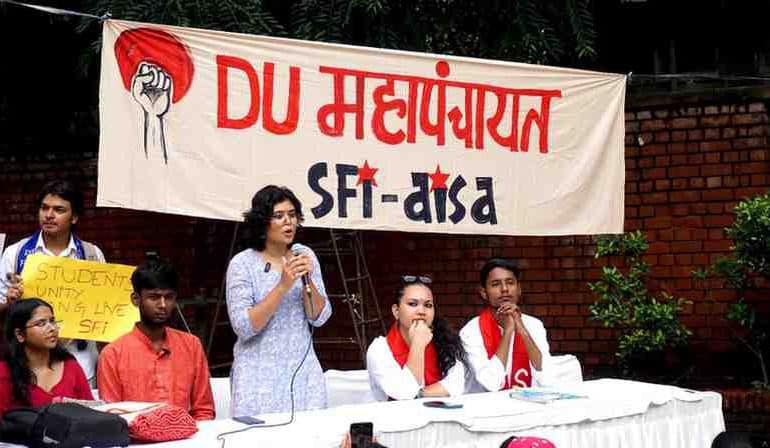
A: See, this is a very relevant question. Because this is seen everywhere. You must know that when we were contesting, the contestants who were contesting for the election had to sign a bond for 1 lakh. Right? So, a common student who comes from a marginalized background, the background I come from, I can’t even dream of contesting and having some representation in Delhi University Students’ Union. Because if you are signing a bond for 1 lakh, how will I pay the money? The people who are roaming around in cars can, of course, pay for it. But the one who is coming from a marginalized background, the already ostracized, is being continually ostracized. When you are putting up such bonds, when you are putting up such demands. So, this is a success of the panel that we are standing in, SFI AISA, our coalition of progressive organizations. So, you must know that the High Court has taken back this bond. Because we protested, we submitted a memorandum. So, when you ask how we combat these financial issues, that is combating. Combating can only happen through organization.  As I said, until there is no education, there will be no agitation. Without agitation, there will be no organization. People will have to organize on these common issues. Not just this 1 lakh bond. See, the rule passed by the Lyngdoh Committee this time, that people can’t throw around pamphlets. Because these pamphlets name people, reminding them, who can do that? The one who has muscle and money power, who has such funds, who has resources. So, people like us, coming from an ostracized background, have very little chance. Right? If we can’t have pamphlets flying around, how will people remember our name? How many times can we campaign, going from person to person? We can’t hire people to give away flyers. You must have seen, outside the college, people wearing Doraemon’s costume, Nobita’s costume, distributing flyers. We can’t hire such people. So, this time the Lyngdoh Committee has passed, so you can’t have such defacement. It can’t happen anymore. So, this is something that is, on a very minute level, combating the muscle and money politics, combating the financial discrepancy that we see. And, like, that’s why we are moving towards a more egalitarian election this time.

N: Like you said, this is something that might be personal to you also. DU has a diverse student culture across campuses, cultures, etc. How do you think you can represent people from all factions if you get elected?

A: See, even if you are from Bihar or if you are from Manipur, everyone is getting a free hike. Just because you can afford it, doesn’t mean you should have to. Because education is a fundamental right. Student mobility is a fundamental right. Students’ safety on campus is a fundamental right. So, the question of diversity pushes it further in a better direction. Here, fighting elections in a diverse environment, it’s much more inspiring because we see that, even after having a diverse background, these people are facing the same issues. So, it reinstates our power, in the idea, in the concept of the common student. Free hikes are happening with everyone. When a woman is exploited here, it’s not just about what background she is coming from; on the way, anyone can be catcalled. Right now, the background I come from, if a classmate from a different background comes from the North-East, she will be called a chinky here. I am queer, visibly queer, if a rich queer, or a poor queer, whose visible representation is queer, they will be hurled with homophobic slurs. So, I understand how class can have an impact on the discrimination we face, but just because of class differences, there is no discrimination against anyone. It’s not like that. Discrimination can be in different hierarchies. Like, a Dalit woman is more exploited, right? But that doesn’t mean that an upper-caste woman is not being exploited. So, in SFI, we believe in the organisation, until all of us are free, none of us are free. So, when I talk about diversity, diversity is one of the most positive things that we can have, when moving, when we are talking about our common student issues. 

N: What are some of the specific, achievable targets with which you can show your progress to students? How can you measure it, and how can you show it, in a specific sort of way?

A: When we say achievements that we have had as a common students’ organisation, first of all, I can talk about Hansraj. In Hansraj, the administration got land to make a girls’ hostel, right? And this is the case, everywhere. I mean, there is a space in SRCC, there is land in MLNC, to make a hostel, but the hostel is not being made. So, when this happened in Hansraj, then the admin said, No, we will make a cow shed here. Then, SFI, the common students’ organisation, protested that yes, you can make a cow shed. Of course, you are doing a good deed. Do a good deed outside the college. What is the right inside the college? What is the fundamental right of the girls? To make a hostel so that students are not exploited by the PG mafia. Expensive, unsafe PGs should not be there. Today, because of these protests, in Hansraj, a girls’ hostel has been set up. This is the power of a common students’ organisation. In JNU, you will see that the SFI AISA union has won many times in JNU. A left panel always wins in JNU. In JNU, you will see, every single student has access to the hostel. What they pay in a month for the room rent is 10 rupees. This is the power of a common students’ organisation. In Miranda, you will know, Miranda’s hostel fees are very popular for their low cost, right? And why is that? When in the middle of the night, the fee in Miranda went up 5000, right? See, 5000 might not mean much to people with BMWs and Thars, but 5000 means a lifetime to us. When it went up, SFI protested,in the middle of the night, and the fee was lowered, I mean, so this is the power of a common student’s organisation. And we were talking about concessional metro passes, right? At Hyderabad University, SFI has formed a union. Now, every single student in Hyderabad University has a concessional metro pass. They get 60% off. The 80 rupees we pay here, they pay 35 or 40 rupees there. This is the power of a common students’ organisation. So, when you say achievable things, when we talk about achievements, it is also an inspiration for us, that yes, when a common students’ organisation comes to power, things can happen. Now, I am from Hindu College. In Hindu College, there was a very regressive culture, V-Tree Pooja, Virgin Tree Pooja. When I came in my first year, in Virgin Tree, they used to hang water-filled condoms. They used to paste pictures of women whom they wanted to break their virginity with. When I came in the first year, my picture was also pasted there. It’s clearly a type of harassment, right? So, along with SFI, I had protested, and today, V-Tree Pooja doesn’t happen there anymore. This is the power of a common students’ organisation. Be it fee hike, be it affordability, accessible hostels, metro passes, or be it misogyny. All of these fights have been achieved, all of these things have been achieved, with SFI being in the union, without SFI being in the union. Because, whether it is an election or not, whether you are a common student or not, if you are a common student, then you have to fight, always.

N: Absolutely. Thank you so much for the interview!


Read Also: Campus Promises: ABVP, NSUI, and SFI–AISA Manifestos 2025

Neeraja Unnikrishnan

[email protected]

 

With DUSU election day less than a week away, tensions rise as Delhi’s largest student body puts forth its demands and expectations from the parties it votes for. Infrastructural upgrades, increased hostel seats, and campus hygiene remain the most widespread demands.


Stakes are high as tensions and excitement rise over the upcoming Delhi University Students’ Union (DUSU) elections which are to be held on September 18th, 2025. The counting of votes is scheduled for the following day, on September 19th 2025. The DUSU elections serve as a platform that acts as a stepping stone for students into politics, either as representatives or voters. With the University of Delhi having the largest student body in the capital, the parties involved in the DUSU elections certainly have a significant weight on their shoulders.

Students have put forth multiple demands with increased hostel availability and campus hygiene being top concerns. First year philosophy student, K.Sameepya from Indraprastha College for Women stated that the administration is quite detached from the students.

“If you want to connect with [the administration] there are a lot of things you kind of have to jump through. And even then it is actually quite difficult to connect with any of them.”

A first year student from SRCC remarked on the need for improved safety outside colleges, particularly women’s colleges. She also raised concerns about the lack of campus hygiene, talking about the state of the restrooms on campus saying,“with the current conditions of the washrooms, you wouldn’t even want to step in there.” Akanksha Singh, a first year student from Ramjas College talked about how the restrooms do not have proper doors – “So, even dogs sometimes come and go in the washrooms on the ground floor.” The availability of hostels, especially for first year students and students from out of state, needs to be increased according to several students.

The release of the manifesto was also a concern. Akanksha Singh, among other students, expressed their frustration over candidates simply “barging into classrooms” before introducing their names and blatantly asking for votes. Candidates generally give little information about their past work, promises and what they stand for, skipping to directly asking for votes. Students say that it is difficult to vote for people they don’t really know they can trust.

The 2025 DUSU elections are likely to be the most competitive yet with the introduction of the fourth year for undergraduate degrees by the NEP. This implies that third year students are no longer considered “final year” students and are hence eligible to compete for positions such as President and Vice-President, increasing the overall competitiveness of the entire process. Further, the 2025 elections will follow stricter guidelines with bans and limitations on loudspeakers, banners, and posters. Posters are to remain handmade and put up in only certain locations. This is expected after the vote counting for the 2024 elections was withheld upon the involvement of the High Court due to alleged defacement of public property.

The presidential candidates for this year’s elections include Aryan Maan for the Akhil Bharatiya Vidyarthi Parishad (ABVP), Joslyn Choudhary for the National Students’ Union of India (NSUI), and Anjali for the SFI(Students’ Federation of India)-AISA(All India Students’ Association). With the highly competitive atmosphere of the DUSU elections, each candidate is likely to give the other a run for their money. 


Read Also: Protest at Motilal Nehru College against Student Election Nominations


Souparnika.S.R

[email protected] 


Image Credits: Jansatta

With the Delhi University Students’ Union elections approaching, major student organisations have released their manifestos announcing promises, reflecting issues, and revealing both overlaps and contrasts in priorities.

There are significant variances as well as obvious parallels between the ABVP, NSUI, and SFI-AISA coalition manifestos. The goals of these three parties are to solve persistent problems in Delhi University politics, such as women’s safety, campus infrastructure, and affordability. However, each uniquely presents its strategy, answering critiques of earlier DUSU terms and reflecting its ideological foundations.

Student health and welfare have been foregrounded more strongly this year. ABVP explicitly promised, “subsidised health insurance schemes for students”, a measure that responds to recurring demands for affordable healthcare after years of rising living costs. NSUI brought the conversation into the gendered domain, with its women’s manifesto pledging, “helpline numbers, menstrual health awareness, sanitary pad vending machines, and proper gender sensitivity measures.” The SFI-AISA alliance combined health and gender justice, promising menstrual leave and insisting on institutional structures like, “elected Internal Complaints Committees and gender sensitisation cells in all colleges”.

The only organisation to make a specific commitment on digital access is ABVP, which has pledged “free Wi-Fi access for university students.” Although the Left alliance and NSUI did not use the same language to emphasise Wi-Fi, they both emphasised infrastructure and accessibility in more general terms, implying a move away from band-aid technological solutions and towards structural reforms.

The affordability debate remains central, carrying forward unresolved issues from past years, such as fee hikes and opposition to the National Education Policy (NEP). The SFI-AISA alliance has taken the clearest stance, stating that it has, “pledged to oppose fee hikes” and presenting its programme as ‘a true student-centric manifesto.’ NSUI echoed this with calls for, “public funding for equitable education” and a rejection of NEP-linked restructuring. ABVP, while not quoted as directly opposing fee hikes, emphasised subsidised schemes and improved facilities.

Women’s safety and inclusion, an issue repeatedly raised after incidents on campus in previous years, has again appeared prominently. NSUI’s separate women’s manifesto is notable in its detail, listing concrete measures like, “helpline numbers, menstrual health awareness, sanitary pad vending machines, and proper gender sensitivity measures.” The SFI-AISA alliance, in line with its activist tradition, focused on structural reform: “elected Internal Complaints Committees and gender sensitisation cells in all colleges.” ABVP’s framing was broader, with its candidate speeches highlighting campus safety and “accessibility audits for students with special needs.”

Finally, housing and hostels continue to be a major theme, reflecting perennial shortages and past protests by outstation students. ABVP’s manifesto directly included, “construction of new hostels to accommodate growing student needs.” NSUI’s broader call for inclusive infrastructure implicitly covered hostel provisions, while SFI-AISA explicitly folded hostel expansion into its demands for resisting privatisation. 

While all parties echo recurring demands like safety, hostels, and digital access, their manifestos also respond to past gaps, some promising continuity, others pledging fresh reforms to long-standing student concerns.


Image Credits: Manan for DU Beat

Anjali Kumari Jha
[email protected]

Read Also: ASAP, The New Student Wing of AAP, Refrains from Contesting DUSU Polls Days Before the Election

Delhi University may soon conduct an Open Mop-Up Round to fill vacant UG seats with spot admissions at colleges. The EC has also approved new PhD credit rules from 2025, research spaces in colleges, and an honorary degree for Sri Lankan PM Harini Amarasuriya.

Delhi University (DU) is likely to introduce an ‘Open Mop-Up Round’ to fill vacant undergraduate (UG) seats across its colleges, with admissions being conducted physically at the college level. The idea was proposed by Vice-Chancellor Yogesh Singh during the Executive Council (EC) meeting on Friday.

The matter was raised during the meeting’s ‘zero hour,’ when members noted that several colleges still had unoccupied seats even after the Central Seat Allocation System had concluded. Singh suggested that direct spot admissions at colleges could help ensure that all available seats are utilized.

Addressing queries about the extracurricular activities (ECA) and sports quota, Singh clarified that the five percent reservation is applicable to colleges collectively. Institutions may apportion this quota in a 3:2 ratio between ECA and sports, depending on their facilities. The EC also authorized the Vice-Chancellor to formulate a uniform policy on the issue.

As DU prepares to implement the fourth year of its undergraduate programme under the National Education Policy (NEP) 2020, Singh directed all colleges to establish dedicated “research discussion rooms” for students as well as spaces for faculty.

The EC further approved new guidelines for PhD programmes, to be implemented from the 2025–26 academic session, ensuring uniformity across departments. The revised framework will require coursework within a 12–16 credit structure, including 4 credits in Research Methodology (or Advanced Research Methodology for trained candidates), 2 credits in Research Publication Ethics, 2 credits in Research Tools, and 4 credits in a Discipline-Specific Elective (DSE). Departments may also introduce an additional 4 credits through DSEs if needed. These courses must be of a higher level than postgraduate syllabi and will count towards faculty workload.

In another key development, the EC ratified the Academic Council’s recent decision to award an honorary doctorate to Sri Lankan Prime Minister Harini Amarasuriya, a DU alumna. The degree will be conferred during a special convocation in mid-October, coinciding with her visit to India. Amarasuriya, who studied Sociology at Hindu College between 1991 and 1994 under a Ministry of External Affairs (MEA) scholarship, will become the first serving Sri Lankan Prime Minister to receive this honor from DU.

The EC also unanimously passed a resolution congratulating CP Radhakrishnan on assuming charge as the 15th Vice-President of India and, in that capacity, the Chancellor of the University of Delhi.


Featured Image Source:
Amar Ujala

Richa Choudhary
[email protected]

Read Also: Protest at Motilal Nehru College against Student Election Nominations

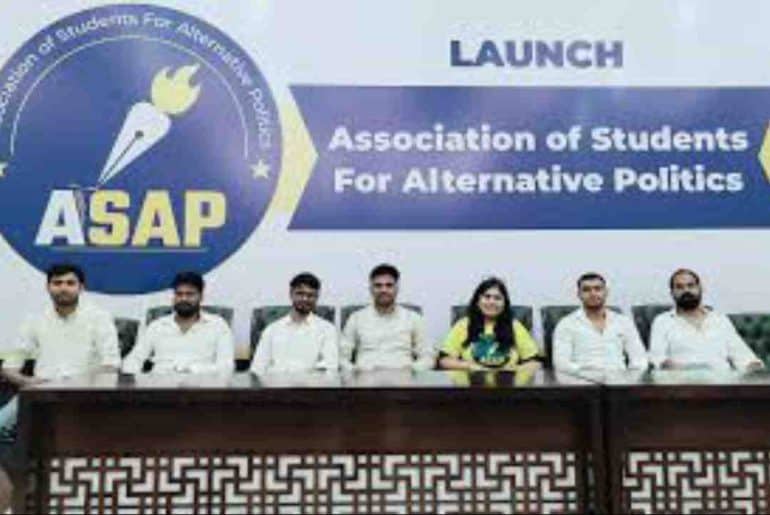
The Association of Students for Alternative Policies (ASAP) was set to make its DUSU election debut this year. However, it has shifted its strategy just days before the 2025 DUSU elections, deciding to focus more on grassroots engagement and prioritising student welfare.

At the beginning of this year’s election season, the Aam Aadmi Party (AAP) launched a new student wing, the Association of Students for Alternative Policies (ASAP). While ASAP was set to make its debut in the 2025 Delhi University Students’ Union (DUSU) elections, it has now decided to refrain from participating in this year’s DUSU polls, focusing instead on reinforcing its student support at the college level.


With just a few days left for the DUSU elections, to be held on 18th September, ASAP has decided to skip the polls and shift its attention to campaigning and contesting at the college level. Previously, they had planned to contest all four central panel seats, namely that of President, Vice President, Secretary and Joint-Secretary. So far, ASAP has secured victories at two colleges, one of them being the Indira Gandhi Institute of Physical Education and Sports Sciences (IGIPE), where two candidates were elected unopposed. This decision is indicative of ASAP’s previous remarks, stating their commitment towards concrete student issues and actions in lieu of electoral politics. The party’s agenda has historically been associated with matters of student welfare, including those related to infrastructure, fee hikes, access to more hostel and library facilities for students, as well as free student metro passes, which they have been pitching since the beginning of CYSS. ‘Hala Bol’, ASAP’s first protest on 5 August, marked the beginning of their campaign. Approximately 150 students gathered to demand refinement of the recruitment process of the Staff Selection Post (SSC), where several administrative and technical disruptions compromised the efficient execution of the exam.

Deepak Bansal, who joined CYSS in 2023, told the Indian Express that ASAP is devoted to breaking caste-based disproportions in the four central panel posts. Also steering the party’s campaign this year, Bansal claimed that they will be pushing SC/ST, and candidates from other marginalised communities to contest, and break the ongoing dominance of Jats and Gurjars of other parties.

AAP’s original student wing, the Chhatra Yuva Sangharsh Samiti (CYSS), was formed in 2014 as an effort to introduce “alternative politics” and to expand its youth outreach. However, CYSS was largely unsuccessful in both Delhi and Punjab University despite having significant financial and political backing from the party itself, leading to their decision to rebrand and re-strategise their plan of action with regard to student politics. ASAP was formed as an endeavour to “free campus politics from money and muscle power.” Former Delhi Chief Minister Arvind Kejriwal and the party’s national convenor told the Times of India that, “the student wing’s key objective is not just to contest elections, but also to build social and cultural groups in schools and colleges to unite students through ideas and creativity.”

He was also quoted as saying, “We were in power in Delhi for ten years. The politics we did in Delhi is called alternative politics. Giving good education to all is not part of mainstream politics, but it’s part of our alternative politics,” explaining AAP’s ASAP to be a substitute to BJP’s ABVP and Congress’s NSUI.

AAP’s original student wing, the Chhatra Yuva Sangharsh Samiti (CYSS), was formed in 2014 as an effort to introduce “alternative politics” and to expand its youth outreach. However, CYSS was largely unsuccessful in both Delhi and Punjab University despite having significant financial and political backing from the party itself, leading to their decision to rebrand and re-strategise their plan of action with regard to student politics. ASAP was formed as an endeavour to “free campus politics from money and muscle power.” Former Delhi Chief Minister Arvind Kejriwal and the party’s national convenor told the Times of India that, “the student wing’s key objective is not just to contest elections, but also to build social and cultural groups in schools and colleges to unite students through ideas and creativity.”

He was also quoted as saying, “We were in power in Delhi for ten years. The politics we did in Delhi is called alternative politics. Giving good education to all is not part of mainstream politics, but it’s part of our alternative politics,” explaining AAP’s ASAP to be a substitute to BJP’s ABVP and Congress’s NSUI.

Read also: AAP’s Revamped Student Wing Gears Up for DUSU Elections

Image source: du_speak on Instagram

Manya Marwah

[email protected]


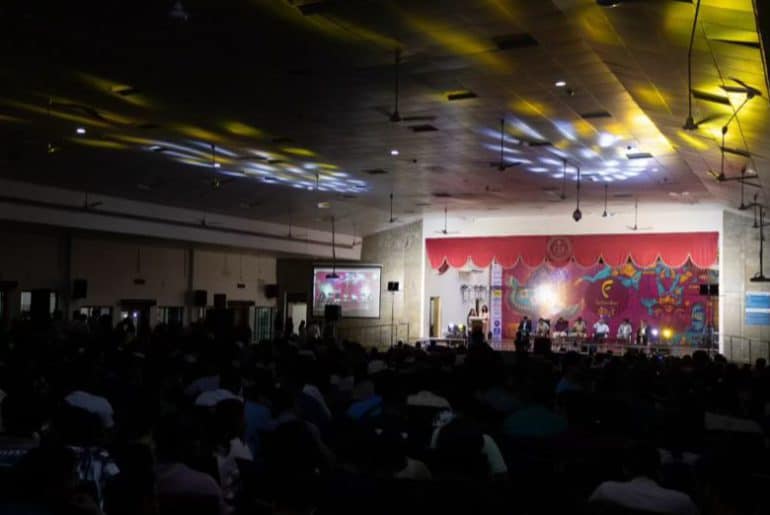
The highly anticipated cultural fest Festember is alive once again at the National Institute of Technology, Tiruchirappalli, from the 18th to the 21st of September, 2025, under the theme “Saga of Secrets”. This year’s theme dives into the allure of mystery and discovery, inviting participants for a journey where every event, performance, and interaction unveils a hidden story waiting to be uncovered. Blending intrigue with artistry, Festember 2025 promises an exciting lineup of events that will captivate hearts and minds, drawing students from across the nation.

Festember 2025 will showcase a diverse array of activities, including amazing proshows, captivating events, thought provoking workshops, and inspiring guest lectures from respected artists and industry leaders.

Festember has earned its reputation as one of India’s most celebrated cultural festivals, and this year’s edition aims to elevate that legacy. With an impressive annual footfall of 18000 students from 500 different colleges, the festival is not only a platform for showcasing talent but also an opportunity for students to network with friends and escape the daily monotony of academics.

Festember has always brought the stage alive  from Benny Dayal and Amit Trivedi’s beats to the soulful voices of Karthik and Neeti Mohan, every pro-show has been a showstopper. And this year? Expect nothing less.

The guest lectures have seen legends like Sid Sriram, Jonty Rhodes, and chess grandmaster Vishwanathan Anand take the mic. So, get ready once again for talks that will inspire and spark ideas within.

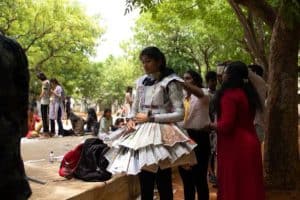
With clusters of events, fan-favorites like Fashion Show, and workshops ranging from fencing to glassblowing, Festember packs something for everyone.

Festember has grown every year to become one of the nation’s most celebrated cultural festivals, and this edition is no different. With preparations going full on, the stage is ready for an unforgettable experience that is meant to last.


Amidst the roar of Motilal Nehru College’s student elections, the college witnessed a protest led by the students against unfair candidate nominations. 

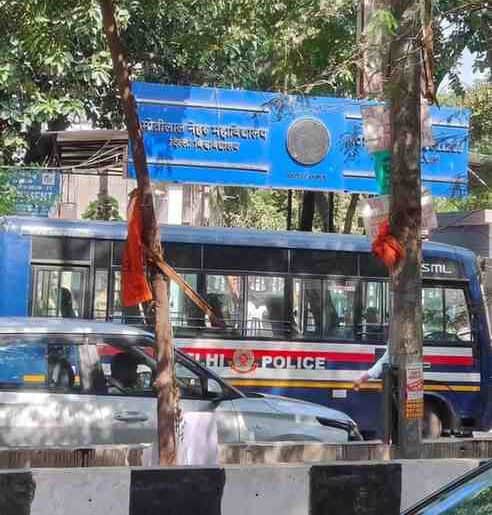
On 10th September 2025, the gates of Motilal Nehru College were closed for the teachers and the faculty by a student-led protest due to unfair intervention in student elections. The displeasure was stirred up as the students had been working on their election campaigns for the past two months, but the final list, released that day, contained only 7 names for 6 posts. This number was selected from an application of 107 students. The President candidature was permitted to a single student from the swarm of 14 nominees. This, the student protesters said, was an unjust treatment of the hopes and efforts of the students. The protest, which began at 6 in the evening, was carried out till late in the dark with the demonstrators refusing food or water. Instead of hearing the concerns of the protestors, the principal called forth police authorities, which led to a female candidate getting pushed by a male officer.

The authorities claimed attendance to be the criteria for selection. According to the official Delhi University regulations, the candidates require 50% attendance to clear their nominations, but MNLC changed it to 75% weeks prior to the elections. This became the main reason for the discourse in the student body. The students also displayed their discontent upon the appointment of a first year for the post of Vice President.

A student from the college told DU Beat,

The candidate for the position of Vice President is running unopposed even though he has been in the college for just a month, without the knowledge of any rules, or even stepping a foot in the campus all thanks to knowing people at high positions and having connections.

The protest began immediately after the release of the official list, with the students locking the gates of the college to prevent anyone from leaving the campus. The students raised their voices outside the principal’s office and the admin block also, but to no avail. The principal’s office was blocked by the protestors, and while they stood on their stance outside in the heat, the faculty refused to take any actions. The candidates went inside the office to clarify the situation with the principal but returned disheartened. The police arrived at 10 at night to break up the mob and to escort the Principal safely outside. The candidates decided to protest in front of the police vehicles but were controlled by force. It was unanimously decided to continue the protest overnight. College premises were occupied by police authorities, SSB and police vans in the morning after the gates were bolted by the protestors again. The principal arrived at around 11, finally allowing entrance into the college and had another meeting with candidates but no changes were agreed upon. This has led to all the student groups—ABVP, B.O.S.S, Ignite and other Independent candidates—coming and standing together. 

Read Also: SFI and AISA Forge Alliance for DUSU Elections, Vow to Challenge ‘Money and Muscle Power’

Featured Image Credits: MNLC on Instagram

Ananya Agarwal

[email protected]


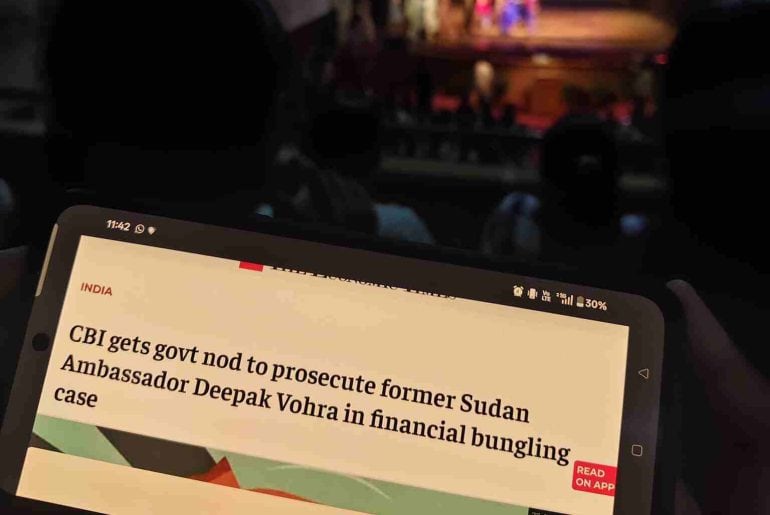
The Department of B.A. Programme at Lady Shri Ram College invited retired diplomat Dr. Deepak Vohra for a speaker session focused on India’s progress and future. Despite high expectations, the event sparked significant criticism due to Vohra’s divisive and bigoted jokes, causing widespread unrest on the college campus.

On Thursday, 11th September, the Department of B.A. Programme at Lady Shri Ram College hosted Ambassador Dr. Deepak Vohra, a retired Indian diplomat with postings in Armenia, Poland, and Sudan. Invited to deliver the inaugural major speaker session of the academic year, Dr. Vohra spoke on the topic “Unstoppable India 2047.” The event held special significance on campus, with the auditorium booked and students’ schedules officially adjusted to encourage maximum attendance, a rare measure for speaker sessions.

For many, this signaled that the event was meant to be an intellectually significant moment, particularly for UPSC aspirants and students interested in public policy and diplomacy. Dr. Vohra is a well-known public figure, often appearing on TED Talks, interviews with media outlets and sessions on college campuses, and his views are widely accessible online.

The auditorium was jam-packed with attendees exceeding the capacity of 780 when he arrived. Ambassador Vohra adopted a highly informal persona, immediately engaging the audience with humour. His presentation included frequent plugs of Bollywood songs that acted as punchlines. The audience, for the most part, was receptive and applauding, up until one his first ‘jokes,’ where he said to the audience at large, “Mera naam Muhammad Deepak hai, abhi toh ek hi (biwi) hai, main chaar rakh sakta hoon [My name is Mohammed Deepak, and while I have only one (wife) right now, I can keep four].” 

On a similar religiously-charged note, Vohra proceeded to clarify that he considered Hindu religious texts Ramayana and Mahabharata as history, not mythology; adding that Lord Krishna from the Mahabharata was ‘the greatest diplomat in human history.’ For many attendees, the final nail in the coffin was his division of the Indian independence into four stages, with the fourth one being ‘the independence of the soul’ after the formation of the Ram Mandir, the hindu temple in Ayodhya endorsed by the incumbent leadership that was built following the demolition of the Babri Masjid.

This string of controversial remarks was followed by another that centred on gender, where he asked the female-only populace of the college’s student body to tell their children to protect the nation “when they become wives and mothers,” and referred to the country in it’s yesteryears using words like ‘napunsak (impotent)’. His speech narrowed in on the military, economic and infrastructure features that shows India’ s superiority over other countries like China (whose military was referred to using slurs like ‘Ch*ng Ch*ng’ that poked fun at their language). While some students hailed him as a ‘true patriot’ and called the session ‘fun and energizing,’ after it ended, many others felt differently.

Vohra presented an overwhelmingly triumphant, jingoistic and exceptionally optimistic view of India that deviated a lot from the current state of things and bordered on delusional chest-thumping. Critical perspectives or difficulties within India were not addressed; instead, the narrative focused solely on achievements and overcoming ‘external adversaries.’ ”

The session has since garnered significant criticism from the student body, with many expressing disappointment with the organising committee and the overall response from students and faculty. Another student that DU Beat approached stated:

To reduce the entire populace of a women’s college to roles in relation to men is simply unacceptable. He openly proclaimed support for the current Prime Minister, and after cracking a slew of islamophobic jokes, asked the audience members whether the government can be anti-Muslim if eight Muslim countries have given Modi their highest honour. The fact that there was a crowd of students and faculty who were present and cheering for misogynistic, racist and Islamophobic jokes and perceived his propaganda as a sort of patriotic act is just disheartening to see. Are there any values we can say our college stands for anymore?

Students also pointed out that last year, when renowned writer and political scientist Nivedita Menon, a former professor of Political Science at Lady Shri Ram College was scheduled to have a session in the college, she was denied entry due to her political views, with the college citing its apolitical stance. Yet, Vohra was allowed to pledge allegiance to Prime Minister Narendra Modi with little interference. A student added:

Our private group chats are exploding. This seems like a breaking point for everything that has been going on throughout this year. The overt expression of Hindutva rhetoric and misogynistic language being celebrated is disturbing to many of us. We demand action, and we demand it now.”

The organizing committee has been criticised for not conducting a thorough background check and for not allowing walkouts during the session as a form of silent protest. Since the outrage, one of the members of the committee shared that they have been told not to share photos or videos of the session, and access to the recording has also been removed.

An official statement has not yet been released by the the College Administration, Students’ Union, or the Department of B.A. Programme. There were discussions about a more formal general body meeting to be held in the future, but all have declined to comment any further.

The speaker announcement post for this session phrased it as an opportunity to ‘hear from one of India’s most renowned diplomats on what the next century of our nation will look like.’ If this was a preview of that future, then it seems that the students of LSR are asking: whose century, whose nation, and at what cost?


Image Credits:
Anonymous

Anonymous
Read More: The DDA-DU Collaboration: Seven Green Lungs Help Delhi NCR Breathe

Jam-packed streets, markets galore and a whole lot of pollution: these are just some things that come to mind when thinking about the bustling capital that is New Delhi, and biodiversity is not on the list. However, at this point, it definitely should be as the Delhi Development Authority (DDA) and Delhi University’s Centre for Environmental Management of Degraded Ecosystems (CEMDE) have joined hands to bring about a biodiversity park revolution.

The central agenda of this collaborative project between the DDA and CEMDE is to restore the wastelands in and around Delhi in order to be able to convert them into biodiversity parks and green urban spaces. The project, which is now responsible for the establishment of Delhi’s seven biodiversity parks, all started with the establishment of the Yamuna Biodiversity Park in 2004. 

Around two and a half decades ago, that piece of land was marred with weeds, dry bushes, and piles of trash scavenged by stray dogs. What once was a wasteland has now been transformed into an urban nature paradise including a herbal garden, sacred grove, and butterfly conservatory. The project succeeded in breathing new life into what was once and still could’ve been a portion of dead land. In fact, this portion of land is the only thriving portion of the wetlands by the Yamuna River. 

Owing to the success of the Yamuna park, six others were created. These include the Aravalli Biodiversity Park, Kamla Nehru Ridge, Neela Hauz, Tilpath Valley, Tughlaqabad, and the Kalindi Biodiversity Park. Each acts as a beautiful green lung for a city that is so packed with people and subsequently, pollution. Not only have these parks succeeded in improving the air quality of the city, they harbour spaces for wildlife, restoring natural balance. They have also managed to improve the drainage, groundwater levels, and quality of soil.

Anyone living in Delhi knows about the city’s lack of drainage facilities. The public drains seem to merely serve as decoration on the street. North Campus students in particular, know the pain of having to swim to college on a rainy day. However, even if the area surrounding the parks turns into a mini ocean during the monsoon, the parks themselves have an army of green, auto trophic soldiers called plants to gulp down the rain leaving behind the soothing petrichor. 

The Delhi NCR is no stranger to groundwater shortage. The Yamuna Biodiversity Park and Aravalli Biodiversity Park are particularly designed to replenish groundwater. These man-made environmental wonders have worked their magic when it comes to water filtration, retention, and ecological function. The fact that ground water levels jumped from  90 metres to 34 metres in the span of a few years serves as a testament to the groundwater recharging capabilities of these parks. 

According to C.R Babu, former Delhi University Vice Chancellor, and head of the CMEDE, what once was a barren wasteland has now been transformed into a “fully functional ecosystem.” Babu remarked, “When I got this project, this piece of land was barren. The underground water was so saline that for nearly a year every seed that we planted here died.” This brings to light the sheer dedication of Babu and his team to the establishment and maintenance of these ecological gems. The DDA provides the land and the CMEDE provides the brains to turn that land into a green lung, and ecological paradise for all sorts of floral and fauna.

Image Credits: Delhi Biodiversity Foundation

Souparnika.S.R
[email protected]

Read Also: “Clean Campus, Green Campus”: ABVP’s Eco-Friendly Election Campaign